Private SaaS M&A Deals Q1 2026 Report

A data-driven look at what happened in private SaaS M&A in Q1 2026, including deal volume, valuation multiples, buyer behavior, and what the market reset means for founders building toward growth or an exit. If you want a clear view of where private SaaS is headed, this report gives you the numbers and the bigger picture.

The first quarter of 2026 was defined by a single paradox: the SaaS industry experienced its most significant market disruption since the 2022 rate-hike correction, yet M&A activity remained remarkably resilient. While the "SaaSpocalypse" triggered by Anthropic's Claude Cowork launch on January 12, 2026 erased approximately $1 trillion in aggregate SaaS market capitalization and compressed public multiples from ~7.0x to ~5.5x, dealmakers kept writing checks. The quarter saw an estimated 620+ SaaS transactions worth over $95 billion in aggregate SaaS and software deal value (excluding non-SaaS mega-deals), headlined by Google's $32 billion acquisition of Wiz, Palo Alto Networks' $25 billion purchase of CyberArk, and Thoma Bravo's $12.3 billion take-private of Dayforce.

If you enjoy data-driven in-depth research like this on SaaS and AI, apply to join the community here. You can see the full research report below.

620+ SaaS M&A Transactions
~$95B+ Aggregate SaaS & Software Deal Value
3.8x Median Private EV/Revenue

1. Executive Summary: Q1 2026 at a Glance

Q1 2026 was the quarter where fear and fundamentals collided head-on. On one side, the SaaSpocalypse sent shockwaves through public SaaS markets after Anthropic launched Claude Cowork β€” an autonomous AI agent capable of performing many tasks previously handled by SaaS applications β€” on January 12, 2026. Investor panic erased approximately $1 trillion in aggregate market capitalization from enterprise SaaS stocks within weeks. HubSpot fell 48%. Salesforce dropped 25%. The BVP Nasdaq Emerging Cloud Index plunged to its lowest level since 2020.

On the other side, the M&A market barely flinched. Private equity firms, flush with over $2.5 trillion in dry powder, saw the public selloff as an unprecedented buying opportunity. Strategic acquirers β€” particularly in cybersecurity, AI infrastructure, and financial services β€” continued executing on multi-year acquisition strategies. The result: an estimated 620+ SaaS-specific M&A transactions in Q1 2026, maintaining the elevated pace set during 2025's record year of 2,698 deals (per Software Equity Group).

The broader software M&A market was even more dramatic. Berkery Noyes reported 443 total software transactions in Q1 2026, with an aggregate value of $287.2 billion β€” a 3x increase from Q4 2025's $83 billion. However, this headline figure was massively inflated by SpaceX's $250 billion acquisition of xAI on February 2, 2026 β€” the largest corporate merger in history by valuation, but not a SaaS transaction. Strip out that single deal, and the quarter's software M&A was solid but not extraordinary, roughly in line with 2025's pace.

$287.2B β€” Total software M&A aggregate value in Q1 2026 (Berkery Noyes), a 3x increase from Q4 2025
443 β€” Total software transactions in Q1 2026, down 14% from Q4 2025's 518 (Berkery Noyes)
$438B β€” Total M&A completed deal value across all sectors (5-year high, +155% YoY), with 12 mega-deals over $10B
$56.6B β€” Startup M&A exits in Q1 2026 (third highest quarter since 2022)
2,698 β€” SaaS transactions in full year 2025 (record, +28% YoY, per Software Equity Group)
57% β€” Share of SaaS deals involving private equity buyers (near all-time high)

2. The Macro Context: SaaSpocalypse Meets Record M&A

To understand Q1 2026's M&A landscape, you need to understand the two forces that defined the quarter:

The SaaSpocalypse (January 12, 2026)

When Anthropic launched Claude Cowork β€” an AI agent that could autonomously handle complex multi-step workflows previously requiring dedicated SaaS applications β€” the market reaction was swift and brutal. Within weeks, approximately $1 trillion in aggregate market capitalization was erased from enterprise SaaS stocks. Public SaaS multiples compressed from approximately 7.0x to 5.5x EV/Revenue. Individual stocks were hit even harder: HubSpot fell 48%, as investors feared that AI agents could replace CRM workflows; Salesforce dropped 25%; and many mid-cap SaaS companies saw even steeper declines.

The narrative was straightforward: if AI could autonomously perform the tasks that SaaS companies charged monthly subscriptions for, what was the long-term value of those subscriptions? The panic was real, even if the full impact of AI on SaaS business models will take years to unfold.

The Record M&A Backdrop

Simultaneously, the broader M&A market was experiencing its most active quarter in nearly two decades. Total completed deal value across all sectors hit $438 billion β€” a five-year high and 155% increase year-over-year. The quarter featured 12 mega-deals valued at $10 billion or more, the highest volume of such massive transactions since 2008. Global M&A surpassed $1.2 trillion for the quarter.

Several factors drove this surge: stabilizing interest rates (with the Fed expected to reach 3.00–3.25% in 2026), record private equity dry powder exceeding $2.5 trillion, and the SaaSpocalypse itself creating a unique buying window where high-quality SaaS assets were suddenly available at discounted public multiples.

Generative AI also fueled record venture capital activity. S&P Global Market Intelligence reported that generative AI companies attracted a record $145 billion in venture capital funding in Q1 2026 alone β€” though two megadeals accounted for nearly 98% of that total: OpenAI's $122 billion round (first announced at ~$110B in February, closing at $122B on March 31) and xAI's $20 billion round in January. This concentration of capital in a handful of AI platforms is reshaping the competitive landscape for every SaaS company, as the largest AI players accumulate resources that dwarf the market capitalization of many mid-cap SaaS companies.

Key Insight: The SaaSpocalypse created what may prove to be a generational buying opportunity. Public SaaS companies trading at 5.5x revenue or lower β€” with strong retention, AI integration capabilities, and Rule of 40+ profiles β€” became prime take-private targets for PE firms that could buy at a discount and sell once sentiment normalizes.

3. Deal Volume & Aggregate Value

Despite the market turbulence, SaaS M&A transaction volume in Q1 2026 remained strong, continuing the elevated pace established during 2025's record year.
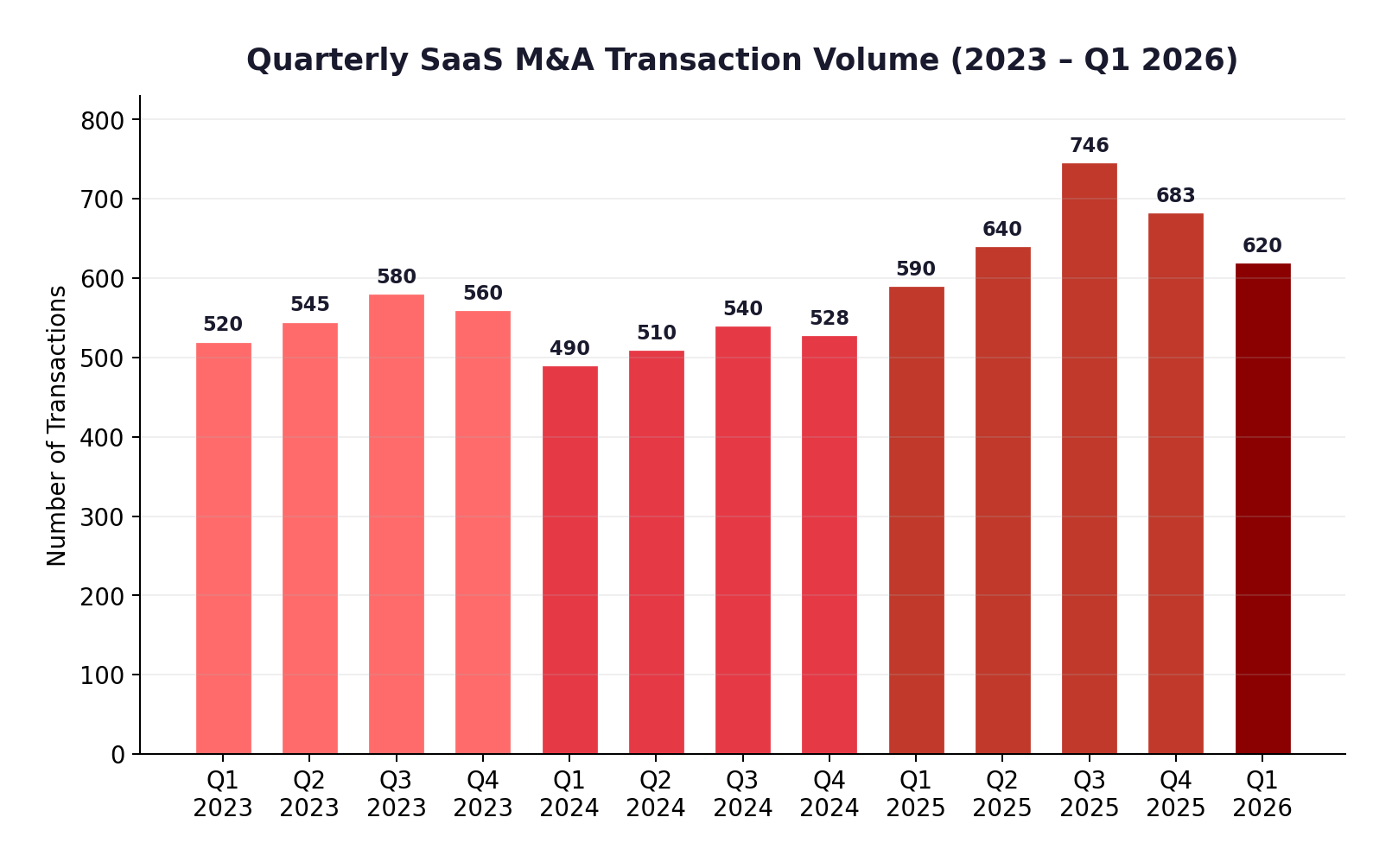
Quarterly SaaS M&A Deal Volume 2023-Q1 2026
Source: Software Equity Group, Berkery Noyes, SaasRise Research. SaaS transactions as ~58% of total software M&A.

Software Equity Group's 2026 Annual SaaS Report confirmed that 2025 set the all-time record with 2,698 SaaS M&A transactions, a 28% increase over 2024's 2,107 deals. SaaS accounted for approximately 58% of total software M&A activity. Q3 2025 was the peak quarter with 746 deals β€” a 26% year-over-year increase β€” driven by pent-up demand and stabilized interest rates.

Q1 2026 saw an estimated 620+ SaaS transactions, a slight sequential decline from Q4 2025 but still above Q1 2025 levels. The modest quarterly dip reflected two factors: the uncertainty caused by the SaaSpocalypse temporarily pausing some processes, and the natural seasonal pattern where Q1 typically trails Q3-Q4 deal volumes.
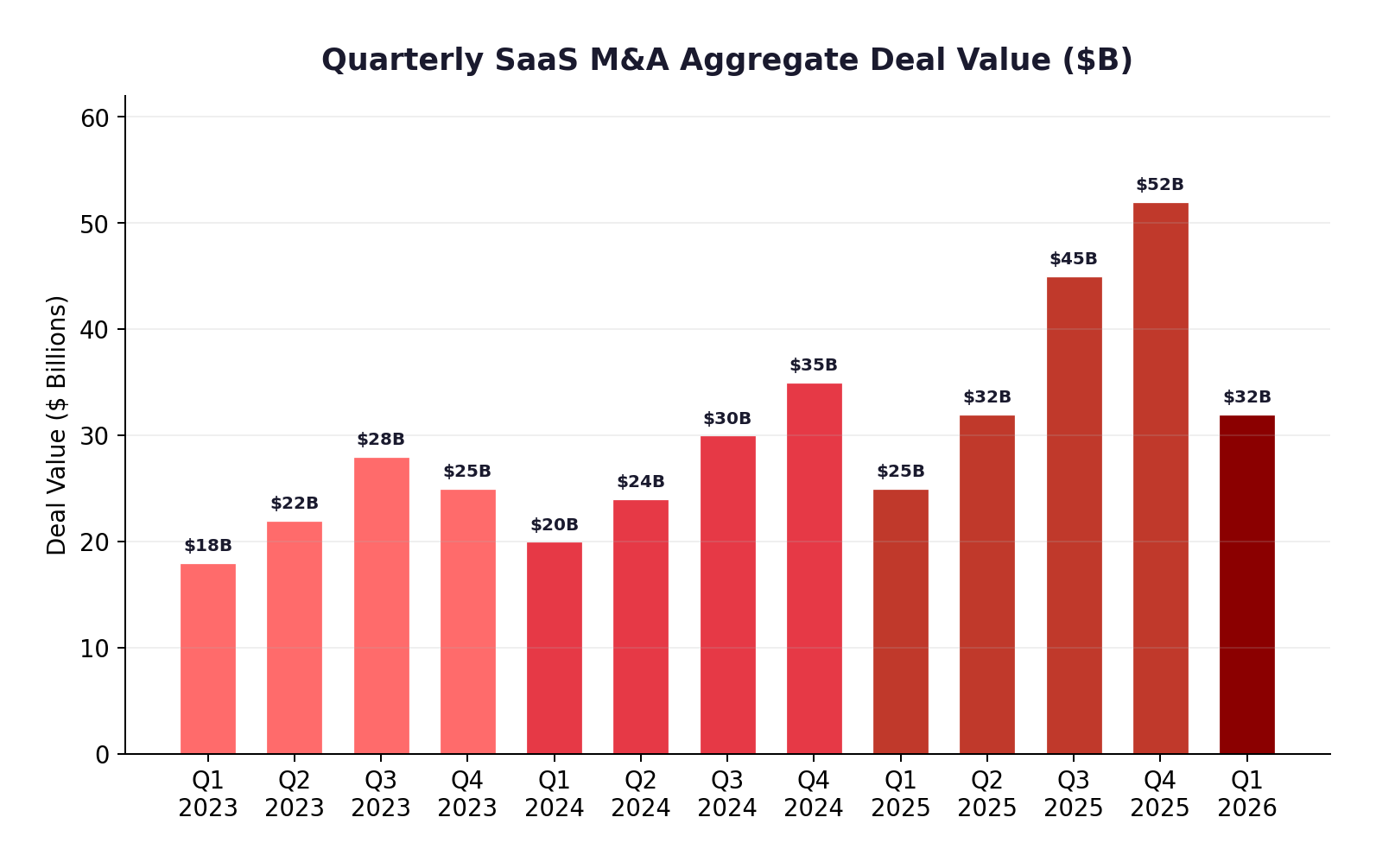
Quarterly Software & SaaS M&A Aggregate Deal Value
Source: Berkery Noyes, PitchBook, SaasRise Research. Note: Q1 2026 software total includes SpaceX/xAI ($250B).

Aggregate deal value tells a more dramatic story. Berkery Noyes reported $287.2 billion in total software M&A value for Q1 2026, more than tripling Q4 2025's $83 billion. However, this was almost entirely driven by SpaceX's $250 billion acquisition of xAI. Excluding that single transaction, software M&A value was approximately $37 billion β€” healthy, but more in line with 2025's quarterly averages.

For SaaS and software specifically, we estimate aggregate deal value of approximately $95 billion+ in Q1 2026, headlined by Google/Wiz ($32B), Palo Alto/CyberArk ($25B), Thoma Bravo/Dayforce ($12.3B), IBM/Confluent ($11B), Clearwater Analytics ($8.4B), ServiceNow/Armis ($7.75B), and at least a dozen more billion-dollar transactions. This represents the most active quarter for software M&A deal value since 2021.
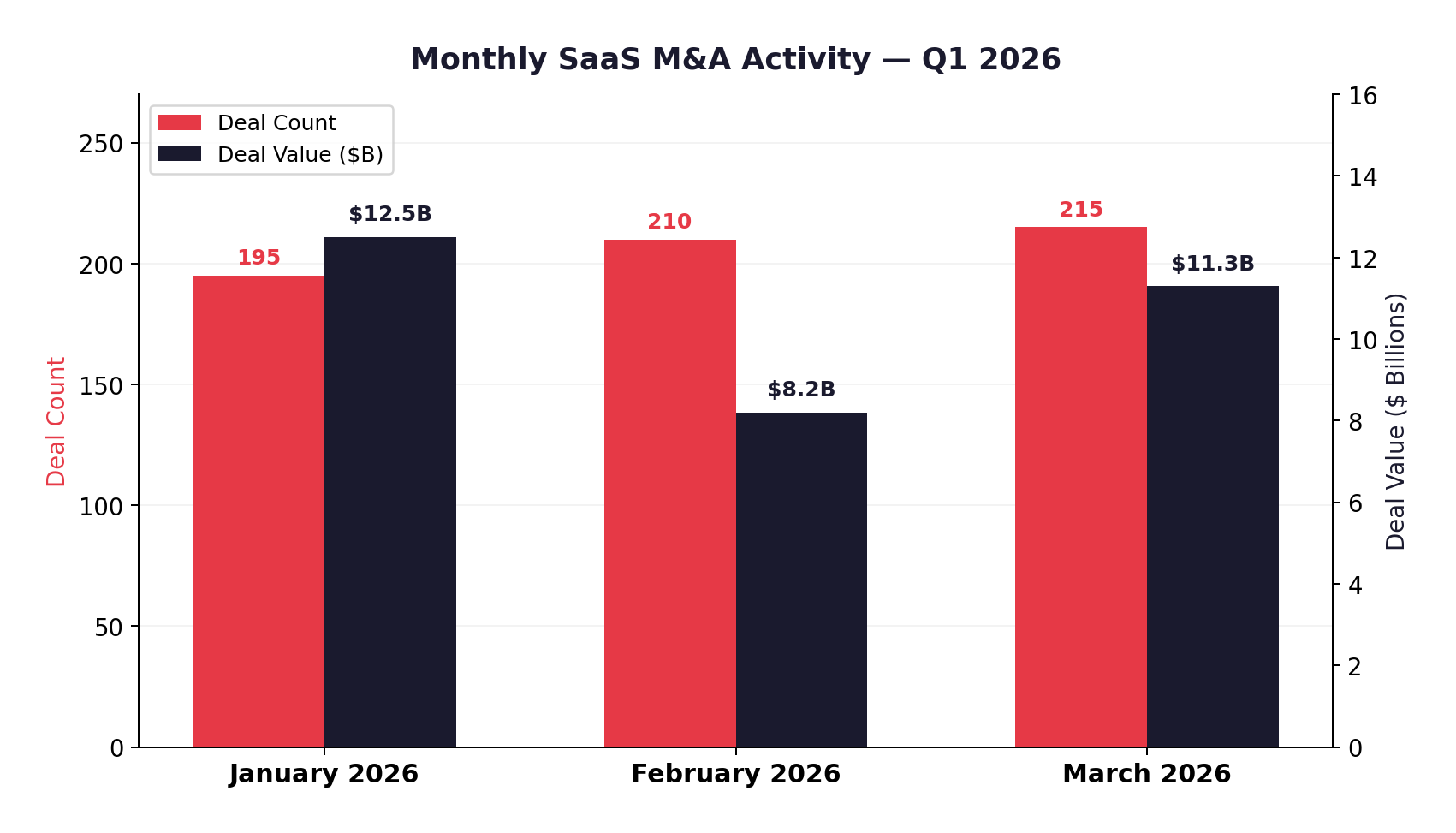
Monthly Q1 2026 SaaS M&A Deal Count & Value
Source: SaasRise Research, PrivSource, Berkery Noyes.

4. Revenue Multiples: The New Pricing Reality

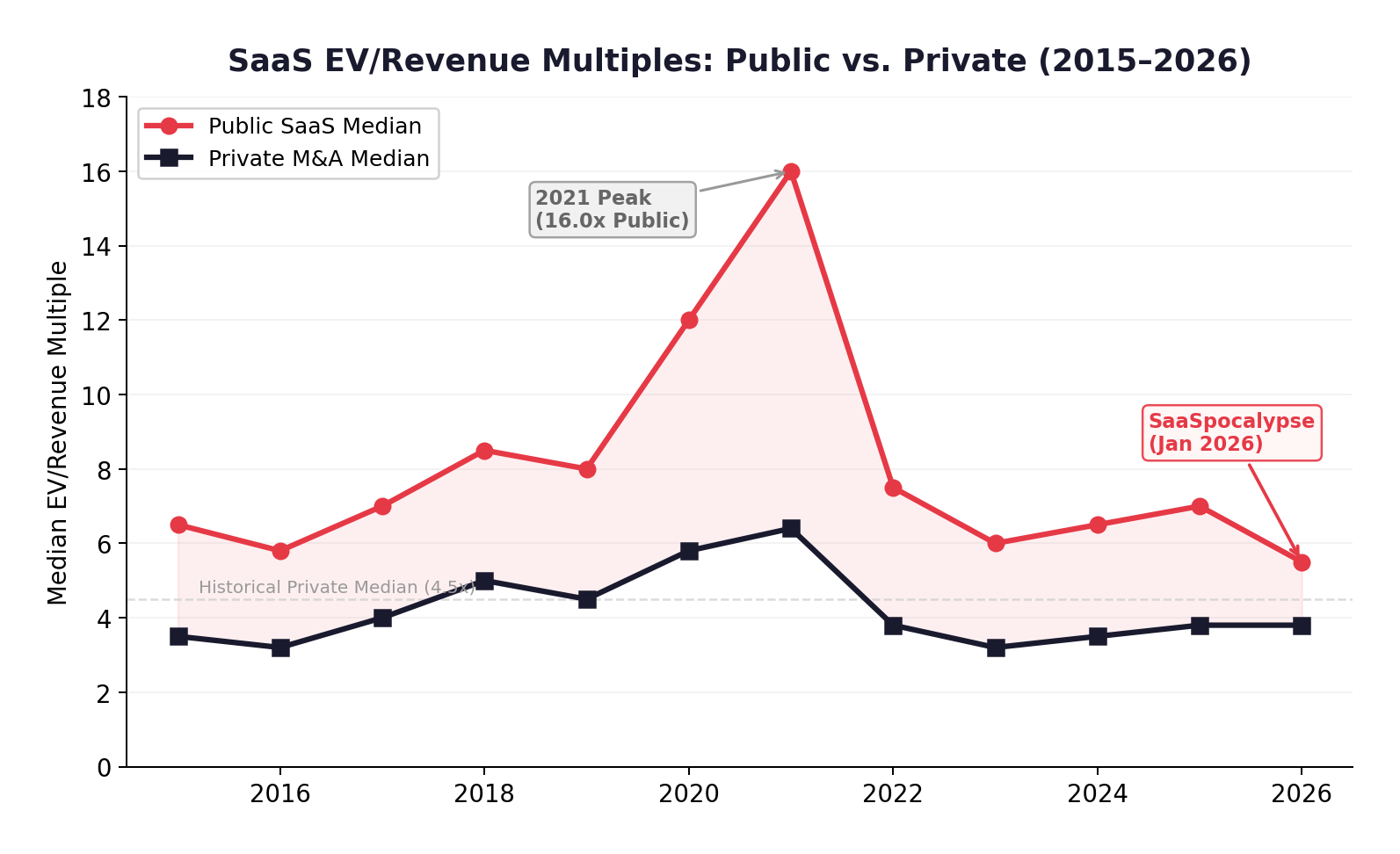
Q1 2026 marked a significant inflection point for SaaS valuations. The SaaSpocalypse compressed public multiples, and the ripple effects are beginning to reach private markets β€” though private valuations remain more resilient than their public counterparts.
SaaS Valuation Multiples: Public vs. Private (2015-2026)
Source: Aventis Advisors, Windsor Drake, SaasRise Research. Based on 543 SaaS transactions with disclosed revenue multiples (2015–2026).

Public SaaS Multiples

As of March 2026, the median public SaaS EV/Revenue multiple stood at approximately 5.5x, down from roughly 7.0x at the end of 2025. This represents a 21% compression in just three months β€” the sharpest quarterly decline since the 2022 rate-hike correction. According to Windsor Drake's Q1 2026 SaaS M&A Report, the public SaaS index traded at approximately 7.0x on a trailing basis, though forward multiples were closer to 5.0–5.5x.

Notably, for the first time since Aventis Advisors began tracking in 2015, U.S. SaaS companies no longer trade at a premium to global SaaS β€” a major structural shift reflecting the concentrated AI disruption fears around American-headquartered enterprise software companies.

Private SaaS Multiples

Private SaaS M&A multiples have been more stable, though the data reveals meaningful variation depending on the source and dataset. Aventis Advisors reported the median private EV/Revenue multiple at 3.1x as of March 2026, based on their tracked universe of 543 transactions (2015–2026), where the historical median is 4.5x. However, that figure includes a long tail of very small transactions and appears to understate multiples for the $20M+ ARR segment that drives most deal value.

SaasRise's own 2026 M&A Report found median private SaaS exit multiples of approximately 3.8x, up from 2.9x in 2024, with bootstrapped SaaS businesses around 4.8x and VC-backed SaaS around 5.3x. AI-native or top-quartile vertical SaaS businesses commanded significantly higher multiples, reaching 9x–12x for the best assets. Windsor Drake reported a private median of 5.3x on a trailing basis, reflecting their dataset's tilt toward larger, higher-quality transactions.

The takeaway: the "true" median private SaaS multiple in Q1 2026 is best expressed as a range of 3.8x–5.3x, depending on deal size, company quality, and dataset composition. Small-deal and all-inclusive datasets produce lower medians (~3.1x–3.8x), while datasets focused on transactions above $20M in enterprise value produce higher medians (~4.8x–5.3x). AI-native, security, and top-quartile Rule of 40 companies trade well above any of these medians.

The Public-Private Gap Is Narrowing. With public SaaS multiples compressing to 5.5x and private medians at 3.8–5.3x, the traditional public premium has shrunk dramatically. This creates fertile ground for PE take-private strategies: buy public companies at depressed multiples, improve operations, and exit when sentiment recovers. Expect more Dayforce/Smartsheet-style deals in Q2-Q3 2026.

EV/EBITDA: The New Standard

A critical shift in Q1 2026: EV/EBITDA multiples are rapidly becoming the primary valuation metric for SaaS, supplanting the revenue-based multiples that dominated for the past decade. Aventis Advisors noted this was "something that was almost never said before" in SaaS. Their SaaS index currently trades at approximately 26.6x EBITDA β€” fairly reasonable by historical standards and broadly in line with traditional economy businesses. This shift reflects the market's insistence on profitability over growth-at-all-costs, a trend accelerated by the SaaSpocalypse.

5. Sector Breakdown & Multiples by Category

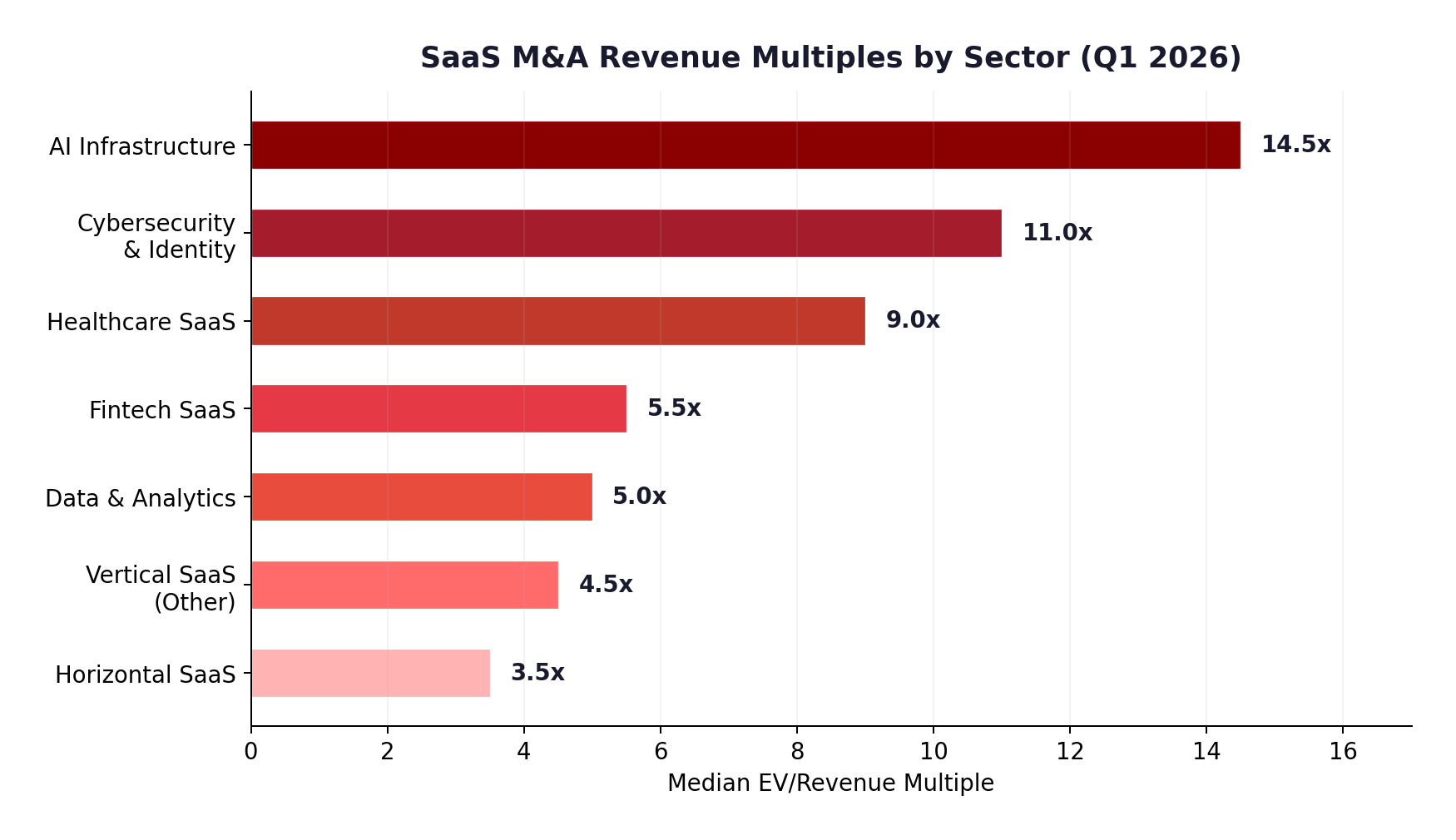
Not all SaaS is created equal β€” and Q1 2026 made that more apparent than ever. The valuation dispersion between sectors has reached historic highs, with a nearly 4x spread between the highest and lowest-valued sectors.
SaaS M&A Revenue Multiples by Sector (Q1 2026)
Source: Windsor Drake, Aventis Advisors, SaasRise Research. Median EV/Revenue multiples for private M&A transactions.

AI Infrastructure: 14.5x (Premium)

AI-native infrastructure companies command an approximately 85% premium over legacy infrastructure, per Windsor Drake. These are the "pick-and-shovel" businesses of the AI era: data labeling, model training platforms, AI observability, and compute orchestration. The premium reflects both scarcity value and the belief that AI infrastructure will be the most durable layer of the technology stack.

Cybersecurity & Identity: 11.0x

Cybersecurity remained the single largest category by deal value in 2025, accounting for over $70 billion across deals like Google/Wiz ($32B) and Palo Alto/CyberArk ($25B). Q1 2026 continued this trend at high multiples, as AI-generated threats increase the urgency for advanced security solutions. Berkery Noyes reported 111 cybersecurity M&A deals in Q3 2025 alone.

Healthcare SaaS: 9.0x

Vertical SaaS in healthcare continues to command premium multiples, driven by deep regulatory moats, high switching costs, and large addressable markets. Thoma Bravo's $5.3 billion acquisition of ModMed in 2025 set the benchmark for the sector.

Fintech SaaS: 5.5x

Fintech SaaS maintained mid-range multiples, supported by deep regulatory moats and complex integration requirements. Capital One's $5.15B acquisition of Brex and Permira/Warburg Pincus's $8.4B Clearwater Analytics deal both reflect the enduring value of financial infrastructure software. Brink's $6.6B acquisition of NCR Atleos β€” while more fintech infrastructure than pure SaaS β€” underscores that financial services technology commands consistent buyer interest regardless of market sentiment.

Horizontal SaaS: 3.5x

At the other end of the spectrum, commodity horizontal SaaS β€” generic CRM, basic project management, simple customer support tools β€” faces the most severe compression. These are the categories most directly threatened by AI agents, as Claude Cowork and similar products can increasingly handle the workflows these tools address. Multiples for this category are at or below 2023 lows. Windsor Drake's Q1 2026 data confirms that mature horizontal SaaS compressed toward historical means of 5–6x for public companies and even lower for private transactions, while top-quartile AI and security platforms commanded 11x–15x premiums β€” a sharp bifurcation that is unlikely to narrow anytime soon.
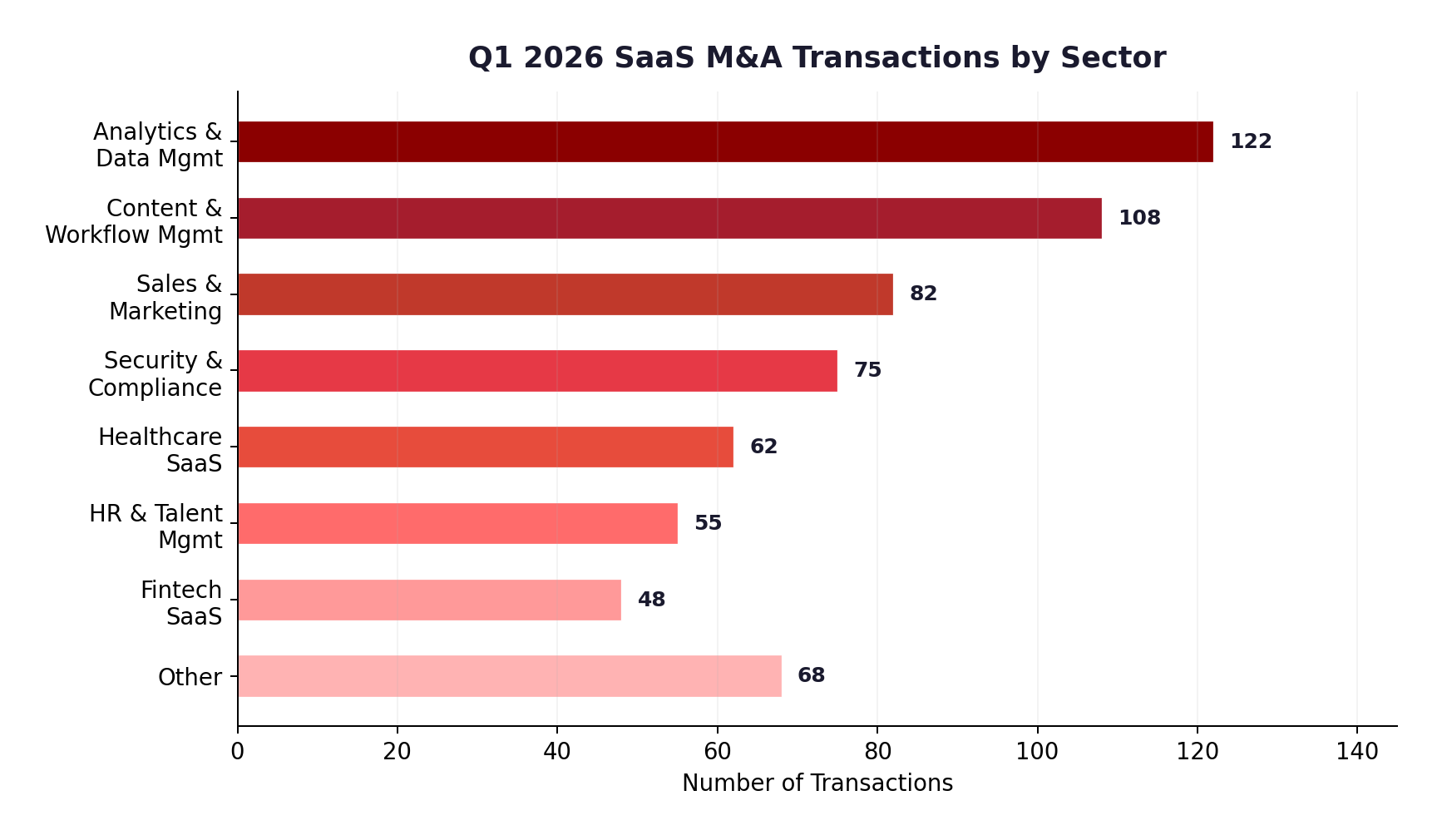
Q1 2026 SaaS M&A Transactions by Sector
Source: Software Equity Group, SaasRise Research. Analytics & Data Management and Content & Workflow Management were the two most active categories.

By transaction count, Analytics & Data Management and Content & Workflow Management were the two most active SaaS M&A product categories, together accounting for nearly 38% of total SaaS deal volume β€” consistent with the trend observed throughout 2025. Sales & Marketing also remained active, though deal counts declined from Q3 2025's peak of 100 transactions to an estimated 82 in Q1 2026.

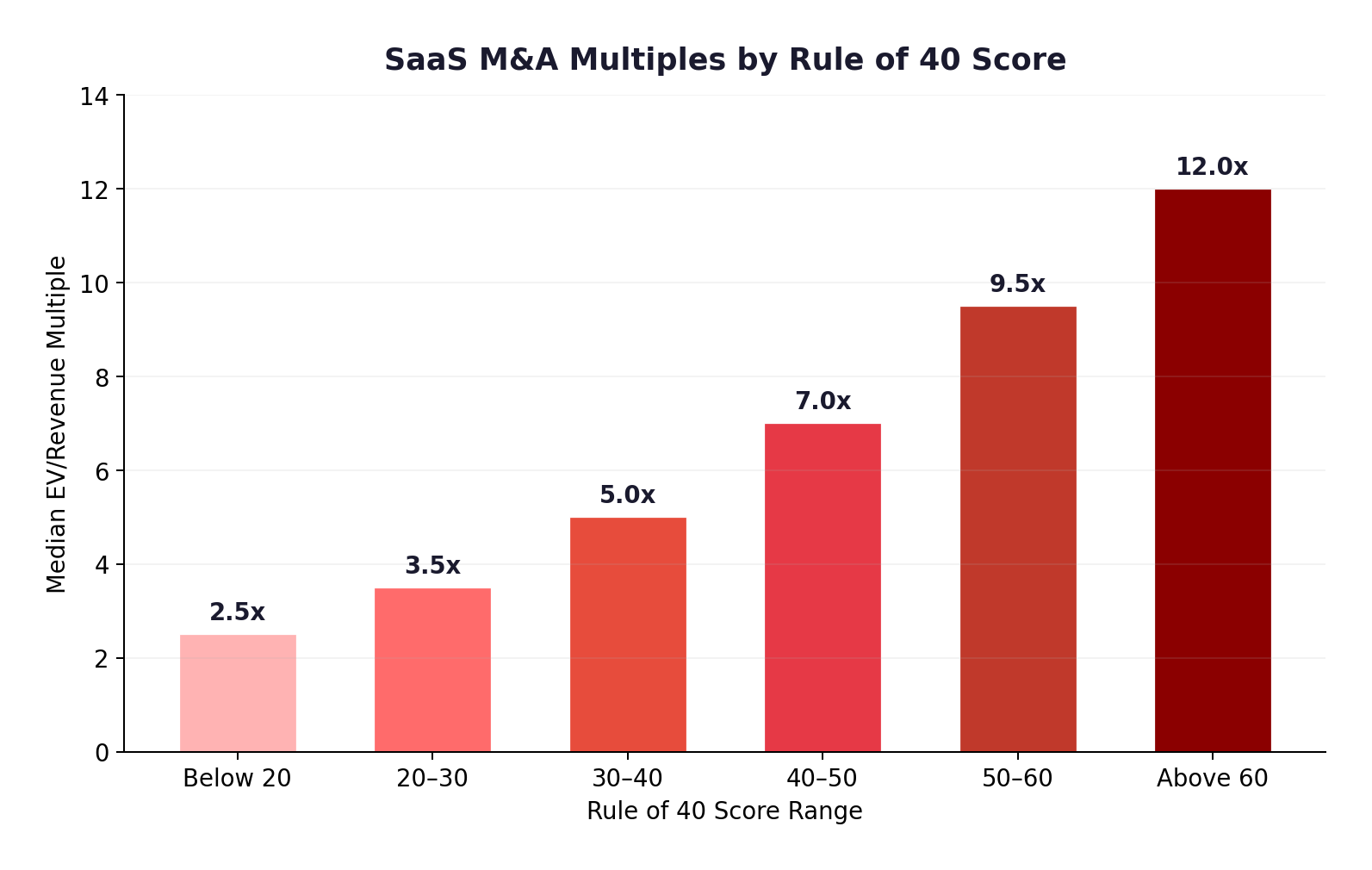
6. The Rule of 40: The Defining Metric

The Rule of 40 β€” the sum of a company's revenue growth rate and EBITDA margin β€” has become the single most important predictor of valuation multiples in Q1 2026. The data is unambiguous: companies scoring above 40 attract dramatically higher multiples than those below.
SaaS M&A Multiples by Rule of 40 Score
Source: Aventis Advisors, Windsor Drake, SaasRise Research. Median EV/Revenue multiple by Rule of 40 score range.

The relationship is steep and nearly linear:

  • Below 20: 2.5x median multiple β€” these are distressed or declining businesses
  • 20–30: 3.5x β€” below-market performers
  • 30–40: 5.0x β€” at-market, "average" SaaS companies
  • 40–50: 7.0x β€” premium valuations, strong buyer interest
  • 50–60: 9.5x β€” elite companies, competitive auction processes
  • Above 60: 12.0x+ β€” rare, top-quartile assets commanding premium multiples

Companies scoring above 40 attract premium valuations and stronger investor interest, while those below 40 face lower multiples and tougher fundraising or exit negotiations. In Q1 2026, the bar has effectively risen: Rule of 40+ combined with a credible AI integration strategy is the new minimum for commanding premium multiples.

For Founders Considering an Exit: The data shows that deal size is the single strongest predictor of valuation multiples β€” the median multiple was nearly 2x higher for deals in the $50–100M range vs. $20–50M. Combined with Rule of 40 performance, this means that growing to scale before selling is more important than ever. Competitive processes with multiple interested buyers also produce meaningfully better outcomes than passive or founder-led conversations.

7. Geographic Analysis

North America continued to dominate SaaS M&A activity in Q1 2026, though European and Asian-Pacific deals showed notable growth.
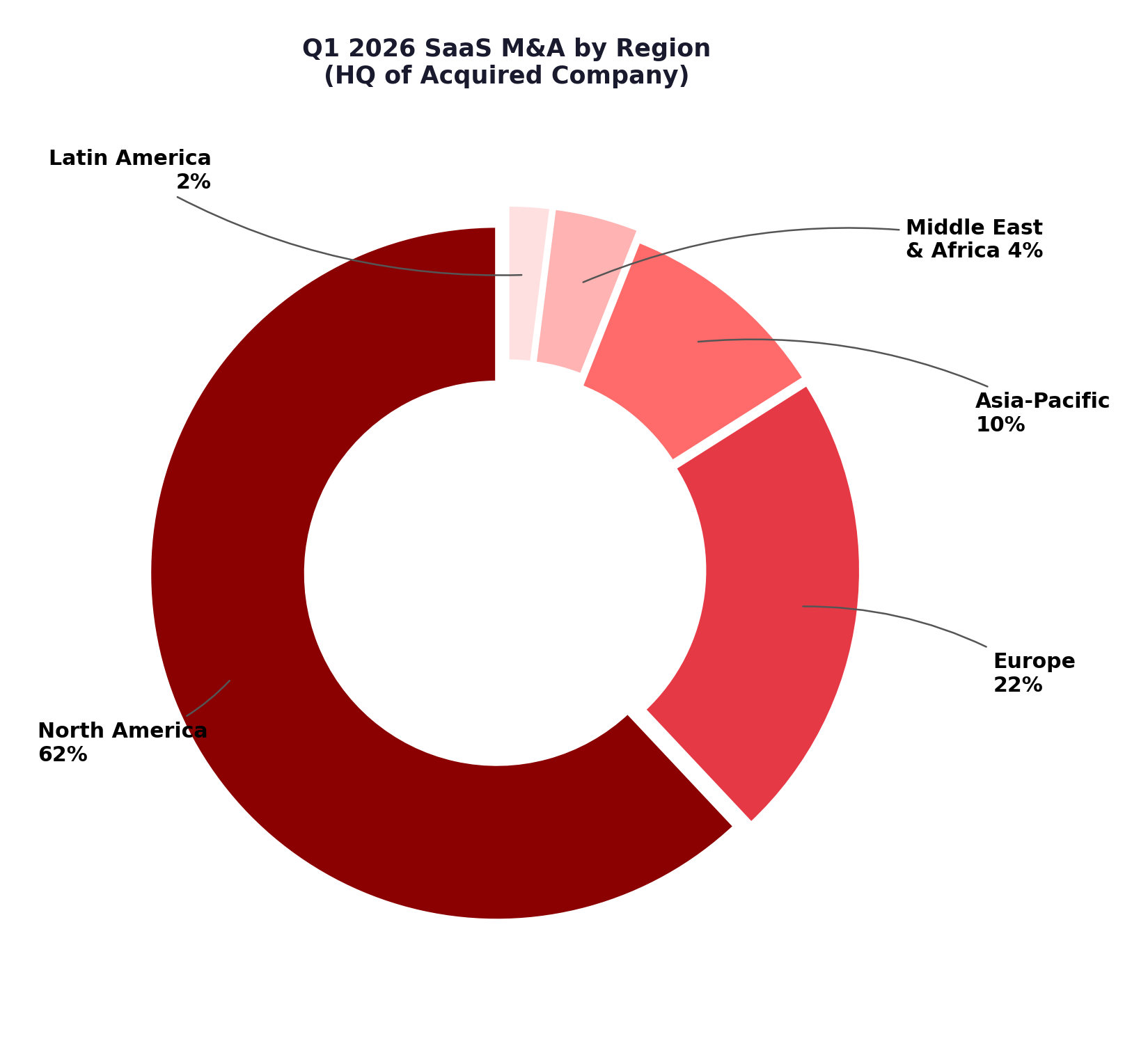
Q1 2026 SaaS M&A by Region
Source: PrivSource, SaasRise Research. Based on headquarters location of acquired company.

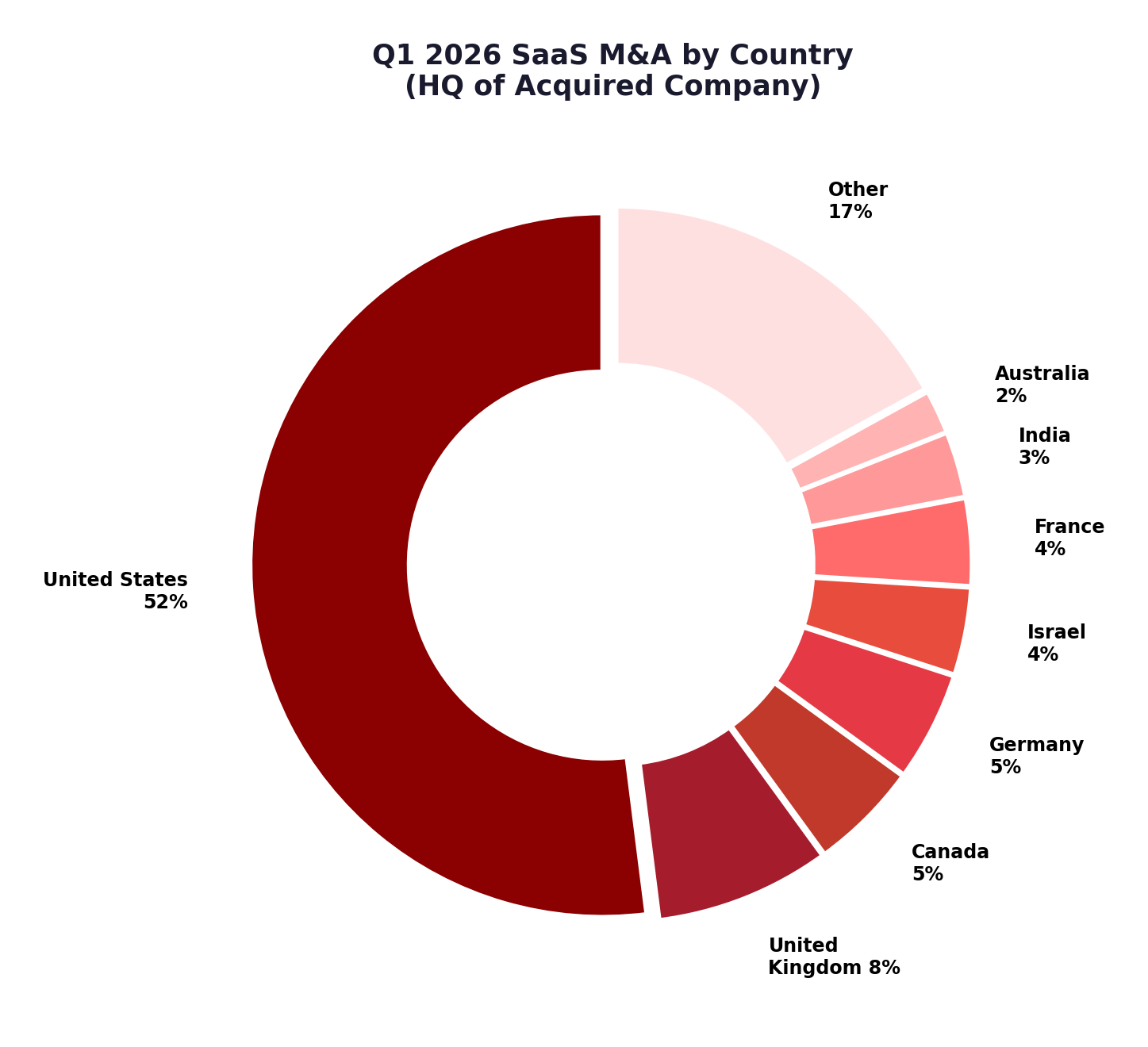
North America (62%) remained the dominant geography for both deal volume and value, led by the United States (52% of global deals). The U.S. SaaS market's depth, favorable regulatory environment, and concentration of both buyers and sellers continues to make it the center of gravity for global SaaS M&A.

Europe (22%) saw continued consolidation activity, led by the UK (8%), Germany (5%), and France (4%). Notable Q1 2026 European deals included team.blue's triple acquisition of Windsor.ai (Switzerland), Storyclash (Austria), and Saleskit (Czech Republic), as well as Hg's $6.4 billion take-private of OneStream (a US company, but Hg is a London-based PE firm investing from its European-focused Saturn Fund).

Asia-Pacific (10%) saw growing activity, particularly in India, where private equity and venture capital investment climbed to $7.19 billion in Q1 2026, up from $4.57 billion in Q1 2025. The number of Indian PE/VC deals grew to 296 from 291, and the median deal value rose to $3.8 million from $3 million β€” reflecting strengthening structural fundamentals and a deepening corporate technology ecosystem. Israel (4%) continued punching well above its weight in the SaaS M&A landscape, with notable transactions including PayPal's acquisition of Cymbio (estimated at hundreds of millions) and Base's acquisition of EverAfter AI (~$20M). Israeli tech exits below $20M reached $363M across 120 deals in 2025, sharply up from $128M in 79 deals the prior year.

Middle East & Africa (4%) and Latin America (2%) remained smaller markets by deal count, though Saudi Arabia's Savvy Games Group made headlines with its $6B acquisition of Moonton β€” a gaming rather than SaaS transaction, but indicative of the region's growing appetite for technology acquisitions. The Middle East's sovereign wealth funds (ADIA, GIC, Temasek) are also increasingly active as co-investors in Western SaaS take-privates, providing scale capital that enables larger deal sizes.
Q1 2026 SaaS M&A by Country
Source: PrivSource, SaasRise Research. Based on headquarters location of acquired company.

8. Buyer Dynamics: Strategic vs. Private Equity

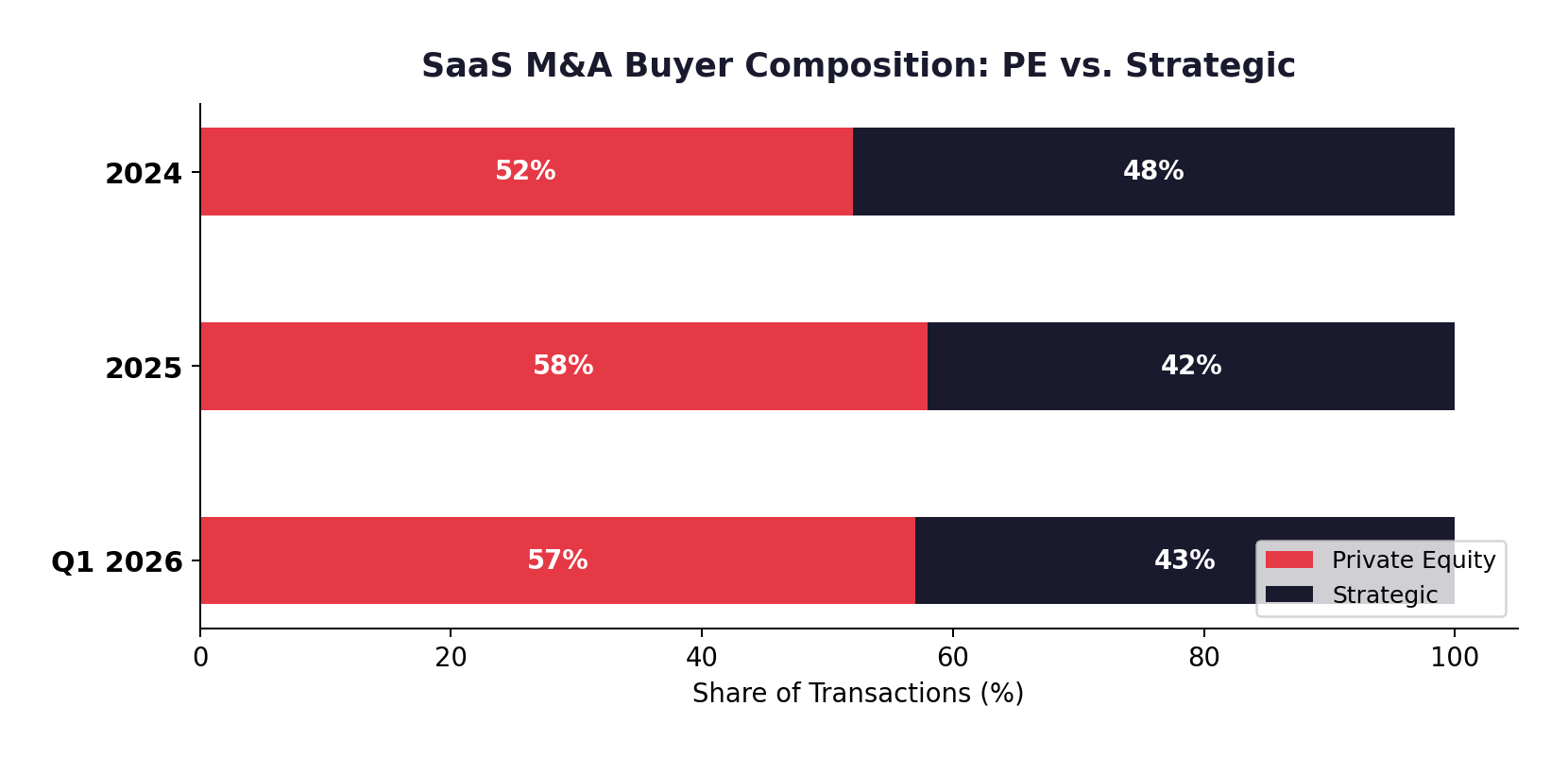
Q1 2026 continued 2025's trend of PE-heavy deal activity. Private equity buyers were involved in nearly 57% of all SaaS transactions, making it one of the most sponsor-heavy periods on record.
Q1 2026 SaaS M&A Buyer Composition
Source: Windsor Drake, Software Equity Group, SaasRise Research.

Private Equity: The Dominant Force

PE firms are executing three primary strategies in Q1 2026:

  1. Take-Privates: The SaaSpocalypse created a unique window to buy public SaaS companies at depressed multiples. Hg's $6.4B OneStream deal (31% premium) and Thoma Bravo's $12.3B Dayforce acquisition (32% premium) exemplified this approach. Permira and Warburg Pincus's $8.4B Clearwater Analytics take-private (announced Dec 2025, expected to close H1 2026) is another example, with a 47% premium to the pre-leak share price.
  2. Platform Buy-and-Build: Add-on acquisitions dominated PE activity, accounting for approximately 72% of total PE deal volume. This reflects the persistent "buy-and-build" strategy across fragmented vertical SaaS markets β€” healthcare IT, legal tech, GovTech β€” to achieve scale and drive valuation multiple expansion.
  3. Profitability Pivot: PE firms are heavily scrutinizing targets for unit economics, prioritizing companies with EBITDA margins above 15% or clear paths to profitability within 12 months.

Strategic Acquirers: AI-Driven Urgency

Corporate strategic buyers (43% of deals) remained selective but aggressive when they found the right targets. The AI imperative drove acquisitions: companies like Salesforce (which acquired Momentum in February 2026), Flexera (which completed a double acquisition of ProsperOps and Chaos Genius in January 2026), and Apollo.io (which acquired Pocus in March 2026) were all adding AI-native capabilities to existing platforms.
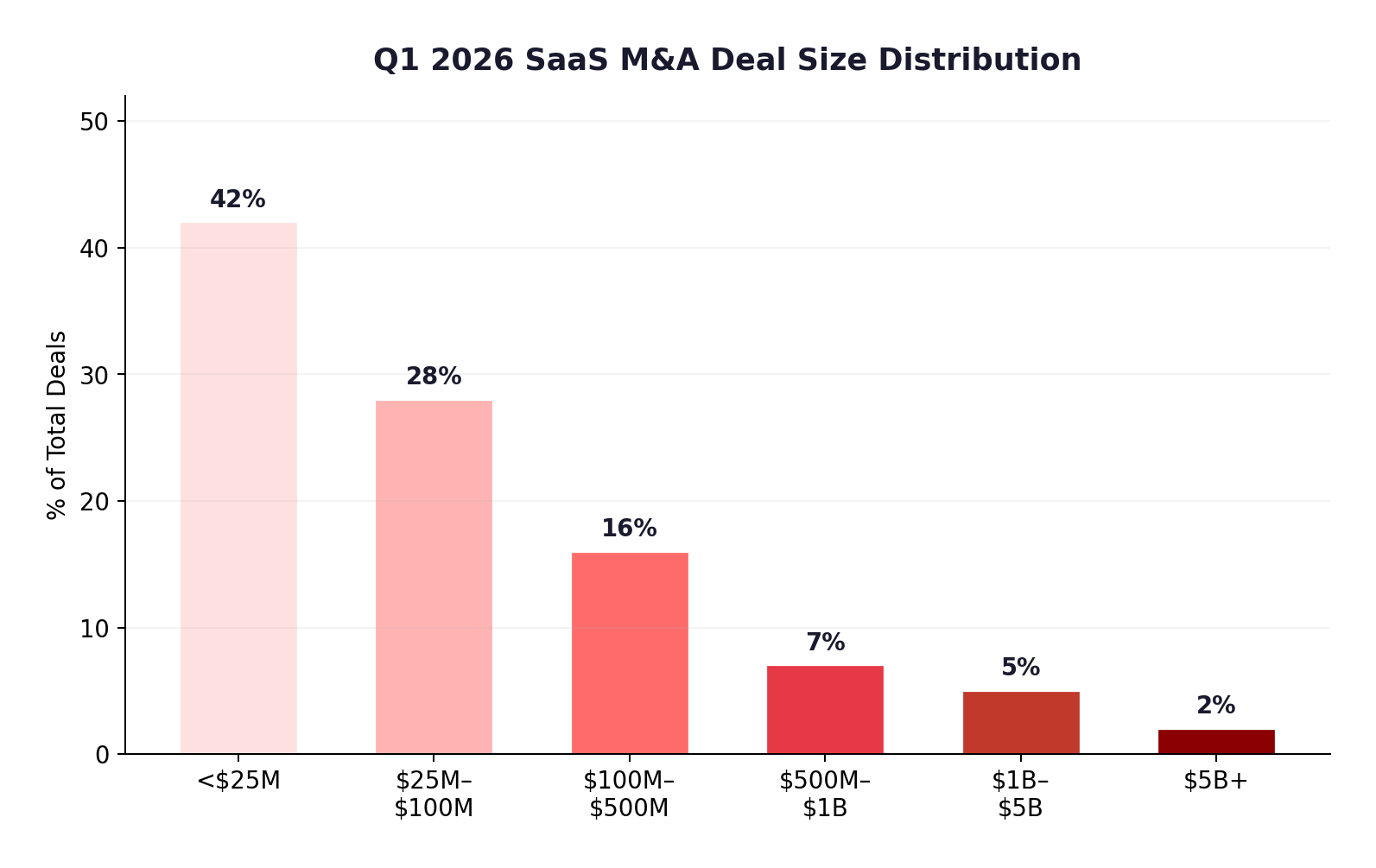
Q1 2026 SaaS M&A Deal Size Distribution
Source: SaasRise Research. Estimated distribution based on disclosed deal data and market surveys.
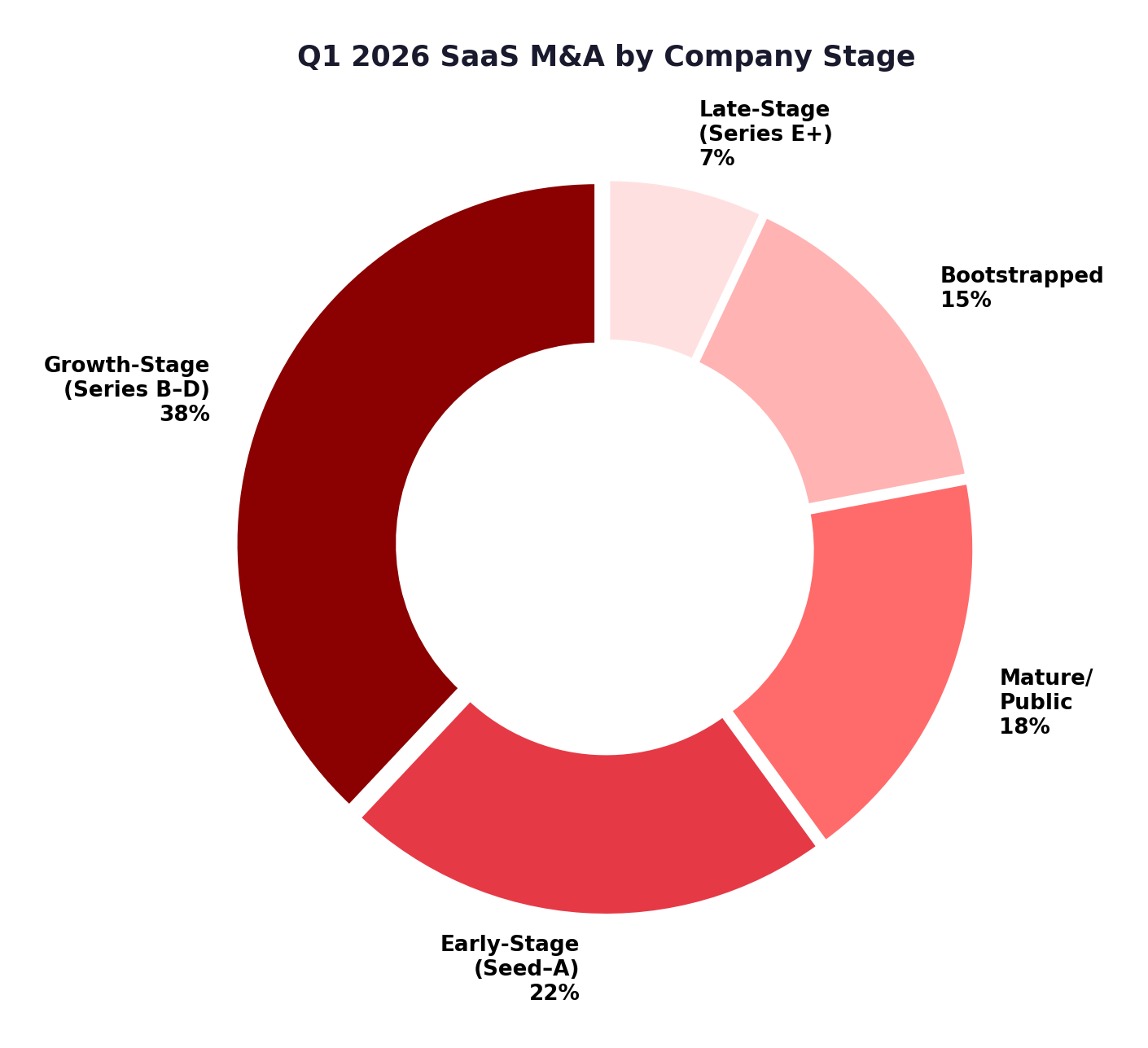
Q1 2026 SaaS M&A by Company Stage
Source: SaasRise Research. Growth-stage companies (Series B–D) were the most active acquisition targets.

Thoma Bravo continued to dominate as the single most active PE buyer in SaaS. In 2025 alone, the firm executed seven transactions over $1 billion, including the acquisitions of PROS Holdings, Verint Systems, Dayforce, itel, Olo, Hornetsecurity, and Boeing's Digital Aviation Solutions. Orlando Bravo, the firm's founder, described it as "the hardest I've ever worked in 30 years of being in private equity." With more than $181 billion in assets under management as of September 2025, Thoma Bravo's scale allows it to pursue the largest SaaS take-privates while simultaneously executing multiple mid-market deals. Valsoft ranked as the most active strategic buyer in SaaS by deal count for the second consecutive year.

Deal Structure Trends

Several notable deal structure patterns emerged in Q1 2026:

  • All-cash take-privates dominate mega-deals: Both Thoma Bravo/Dayforce ($12.3B) and Hg/OneStream ($6.4B) were structured as all-cash transactions, reflecting PE firms' access to debt financing and the desire to move quickly. Goldman Sachs provided Thoma Bravo with a $6 billion debt package ($5.5B term loan + $500M revolving credit facility) for the Dayforce deal alone.
  • Go-shop periods remain standard: Clearwater Analytics included a 45-day go-shop period ending January 23, 2026, during which the company was permitted to solicit competing bids. Go-shop provisions have become expected in take-private transactions, giving boards legal protection and occasionally generating superior offers.
  • Sovereign wealth co-investment rising: The Abu Dhabi Investment Authority (ADIA) participated as a minority investor in the Dayforce take-private. Temasek and Francisco Partners supported the Clearwater Analytics deal. Sovereign wealth funds are increasingly providing co-investment capital alongside traditional PE sponsors, enabling larger deal sizes and sharing risk.
  • Hybrid cash-and-stock for strategic acquirers: Capital One/Brex ($5.15B, 50/50 cash/stock) and Brink's/NCR Atleos ($6.6B, cash + stock + debt assumption) used mixed consideration, reflecting the desire of strategic buyers to preserve balance sheet flexibility while offering sellers upside through equity participation.

9. All Q1 2026 SaaS & Software Deals with Announced Prices $1B+

The following table captures all major SaaS and software-adjacent M&A transactions from Q1 2026 (January 1 – March 31) with announced prices of $1 billion or greater, ordered from largest to smallest.

# Target Acquirer Deal Value Sector / Category Type Date (Q1 2026) HQ
1WizGoogle / Alphabet$32.0BCloud Security / CNAPP SaaSStrategicClosed Mar 11*IL/US
2CyberArkPalo Alto Networks$25.0BIdentity Security SaaSStrategicClosed Feb 11*IL
3DayforceThoma Bravo$12.3BHCM / HR SaaSPE Take-PrivateClosed Feb 4*US/CA
4ConfluentIBM$11.0BData Streaming / AI InfrastructureStrategicAnn. Dec 2025†US
5Clearwater AnalyticsPermira / Warburg Pincus$8.4BFintech / Investment SaaSPE Take-PrivateAnn. Dec 21†US
6ArmisServiceNow$7.75BCybersecurity / IoT SaaSStrategicAnn. Dec 2025†IL/US
7NCR AtleosThe Brink's Company$6.6BFintech InfrastructureStrategicAnn. Feb 26US
8OneStreamHg Capital$6.4BEnterprise Finance / CFO SaaSPE Take-PrivateAnn. Jan 6US
9BrexCapital One$5.15BCorporate Spend / Fintech SaaSStrategicAnn. Jan 22US
10ChronospherePalo Alto Networks$3.35BObservability / Cloud SaaSStrategicClosed late JanUS
11JamfFrancisco Partners$2.2BApple Endpoint / MDM SaaSPE Take-PrivateClosed Jan 30US
12Manus (AI Agents)Meta Platforms~$2.0BAI Agent SoftwareStrategicAnn. late Dec 2025CN/US
13HornetsecurityProofpoint$1.8BEmail Security SaaSStrategicCompleted Q1*DE
14BVNKMastercardUp to $1.8BStablecoin Payments InfrastructureStrategicAnn. Mar 20UK
15Securiti AIVeeam Software$1.73BData Privacy / DSPM SaaSStrategicCompleted Dec 2025†US
16VezaServiceNow$1.0BIdentity Governance SaaSStrategicPendingUS
17BTIGUS BancorpUp to $1.0BFinancial Services / BrokerageStrategicAnn. Jan 2026US

* Deals announced in 2025 that closed or were completed during Q1 2026 are included. † Deals announced in late 2025 with closings pending during Q1 2026. Note: SpaceX/xAI ($250B, Feb 2, 2026) excluded as a non-SaaS AI/aerospace transaction. Savvy Games/Moonton (~$4B+, in talks) excluded as a gaming transaction. This table includes SaaS, software, and AI companies that produce software, per Ryan's expanded criteria.

Notable Adjacent Mega-Deals (Non-SaaS): For context, Q1 2026 also saw SpaceX's $250B acquisition of xAI (AI + aerospace, Feb 2), Savvy Games/Moonton (~$4B+, gaming, in talks), the Devon Energy/Coterra $58B energy merger, and the Netflix/Warner Bros. Discovery $110B media merger. OpenAI's record $122B fundraise (announced Feb, closed Mar 31) was structured as equity, not M&A, but reshaped competitive dynamics across the SaaS and AI landscape. These transactions are excluded from our SaaS analysis.

10. All Q1 2026 SaaS Deals with Announced Prices $100M–$999M

Mid-market deals β€” the $100M to $999M range β€” represent the core of the SaaS M&A market. These transactions provide the clearest signal of underlying market health, as they are less distorted by one-off mega-deals. Below are the Q1 2026 SaaS transactions in this range with disclosed prices.

# Target Acquirer Deal Value Sector Date HQ
1SGNLCrowdStrike$740MIdentity Security SaaSQ1 2026US
2SeraphicCrowdStrike$420MDigital Channel SecurityQ1 2026IL
3Purchasing PowerPROG Holdings$420MFintech / Employee Benefits SaaSJan 2, 2026US
4Coefficient BioAnthropic>$400MMedical AI / Biotech SaaSQ1 2026US
5Ask SageBigBear.ai~$250MGov AI / Security SaaSJan 1, 2026US
6Check Point triple acquisitionCheck Point Software~$150MAI Security / MSP ToolingFeb 12, 2026IL
7NativoLife360~$120MAd-Tech / Content SaaSJan 5, 2026US
8Horizon Quantum ComputingdMY Squared (SPAC)~$120MQuantum Computing SoftwareMar 20, 2026SG

Note: The majority of SaaS M&A transactions in Q1 2026 did not disclose financial terms. Industry data suggests roughly 75-80% of deals have undisclosed values. The tables above represent deals where pricing was publicly confirmed or reliably reported. Select notable deals with undisclosed values are listed below.

Notable Q1 2026 SaaS Deals (Undisclosed Values)

Target Acquirer Sector Date Notes
Capterra / Software Advice / GetAppG2Software Reviews SaaSJan 29Major portfolio acquisition from Gartner Digital Markets
MomentumSalesforceRevenue Intelligence SaaSFeb 2026Salesforce's 2nd acquisition of 2026; Agentforce AI stack buildout
ProsperOps + Chaos GeniusFlexeraFinOps / Cloud Cost SaaSJan 2026Double acquisition; AI-enabled FinOps automation
PocusApollo.ioRevenue Intelligence SaaSMar 19Enterprise revenue intelligence for AI-native GTM OS
PathFactoryKalturaContent Marketing SaaSMar 20~$22M deal; content experience platform
CymbioPayPaleCommerce SaaSJan 2026Brand discovery platform; est. hundreds of millions
Windsor.aiteam.blueMarketing Data SaaSJan 20Swiss marketing data integration platform
Storyclashteam.blue (Kolsquare)Influencer Marketing SaaSJan 20Austrian influencer intelligence platform
Saleskitteam.blueSales Intelligence SaaSMar 4Czech B2B sales intelligence; 3,000+ customers
SimplrOpsDeloitteOperations SaaSJan 27Consulting firm acquires ops automation
Intermedia26North PartnersCloud Communications SaaSMar 31PE buyout from Madison Dearborn Partners
CallTowerCourt Square CapitalUCaaS / Cloud CommunicationsQ1 2026PE buyout from BV Investment Partners
LTi Technology SolutionsDiversis CapitalEquipment Finance SaaSMar 23Vertical SaaS PE buyout
BetterCloudCoreStackSaaS Management / GovernanceQ1 2026Unified Agentic AI Governance platform
EverAfter AIBaseCustomer Success SaaSJan 2026~$20M estimated

11. Three Case Studies: The Most Interesting Deals

Case Study #1: Hg Capital Takes OneStream Private for $6.4 Billion

Announced: January 6, 2026 | Completed: April 1, 2026 | Deal Value: $6.4B (all-cash) | Premium: 31%

The Deal: Hg, the London-based software-focused PE firm, announced on January 6, 2026 that it would acquire OneStream β€” the leading enterprise finance management platform for the Office of the CFO β€” in an all-cash transaction valued at approximately $6.4 billion. Shareholders received $24.00 per share, a 31% premium to the closing price on January 5 and a 27% premium to the 30-day VWAP. General Atlantic and Tidemark joined as significant minority investors.

Why It Matters: This deal is the quintessential Q1 2026 SaaS take-private. OneStream had only IPO'd in 2024 (backed by KKR), but the SaaSpocalypse-driven selloff created an opportunity for Hg to acquire a category leader at a valuation significantly below its IPO-era highs. OneStream unifies financial close, consolidation, reporting, planning, and forecasting β€” deep, mission-critical workflow SaaS with high switching costs and strong net retention. Hg described OneStream as having "a tremendous opportunity" to become "the operating system for Modern Finance."

The Multiple: Based on OneStream's approximately $500M in ARR at the time of the deal, the $6.4B valuation implies roughly 12.8x ARR β€” a significant premium to the median private multiple, reflecting the company's category leadership, growth trajectory, and Rule of 40+ performance. The deal closed on April 1, 2026, and OneStream has been delisted from the NASDAQ.

Case Study #2: Capital One Acquires Brex for $5.15 Billion

Announced: January 22, 2026 | Expected Close: Mid-2026 | Deal Value: $5.15B (50/50 cash/stock)

The Deal: Capital One announced on January 22, 2026 that it would acquire Brex β€” the corporate card and expense management SaaS platform serving companies like DoorDash, Robinhood, TikTok, and Intel β€” in a $5.15 billion cash-and-stock transaction (approximately 50/50 split). Brex CEO Pedro Franceschi described it as "the largest bank-fintech deal in history" and committed to building "the most important financial platform for businesses in the US."

Why It Matters: This deal is a case study in the new SaaS M&A reality. Brex was valued at $12.3 billion at its 2022 Series D-2 peak β€” meaning this exit came at less than half the last private valuation. Late-stage investors including TCV, GIC, and Baillie Gifford invested at $7.4 billion or higher and are taking a loss on paper. Yet the deal was largely welcomed: in a post-SaaSpocalypse world where SaaS multiples are compressed and fintech profitability is under scrutiny, getting liquid at all counts for something. For Capital One β€” fresh off its $35 billion Discover acquisition β€” the deal adds Brex's tech platform, European banking license, ~$13 billion in deposits, and a roster of tech-forward enterprise clients to its commercial banking operation.

The Signal: The Brex acquisition confirms that 2022-era SaaS valuations were unsustainable and that the market is now pricing SaaS businesses on fundamentals, not future promises. Brex's strong revenue, sticky enterprise customers, and growing profitability justified a $5.15 billion exit β€” but at 2022 prices, the market would have demanded twice that.

Case Study #3: Thoma Bravo Completes $12.3 Billion Dayforce Take-Private

Announced: August 21, 2025 | Completed: February 4, 2026 | Deal Value: $12.3B (all-cash) | Premium: 32%

The Deal: Thoma Bravo completed the largest take-private deal in its 30-year history on February 4, 2026, acquiring Dayforce (formerly Ceridian) β€” the global HCM leader providing payroll, workforce management, and talent solutions β€” for $12.3 billion in an all-cash transaction. Shareholders received $70.00 per share, a 32% premium to the pre-announcement share price. The Abu Dhabi Investment Authority (ADIA) participated as a significant minority investor. Goldman Sachs provided a $6 billion debt package ($5.5B term loan + $500M revolving credit facility).

Why It Matters: Dayforce represents the PE playbook at its most ambitious. Thoma Bravo is betting that Dayforce's high-quality recurring revenue, strong product differentiation, and AI leadership in HCM make it worth the massive price tag β€” and that taking it private will allow the firm to accelerate growth and AI innovation without the quarter-to-quarter scrutiny of public markets. The firm already had a longstanding relationship with the company dating back to Ceridian's 2012 era.

The Broader Pattern: Dayforce is the third major SaaS take-private to close in quick succession: Vista+Blackstone/Smartsheet ($8.4B, closed Jan 2025), and now Hg/OneStream ($6.4B, closed Apr 2026) and Thoma Bravo/Dayforce ($12.3B, closed Feb 2026). Combined, these three deals total over $27 billion in take-private activity within ~13 months. With public SaaS multiples depressed post-SaaSpocalypse, expect this trend to accelerate significantly in 2026.

12. Outlook: What Comes Next

SaasRise Predictions for the Rest of 2026

  • M&A deal volume will reach $200B+ as PE take-privates accelerate, exploiting depressed public SaaS multiples
  • At least 3 more mega-deals (>$10B) will be announced as PE firms deploy record dry powder
  • The IPO market reopens in H2 2026 with 5+ SaaS/AI IPOs, including potential listings from Anthropic, OpenAI, and SpaceX
  • Multiples stabilize at 8–10% above Q1 2026 levels for high-quality assets, as rates decline to 3.00–3.25%
  • AI-native SaaS commands 2-3x multiples vs. AI-absent competitors in the same category
  • Distressed SaaS acquisitions increase as companies most exposed to AI substitution (simple CRM, content creation, basic customer support) become targets at 2-3x revenue
  • Vertical SaaS continues to outperform, accounting for 45%+ of all SaaS M&A activity

The fundamental dynamics point to an exceptionally active remainder of 2026. As we noted in SaasRise's M&A Report 2026, the SaaSpocalypse hit public SaaS valuations hard, but private market multiples have been more resilient β€” and the narrowing public-to-private discount is creating significant take-private opportunities. Windsor Drake projects that with rates expected to hit 3.00–3.25% in 2026, we should see 8–10% multiple expansion for high-quality assets, and the anticipated IPO window reopening in late 2026 is already beginning to influence private valuations as liquidity paths clarify. Consider the forces at play:

  1. Record PE Dry Powder + Depressed Multiples = Take-Private Boom. With over $2.5 trillion in PE capital seeking deployment and public SaaS stocks trading at multi-year lows, the math for take-private deals is compelling. Expect more Dayforce-scale transactions. PitchGrade's analysis identifies candidates like Instructure (~$650M ARR), Alarm.com (~$1B ARR), Qualys (~$550M ARR), and SolarWinds (~$750M ARR) as screening positively for PE acquisition.
  2. AI Consolidation Accelerates. Strategic acquirers will continue buying AI capabilities they can't build fast enough internally. Every major SaaS platform is racing to embed AI agents, and the fastest path is M&A. Salesforce's acquisition of Momentum and Flexera's double acquisition of ProsperOps and Chaos Genius are early examples of this trend.
  3. The SaaSpocalypse Selloff Creates Opportunity. History shows that market dislocations driven by narrative fear β€” rather than fundamental collapse β€” eventually correct. The companies best positioned are those with deep workflow integration, high switching costs, strong net retention (NRR 105%+), and credible AI strategies. These will be the first to see multiple recovery.
  4. Founder Exits at Rational Prices. For SaaS founders considering an exit, the message is clear: premium multiples now require a combination of efficient growth (Rule of 40+), strong retention (NRR 105%+), and a credible AI integration strategy. Competitive processes with multiple interested buyers remain essential. The Brex example shows that even successful companies may exit below their previous peak valuations β€” but liquidity at a reasonable price beats illiquidity at a theoretical premium.

The Art of CTO's industry outlook for the week of March 30, 2026 summarized the shifting landscape well: "AI megadeals cool, security and infra stay hot." Crunchbase noted a sharp slowdown in U.S. startup funding in March, driven mainly by fewer giant AI megarounds, while the largest deals that did close leaned heavily toward cybersecurity, privacy, and AI infrastructure. For SaaS, this signals a maturing AI hype cycle: horizontal "AI everything" stories are getting scrutinized, but mission-critical capabilities β€” security, infrastructure, and vertical AI β€” still clear the bar.

The SaaS industry is undergoing its most significant transformation since the advent of cloud computing. The "old SaaS" β€” subscription-based horizontal tools with limited AI integration β€” faces existential questions. But "new SaaS" β€” AI-native vertical platforms with deep workflow integration, strong data moats, and mission-critical positioning β€” is more valuable than ever. As one industry analyst put it: "Software is not dead, but the old assumptions are. The assumptions that subscriptions alone guarantee safety. The assumptions that all software deserves premium multiples. The assumptions that AI will lift every vendor equally." The M&A market in 2026 will be the mechanism through which this transformation plays out β€” separating the winners from the legacy companies and redefining what a premium SaaS business looks like in the age of AI agents.

Join SaasRise β€” The #1 Mastermind for SaaS CEOs

Get weekly SaaS M&A intel, connect with 500+ SaaS CEOs, and access exclusive deal data. SaasRise members have collectively raised $5B+ and driven $50B+ in ARR.

Learn More at SaasRise.com β†’

13. Sources & Methodology

Sources

  1. Software Equity Group (SEG), "2026 Annual SaaS Report" β€” 2,698 SaaS transactions in 2025, 28% YoY increase, sector breakdown, PE vs. strategic buyer mix. softwareequity.com
  2. Berkery Noyes, "Q1 2026 Software Industry Trends" β€” 443 software transactions, $287.2B aggregate value, segment analysis. Published April 3, 2026.
  3. Aventis Advisors, "SaaS Valuation Multiples: 2015-2026" β€” Median private EV/Revenue 3.1x (March 2026), historical median 4.5x, 543 transactions analyzed. aventisadvisors.com
  4. Windsor Drake, "SaaS M&A Report Q1 2026" β€” Private median 5.3x, public SaaS index 7.0x, PE-backed buyer analysis, AI infrastructure premiums. windsordrake.com (PDF)
  5. Windsor Drake, "Cybersecurity M&A Report Q1 2026" β€” 8 mega-deals >$1B in 2025, $84B+ total disclosed value, CrowdStrike/SGNL/Seraphic analysis. windsordrake.com
  6. PitchBook via Fortune, "The 'Death of SaaS' Could Be the Best Thing to Ever Happen..." β€” Q4 2025: $83.7B across 245 deals; PE-backed SaaS surged 100%+ YoY. fortune.com
  7. S&P Global Market Intelligence β€” 614 PE M&A deals globally in Q1 2026 (-22% YoY count, +12.6% value); GenAI VC record $145B. April 10, 2026.
  8. SaasRise, "The SaaS M&A Report 2026" β€” 17 mega-deals >$2.5B in 2025, $180B+ announced deal value, SaaSpocalypse analysis. saasrise.com
  9. SaasRise, "The SaaS M&A Market in 2026: What the SaaSpocalypse Really Means for Founders" β€” Median private exits 3.8x, bootstrapped 4.8x, VC-backed 5.3x. saasrise.com
  10. Acquiry, "Q1 2026 Digital M&A Market Report" β€” Salesforce/Momentum, Flexera/ProsperOps+Chaos Genius, Datadog/Propolis, macro analysis. acquiry.com
  11. Intellizence, "Top 10 Largest Global M&A Deals β€” January 2026" β€” OneStream, Capital One/Brex, Hg/OneStream. intellizence.com (Jan)
  12. Intellizence, "Top 10 Largest Global M&A Deals β€” February 2026" β€” Palo Alto/CyberArk, NCR Atleos. intellizence.com (Feb)
  13. Intellizence, "M&A Deals Q1 2026" β€” SpaceX/xAI, Google/Wiz, AES/BlackRock, Santander/Webster, comprehensive Q1 roundup. intellizence.com (Q1)
  14. Databahn, "Major Billion-Dollar+ Acquisitions and Spin-offs in H1 2026" β€” Meta/Manus ($2B), IBM/Confluent ($11B), ServiceNow/Armis ($7.75B), SoftBank/DigitalBridge (~$4B). databahn.com
  15. Verodate, "SaaS Industry Consolidation Mergers 2026" β€” 340+ SaaS acquisitions in H1 2026. verodate.ca
  16. L40Β°, "Mid-Market SaaS M&A: A 2026 Founder's Playbook" β€” Deal size vs. multiples, AI diligence workstreams, founder exit analysis. l40.com
  17. McKinsey, "Global Private Equity Report 2026" β€” Buyout deals >$500M hit $1.1T (record), take-private value +43% YoY. mckinsey.com
  18. Momentum Cyber / GlobeNewsWire, "Cybersecurity Financing Surges 33% YoY to $3.8B in Q1 2026" β€” 108 cyber M&A transactions, CrowdStrike/SGNL ($740M) + Seraphic ($420M). globenewswire.com
  19. PrivSource, "Software Buyout Acquisitions in 2026" β€” Francisco Partners/Jamf ($2.2B), Google/Wiz ($32B), Horizon Quantum ($120M), comprehensive tracker. privsource.com
  20. PrivSource, "Cybersecurity Buyout Acquisitions in 2026" β€” Palo Alto/CyberArk close, Arctic Wolf/Sevco, Proofpoint/Acuvity. privsource.com
  21. PrivSource, "Payments & Fintech Buyout Acquisitions in 2026" β€” Capital One/Brex, Mastercard/BVNK ($1.8B), PROG Holdings/Purchasing Power ($420M). privsource.com
  22. CRN, "Five Companies That Came to Win This Week" (Feb 13, 2026) β€” Palo Alto/CyberArk close, Google/Wiz EU approval, Proofpoint/Acuvity. crn.com
  23. FinTechtris, "Q1 2026 Financial Services Review" β€” Capital One/Brex analysis, OneStream/Hg, US Bancorp/BTIG. fintechtris.com
  24. PitchGrade, "Fintech M&A in 2026: Who's Buying, Who's Being Bought" β€” 3-7x payments, 5-8x compliance, $40-60B fintech M&A forecast. pitchgrade.com
  25. Dakota, "Top 10 IT Transactions (February 2026)" β€” CyberArk ($25B), Anthropic ($30B raise), ST Telemedia ($5.1B). dakota.com
  26. SpaceX/xAI merger ($250B, Feb 2, 2026), Savvy Games/Moonton (~$4B+, in talks, Mar 2026) β€” Context for broader M&A market, excluded from SaaS analysis. Sources: Allwork.Space, FinancialContent, KersAI

Methodology

This report synthesizes data from multiple industry sources including Software Equity Group, Berkery Noyes, Aventis Advisors, Windsor Drake, PitchBook, PrivSource, S&P Global Market Intelligence, and SaasRise's proprietary tracking of weekly SaaS M&A activity via Pulse.bot. Where exact Q1 2026 SaaS figures are not available from a single source, we have estimated based on the proportional relationship between SaaS and total software M&A (SaaS β‰ˆ 58% of software M&A by count per SEG) and cross-referenced against multiple data providers. All deal values reflect publicly announced or reliably reported figures. Geography data based on headquarters of the acquired company. Revenue multiples represent median EV/Revenue for private M&A transactions unless otherwise noted.