
Corbenic AI launches Galahad, a 14× faster AI memory layer for SaaS workloads
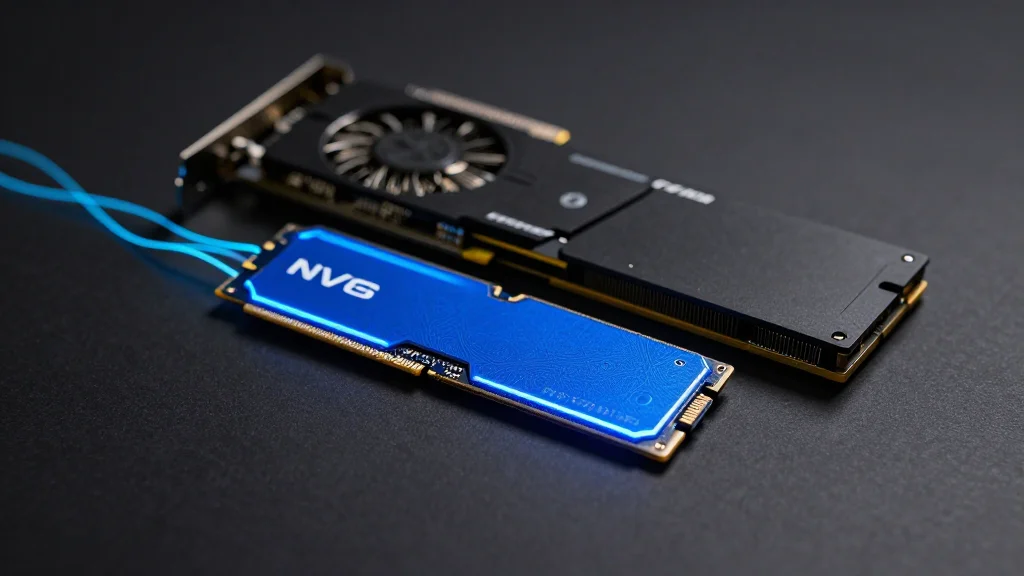
Corbenic AI introduced Galahad, a beta‑stage AI memory service that stores key‑value caches on local NVMe drives and claims up to a 14× speedup for inference. The solution requires only a Linux host, an Nvidia GPU and a standard SSD, positioning it as a plug‑and‑play add‑on for SaaS AI providers. The company says the gain comes from avoiding redundant GPU recomputation rather than raw storage bandwidth.
Why It Matters
Galahad’s approach tackles a fundamental bottleneck in generative AI serving: the repeated reconstruction of KV caches when the same context is queried multiple times. By persisting these caches on inexpensive NVMe storage, SaaS AI vendors can achieve higher throughput without proportionally increasing GPU spend, directly improving gross margins. The solution also reinforces a broader trend toward software‑only performance optimizations that sidestep the capital‑intensive hardware refresh cycles that have dominated AI infrastructure investments.
Beyond cost, the technology could enable new product experiences. Faster repeat queries open the door to more interactive, real‑time AI features in vertical SaaS applications—think legal document analysis or medical record summarization—where latency is a competitive moat. If Galahad proves reliable at scale, it may spur a wave of similar cache‑layer services, intensifying competition among AI infrastructure startups and prompting incumbents to double‑down on software‑centric memory management.
Key Points
- Corbenic AI launched Galahad in beta on Oct. 1, 2026, claiming up to 14× faster inference
- Galahad stores KV attention caches on encrypted local NVMe drives, requiring only Linux, an Nvidia GPU and standard SSD
- Speedup largely attributed to Blaise retrieval component that reduces input tokens from ~96k to ~668 per query
- No special hardware needed; CXL‑based storage showed no performance benefit in tests
- Targets SaaS AI providers looking to cut GPU compute costs and improve latency without hardware upgrades
Analysis
The emergence of Galahad underscores a maturation point for AI infrastructure: the low‑hang‑up is no longer raw compute power but the efficient reuse of intermediate state. Historically, AI serving architectures have relied on keeping KV caches in GPU memory, a strategy that breaks under memory pressure or during container restarts. Corbenic’s decision to offload that state to local flash mirrors the broader storage‑first shift seen in data‑intensive workloads over the past decade, where SSDs supplanted DRAM for tiered caching.
From a competitive standpoint, Galahad’s value proposition hinges on its simplicity and tenant isolation. While Nvidia’s proprietary solutions integrate tightly with its hardware stack, they lock customers into a single vendor ecosystem. Corbenic’s hardware‑agnostic library can be dropped into any Linux‑based GPU server, making it attractive to multi‑cloud SaaS operators who juggle heterogeneous environments. The trade‑off is reliance on a retrieval layer (Blaise) that effectively performs a coarse‑grained indexing step; this adds a software dependency that could become a target for optimization by open‑source communities.
Looking ahead, the key question is adoption velocity. Early adopters will likely be niche vertical SaaS firms with high repeat‑query workloads—legal tech, finance, and health—where latency directly impacts user experience and revenue. If those pilots demonstrate measurable cost savings, larger cloud providers may either acquire Corbenic or replicate the approach in their managed services, potentially compressing the market for independent cache‑layer startups. In any case, Galahad signals that the next frontier of AI performance will be won on the software side, reshaping how SaaS founders think about scaling inference workloads.