
Terafac raises US$800K (Rs 6.5 crore) in pre-seed round led by Inuka Capital
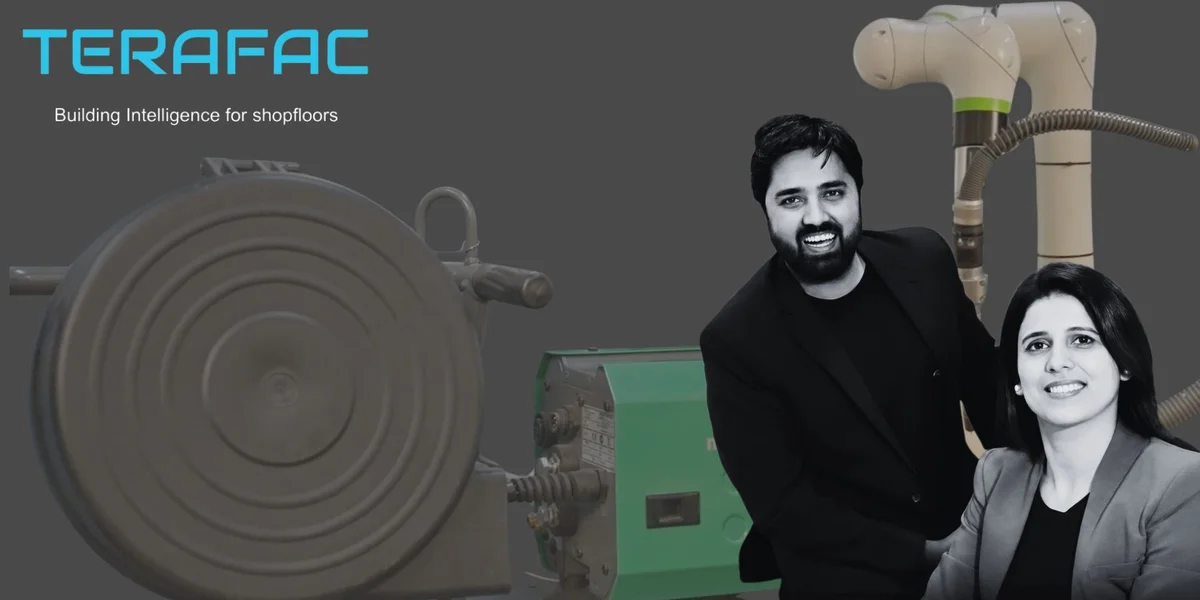
TerafacCompany
DeVCInvestor
Bharat Founders FundInvestor
Terafac, a Chandigarh‑based AI‑robotics startup, closed a US$800K (Rs 6.5 crore) pre‑seed round on July 24, 2026, led by Inuka Capital with participation from DeVC, Bharat Founders Fund and Innovation Mission Punjab.
Terafac secured US$800K (Rs 6.5 crore) in a pre‑seed financing round, marking the latest infusion of capital into India’s deep‑tech SaaS landscape. The round was led by Inuka Capital and included DeVC, Bharat Founders Fund and Innovation Mission Punjab as co‑investors. ## Deal Terms The funding will be allocated to accelerate product development, expand the engineering team and push market expansion for the company’s computer‑vision‑enabled robotic welding platform, WeldT. The round, announced on July 24, 2026, follows a two‑year product build effort that began after the 2021 founding by CEO Anubhi Khandelwal and CTO Amrit Singh. ## Market Context Terafac’s core proposition—"Software as a Skill"—layers AI‑driven perception on existing industrial robots, allowing factories to reprogram on the fly without specialist intervention. By targeting India’s fragmented small‑ and mid‑size manufacturing base, the startup aims to bypass the high capital outlay traditionally required for full‑stack automation. The company plans to reach 80 deployments across more than 20 customers within a year of the raise, leveraging system integrators to gain footholds in Punjab and Haryana’s dense manufacturing clusters. The capital raise underscores growing investor appetite for modular, SaaS‑styled automation solutions that can be retrofitted onto legacy equipment, a niche that remains under‑served by legacy hardware‑centric vendors.
Why It Matters
The infusion of pre‑seed capital gives Terafac the runway to scale its vision‑first automation stack faster than hardware‑only rivals, which must sell new robots to win contracts. By selling a software capability that runs on machines factories already own, Terafac can undercut the total cost of ownership and win early‑adopter SMBs that have been priced out of full automation. This pressure could force established industrial automation suppliers to reconsider pure‑hardware go‑to‑markets and potentially partner with or acquire SaaS‑layer providers. For investors, the round validates the "software as a skill" thesis and may catalyze further funding into AI‑driven modular robotics across emerging markets.
Terafac’s focus on integrator partnerships also reshapes the competitive dynamics. Integrators, already trusted by thousands of small factories, become a distribution channel that hardware vendors have struggled to penetrate. If Terafac can demonstrate rapid ROI on its WeldT deployments, it will set a performance benchmark that could shift procurement criteria from equipment cost to software‑enabled flexibility, accelerating the broader adoption of AI‑augmented robotics in the Indian manufacturing ecosystem.
Key Points
- Terafac raised US$800K (Rs 6.5 crore) in a pre‑seed round.
- The round was led by Inuka Capital with participation from DeVC, Bharat Founders Fund and Innovation Mission Punjab.
- Funding will support product development, hiring and market expansion of its computer‑vision welding platform.
- Terafac targets India’s small‑ and mid‑size manufacturers, aiming for 80 deployments across 20+ customers within a year.
- The "Software as a Skill" model sells capability to existing robot hardware, differentiating it from hardware‑centric automation vendors.
Analysis
The $800K pre‑seed raise places Terafac at a valuation typical for Indian deep‑tech startups at this stage—often between $5M and $10M—implying a multiple of roughly 6‑12x projected ARR once the company reaches modest revenue traction. The capital reflects a broader investor shift toward SaaS‑styled automation that can be layered onto legacy equipment, a model that reduces upfront CAPEX and aligns with the subscription‑based economics investors favor. As Indian manufacturing grapples with a chronic shortage of skilled welders, AI‑driven vision platforms like Terafac’s WeldT offer a scalable solution that can be monetized through recurring software licenses, maintenance fees and usage‑based pricing. This creates a more predictable revenue stream compared with traditional hardware sales, improving gross margins and net revenue retention prospects.
For operators, the deal signals that modular AI robotics can be a viable growth lever without the need for massive capital outlays. Companies that can integrate such software into existing lines will likely see faster ROI and higher capacity utilization, driving higher ARR per machine. Investors will watch Terafac’s deployment targets as a leading indicator of market appetite; hitting the 80‑deployment milestone could unlock larger Series A rounds at higher multiples, while also prompting incumbents to explore similar SaaS overlays or strategic acquisitions. Overall, the round underscores the convergence of AI, robotics and SaaS economics, suggesting a wave of capital will continue to flow into startups that can decouple software value from hardware constraints.