
Clastix bags €2.9M to tackle the complexity of Kubernetes at scale
Mistral AICompany
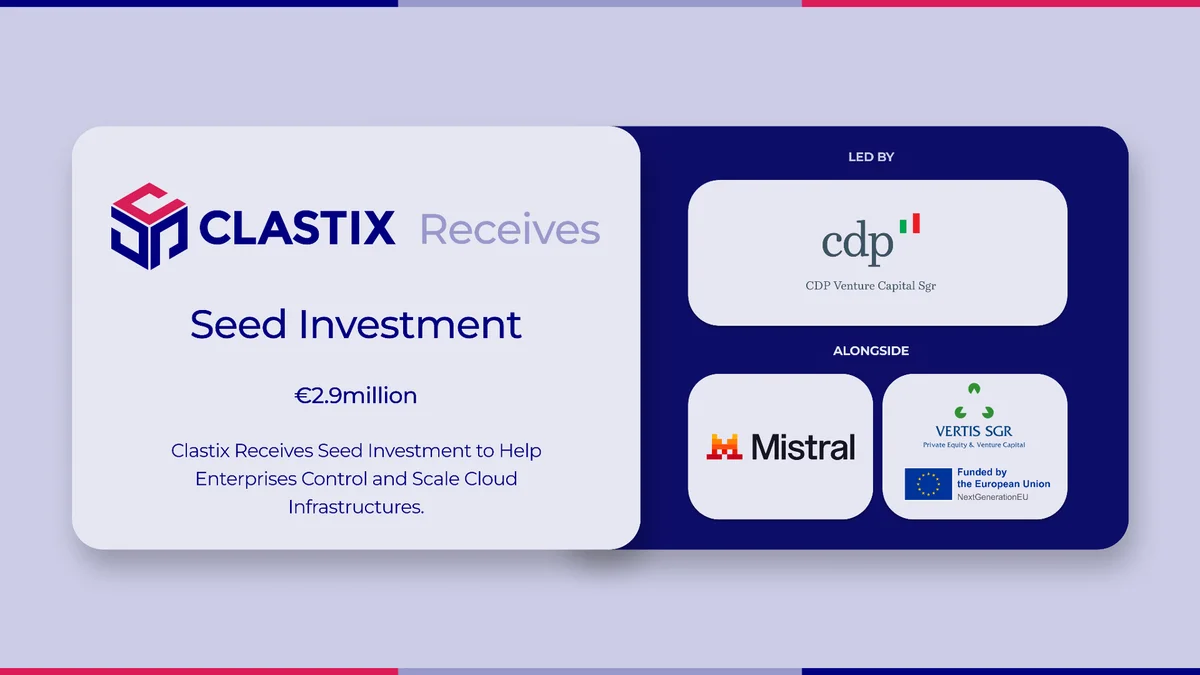
Clastix closed a US$3.2 million (€2.9 million) seed round on Sept. 24, 2026, led by CDP Venture Capital Sgr with participation from Mistral and VERTIS SGR, to scale its Kubernetes fleet‑management platform and address AI‑driven workload complexity.
Clastix secured US$3.2 million (€2.9 million) in seed funding on Sept. 24, 2026, to accelerate development of its Kubernetes‑at‑scale platform and broaden its go‑to‑market reach. The round was led by CDP Venture Capital Sgr, with strategic participation from Mistral and VERTIS SGR’s Vertis Venture 6 Digital Sud fund, which benefits from EU Next‑Generation funding.
Deal Terms
The seed round brings together three investors that have a vested interest in Europe’s emerging AI stack. CDP Venture Capital Sgr acted as the lead, while Mistral – a fast‑growing AI model developer – and VERTIS SGR, a public‑private venture vehicle, each contributed undisclosed amounts. No valuation or revenue multiples were disclosed.
Market Context
Clastix builds infrastructure software that abstracts Kubernetes control planes onto shared hardware, allowing large organisations to run dozens or hundreds of clusters without a dedicated control‑plane per cluster. Its open‑source Kamaji engine powers the commercial kMetal platform, which adds fleet‑wide governance, multi‑tenancy and production‑grade operations. The company reports active deployments across AI labs, telecom operators, cloud providers and public‑sector bodies in Europe and North America.
Co‑founder and CEO Adriano Pezzuto emphasized that the next wave of AI will be decided by the underlying infrastructure, not just model innovation. The fresh capital will fund R&D to support AI‑scale workloads, expand the kMetal product suite, and grow sales and customer‑success teams in new markets.
Clastix also plans to double its headcount over the next three years, deepen its engineering resources for Kamaji, and accelerate customer acquisition as enterprises look to simplify Kubernetes management while preparing for AI‑intensive workloads.
Why It Matters
For Clastix, the seed infusion provides the runway to transition from a niche open‑source project to a full‑stack SaaS offering that can compete with established Kubernetes management solutions such as Rancher, OpenShift and VMware Tanzu. By bolstering its R&D and sales capacity, Clastix can lock in early‑stage enterprise contracts and create network effects that raise the barrier to entry for rivals.
Mistral’s participation signals a strategic alignment between AI model developers and the underlying compute fabric. Backing Clastix gives Mistral a domestic partner to ensure low‑latency, multi‑tenant Kubernetes clusters for training and inference, potentially reducing reliance on non‑European cloud providers and strengthening Europe’s sovereign AI ecosystem.
Key Points
- Clastix raised US$3.2 million (€2.9 million) in a seed round on Sept. 24, 2026.
- CDP Venture Capital Sgr led the round; Mistral and VERTIS SGR participated.
- Funding will expand the kMetal platform and accelerate AI‑scale workload R&D.
- Clastix’s technology abstracts Kubernetes control planes onto shared infrastructure.
- The round includes a fund partially financed by the EU’s Next‑Generation programme.
Analysis
The seed round places Clastix at a pivotal inflection point in the Kubernetes management market, where operators are seeking cost‑effective, multi‑tenant solutions to support burgeoning AI workloads. While no valuation was disclosed, a US$3.2 million seed typically implies a pre‑money valuation in the low‑double‑digit millions, suggesting a modest revenue base but strong growth potential. The capital will likely be deployed to deepen the SaaS components of kMetal, driving higher gross margins as the product shifts from professional services to subscription revenue.
From an investor perspective, the deal underscores a broader trend: venture capital is gravitating toward infrastructure layers that enable AI at scale, rather than the models themselves. European sovereign funds and AI‑focused investors are betting that control‑plane efficiency will become a competitive moat for cloud‑native enterprises. For SaaS operators, Clastix’s approach—sharing control‑plane resources across clusters—offers a pathway to reduce CAPEX, improve net revenue retention through add‑on services, and accelerate expansion into regulated sectors that demand on‑prem or hybrid deployments.
If Clastix can translate its open‑source traction into a differentiated, high‑margin SaaS offering, it could command valuation multiples comparable to other niche cloud‑infrastructure players, potentially reaching 12‑15× ARR within the next 24 months. The round also signals to incumbents that the market for Kubernetes fleet management is still wide open, encouraging further consolidation or strategic partnerships.