Write Simple, Sell More
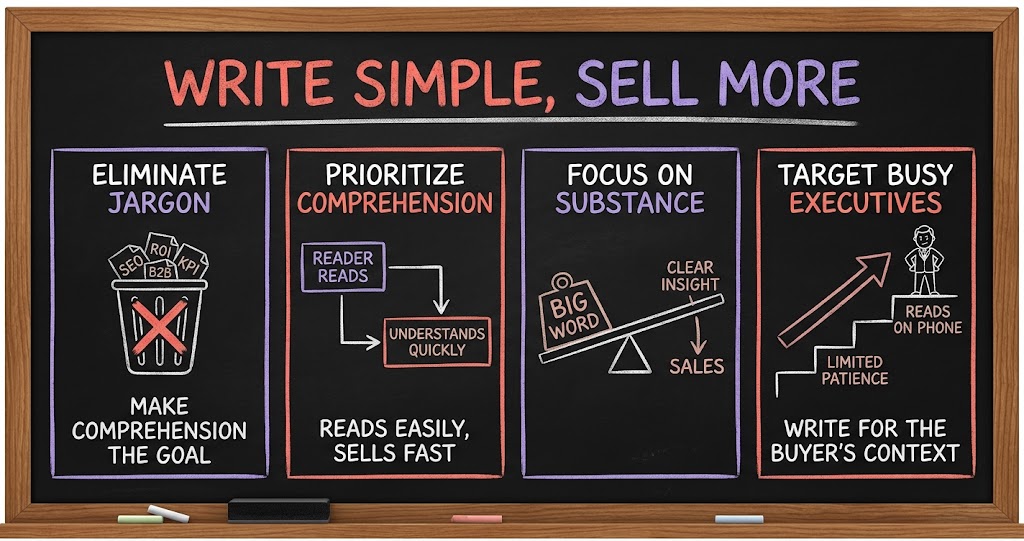
An expert writing to sell to other experts almost always makes the same mistake: writing at the level they think, not the level their buyer reads. Founders in our mastermind explain why the advice to write like your reader is five isn't as dumbed-down as it sounds.

A founder in our Enterprise mastermind, deep in the technical weeds of his own product, brought a familiar problem to the group. He was ramping up content on LinkedIn, aimed at driving sales, and kept running into the same wall. As someone who genuinely understands his subject at an expert level, his natural instinct was to write for other experts, using the vocabulary and depth that felt honest to how he actually thinks. But the people he actually needs to reach, the executives making the buying decision, don't necessarily share that same depth of familiarity. His question was direct: how do you write content that appeals to the audience that actually buys, instead of the audience that already knows as much as you do?
The advice: write like you're explaining it to a five-year-old
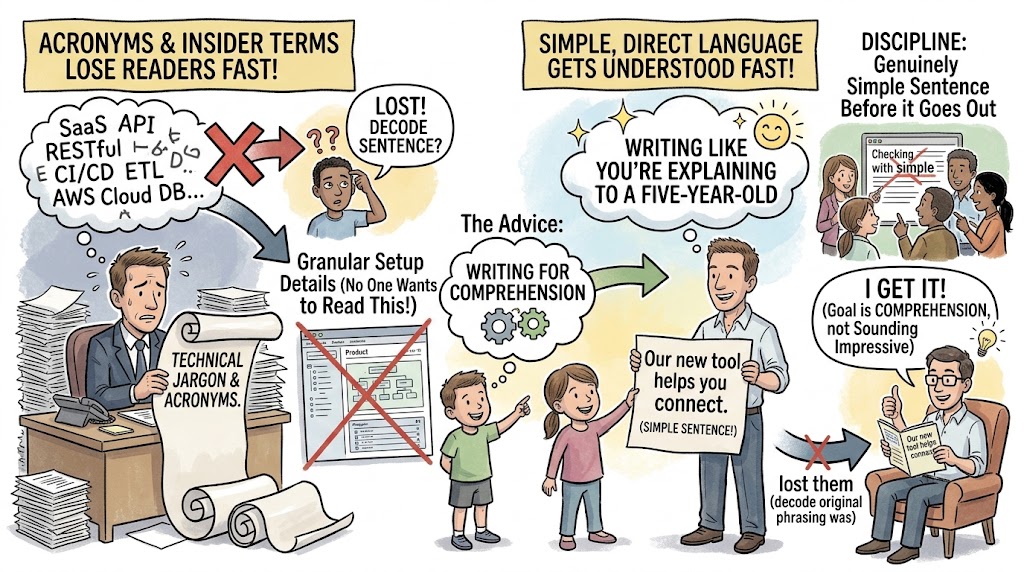
The first response from the group was blunt and immediately memorable: write like you're explaining it to a five-year-old. Not because the audience is unintelligent, but because simple, direct language travels further and gets understood faster than dense, jargon-heavy writing, even when the reader is a sophisticated executive.
- Acronyms and insider terms lose readers fast. One founder pointed out that almost nobody outside your specific technical niche wants to read about the granular setup details of your product, things like specific technical configuration steps that only make sense to someone already deep in the weeds.
- Simple language is a discipline other companies enforce deliberately. One founder described an internal practice at his company where anyone shipping something new has to explain it in a genuinely simple sentence before it goes out, specifically to catch and strip out unnecessary jargon before it reaches a reader.
- The goal is comprehension, not sounding impressive. If a reader has to stop and decode your sentence, or worse, doesn't understand it and moves on, you've lost them, regardless of how technically precise or impressive the original phrasing was.
The pushback: doesn't simple mean generic?
The founder who raised the topic pushed back on this advice in a useful way, and it's worth addressing head-on because a lot of writers have the same instinct. If everyone writes simply, doesn't that just make your content sound like everyone else's? Doesn't simplifying language cost you the nuance that actually makes your insight valuable?
The answer the group landed on draws an important distinction between simplifying your language and simplifying your substance. Those are not the same thing, and conflating them is what makes this advice feel wrong to a lot of subject matter experts at first.
- The insight can be sophisticated even when the sentence is plain. A specific framework you've developed, a real outbound campaign that succeeded or failed and why, a genuine lesson from experience, these are valuable regardless of how simply they're written. The value lives in the substance, not the vocabulary.
- Nobody wants the technical plumbing, they want the outcome. Readers generally aren't interested in the granular technical setup steps behind a result. They want to know what worked, what didn't, and why, described in language they don't have to decode.
- Simple writing about a genuinely useful insight still stands out. Most content in any given niche isn't actually that insightful to begin with. Clear writing about something genuinely useful will stand out from the noise regardless of vocabulary, because most competing content is neither clear nor particularly insightful.
If writing simply isn't your gift, you have options
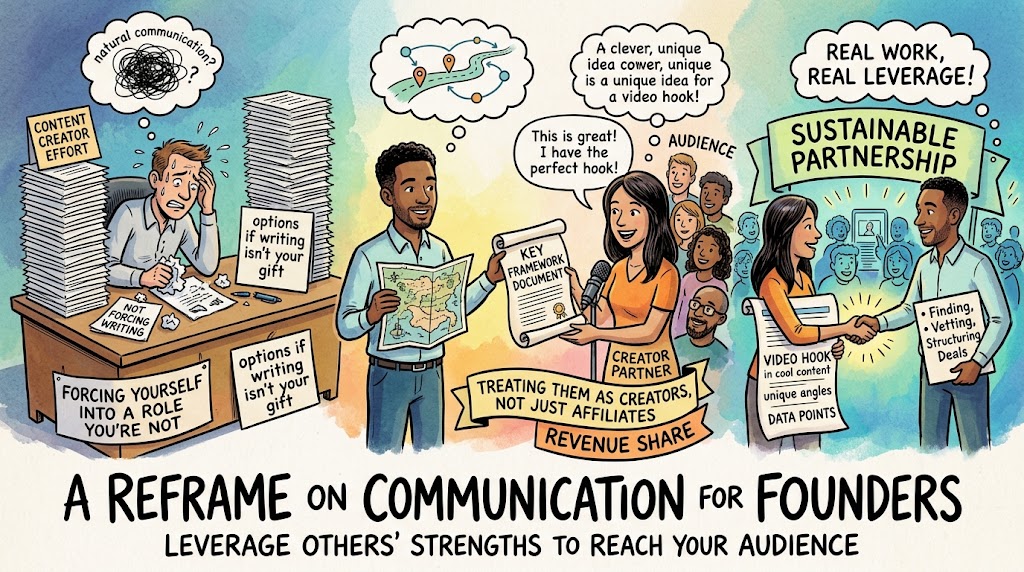
Not every founder is a naturally gifted writer, and the discussion acknowledged that directly and usefully. One founder offered a reframe worth taking seriously: if you don't have a natural gift for communication, there's a real alternative to trying to force yourself into being a content creator.
- Consider an affiliate or partnership-style approach. Some people in your space genuinely have a gift for communication and already have an audience. Partnering with them, through a revenue share or a similar structure, lets your substance reach an audience through someone else's voice.
- Think of these people as creators, not just affiliates. The deal structure and the relationship look different depending on how you frame it. Treating a strong communicator in your space as a creator partner, rather than a pure sales affiliate, often produces a better working relationship and better content.
- A specific document can become someone else's hook. Handing a genuinely useful document, framework, or data point to someone skilled at communication can result in an angle or a hook on your own material that you might never have thought of yourself.
- This is real work too, just a different kind. Finding, vetting, and structuring a deal with the right partner-creator takes real effort. It's not a shortcut that avoids work entirely, but it does let you lean on a skill you may not have without forcing yourself to become someone you're not.
A useful benchmark: technical enough to be credible, simple enough to be read
One founder offered a real example that helped ground the whole discussion: another member's content in the community consistently lands well for him specifically because it's more technical than a true beginner-level explanation, but still approachable enough for his own skill level to follow without friction. That's a useful benchmark to hold onto. The real goal is calibrating your writing to the actual reading level and context knowledge of the specific audience you're trying to reach, not chasing the absolute simplest possible version of every idea, and checking that calibration honestly rather than assuming your own expert vocabulary is the right default.
- Know your actual audience, not your ideal reader. The executive deciding whether to buy your product is very likely reading your content on their phone, between meetings, with limited patience for decoding jargon. Write for that person, not for a peer at your own level of expertise.
- Test your writing against a real outsider before publishing. Ask someone outside your specific niche, even someone at your own company in a different function, whether your draft makes sense to them. If it doesn't, that's a clearer signal than your own gut feeling about the writing.
- Save the deep technical detail for the audience that wants it. There's nothing wrong with writing genuinely technical content for practitioners in dedicated channels or documentation. The mistake is defaulting to that register on the content meant to reach a buyer who isn't there yet.
The instinct to write at your own level of expertise is natural, especially for founders who built deep credibility the hard way and want their writing to reflect that. But the content that actually drives sales tends to do a different job than proving how much you know. It helps a busy executive understand, quickly and clearly, why what you know matters to them, and that job gets easier, not harder, the simpler your language gets.
Putting this into practice on your next piece of content
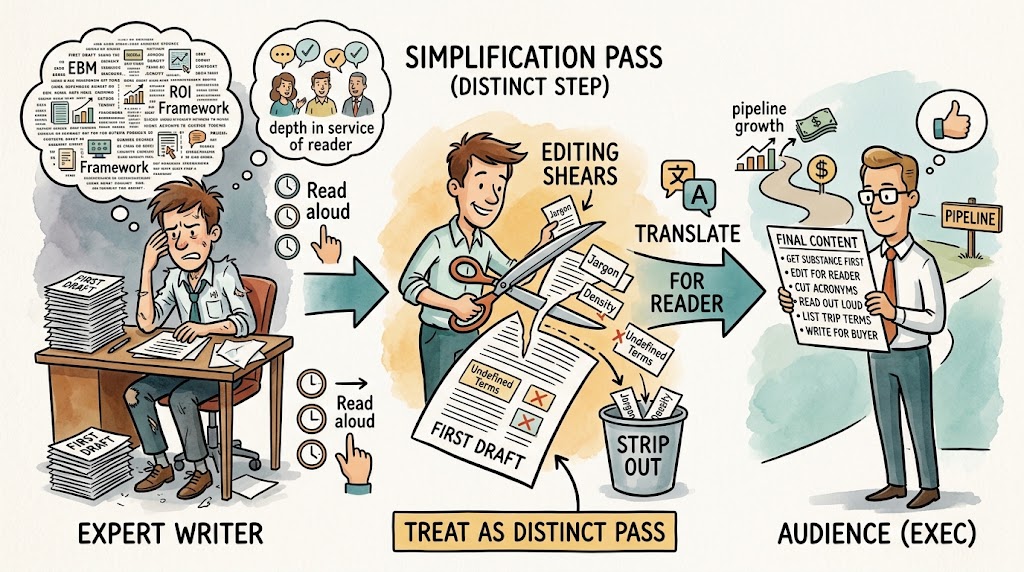
The next time you sit down to write something meant to reach a buyer rather than a peer, treat the simplification step as a distinct pass in your process, not something you're trying to do correctly on the first draft. Get the substance down first, the real insight, the framework, the specific example, in whatever language comes naturally. Then go back through with the explicit goal of stripping out anything a smart executive outside your niche wouldn't immediately understand.
- Draft for yourself, edit for your reader. Writing your first draft in your natural, expert voice is fine and often faster. The discipline comes in the editing pass, where you deliberately translate that voice into something your actual audience can follow without friction.
- Cut any acronym or term you haven't defined in the same paragraph. If a term requires outside knowledge to understand and you haven't explained it inline, either cut it or explain it in one short phrase right where it appears.
- Read it out loud before you publish. Jargon and overly dense phrasing tend to reveal themselves quickly when you hear your own writing read aloud, in a way they don't when you're just scanning the page silently.
- Keep a running list of terms that trip people up. Over time, you'll notice the same handful of internal or technical terms causing confusion. Build a habit of catching and simplifying those specific words before they make it into public-facing content.
None of this requires abandoning the depth of knowledge that makes your content worth reading in the first place. It just means putting that depth in service of a reader who doesn't share your background, rather than assuming they do. That single shift in who you're actually writing for is usually worth more to your pipeline than any amount of additional technical polish on the writing itself, and it's a shift you can start making on the very next piece of content you sit down to write.