
Why You Shouldn't Hire a CRO Too Soon
A Chief Revenue Officer title sounds like the obvious next hire once you have a real sales team, but founders in our mastermind who've actually made this hire, and made this mistake, say the timing and the job description matter more than the title.

A founder in our mastermind was ready to make what felt like an obvious next hire. His company had an enterprise sales team and an inside sales team, and he'd just let go of his inside sales manager specifically to clear the org chart for a Chief Revenue Officer, someone senior enough that every person carrying a quota would report up through them. He wanted to know how this had gone for other founders in the room. What came back wasn't a simple yes or no. It was a set of hard-won distinctions that most founders don't figure out until after they've already made an expensive mistake.
Define the job before you define the title
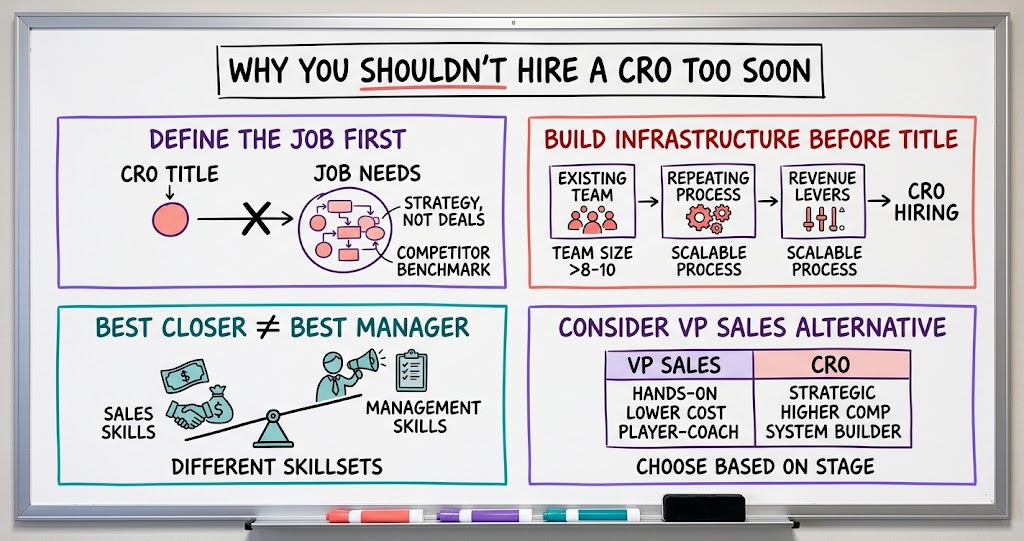
The first question another founder asked, before offering any advice, was the right one: what do you actually expect this person to do? It sounds basic, but a surprising number of founders skip it. "Chief Revenue Officer" gets used to describe wildly different jobs depending on the company, and the mismatch between what you're hiring for and what the title implies is where a lot of these hires go wrong.
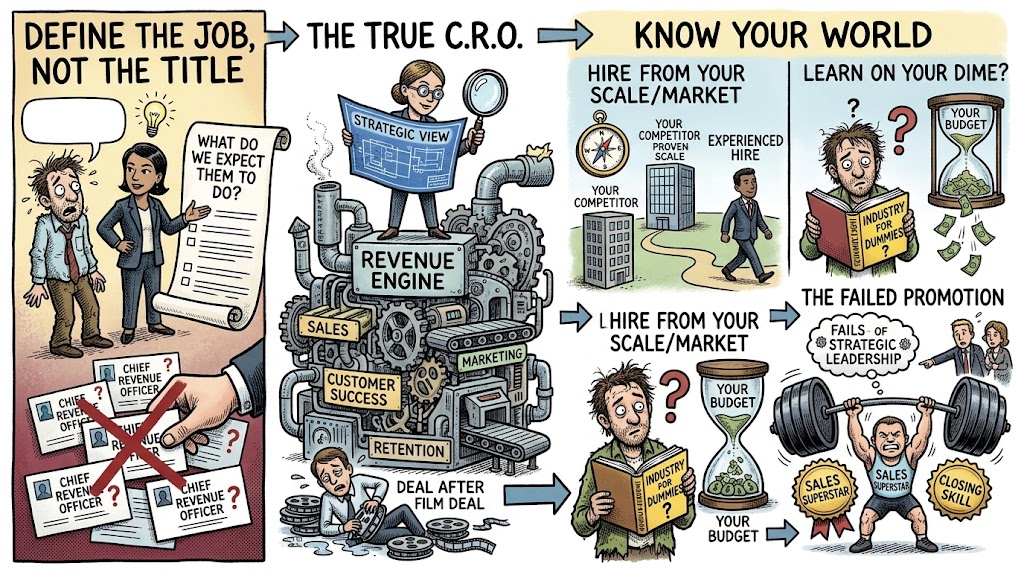
- A true CRO thinks in strategy, not deals. Founders who've made this hire successfully describe the role as needing a fundamentally different skill set than closing deal after deal. It's a strategic, portfolio-level view of the whole revenue engine, not another layer of individual selling.
- They should already know your world. One founder's blunt advice: look at who your competitors have hired into similar roles, because you want someone who's already operated at the scale and in the market you're trying to reach, not someone learning your industry on your dime.
- Rising your best salesperson into the role often backfires. More than one founder in the group had made this exact mistake, promoting a strong individual seller into a CRO title, only to find that closing skill and strategic leadership skill are not the same muscle.
The infrastructure has to exist before the title does
One of the sharper points made in the discussion was about sequencing. A real CRO isn't good at what one founder called "first gear." They're not built to be your second salesperson, grinding out the earliest deals while also building the function around themselves. They need an existing team, existing infrastructure, and existing revenue to actually operate the levers a CRO is supposed to pull.
- Ask what team size actually supports the role. In the case that prompted this conversation, the company had roughly eight to ten people across enterprise and inside sales, split into a handful of functional groups. That's generally considered a workable foundation for a CRO to operate real levers on, rather than doing the selling themselves.
- A CRO needs dials to pull, not just a title. If there's no team, no existing process, and no real revenue engine yet, you don't have a CRO-shaped hole. You have a head-of-sales-shaped hole, or possibly just a need for one more great closer.
- Compensation should already be in the ballpark before you post the role. One founder shared a benchmark from his own company's history: a senior sales leader hired to run a growing mid-market segment was paid roughly $300,000 in total compensation, split evenly between base and bonus, at a mid-sized SaaS company. Adjusted for today, that's closer to $400,000 in total comp for someone genuinely capable of running that kind of operation.
The cheaper, often better alternative
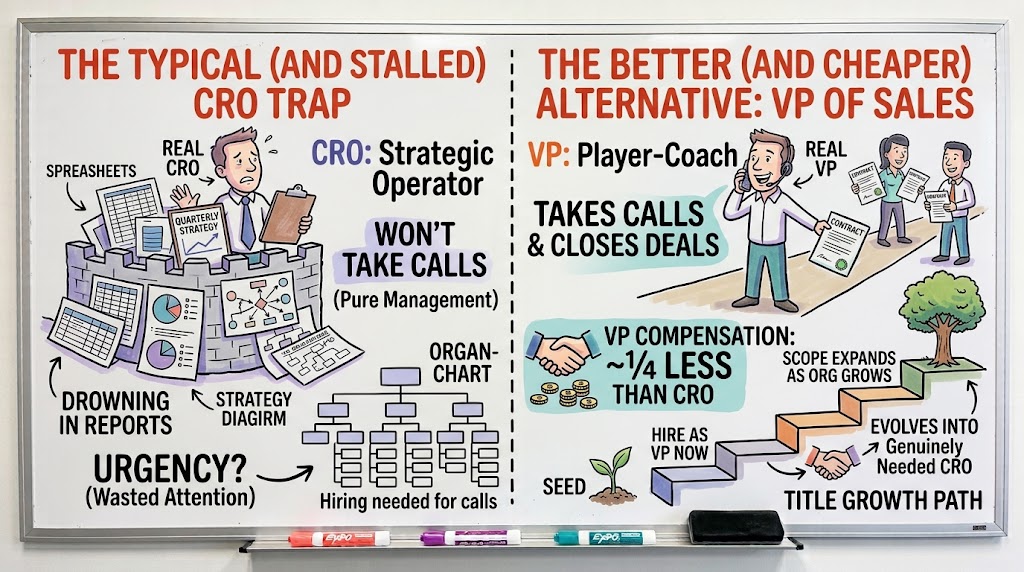
If your sales org is still relatively small, in the range of eight to ten people rather than several dozen, there's a strong case for a different hire entirely: a VP or SVP of Sales instead of a Chief Revenue Officer. The distinction isn't just semantic.
- A player-coach can actually take calls. A VP of Sales is more likely to get on calls themselves, close deals personally when it matters, and lead by doing rather than purely by managing. A true CRO usually won't, and shouldn't, be expected to.
- You can often get similar caliber for meaningfully less. One founder in the discussion estimated you could bring in a strong VP of Sales for roughly a quarter less in total compensation than a true CRO hire, without giving up much in terms of actual capability at that stage of the company.
- The title can grow with the person and the company. It's entirely reasonable to hire someone as VP or SVP of Sales now and expand their title, and their scope, as the sales org grows into something that genuinely needs a CRO-level strategic operator.
What happens when you promote a closer into a manager role
One story from the discussion is worth sitting with. A founder had moved his best salesperson out of selling and into a pure management role, expecting the natural next step for a top performer to be running the team rather than carrying a bag. It turned out to be, in his own words, a very expensive experiment, costing several million dollars a year in lost production while that person sat in a management seat instead of closing deals. He eventually told the person directly to get back to selling, and the salesperson was relieved. Sitting in management had also quietly cost him hundreds of thousands of dollars a year in commission he would have otherwise earned.
- Your best closer is not automatically your best manager. These are different skills, and assuming one predicts the other is one of the more common and expensive mistakes in scaling a sales org.
- Letting someone keep an impressive title while doing the job that actually fits them is fine. There's no rule that says the title has to match the org chart perfectly. If someone is effectively a glorified senior account executive but doing great work under a bigger title, that's a reasonable outcome, not a failure.
- Watch for the signal that someone wants back in the field. If a top performer seems unhappy in a management seat, take that seriously. The fix is often as simple as letting them go back to what they're actually best at.
What actually happens once the right person is in the seat
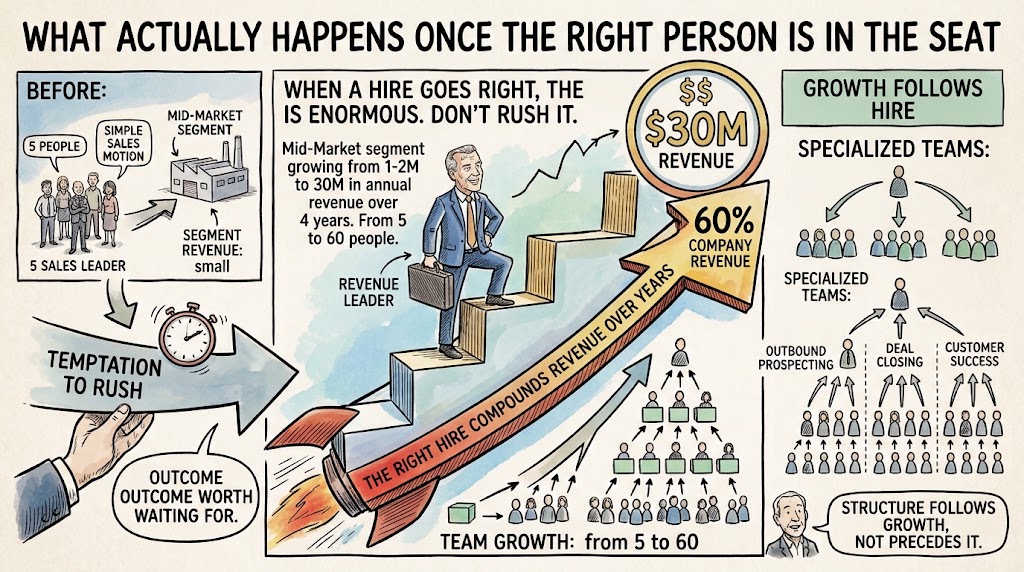
It's worth pointing out that when this hire goes right, the impact can be enormous, which is exactly why the temptation to rush it is so strong. Ryan shared his own experience building out a mid-market sales motion at a company he ran years ago. The team hired a senior sales leader to take over a segment that was generating one to two million dollars a year in revenue. Over the following four years, that same segment grew to thirty million dollars in annual revenue, and it ended up representing sixty percent of the company's total revenue by the time it was acquired. The team under that leader grew from five people to sixty, split across dedicated managers for outbound prospecting, deal closing, and customer success, each with their own reporting line up to the one senior hire.
- The structure came after the growth, not before it. That level of specialized management, a manager just for the SDRs, another just for the account executives, another just for customer success, only made sense once the team had grown large enough to need it. Building that structure prematurely would have added overhead without the revenue to justify it.
- The right hire compounds instead of just executing. The difference between a strong individual closer and a genuine revenue leader shows up over years, not months. The four-year trajectory in this example wasn't the result of one great quarter. It was consistent, compounding growth built on top of a repeatable system.
- This is the outcome worth waiting for. Getting the timing right on this hire, letting the team and infrastructure catch up to the title, is exactly what makes this kind of multi-year growth trajectory possible instead of an expensive false start.
The bottom line before you post the job
Before you write a job description with "Chief Revenue Officer" at the top, get specific about three things: what this person will actually do day to day, whether your existing team and infrastructure can support someone operating at that strategic altitude, and whether a less expensive, more hands-on VP of Sales might actually serve your current stage better. The title is the easy part. Getting the timing and the job definition right is what determines whether the hire, whatever you call it, actually moves your revenue.
It's also worth asking the question again in six months, and again after that. The right title for your revenue organization today is not necessarily the right title in two years. Founders who treat this as a one-time decision tend to either overhire too early, paying for a strategic operator with nothing yet to operate, or underhire for too long, keeping someone in a role they've outgrown simply because changing titles feels awkward. Revisiting the question on a regular cadence, tied to real milestones like team size, revenue, and the complexity of your go-to-market motion, keeps the decision grounded in where the company actually is rather than where you assumed it would be when you first wrote the job posting.