
Why Would CrowdStrike Pay Nearly $44 Billion for Its Own Partner?
CrowdStrike agreed to buy Zscaler, a company it already partnered with and shared more than 2,000 customers with. Here is what the deal says about who might buy your SaaS, and how to prepare.

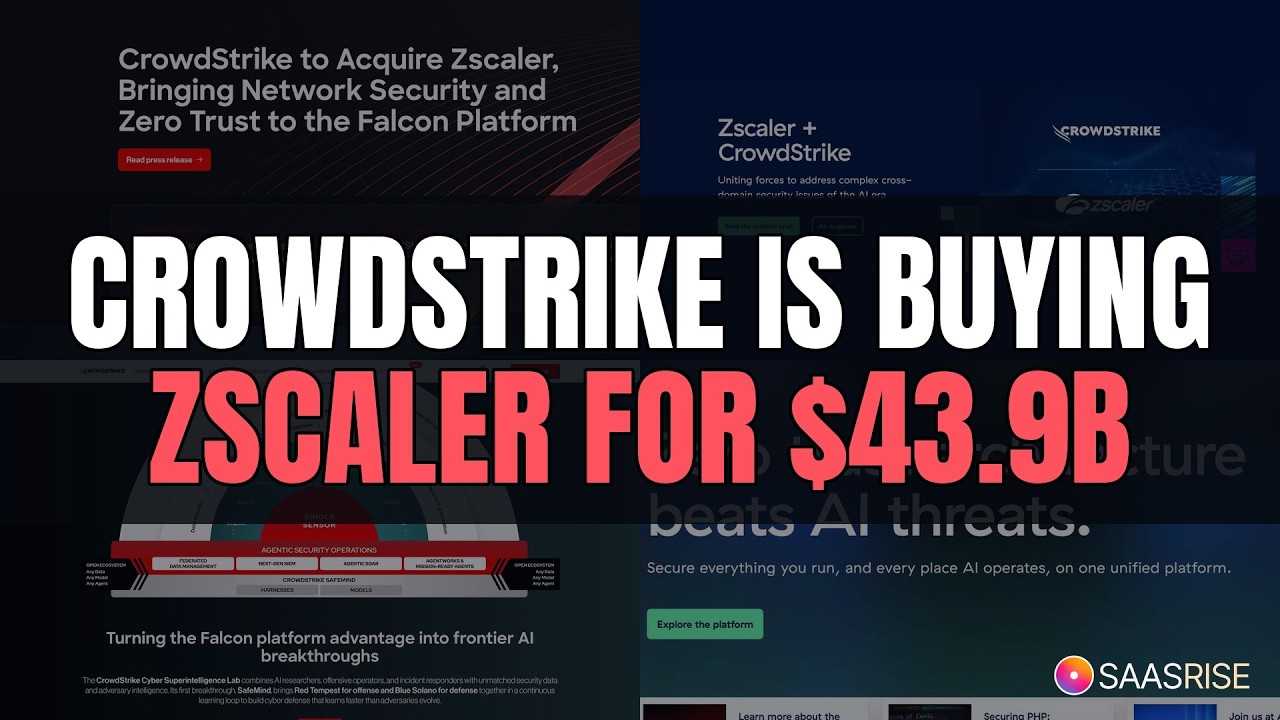
On Monday, CrowdStrike agreed to buy Zscaler for nearly $44 billion, paid in CrowdStrike's own stock at a 34% premium to Zscaler's share price. The unusual thing about the deal is that the two companies were already partners. They had a working relationship, shared customers, and had connected their products. So why pay a premium for a company you already work with, and what does that tell you about who will one day buy your SaaS?
In this post I'll explain what each company does, walk through the numbers, show why investors were not convinced, and describe a practical step you can take this week to build the kind of relationship that makes a future acquisition more likely and more valuable.
Two Companies, Two Halves of the Same Problem
In plain words, CrowdStrike protects a company's laptops and servers. Zscaler protects the connection between a company's people and the apps they use. Those are two sides of the same security job, which is why customers often buy both. Before the deal, the two companies already shared more than 2,000 customers, and their products connected in 16 ways.
- CrowdStrike. Protects laptops and servers.
- Zscaler. Protects the connection between people and the apps they use.
- Shared customers. More than 2,000 before the deal.
- Integrations. Their products connected in 16 ways.
That history matters. A partnership that has grown to thousands of shared customers and many integrations has already shown that customers want both products working together.
The Numbers Behind the Deal
The price is large, and so is the opportunity CrowdStrike sees. About 8,000 Zscaler customers don't buy from CrowdStrike yet. CrowdStrike expects about $1 billion a year in new revenue from selling to each other's customers. That figure is the core of the argument for the deal: two companies with overlapping customers can each sell more to the other's base.
- Price. Nearly $44 billion, paid in CrowdStrike stock.
- Premium. 34% above Zscaler's share price.
- Customers not yet shared. About 8,000 Zscaler customers don't buy from CrowdStrike.
- Expected benefit. About $1 billion a year in new revenue from cross-selling.
Investors weren't sure the math justified the price. CrowdStrike's own stock closed down almost 9% on Monday. That reaction is a reminder that even a deal with a clear strategic logic can be questioned when the price is high.
Why Partners Make Natural Buyers
CrowdStrike's own press release makes the point plainly: a partnership integrates separate products, and one company integrates everything. That is the pitch behind most platform acquisitions. A customer who uses two vendors has to manage two contracts, two sets of settings, and two support teams. A single vendor that covers both can offer a simpler experience and a single relationship.
- Partnership. Connects separate products, but each company still sells and supports its own.
- Combined company. Can integrate everything under one product and one relationship.
- Customer benefit. Fewer vendors to manage.
- Buyer benefit. Can sell more to a customer base it already knows.
The buyer most likely to pay a premium is often the platform your customers already use alongside you. That platform understands your value, knows your customers, and can see exactly how much more it could sell by owning your product.
What This Means for a Smaller SaaS Company
You may not be a $44 billion company, but the logic scales down. The larger platforms in your category are watching which smaller tools their customers use next to them. When your product shows up in the same accounts again and again, and your customers keep asking for the two products to work together, you become a more natural candidate for a partnership, an integration deal, and eventually an acquisition.
There is also a benefit well before any sale. A strong integration with a bigger platform is a sales channel, because that platform's customers can discover you through it. It reduces churn for shared customers, since a connected product is harder to replace. And it gives you information about how the larger company thinks about your category.
- Discovery. Shared customers find you through the platform's ecosystem.
- Retention. Connected products are harder for customers to drop.
- Relationship. You build familiarity with the team that may one day want to buy you.
- Evidence. Shared-customer numbers become part of your story to any future acquirer.
What Investors Worry About in Platform Deals
The drop in CrowdStrike's stock shows the risk on the buyer's side, and it is worth understanding because it shapes how large buyers think. Combining two companies is hard. Products need to be merged or at least linked cleanly, sales teams have to learn to sell a bigger bundle, and customers who liked buying separately may resist. When a deal is paid for in stock at a premium, investors also watch how much ownership current shareholders are giving up. A large expected benefit, such as $1 billion a year in new revenue, has to arrive for the price to make sense.
- Integration work. Combining products and teams takes time and attention.
- Selling a bundle. Sales teams must learn new products and new buyers.
- The premium. A 34% premium raises the bar the deal has to clear.
- Proof of benefit. Investors look for evidence that cross-selling works at the scale promised.
For you, the lesson is that acquirers want proof. The more evidence you have that your product works well alongside theirs, such as shared customers, joint wins, and reduced churn for accounts that use both, the easier it is for them to justify a price. Your integration data becomes part of your case.
How to Build the Evidence
If you want to be the obvious partner, the numbers need to exist before anyone asks for them. That means tracking, from the start, which of your customers also use a given platform, how those customers behave compared with the rest, and what they say about the combination. Over time, you can show that shared customers stay longer, expand more, or buy faster. That information is useful in partnership talks long before any acquisition.
- Tag shared customers. Mark which accounts also use each major platform.
- Compare retention. Check whether shared customers churn less than the rest.
- Compare expansion. See whether they spend more over time.
- Collect stories. Ask a few shared customers to describe what the combination does for them.
Even a small set of clear results gives you something concrete to bring to a larger company. A partner manager is much more likely to take a meeting when you can say how many customers you share and what the integration changes for them.
The Exercise: Find Who Shares Your Customers
Here is the step I'd take this week. Make a list of the three bigger platforms your best customers also pay for. You can find them by asking your top accounts what else is in their stack, by checking which integrations come up most in support tickets, and by looking at the logos on your competitors' partner pages. Then pick one of the three and build the integration your shared customers keep asking for.
- Step 1. List the three bigger platforms your best customers also use.
- Step 2. Count how many of your customers use each one.
- Step 3. Find the integration request that comes up most.
- Step 4. Choose one platform and scope a first integration.
- Step 5. Track shared-customer counts and usage over time.
Keep the first integration small and useful. A single well-built connection that solves a problem your customers talk about is worth more than a long list of shallow ones.
A Realistic Way to Think About Acquisition
Most SaaS companies are never acquired by a giant, and building a business around that hope is a mistake. The better way to use this story is as a lens for your partnerships. Companies that build deep integrations with the platforms their customers already use tend to gain in several ways at once: more distribution, lower churn, and a stronger position if an offer ever comes. If the offer never comes, you still have a healthier business.
So treat the exercise in this post as a normal part of product planning rather than an exit strategy. Each integration should earn its place by helping customers today, and any acquisition interest it creates is a bonus.
One last point on timing: start now. Integrations take months to build and months more for customers to adopt, so the evidence a future partner might ask for is created long before the conversation happens.
What to Remember
Two thousand shared customers became a nearly $44 billion deal. That is a large-scale example, but the underlying idea is simple: the company most willing to pay a premium for you is often one whose customers already depend on you. Start with the question the video ends on. Who shares yours? Find the answer this week, and put your next integration where it counts.