
Why SaaS Firms Should Start Implementing MCP
This post explains Model Context Protocol (MCP) and why SaaS companies should begin implementing it as AI agents become a new way software is used. It outlines how MCP allows tools like Claude, ChatGPT, and Gemini to interact directly with SaaS products through standardized interfaces, creating a new AI-native usage channel. This also provides a practical implementation roadmap—starting with API audits and OpenAPI documentation, then building MCP wrappers and skills documentation—while highlighting how early adoption can create distribution, usage, and competitive advantages as AI-driven workflows become more common.

Something interesting is happening across the SaaS landscape right now. Quietly, under the radar, a new infrastructure layer is emerging that could fundamentally change how software gets used.
For the last twenty years, SaaS companies have primarily built products for humans. We design dashboards, workflows, and interfaces for people sitting behind keyboards.
But that assumption is about to shift.
Increasingly, software will be used not just by humans—but by AI agents acting on behalf of humans. And the protocol that is beginning to standardize how that interaction works is something called Model Context Protocol, or MCP.
For SaaS founders and CEOs, MCP is one of those developments that seems niche at first, but will likely become table stakes surprisingly quickly.
Let’s unpack what it is, why it matters, and how to actually implement it inside a SaaS company.
What MCP Actually Is
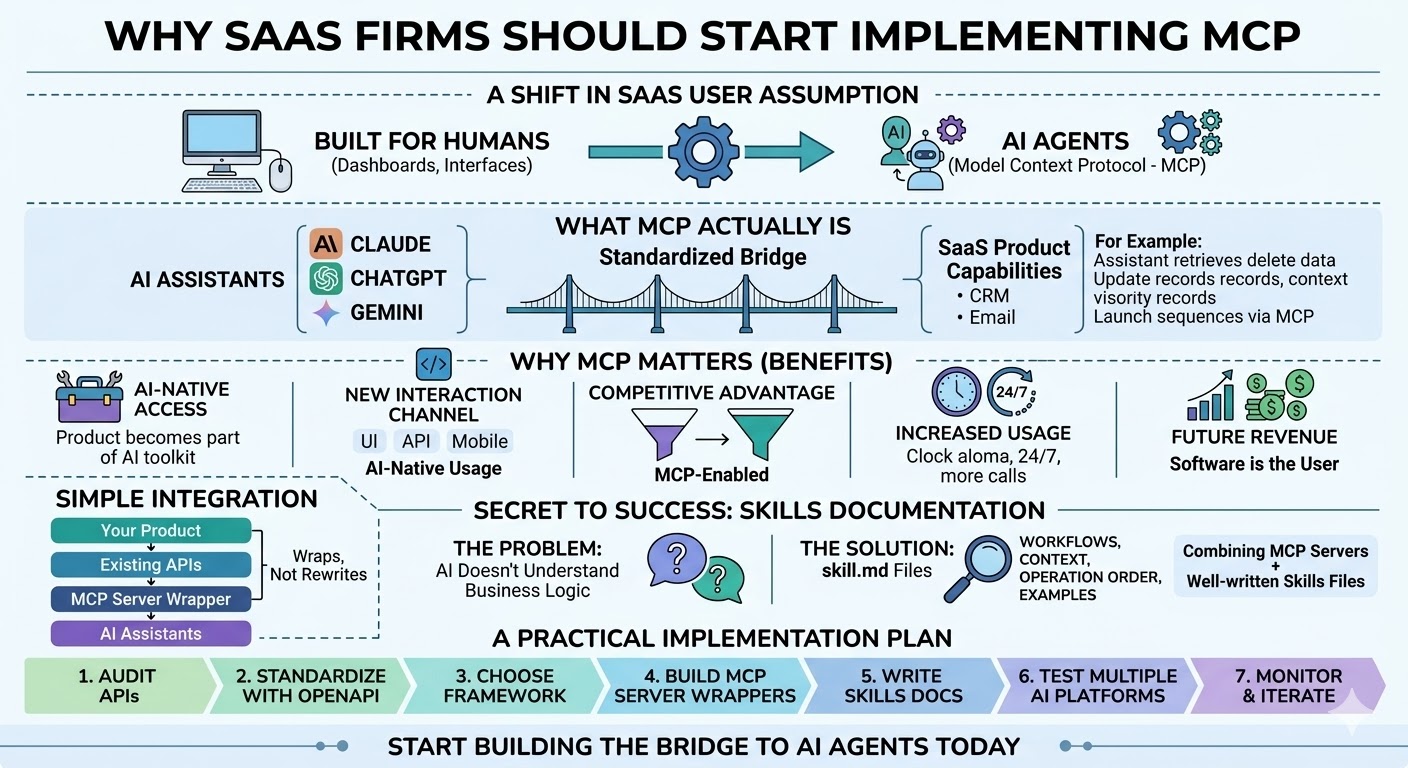
At its core, Model Context Protocol (MCP) is a standardized way to expose your SaaS application’s functionality to AI agents like Claude, ChatGPT, and Gemini.
Or put more simply:
“Model Context Protocol (MCP) is a standardized way to expose your SaaS application's functionality to AI agents like Claude, ChatGPT, and Gemini.”
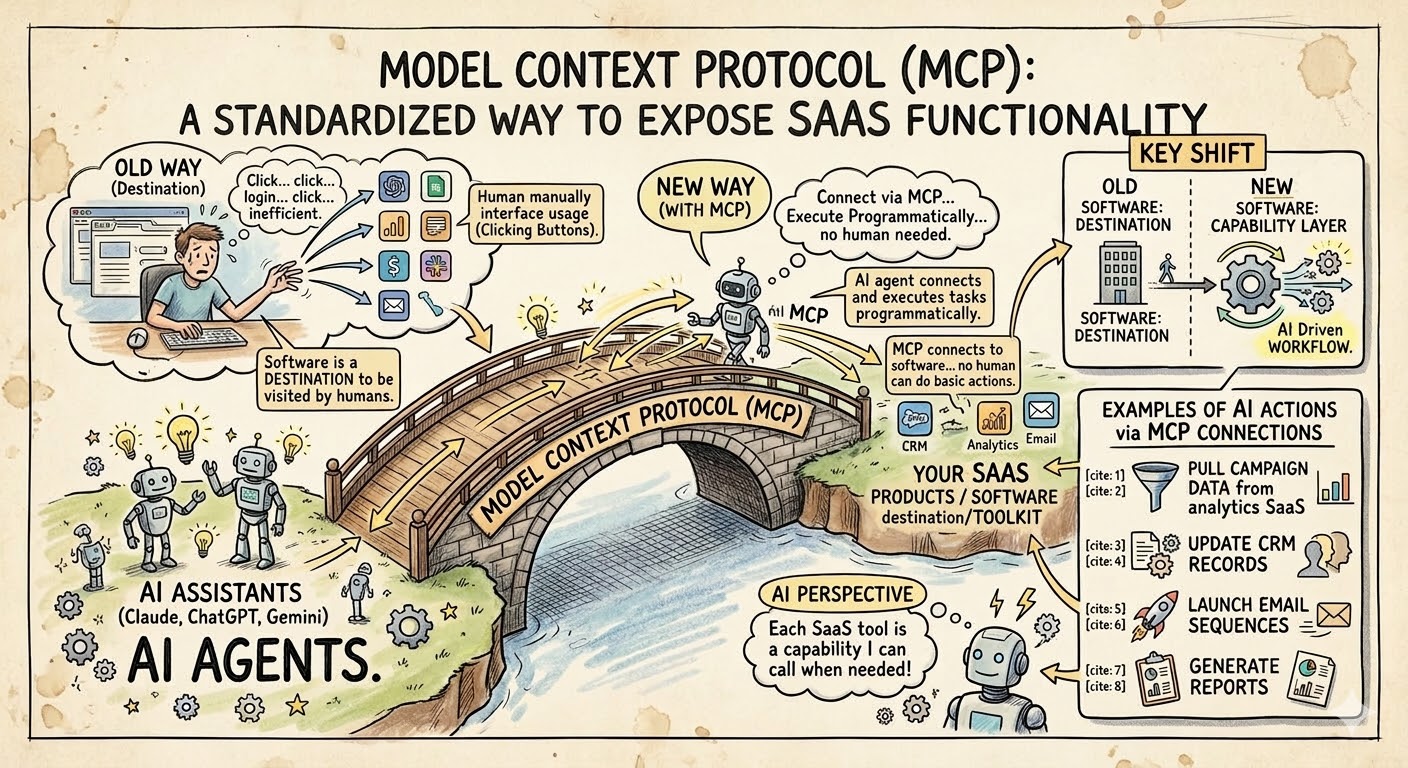
Think of MCP as a bridge between AI assistants and software products.
Instead of a human clicking buttons in your interface, an AI agent can connect to your product through MCP and execute tasks programmatically.
For example, imagine an AI assistant helping a marketing leader run their day. Instead of logging into five different tools, the AI could:
• Pull campaign data from your analytics SaaS
• Update CRM records
• Launch email sequences
• Generate reports
All through MCP connections.
From the AI’s perspective, each SaaS tool becomes a capability it can call when needed.
The shift is subtle but profound. Software stops being just a destination and becomes a capability layer inside an AI-driven workflow.
Why MCP Matters for SaaS Companies
If you zoom out a bit, MCP represents the next stage in the evolution of APIs.
First we had web interfaces.
Then APIs.
Then API ecosystems.
Now we’re entering the AI agent era, where software tools become capabilities inside autonomous workflows.
That’s where MCP comes in.
There are several reasons SaaS founders should start paying attention now.
AI-Native Access to Your Product
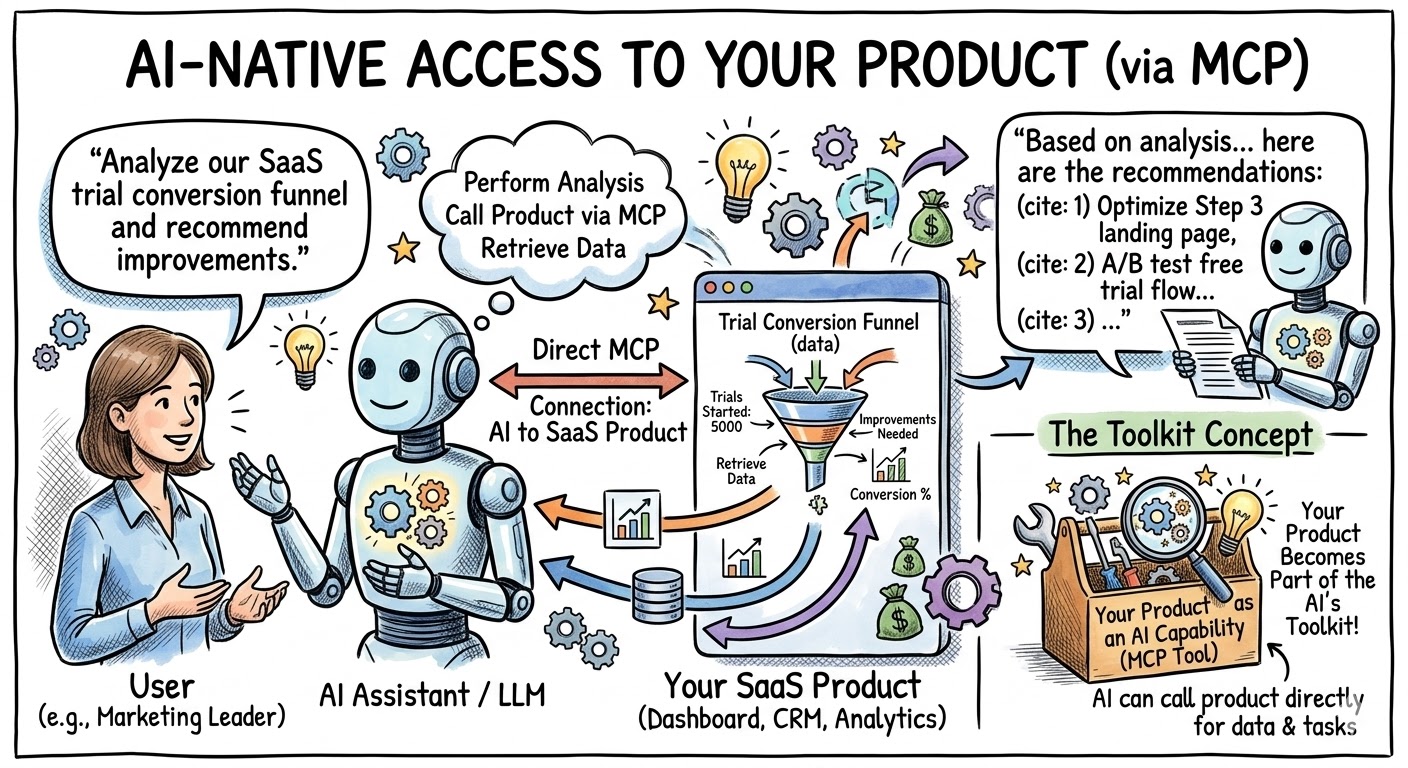
The most obvious benefit is that MCP allows AI assistants to use your product directly.
That means a user could say something like:
"Analyze our SaaS trial conversion funnel and recommend improvements."
Their AI assistant could then call your product via MCP, retrieve the data, and perform the analysis.
Your product becomes part of the AI’s toolkit.
A New Interaction Channel
Historically, SaaS companies gained users through three main channels:
• Human UI usage
• API integrations
• Mobile apps
MCP introduces a fourth:
AI-native usage.
And over time, this may become a major driver of activity.
Competitive Advantage
Right now, very few SaaS companies have implemented MCP. But that won’t last.
The companies that expose MCP endpoints early will become the easiest tools for AI agents to use.
That can create a real distribution advantage.
When an AI assistant is deciding which CRM, analytics tool, or marketing platform to interact with, MCP-enabled tools will simply be easier to orchestrate.
Increased Usage
AI agents are tireless.
They run automations continuously, monitor metrics, trigger workflows, and surface insights proactively.
That means more API calls, more feature usage, and more embedded reliance on your platform.
A Future Revenue Channel
Perhaps the most interesting implication is economic.
“By 2027, AI agents may generate significant revenue alongside human users.”
In other words, the buyer might still be human—but the user might increasingly be software.
SaaS products that are easy for agents to operate will benefit from that shift.
How MCP Fits Into Your Existing Architecture
The good news is that implementing MCP does not usually require rewriting your product.
Most SaaS companies already have APIs. MCP simply wraps those APIs in a way that AI agents can discover and use more easily.
The architecture typically looks like this:
Your SaaS product
⬇
Existing REST APIs
⬇
MCP server wrapper
⬇
AI assistants (Claude, ChatGPT, Gemini)
The MCP server acts as a translator layer between AI systems and your APIs.
The Real Secret: Skills Documentation
During a recent conversation inside the SaasRise community, one insight kept coming up again and again.
The problem wasn’t building MCP servers.
The problem was making them useful.
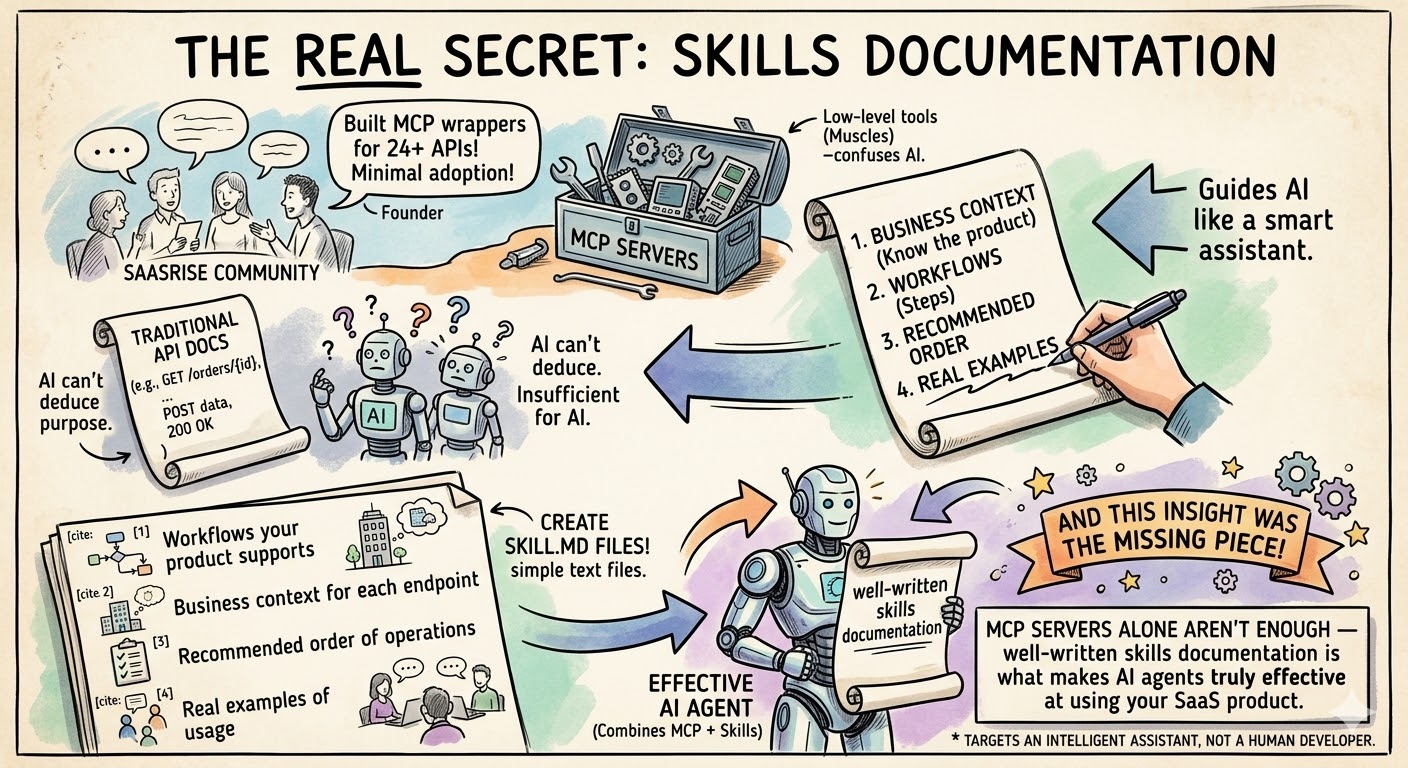
One founder shared that their team had built MCP wrappers for more than two dozen APIs, but adoption was minimal.
The reason turned out to be surprisingly simple.
The AI didn’t understand how to use them.
APIs describe endpoints.
They describe parameters.
But they rarely explain the business logic behind the product.
That’s where skills documentation comes in.
“Create skill.md files that explain the business logic and context for how to use your APIs effectively. These simple text files help AI understand not just what your API does, but when and how to use it.”
These files describe:
• The workflows your product supports
• The business context for each endpoint
• The recommended order of operations
• Real examples of usage
Think of it as writing documentation for an intelligent assistant rather than a human developer.
And this insight turned out to be the missing piece.
“MCP servers alone aren't enough — combining them with well-written skills documentation is what makes AI agents truly effective at using your SaaS product.”
A Practical MCP Implementation Plan
If you're running a SaaS company today, implementing MCP can be approached in a structured way.
Step 1: Audit Your Existing APIs
Start by cataloging what you already have.
Document:
• All endpoints
• Authentication methods
• Data models
• Rate limits
Then identify which APIs would be most valuable for AI access.
Typically these include:
• Data retrieval
• Reporting
• automation workflows
• account management actions
You don't need to expose everything immediately.
Start with the capabilities that AI agents would most naturally automate.
Step 2: Standardize with OpenAPI
Before building MCP servers, ensure your APIs are well documented.
The best approach is to generate OpenAPI (Swagger) specifications for each endpoint.
This provides a structured description that makes it easier to generate MCP wrappers later.
It also forces clarity around parameters, responses, and error states.
Several founders inside our mastermind mentioned taking this step first before touching MCP at all.
Step 3: Choose an MCP Framework
You can build MCP servers in multiple languages depending on your stack.
Two common approaches are emerging.
Python-based MCP servers are popular because many AI infrastructure tools already live in Python ecosystems.
Meanwhile, Microsoft recently released ASP.NET Core MCP support, including auto-generated discovery endpoints.
Some teams are leaning in that direction if they already run .NET infrastructure.
The key point is that MCP is flexible. It doesn't lock you into a specific language.
Step 4: Build MCP Server Wrappers
Next, you create MCP servers that wrap your APIs.
These servers handle:
• Tool discovery
• Request translation
• Authentication
• rate limiting
A common mistake is trying to wrap every API immediately.
Start small.
Pick three to five high-value capabilities and implement those first.
Once you see how AI agents interact with them, you can expand coverage.
Step 5: Write Skills Documentation
This is where most of the real value happens.
For each MCP server, write a skill.md file that describes how the APIs should be used.
Include:
• Business context
• Example workflows
• Common tasks
• recommended sequences of calls
In practice, these files function like training manuals for AI agents.
Without them, the agent sees a toolbox.
With them, the agent understands how to build things.
Step 6: Test Across Multiple AI Platforms
Different AI systems interpret MCP slightly differently.
So testing matters.
You should validate your MCP servers with:
• Claude
• ChatGPT
• Google Gemini
Run real workflows, not just API tests.
Ask the AI to complete tasks using your product.
Then observe how it behaves.
This feedback loop is incredibly useful.
Step 7: Monitor and Iterate
Once MCP is live, the work isn’t finished.
Watch how AI agents interact with your platform.
Track:
• Which tools they call
• where errors occur
• which workflows succeed
Then refine your skills documentation accordingly.
Often the biggest improvements come from adjusting the documentation rather than the APIs.
What SaaS Founders Are Seeing So Far
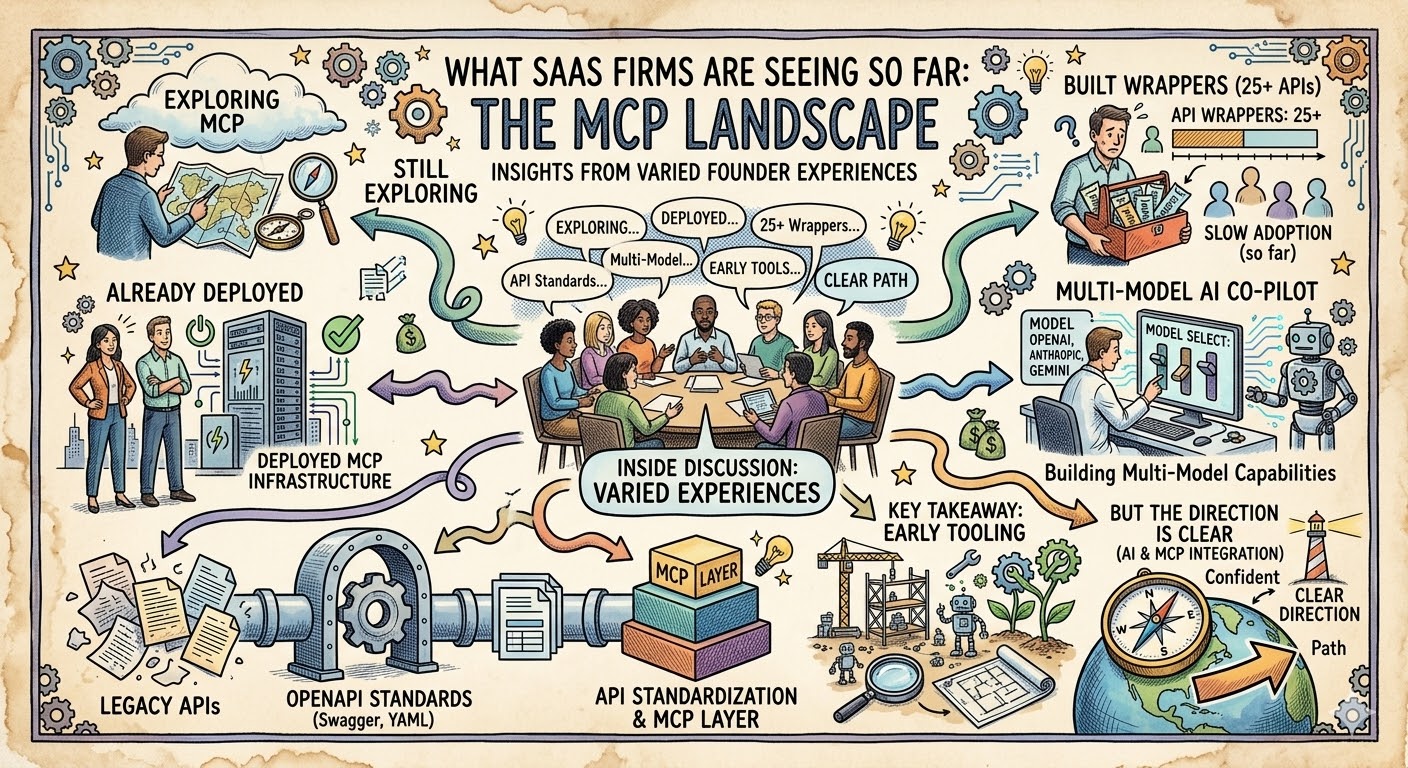
Inside our recent discussion among SaaS founders, experiences varied.
Some teams are still exploring.
Others have already deployed MCP infrastructure.
One founder mentioned that their company built wrappers for 25 APIs, but adoption has been slow so far.
Another is building an AI co-pilot that can switch between OpenAI, Anthropic, and Gemini.
Several are first migrating their APIs to OpenAPI standards before layering MCP on top.
One of the most interesting takeaways is that the tooling is still early.
But the direction is clear.
The Big Picture
Right now MCP is in the phase where APIs were around 2005.
Developers are experimenting.
Standards are forming.
Adoption is uneven.
But the trajectory is obvious.
AI agents will increasingly orchestrate software tools on behalf of humans.
And when that happens, the products that expose clean MCP interfaces will be dramatically easier to integrate into those workflows.
Which leads back to the core insight.
“The combination of MCP servers plus well-written skills files is what drives adoption and effectiveness.”
If you run a SaaS company today, it’s worth beginning the process now.
You don’t need a perfect implementation.
You just need to start building the bridge between your software and the AI agents that will soon be using it.
Because in a few years, the companies that did will look obvious in hindsight. And the ones that didn’t will be scrambling to catch up.