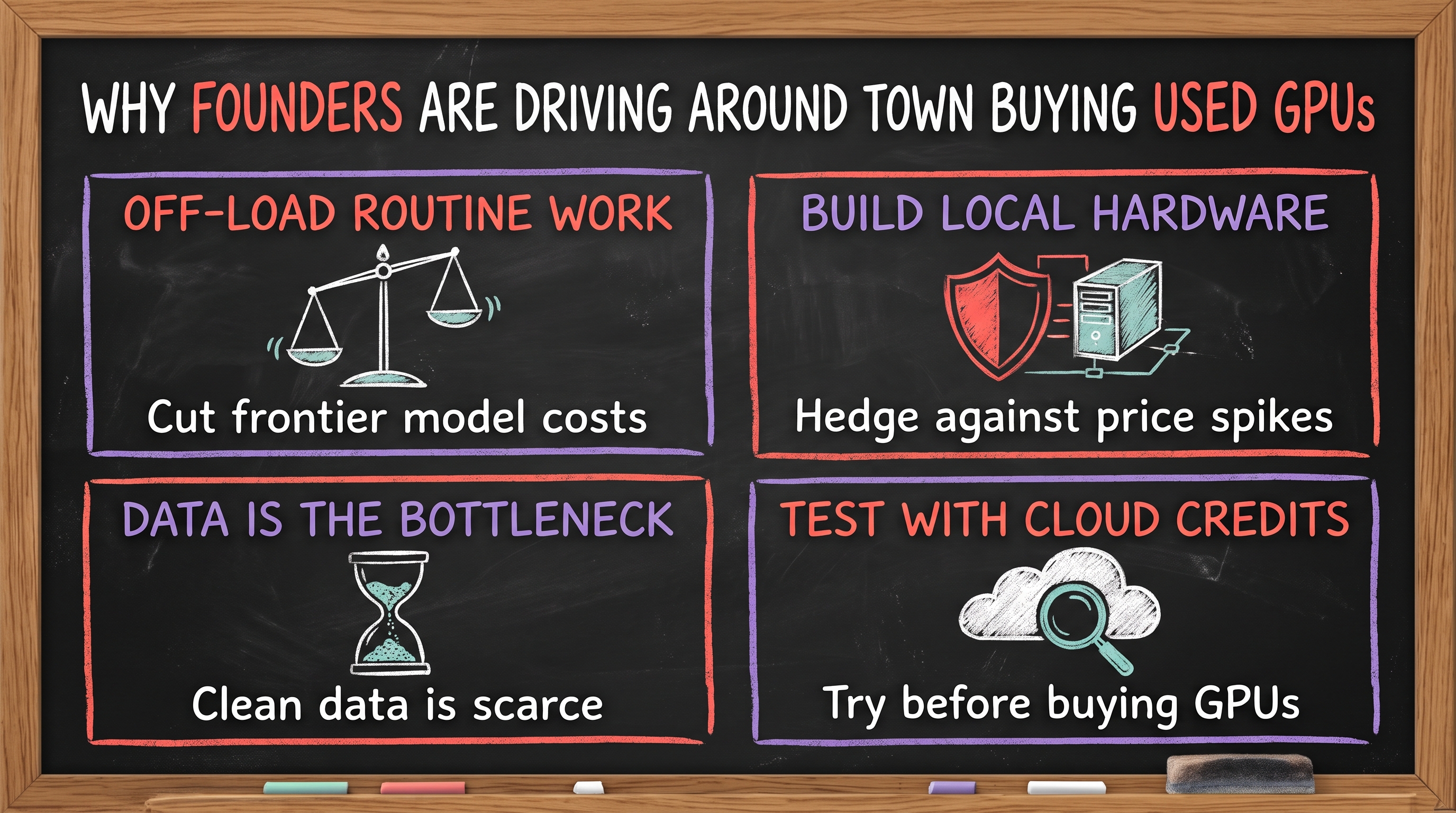
Why Founders Are Driving Around Town Buying Used GPUs
Open-weight models can cut AI costs sharply for routine business automation, and some founders are already building their own hardware. Here is what the economics, the risks, and the cheap ways to test it look like.

One of the more entertaining updates in our mastermind this month came from a founder whose CTO has been touring the suburbs on weekends, picking up used graphics cards from sellers on local marketplaces. The cards cost a few hundred dollars each, and the goal is to run an open-weight model that has been trained on the company's own material. The idea is a company brain that knows only what the business knows and never needs to look anything else up.
It sounds like a hobby until you hear what other founders in the room are doing. One has clusters of data-center GPUs and keeps buying capacity in several cities because the training queue is always full. Another has priced out a retail build and is trying to decide whether it is worth it. All of this is happening because of a question more founders are starting to ask: what happens to our business if the AI we depend on gets ten times more expensive, or gets restricted?
The case for moving routine work off the frontier models
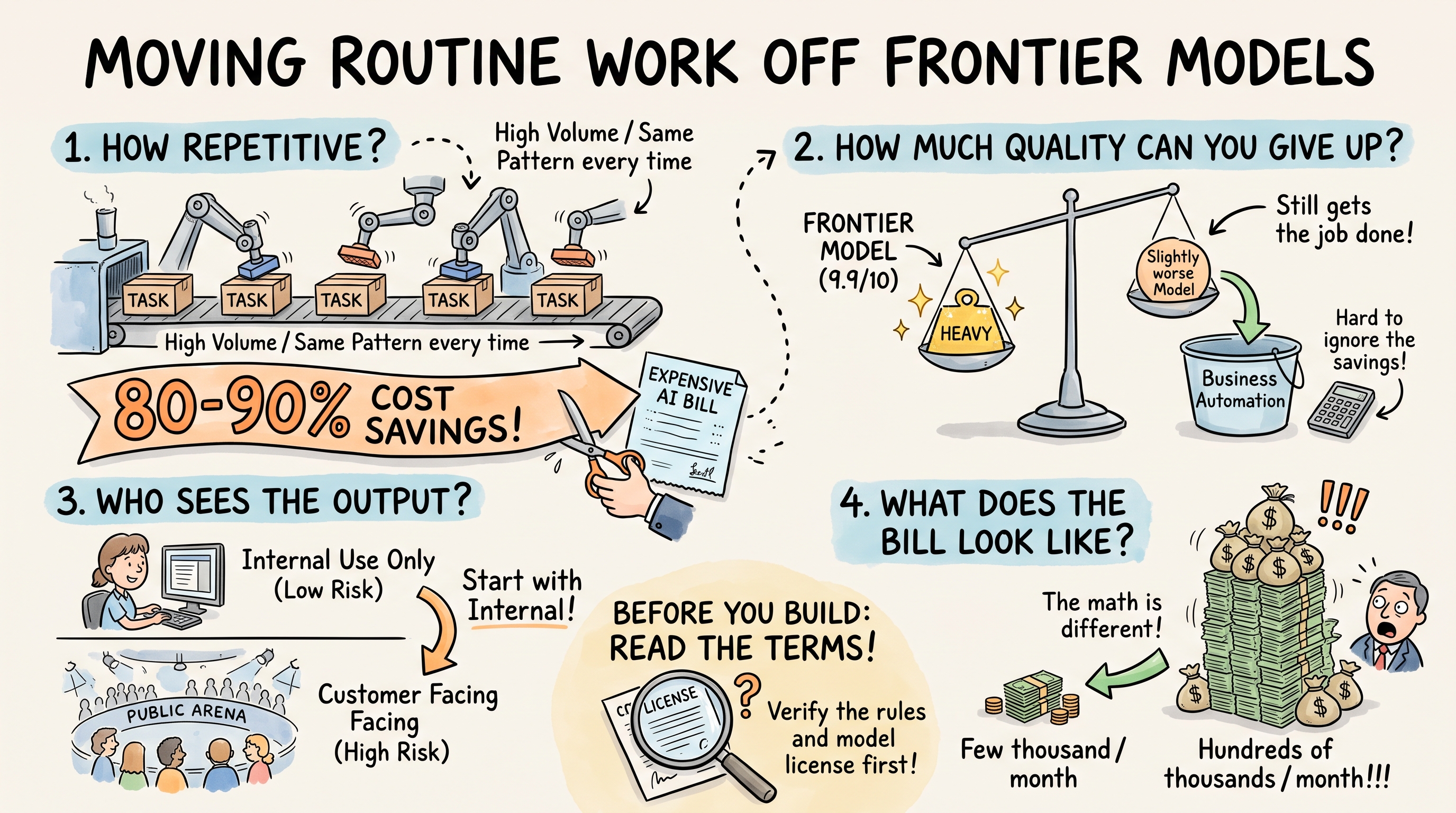
My own view is that enterprises spending serious money on a frontier model will move a large share of that work to locally hosted models as soon as they can. Most business automation does not need the best model in the world. As I put it in the call, "you can save 80 to 90 percent of the cost by moving off of the frontier model for most of your business automation." I added that I may be wrong, because this is changing all the time, and I would repeat that caveat here. I am a non-technical person, so treat this as an operator's observation and not an engineering recommendation. The models I keep seeing in these conversations come from a handful of labs, most of them outside the United States, because there is not really a strong American open model at the frontier right now.
- Ask how repetitive the task is. High-volume work that follows the same pattern every time is the best candidate to move first.
- Ask how much quality you can give up. If a model that is slightly worse still gets the job done, the savings are hard to ignore.
- Ask who sees the output. Internal automations carry less risk than customer-facing writing.
- Ask what your bill looks like. At a few thousand dollars a month, the math is different from a bill in the hundreds of thousands.
Two or three model families keep showing up in these discussions, and they are the ones to look at if you decide to test this. Which one fits depends on your task, your budget, and the license. A founder on the call raised the license question, and nobody had a confident answer, so read the terms before you build anything on top of one of them.
What a local setup actually costs
The founder who has been researching this priced out a few options. The idea was to buy retail components and build a Linux machine, with no used chips involved. The cheapest configuration he found came in under ten thousand dollars, and the more capable builds ran to around fifty thousand, depending on the model and the requirements. His company currently spends a few thousand dollars a month on AI, which adds up to a bit over thirty thousand a year. On that basis the savings alone do not make the case for the expensive builds. His real motivation is protection. As the company becomes more dependent on AI inside its product, he wants a backup if prices rise or access narrows.
- Budget range. Expect a spread from under ten thousand dollars for a modest build to around fifty thousand for something more capable.
- Compare to your annual spend. A year of API bills is the number your hardware has to beat over time.
- Count the hidden work. Someone has to set it up, keep it running, and update models as better ones appear.
- Price the insurance. Ask what a tenfold price increase would do to your margins, and what a backup is worth against that.
That last question is the one that stuck with me. Most of us price our products assuming AI costs keep falling, and so far they have. A founder who builds in a hedge is not predicting a price spike, only deciding not to be surprised by one.
The argument that open models might stall
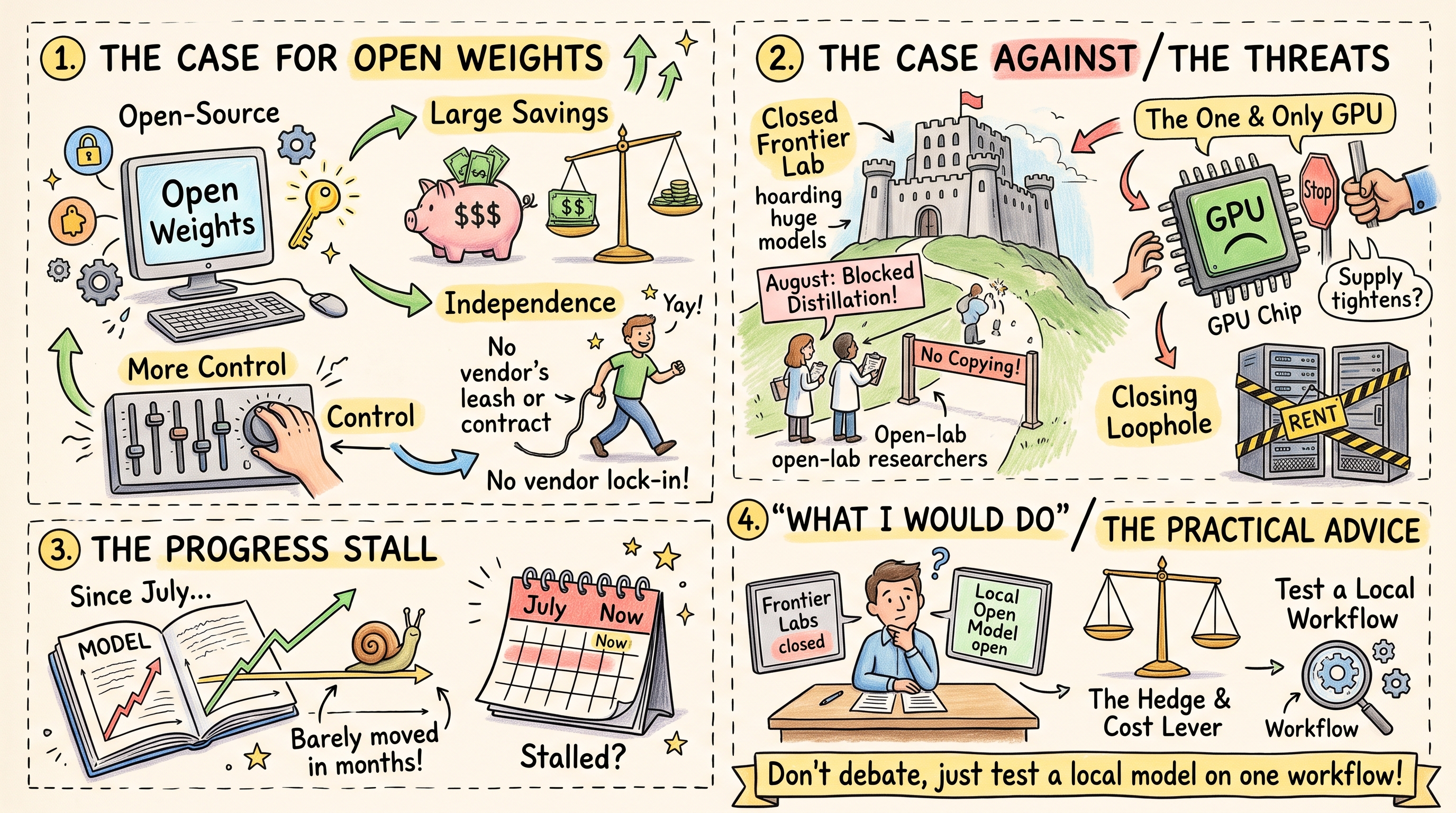
Not everyone on the call agreed that cheap open models are the future. A founder with deep technical experience made a counterpoint that I found useful. He argued that the open-source case depends on one thing: chip makers continuing to sell their best GPUs to the labs training those models. In his view, all training for models worldwide happens on one company's GPUs, and domestic alternatives are only used for running models, not training them, and will take years to catch up. He also pointed out that the leading closed labs got much better at blocking distillation in August, which is the technique open labs use to learn from closed models. In his reading, open models have not progressed much since July, and a stop on chip sales right now would actually favor the frontier labs. I also mentioned that a loophole, in which data centers in other countries rent the newest chips to labs that cannot buy them directly, was reportedly being shut down that same week.
- The case for open weights. Large savings, more control, and no dependence on a single vendor's pricing.
- The case against. Progress may slow if the supply of training chips tightens or if closed labs keep making distillation harder.
- What the data says so far. By one founder's measurement, open writing models have barely moved in months.
- What I would do. Treat open weights as a hedge and a cost lever, not a bet that every frontier model becomes obsolete.
I like having both views in the same conversation, because they point to the same practical advice. You do not need to settle the debate to benefit from testing a local model on one workflow.
What one founder learned training a writing model
The most concrete experience came from the founder running GPU clusters. His team is training a writing model built on an open-weight base, because in their own evaluations the large commercial models have barely improved at writing for about eighteen months. They brought their model up to the level of the best closed models available, which he considers good but still short of human quality. The surprise was where the difficulty sits. Training the model turned out to be the manageable part. The hard part is getting writing data that is actually good, and that applies to anyone trying to teach a model to write well, whatever size the company is. His team also buys up spare GPU capacity in several cities because their own servers are always overloaded with training jobs and reinforcement learning work done with their engineers.
- Training is manageable. The tooling has matured enough that a small team can run it.
- Data is the bottleneck. High-quality examples of the behavior you want are scarce and expensive to collect.
- Capacity is always tight. Teams that train regularly end up hunting for compute wherever they can find it.
- Evaluate on your own work. Public benchmarks matter less than how a model performs on the task you actually care about.
If you are thinking about a company brain trained on your own documents, the same lesson applies. The model matters less than whether your internal material is clean, current, and organized well enough to teach anything.
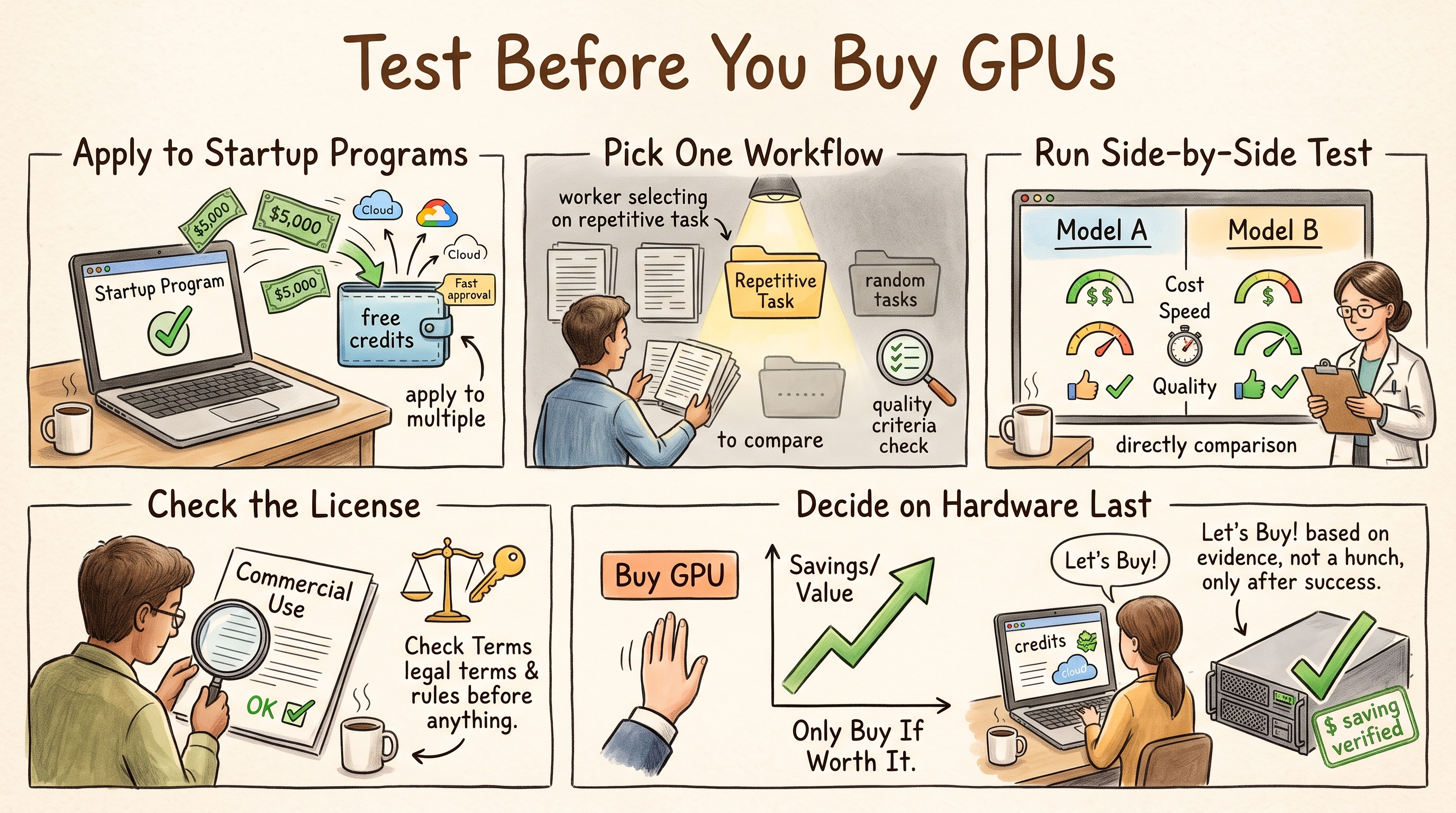
How to test it before you buy a single GPU
The most practical tip of the call came near the end. Several major cloud providers run startup programs that give away credits worth about five thousand dollars each, and the founder who shared this said approval is nearly instant and takes about a week. Five thousand dollars is enough GPU time to host a model yourself and find out whether it works for your business. That lets you decide on hardware with evidence instead of a hunch, and it costs you nothing but an application.
- Apply to the startup programs. Each one gives roughly five thousand dollars in credits, and you can apply to more than one.
- Pick one workflow. Choose a repetitive task with clear quality criteria so you can compare results.
- Run the same task on both models. Measure cost, speed, and output quality side by side.
- Check the license. Confirm the terms allow your intended commercial use before you commit.
- Decide on hardware last. Buy only after the test shows a saving worth owning the machines for.
The founder buying used GPUs in the suburbs may be ahead of the curve or may be running an expensive experiment. Either way, the cost of finding out is small now, and the cost of being caught flat-footed by a price change is not.