
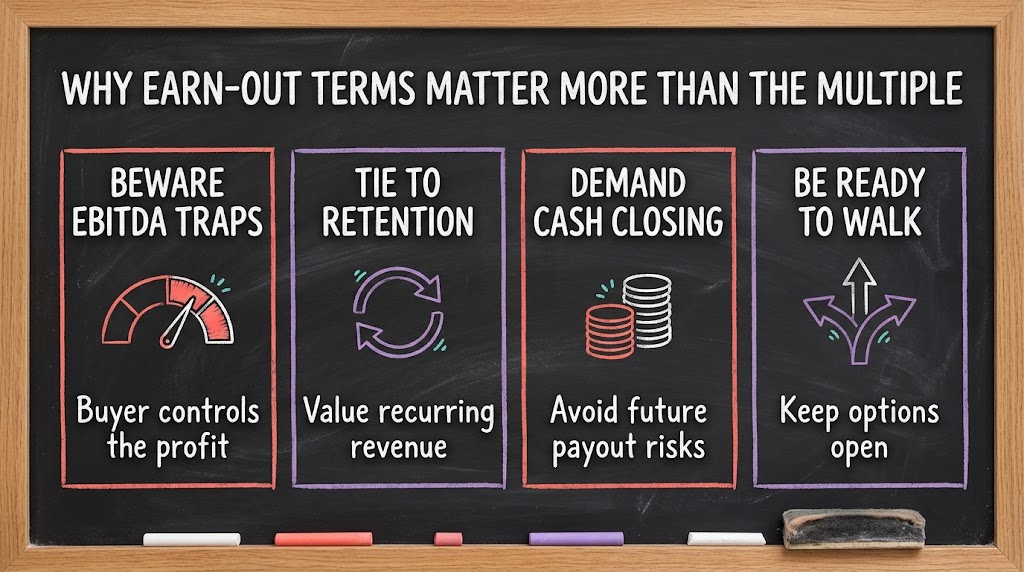
Why Earn-Out Terms Matter More Than the Multiple
A headline multiple can look generous while most of the money is tied to results you do not control. A mastermind member's near miss with an EBITDA-based earn-out shows how to read an offer before you sign.

When founders think about selling a software company, the first question is almost always about the multiple. How many times revenue will someone pay? That number gets all the attention, and it deserves some. But the structure of the payments often decides how much money you actually receive. A recent conversation in our mastermind showed exactly how that plays out.
The offer that looked fine until you read the earn-out
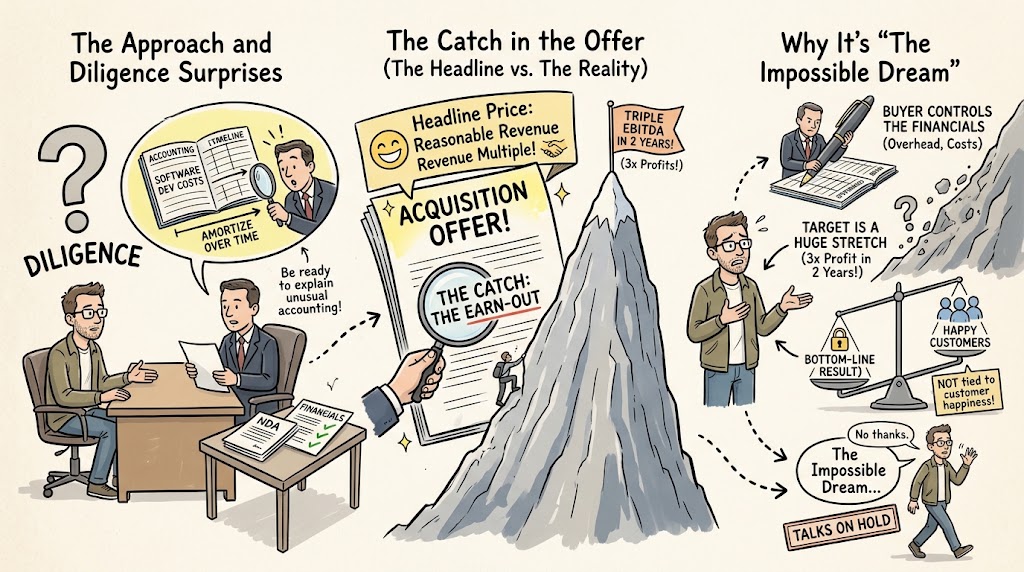
One founder in our community has run a software company for a long time. About six months ago, a buy-and-hold acquirer reached out, and he decided to explore the market and see what appetite there was for a business like his. He signed an NDA, shared financial statements, and moved up to speak with a senior finance person at the buyer.
Two things came up in diligence. The first was an accounting choice. His company capitalizes its software development costs and amortizes them over time, and that surprised the buyer's team. It is a fair reminder that how you present your financials changes how a buyer reads your profitability. If you do anything unusual, be ready to explain it clearly before the first call.
The second issue was the offer itself. The headline price was expressed as a multiple of revenue, which looked reasonable. The catch was in the earn-out. A substantial piece of the purchase price would only be paid if the company tripled its EBITDA within two years. Here is the way he described his concern:
- He would not control the number. After the sale, the buyer owns the financial statements, and the buyer decides on overhead, shared costs, and allocations.
- The target was a stretch. Tripling profit in two years is a bold goal for a stable business.
- The contingent piece had nothing to do with customers. It was tied to bottom-line results, not to whether his customers stayed.
He put the talks on hold. In his words, it was the impossible dream. I think he was right to treat it that way, and the reasoning applies well beyond his deal.
Why EBITDA earn-outs are a trap
Think about what an EBITDA target asks of you. You hand over control of the company to the buyer, and then you are measured on a profit figure that depends on decisions the buyer now makes. The buyer can add costs, shift expenses between entities, invest in other projects, or change the sales plan. Some of those moves may be perfectly reasonable for the buyer. They can still push your earn-out out of reach.
As I told him, whenever someone offers you most of your compensation based on future potential, it is not something to consider unless you are in a very dire situation. A well-structured deal puts most of the value in cash at closing, and uses contingent payments for a minority of the price.
Before you accept any contingent payment, test it against these questions:
- Can I influence the metric? If the buyer controls the inputs, the metric is theirs, not yours.
- Is it measured on something I can verify? Customer counts and recurring revenue are visible, while allocated overhead often is not.
- How much of the price is at risk? A small contingent slice is a sweetener, but a majority is a gamble.
- What happens if the buyer changes the plan? Look for protections that apply if they change pricing, merge your product, or cut your team.
Founders often agree to things in the excitement of a deal that they would never accept in a calmer moment. Reading the earn-out as a separate negotiation, with its own risks, is a useful discipline.
A retention-based structure is a better fit
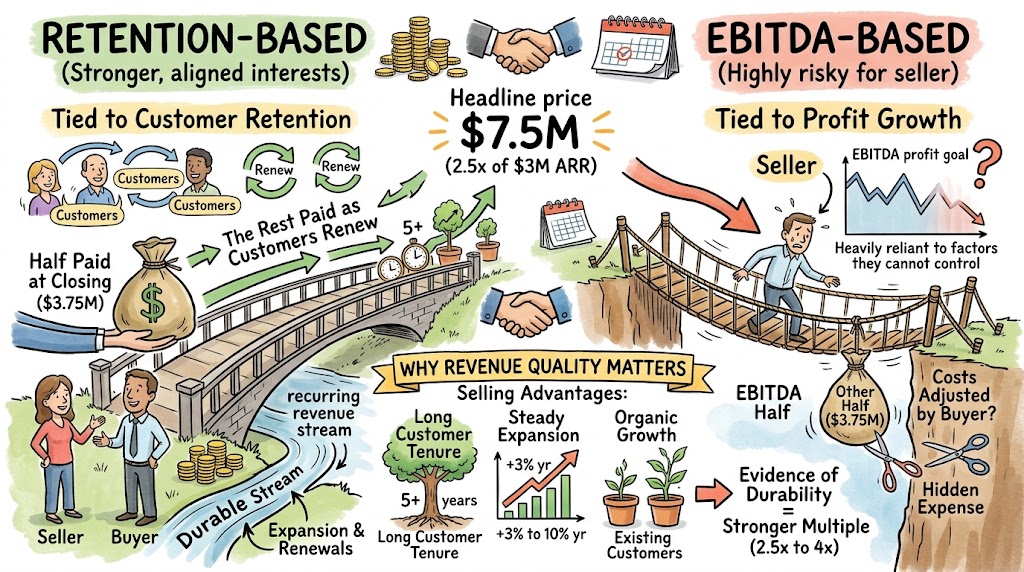
The alternative I recommend, especially for smaller companies, ties the contingent portion to customer retention. For companies at this size, buyers typically pay around two to three times revenue. A common structure puts about half down at closing, with the other half paid over time based on how many customers stay.
That structure lines up the interests of both sides. The buyer is paying for a stream of recurring revenue, so it makes sense to hold back part of the price until the stream proves durable. You, as the seller, can see the number, because you know your customers, and the buyer cannot easily change it by adjusting costs.
To make the idea concrete, here is a simple illustration. Say a company has three million dollars in annual recurring revenue and sells at 2.5 times revenue, so the headline price is 7.5 million dollars. In the retention-based version, roughly 3.75 million is paid at closing, and the rest is released as customers renew. In the EBITDA version, that same remaining half depends on profit growth the seller cannot steer. The headline multiple is identical, but the two deals carry very different risk. (These are example numbers for illustration, not figures from any member.)
This is why focusing on revenue quality matters when you prepare to sell. The founder in this story has strong numbers on that front:
- Long customer tenure. The average customer stays five years or more.
- Steady expansion. Revenue per customer grows at least three percent a year, and often five to ten percent.
- Organic growth. Much of the growth comes from existing customers, which buyers value highly.
A track record like that supports a retention-based earn-out, because the seller can point to evidence that the stream is durable. It also supports a stronger multiple. Depending on retention, growth rate, and profitability, a range of roughly two and a half to four times revenue is possible with the right buyer.
Walking away is a legitimate answer
It takes discipline to pause a process when the terms are wrong, particularly after months of conversations and a pile of shared documents. The founder did that, and the cost to him was small. He still has his company, his customers, and his options, including a second buyer who had approached him separately.
When a buyer changes the structure after you have already agreed on a headline number, that is worth recognizing for what it is. A late shift that moves most of your payout into future performance is often called a retrade. A few habits make it easier to handle:
- Agree on structure early. Ask about payment terms in the first conversations, before you invest time in diligence.
- Compare offers side by side. Convert every proposal into what you receive at closing, what you receive over time, and what could go to zero.
- Keep a second conversation open. A competing buyer is the most reliable way to keep terms reasonable.
Who you talk to matters
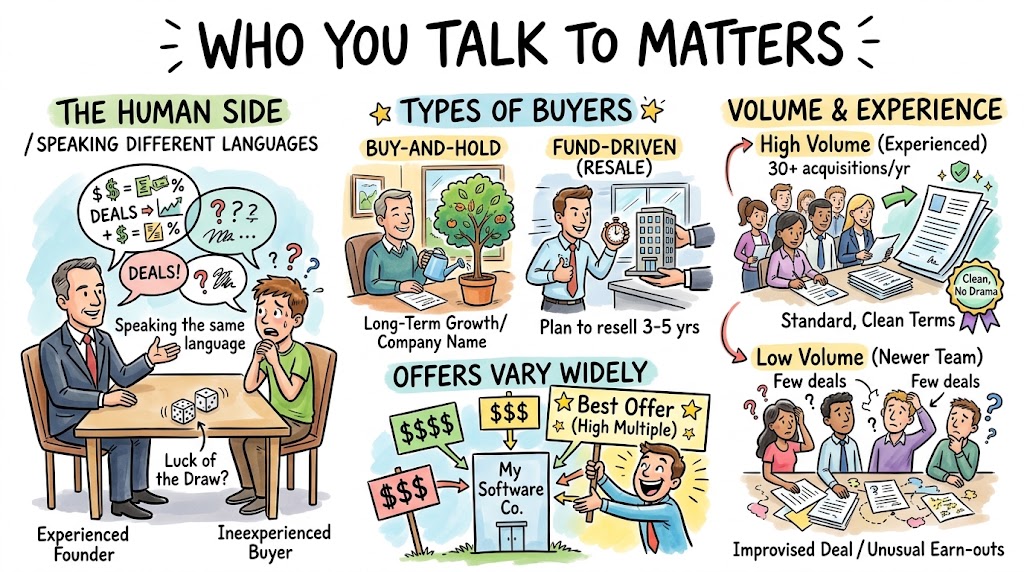
The other lesson from this story is about the human side of the process. The founder has a background in deal-making, and he noticed that the person on the other side was not experienced enough to meet him where he was. They were not speaking the same language. He described it as the luck of the draw, and he was careful not to criticize the firm, which seemed like a good organization.
Buyers vary a great deal, even among firms that look similar from the outside. Here are a few things we discussed about the buyer landscape:
- Buy-and-hold versus fund-driven. Some acquirers plan to keep your company for the long term and build on what you did. Others use a fund structure and plan to resell after a few years, which changes how they evaluate you.
- Offers can differ widely. A recent seller in our community talked to several consolidators and found that offers for the same business varied a great deal, with the buyer showing the most demand paying the best multiple.
- Volume signals experience. One of the larger buy-and-hold groups is reported to acquire around thirty software companies a year, which means its team has seen many deal structures.
That last point matters in practice. A buyer with a lot of deal experience tends to have standard, cleaner terms. A newer team may improvise, and improvisation is where unusual earn-outs show up.
What to do before you talk to anyone
You do not have to be ready to sell to benefit from this. A little preparation puts you in a stronger position if an acquirer calls, and it improves the business at the same time. Start with the following:
- Know your retention numbers cold. Gross and net revenue retention, average customer lifetime, and expansion rates should be at your fingertips.
- Clean up your financial presentation. Be ready to explain choices like capitalized development in a single, plain paragraph.
- Build a list of potential buyers. Know who they are and who handles acquisitions at each one, so you can reach the right person.
- Talk to founders who have sold. Ask what the process was like and what they would negotiate differently.
- Decide your walk-away terms in advance. Know what share of the price must be cash at closing.
The multiple gets the headlines, but the structure decides what lands in your bank account. Read the earn-out first, and negotiate the rest from there.