
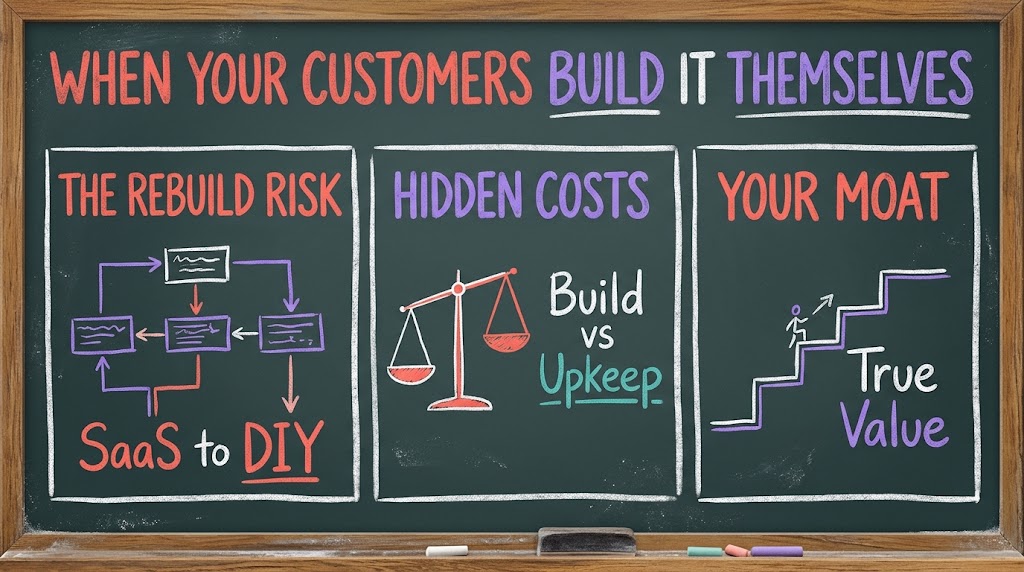
When Your Customers Build It Themselves
AI has made it realistic for customers to rebuild the software they pay for. Here's who is most likely to do it, why many will come back, and what SaaS founders should do now.

One founder in our mastermind told a story recently that got everyone's attention. His team had been paying a third-party vendor for a fairly sophisticated piece of software, and he figured replacing it with an AI-built version might take six to nine months. His developer did it in a week. He was thrilled. Then, about a week later, one of his biggest customers told him they were replacing his product with their own AI-built integration. Within two or three weeks he had been on both sides of the same trade, and he asked the question a lot of us have been quietly asking: where am I going to get differentiation now?
He wasn't the only one with a story like this. Another founder, selling to people who aren't in the software business at all, lost a customer who built a little $35-a-month replacement on his own. A third founder had a long-time customer, a small business owner and a big advocate of the product, admit in a candid conversation that he plans to cancel next year because he's building his own version in-house. None of these were huge companies with big engineering teams. They were regular customers who discovered they could build.
How big is the risk, really?
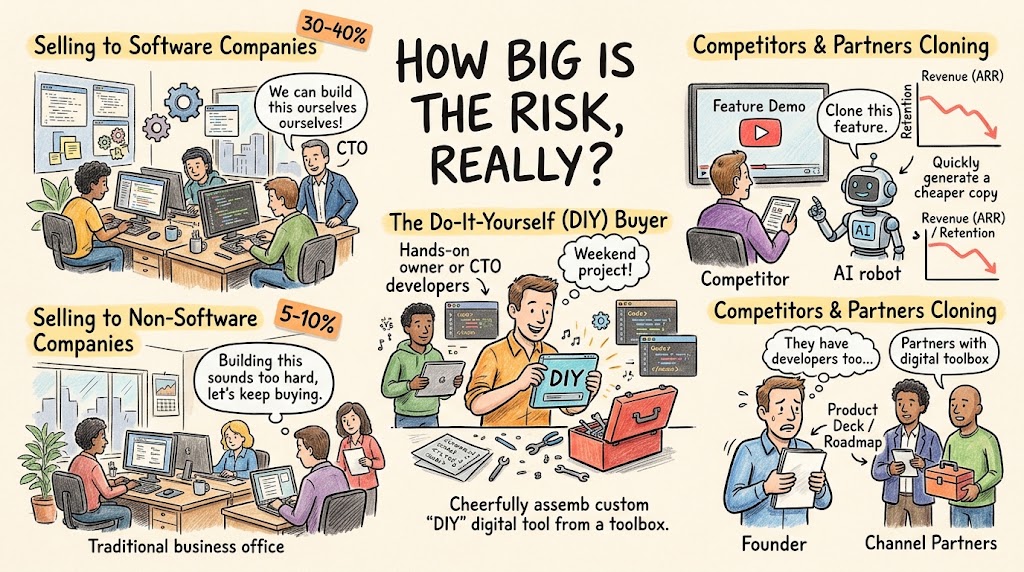
When we talked it through, I gave the group the rough rule of thumb I've been using. If you sell to software companies, it's fair to assume 30 to 40% of your customers will try to build your product for themselves in the next three years. If you don't sell to software companies, that number is more like 5 to 10%. Those aren't precise forecasts, but they're useful for planning, because they tell you how exposed your revenue base actually is.
The founders in the room added some texture to that. The more tech-driven the company you sell into, the more likely they are to replace you with something they built. And the person who does it is usually a particular kind of buyer: the owner or the hands-on operator who wants to dial in a process exactly the way they like it and treats the rebuild as a weekend project.
- Tech-savvy buyers are the most exposed. If your customer is a CTO or has developers on staff, assume they've already thought about building you.
- Owners rebuild for fun as much as for savings. For some, a custom tool is a creative outlet, even when the time spent doesn't pencil out.
- Your product-market fit has shifted a little. As one founder put it, some portion of your market has now decided to do this internally, and that's a real risk to ARR and retention.
- Competitors can copy faster too. The same tools that let a customer rebuild you let a competitor clone your feature set and undercut on price.
That last point is worth sitting with. Two founders admitted they've gotten nervous about showing off their best features, because anyone can watch a product video and ask an AI tool to build the same thing. One had channel partners with in-house developers request a detailed product deck right after a user group presentation, and he hesitated to send it because it was essentially a roadmap of what they do.
Building is the easy part
Here's the good news, and it's real. Building something is very different from maintaining it and improving it every month. One founder put it simply: plenty of people build stuff, and it ends up breaking. AI can help fix it, but somebody still has to own it, keep it secure, keep it integrated with everything else, and keep improving it as the business changes.
I've been living this myself. I'm about four weeks into building my own community platform as a non-technical founder, and I've done roughly 3,500 pull requests in that time. I'm having a lot of fun and learning a ton, but it's taking me two to three hours a day to do it well. I could keep paying about $200 a month for an off-the-shelf tool that does much of the same thing. So I asked myself why I'm doing it anyway, and the answer is the rule I'd give any founder.
- Build what's core. If the software is core to your business and your processes, it can make sense to own it.
- Buy what isn't. If it's not core, happily pay the subscription and spend your hours on the business.
- Count the real cost. The cost isn't just tokens. It's hours of focused attention from someone who could be doing something else.
- Expect a lot of reversals. I think roughly half of the companies that try to build internal solutions will realize it's not worth it.
One founder, who has scaled businesses globally over the last fifteen years, shared that he's seen this cycle many times. Customers move to their own in-house tools, then come back saying they'll pay 30% more because they can't get the result the vendor was delivering. That's a pattern worth remembering when you're feeling nervous about a churned account.
The hidden cost for your customers
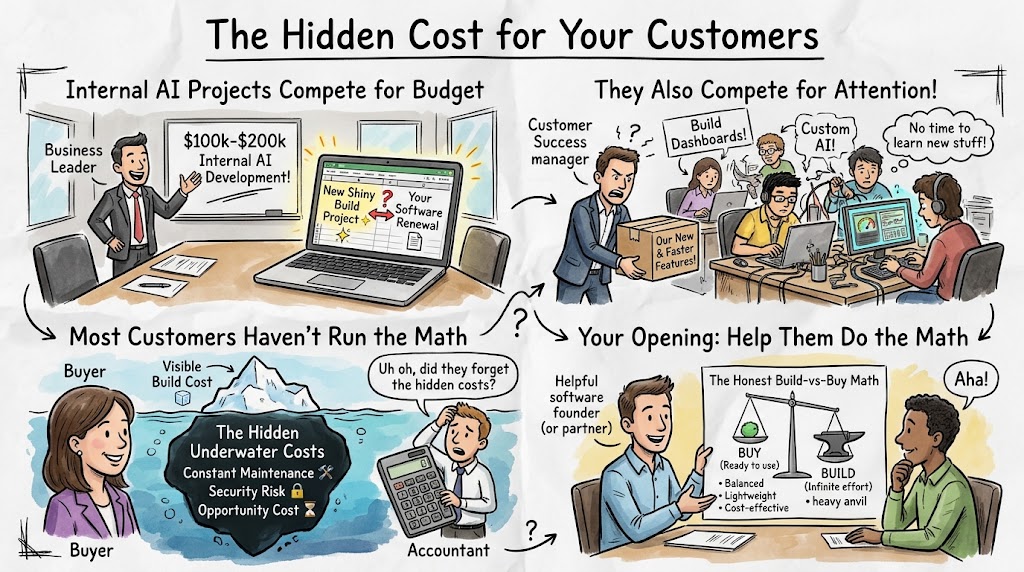
Another founder raised something that I think most of us underestimate. Some of his larger customers told him they're spending $100,000 to $200,000 on AI development this year, building dashboards and metrics tools. AI will help them do it. But he doubted they had looked hard at the economics of the effort versus the return they'll get.
That distraction lands on you too. When a customer's attention and budget go into internal AI projects, they're slower to adopt your new features, slower to expand, and more likely to question the line items on their software bill. One founder who sells a $25,000 to $50,000-a-year platform has found it surprisingly hard to get customers to move to a new version that's better and faster, simply because their attention is elsewhere.
- Internal AI projects compete for the same budget. Your renewal is now sitting next to a shiny build project in the same spreadsheet.
- They also compete for attention. A team busy building dashboards isn't learning your new features.
- Most customers haven't run the math. They see the build cost but not the maintenance, security, and opportunity cost that comes after.
- That gives you an opening. You can be the one who helps them do the honest build-versus-buy math.
What to actually do about it
So what should a SaaS founder do this year? The group's answer was to stay calm and get very clear about where your value comes from and make that value obvious to the customer, every month.
Start with the customers most likely to leave. If you know which accounts are tech-savvy, owner-operated, and pushing hard on custom requests, those are the ones to talk to now, before they've spent three months building. The founder who had the candid conversation with his long-time customer only learned about the plan because he asked directly. That's a question more of us should be asking.
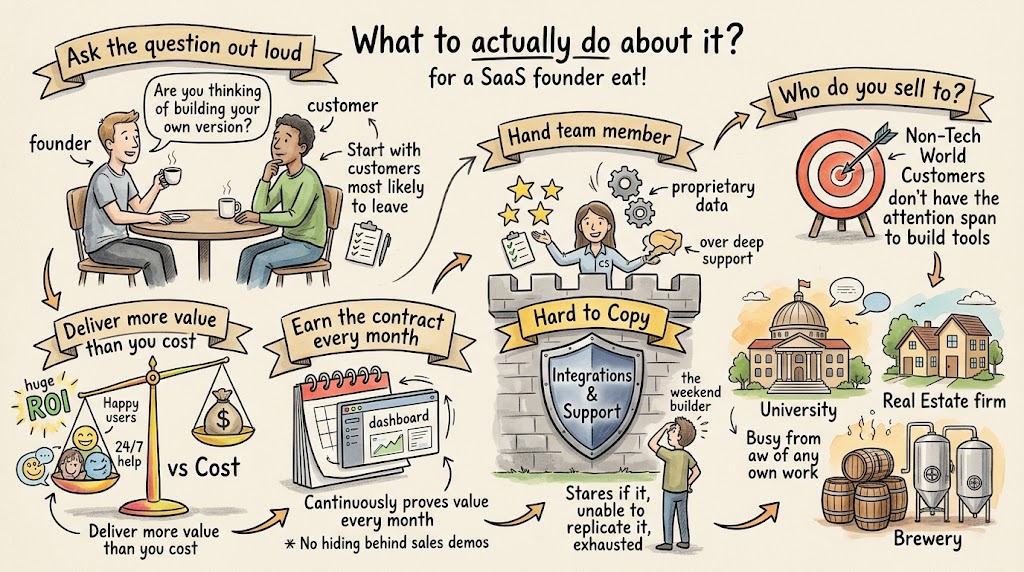
- Ask the question out loud. Ask your best power users whether they're experimenting with building their own version. You'd rather know in January than in November.
- Deliver more value than you cost. One founder framed it as a customer-first test: if you're clearly delivering more value than you charge and the customer knows it, you reduce the odds they ever start thinking about a rebuild.
- Earn the contract every month. As I told the group, we can't hide enterprise products behind sales demos and multi-year lock-ins unless we're really providing the value.
- Lean into what's hard to copy. Proprietary data, deep support, and integrations that take real upkeep are much harder to rebuild over a weekend.
It also helps to think about who you sell to. A couple of founders have found that customers far removed from the tech world, like universities, real estate firms, and breweries, are much less likely to build their own tools and often don't have the attention span to try. That's not a permanent shield, but it changes the math on where you focus your sales and marketing.
A few tumultuous years
I think AI is going to be great for society overall. For software companies, though, it's going to cause a tumultuous four or five years. Some customers will build their own tools. Some will come back. Competitors will copy faster than they used to. And the founders who do well will be the ones who stop treating code as the moat and get serious about the value they deliver around it.
The founder who had both experiences in the same month summed up the feeling well. It's amazing that his team replaced a whole vendor in a week, and it's scary that his customer did the same thing to him. Both are true at the same time. The job now is to make sure that when your customer does the math on rebuilding you, the answer comes out in your favor.