
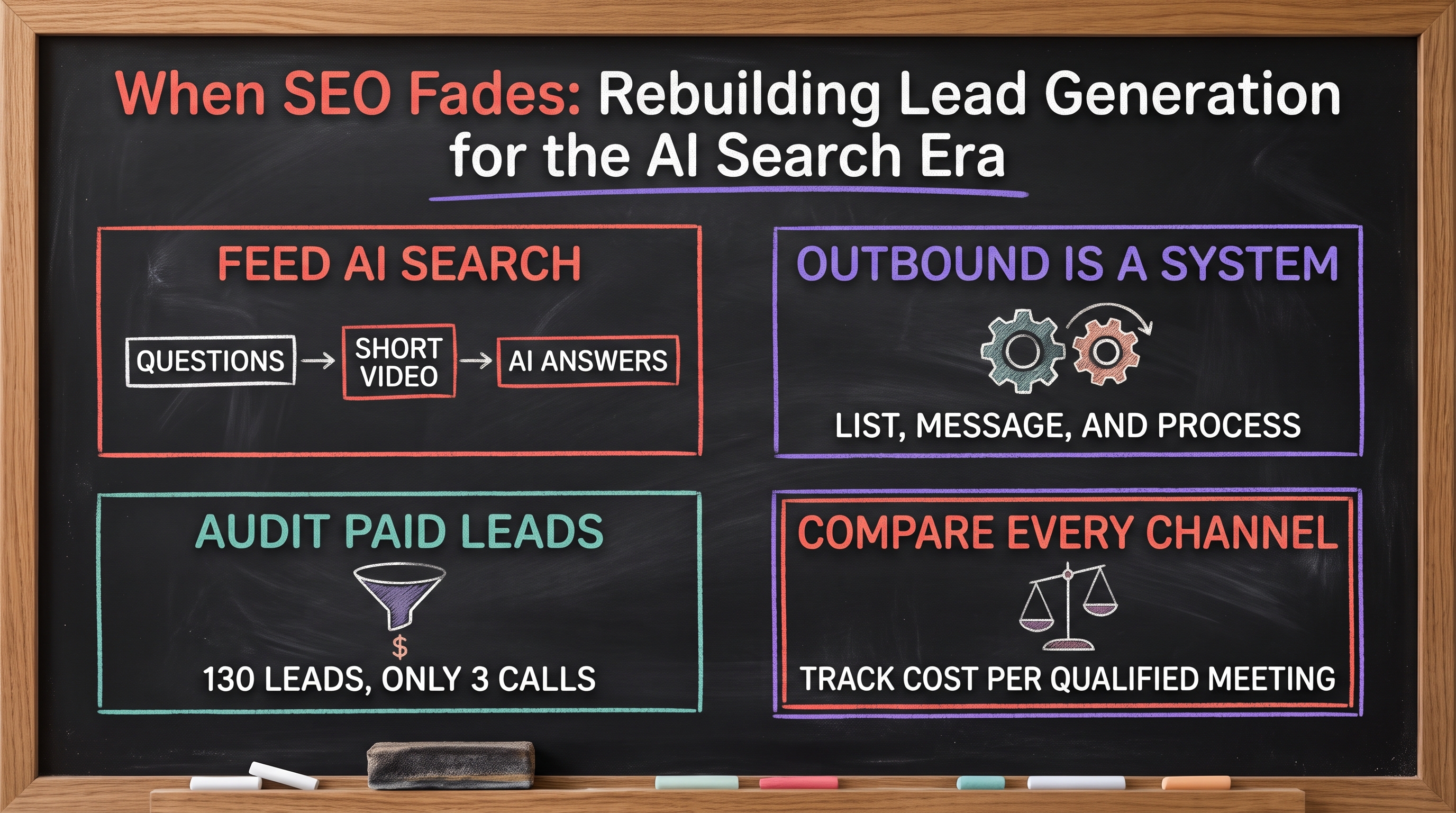
When SEO Fades: Rebuilding Lead Generation for the AI Search Era
A founder with ten years of content marketing watches lead volume fall as AI replaces search. Here is how to rebuild with answer-engine content, outbound, and cleaner paid lead sources.

A founder in our mastermind described a problem I hear more and more often. He built a good product, and he spent ten years building a marketing engine around it: roughly 600 blog posts, a couple dozen ebooks, white papers, and case studies, and appearances on podcasts two or three times a month. It worked for a decade. Then AI search arrived, and the lead volume that used to come in on its own started to shrink. As he put it, when was the last time you Googled something? Fewer people use it every month, so the leads that came from ranking have been drying up.
On top of that, he's watching competitors with weaker products pass him in sales by using aggressive tactics he doesn't want to copy. That combination, falling inbound volume and louder competitors, is a spot a lot of founders are in right now. I want to walk through what the group suggested, what I'd do in his position, and how to tell which new channels are worth the time.
What Changed With Search
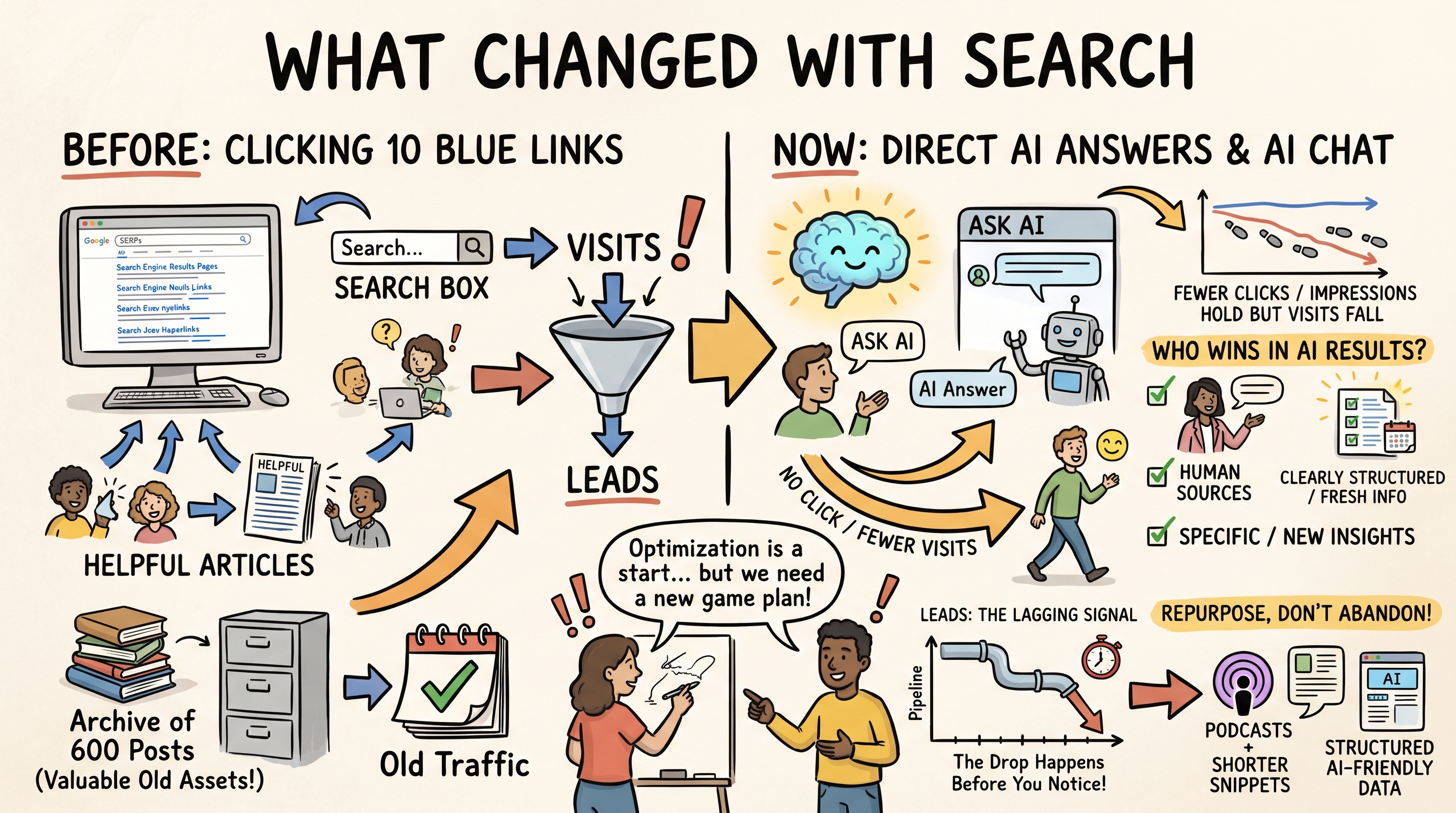
For years, the playbook was simple: publish helpful content, rank for the questions buyers search, and collect the leads who click through. That playbook assumed buyers typed questions into a search box and clicked on ten blue links. Today a growing share of buyers ask an AI tool the same question and get a direct answer, often without visiting any website. If your company isn't one of the sources the AI draws from, you aren't in the conversation, and traffic to even your best articles can fall without any change in their quality.
- Fewer clicks per question. AI answers satisfy buyers before they reach your site, so impressions can hold while visits fall.
- Different sources win. AI tools favor fresh, specific, and clearly structured content, and they like human sources.
- Old assets still have value. Your archive of 600 posts is a library of material to repurpose, not something to abandon.
- Lead volume is the lagging signal. By the time it drops, the change in buyer behavior has already happened.
The founder told us he has already figured out answer-engine optimization a bit, and his content marketing is working a little better. That's a useful first step, but he's right that it doesn't replace the volume he used to get.
Answer-Engine Content That AI Tools Pick Up
One founder in the group has a practical example of how to adapt. He hosts a monthly dinner, collects questions from the attendees, and records a podcast in which he answers each question in two to three minutes. Every answer is labeled clearly inside YouTube. He told us he is already seeing that content show up in AI responses. He believes the tools keep looking for new sources, and a direct, human answer to a specific question is exactly the type of thing they find. His marketing person researches which questions to cover, and he just talks through the answers.
- Start from real buyer questions. Use questions your sales team hears, not keywords from a tool.
- Answer one question per piece. Two to three minutes per answer is long enough to be useful and short enough to be quoted.
- Label clearly. Titles and descriptions should state the exact question being answered.
- Use a human voice. Real, specific answers stand out against the generic content that fills most pages now.
If you already have 600 articles, one low-cost move is to pick the 20 that attract the most buyer interest and turn each one into a short video answer. You've already done the research, so the main work is recording.
Outbound: The Next Channel, With Eyes Open
When this founder talked to other business owners who are growing, everyone told him the same thing: outbound, outbound, outbound. He has never had a successful outbound launch, so it's new territory for his company. He recently flew to interview a senior sales development rep who is crushing it at a friend's company but has no room to move up, and he planned to offer him a job. His reasoning is that if the team gets more at-bats, meaning more meetings on the calendar, they'll close more deals.
I think that's a reasonable bet, with a few caveats. A strong SDR can produce meetings, but outbound is a system, not a person. The list, the message, the sending infrastructure, and the follow-up all matter, and a great rep inside a poor system still struggles. Several people in our group know a lot about outbound email and LinkedIn outreach, and there are specialists who build AI-driven outbound campaigns, so it's worth asking for help before spending months learning it the hard way.
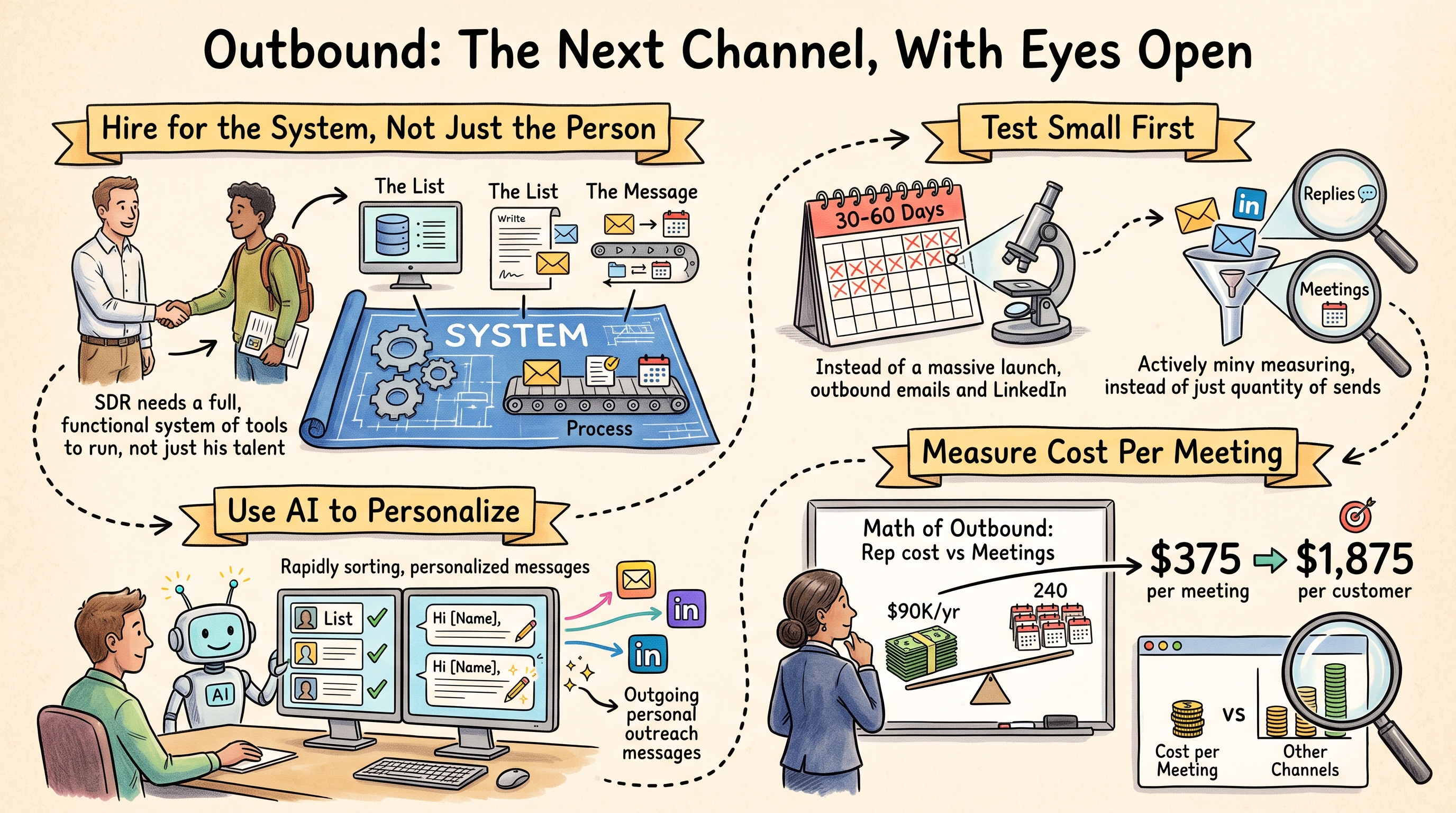
- Hire for the system, not just the person. Make sure there's a list, a message, and a process for the rep to run.
- Test small first. Run a limited campaign for 30 to 60 days and measure replies and meetings, not just sends.
- Use AI to build and personalize lists. Research and first drafts are the parts AI handles best.
- Measure cost per meeting. Compare it against your cost per lead from other channels.
Here is some example math, not real data. Say a rep costs $90,000 a year in total compensation and books 20 meetings a month. That's 240 meetings a year, or about $375 per meeting. If one in five of those meetings becomes a customer, each customer costs about $1,875 to acquire. Whether that works depends on what a customer is worth, but at least it gives you a number to measure.
Fraud and Junk in Paid Lead Sources
The founder's own business is ad fraud detection, so he knows the problem firsthand. He gave us a vivid example from his own campaigns. A recent campaign on a social network produced 130 leads, and only three of them made it to a phone call. Three people confirmed they had filled out the form, and another dozen or so said they hadn't filled out anything at all. When he looked closer, he was not sure the network was worth using for lead generation.
That's a good reminder for anyone moving money from organic to paid lead generation. If you replace falling SEO traffic with paid leads, you need to check how many of them are real people before you judge the channel. A cost per lead that looks cheap can hide a cost per actual conversation that is very high.
- Track leads to calls. Measure how many leads become conversations, not just form fills.
- Verify a sample by hand. Call or email 20 leads and see how many recognize filling out the form.
- Compare channels on cost per meeting. The cheapest lead is often the most expensive meeting.
- Add fraud screening. Filtering bad traffic before it reaches your CRM protects the sales team's time.
How to Know Whether a New Channel Is Working
Whenever a core channel weakens, the temptation is to try five new ones at once and judge them by gut feel. A better approach is to decide in advance what a success looks like for each test, and to measure it the same way across channels. That keeps a flashy channel with lots of activity from beating a quiet one that actually produces customers. It also protects you from the opposite mistake, which is quitting a promising channel after two weeks because the first numbers looked small.
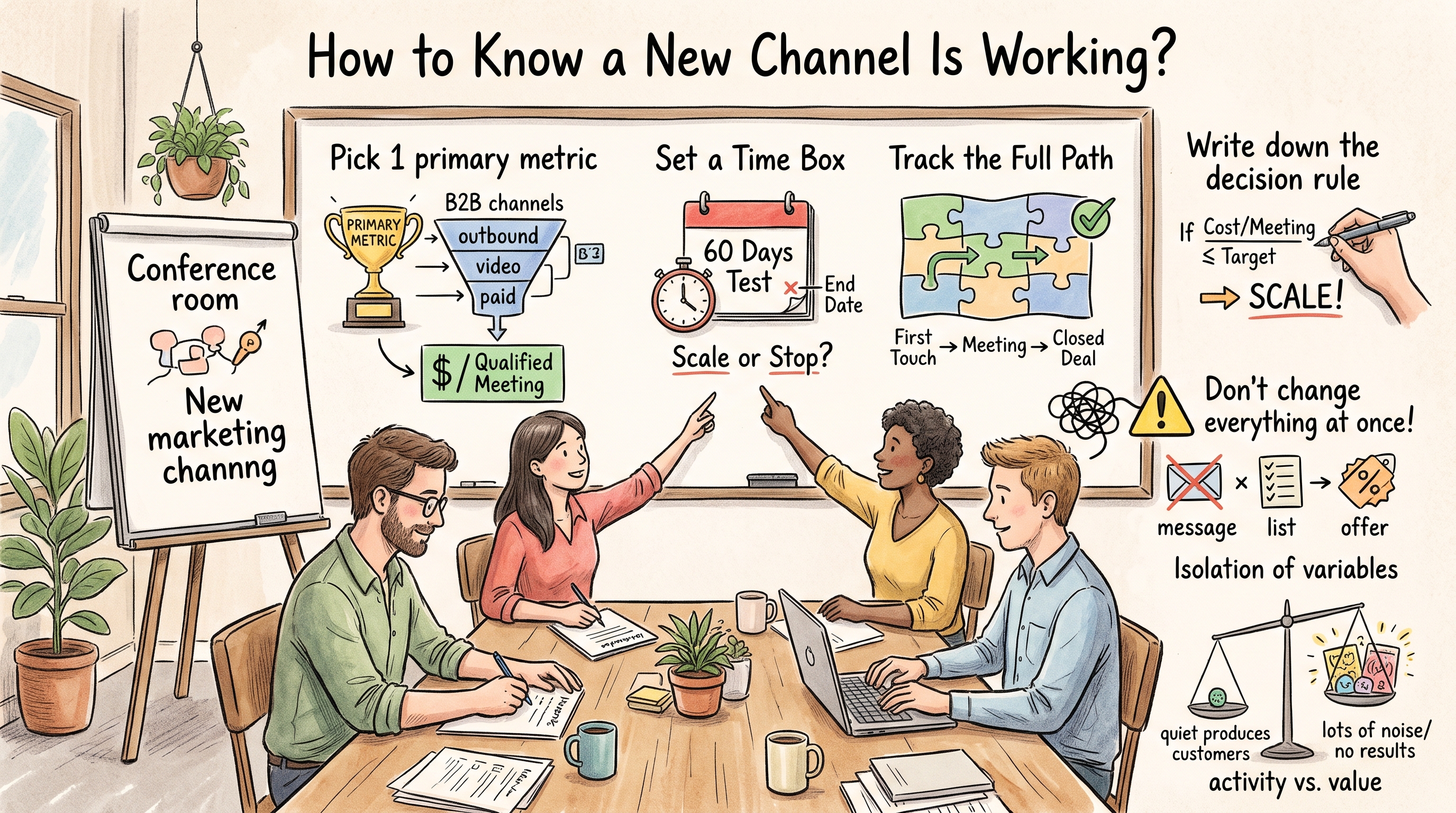
- Pick one primary metric. Cost per qualified meeting works well for most B2B teams, because it applies equally to outbound, video, and paid.
- Set a time box. Give each test a fixed window, such as 60 days, before deciding to scale or stop.
- Track the full path. Follow each lead from first touch to meeting to closed deal, so you know which channel deserves credit.
- Write down the decision rule. For example, scale a channel only if it produces meetings at or below your target cost.
Once the tests are running, resist the urge to change several things at once. If you alter the message, the list, and the offer in the same week, you will not know what made the difference.
Rebuilding a Mix That Doesn't Depend on One Channel
The lesson from the conversation is that no single channel carries a company for ten years anymore. SEO did that for a lot of founders, and it's now weakening, so the safer approach is a mix: answer-engine content for discovery, video for reach, outbound for control, and paid channels only after you've verified the quality. The founders I know who are doing well are running small tests in each area and shifting money to whichever one shows real customers.
- Keep the archive working. Update and repurpose your best content for AI answers.
- Add video answers. They reach people who never visit a blog and get picked up by AI tools.
- Launch outbound as a test. Give it 60 days and a defined budget.
- Audit paid leads. Check quality before scaling spend.
- Review quarterly. Move budget toward the channels that produce customers.
Falling search traffic is frustrating, especially after a decade of building on it. But it's also a chance to rebuild with better information than you had when you started. Pick two of the channels above, run them for a quarter, measure cost per meeting, and decide from there.