

What's Your SaaS Moat When Code Is Free?
AI can now rebuild most software features in weeks, and founders are asking what actually protects a SaaS company. Here is what stopped being a moat, what still counts, and how to decide whether to build, harvest, or sell.

A founder in our mastermind said something recently that I think a lot of SaaS CEOs are feeling and not saying out loud. His company is established and healthy, but he has been reading about what AI can build, and he keeps coming back to one question: what advantage do we offer customers when a product can be built so easily? Some of his own customers have already built small versions of his features themselves, and he expects that to keep happening.
He is far from alone. The question came up from several directions on one call, and the answers were more useful than I expected. Nobody had a tidy formula, but the group did sort the things that still protect a software business from the things that quietly stopped doing so.
A fair look at how worried to be
It helps to start with proportion. One founder pointed out that if you stood in an airport and asked how many people are building their own applications with an AI coding tool, the answer would be something like five in a thousand. That is a gut estimate and not a study, but the instinct is sound. Most buyers do not want to become software developers, and tools are still getting used. What changed is what people expect from software.
- Expectations moved. Buyers now assume your product should do more of the work for them, with fewer clicks and less configuration.
- Older brands have a harder road. Established products with a fixed identity and fixed workflows can find it tougher to become agentic than a new product that starts there.
- The DIY threat is real at the edges. A few customers will build their own version, and that number will grow as the tools get easier.
The practical takeaway is that you should assume a motivated competitor, or a motivated customer, can reproduce your feature list. If your pitch rests on having the features, you are on thin ice. The better question is what a copy of your features would still be missing.

What stopped being a moat
One founder who now has unrestricted access to the newest models through a startup program laid out the situation bluntly. In his view, whatever you can do in code is no longer a differentiator, whether that is the interface, the backend, or the workflow logic. He expects that capability to be available to everyone within roughly six to twelve months, with complete applications rebuilt end to end. Even a data advantage looks shaky to him, because gathering and processing data is itself becoming a commodity.
- Code and UX. Interfaces and backends can be regenerated quickly, so they rarely hold a lead for long.
- Feature count. Shipping fast is now table stakes, and a big list of features is easy to match.
- Cheap, slow engineering capacity. A large offshore development team used to be an advantage on cost. If that team moves slowly with AI-assisted coding, it can turn into a liability.
- Data on its own. Data helps, but if the infrastructure to collect it is commoditized, the lead erodes.
I do not think that list means software is dead. It means the old explanation for why software businesses are valuable has to be updated, and the owners who update it first will have better conversations with customers, investors, and buyers.
What still counts
When we talked about this on the call, the list of durable advantages came back to the same few items: proprietary data, a strong brand, a lead in distribution, and a real sales team. Those take years to build and cannot be generated by a model over a weekend. A competitor can copy your screens, but they cannot copy ten years of customer relationships or an audience that already trusts you.
Another founder added a point I think is underrated, which is that running a business teaches you things that are not public. Every day you hit new problems and learn how to solve them, from which ads actually work to which funnels convert to how customers really behave. A model cannot read that from the internet because nobody wrote it down. The counterargument was fair, since that kind of intelligence lives mostly in people, and people can leave. So the job is to turn that knowledge into systems, data, and process the company owns.
- Proprietary data. Information your customers generate inside your product, or data you have assembled that others cannot easily get.
- Brand and trust. Being the name buyers think of first shortens every sales cycle.
- Distribution. An audience, a community, or a partner network is hard to replicate and pays off every quarter.
- Operating knowledge. Document what you have learned about customers and channels so it survives any one person.
- Talent and capital. These still matter, and they let you move faster than the next company.
Speed deserves its own mention. The founder with the unrestricted model access said his plan to win is simply to move faster than everyone else, because the other levers are hard to guarantee. I agree that speed is a necessary habit, though I would pair it with the slower assets above so you are not racing on speed alone.
A useful exercise is to write down your top five advantages and ask of each one whether a well-funded team with the best AI tools could match it in a quarter. Whatever survives that test is your real moat. Whatever fails is a feature you should keep improving but stop relying on in your pitch.

Build the product so customers do less
The most practical advice in the discussion was to make the product as hands-off as you can. One founder suggested that before anyone gives up on a product, they should run one serious round of making it as agentic as possible, so that customers are mostly clicking approve and not thinking through configuration. Even the welcome experience should change, because many companies still have landing pages that nobody reads. The same logic applies to support. One member runs with no human support at all, and another is working to automate a customer success team of about thirty people. I remember when we had 60 support reps at a company I ran, and that scale of staffing is no longer a given.
- Do the work for the customer. Default to the action, then ask for approval, instead of presenting a form.
- Rethink onboarding. Replace pages nobody reads with guided, conversational setup.
- Automate support carefully. Start with common questions, keep humans for the complex ones, and read what customers ask.
A product that does the work is harder to replace than one that offers capability, because the customer has to trust it with real tasks over time, and that trust takes a while to earn.
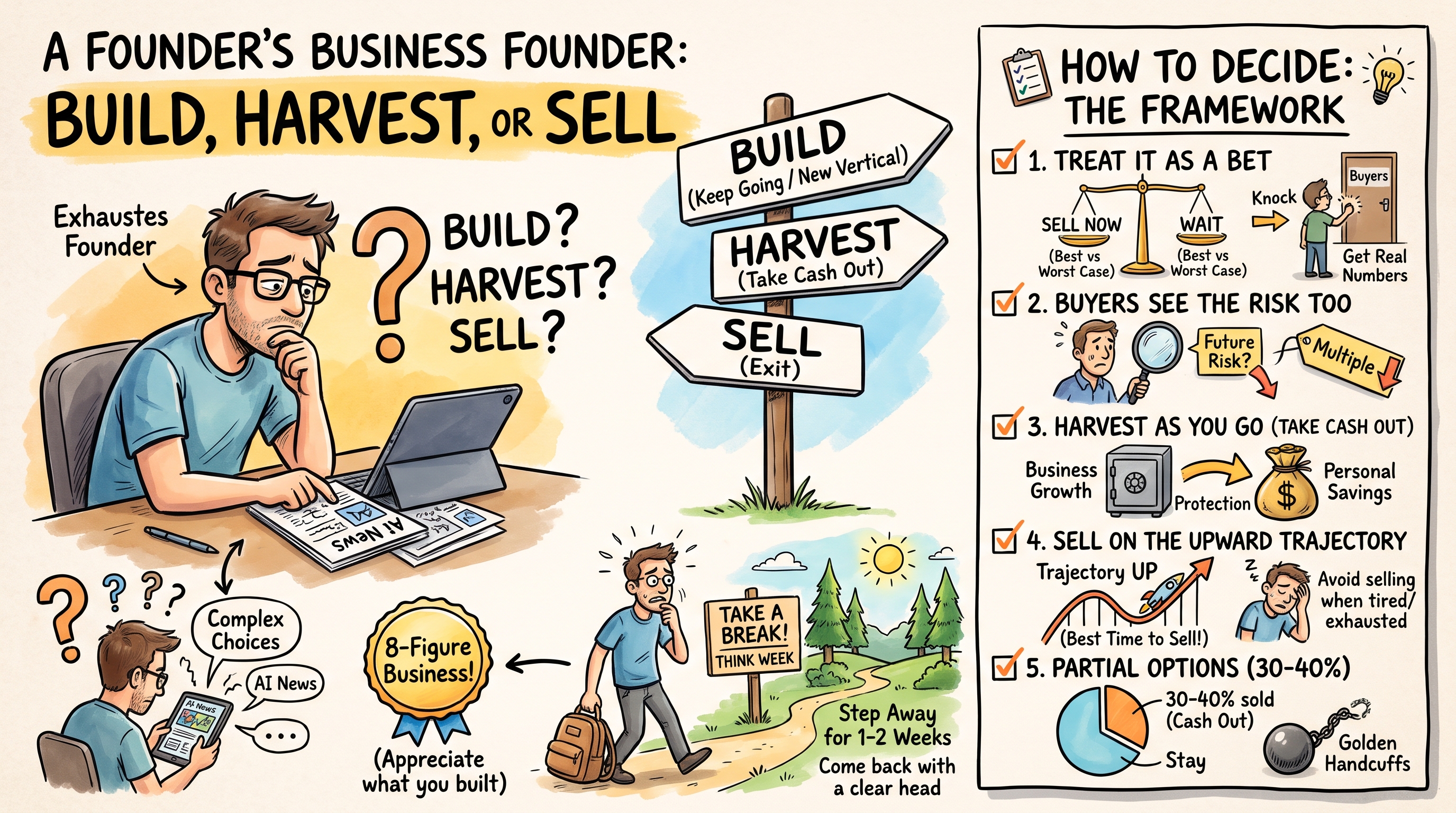
A framework for deciding: build, harvest, or sell
This is where the conversation got personal. The founder who raised the question is feeling the strain, in part because he has been consuming a great deal of news about what AI can do, and he is deciding between continuing to build, moving to a new vertical, or exiting. A few pieces of advice from the group stood out because they apply to anyone in that position.
- Treat it as a bet. List the best case and worst case for selling now and for waiting. Looking for buyers early costs little and gives you real numbers to decide with.
- Remember buyers see the same risk. If you worry the business will not last three or four years, a buyer may price in that same worry, which can lower the multiple.
- Consider taking cash out as you go. One operator has paid himself consistently for years and sees that as protection against a market that changes. Reinvesting every dollar is a risk if the ground shifts.
- Sell when the trajectory points up. The best moment to sell is when the future looks strong, and not when you are exhausted.
- Think about partial options. Selling a minority stake, perhaps 30 to 40 percent, can take chips off the table without forcing a full exit, though any sale usually comes with a stretch of golden handcuffs.
Before any big decision, the room pushed him to take a real break. Step away for a week or two, or take a think week the way some well-known founders do, and come back with a clearer head. Reaching the stage of an eight-figure business puts you in a very small slice of all companies, and it is worth stopping to appreciate that. A tired founder tends to see every option as worse than it is.
My own view, after building SaaS companies since 2002, is that we are in another cycle that looks a lot like the early days, with new tools and new fears. The founders who do well will be the ones who identify what is truly hard to copy, invest in it, and make their product do more of the work for customers.