What Product-Market Fit Actually Looks Like Once You Cross It
A breakdown of how early-stage SaaS and AI founders should actually recognize product-market fit, beyond signups and vanity metrics, using a real mastermind moment as the jumping-off point.

A few weeks ago in one of our SaasRise mastermind sessions, I asked a founder in our group who's building an AI employee product a simple question: what does product-market fit actually mean to you? Not the textbook definition. His definition, the one he uses to know, in his gut, that he's crossed the line from "people are willing to try this" to "people can't run their business without this." What he said back was genuinely one of the more thoughtful answers I've heard on this topic in a long time, and it got me thinking about how badly most early-stage founders misjudge this moment, usually in one of two directions.
Either they declare PMF way too early because they hit some vanity number (a thousand signups, a viral tweet, a demo that got applause), or they wait too long because they're scared to say it out loud before it's "provable" with a spreadsheet. Both mistakes cost you time and money you don't get back. So I want to walk through how I actually think about this, using that conversation as the jumping-off point, because the founder I'm talking about had just done something that matters more than any survey score: he got strangers to pay him real money, more than once, without him having to convince them twice.
Why signups are the wrong thing to celebrate
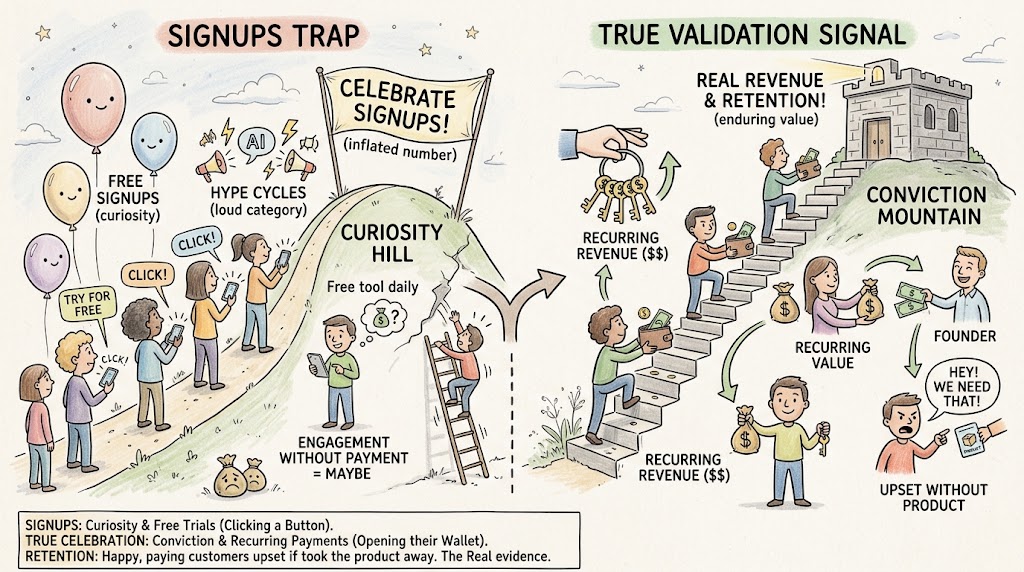
Here's the trap almost every SaaS founder falls into at some point, myself included back in the early days of iContact. You launch something, you get a wave of signups, and it feels like validation. People are trying it! But signups measure curiosity, not conviction. Someone will click a button to try free software, especially if it's got "AI" in the name right now, because the market is genuinely fascinated by what AI tools can do. That curiosity is worth something, but it is not the same signal as someone opening their wallet and deciding your product is worth recurring money when they have a hundred other places they could spend it.
- Signups measure curiosity. They tell you people are willing to click, not that they've changed how they work.
- Free trials inflate the number. A zero-friction trial will always outperform a paid conversion, so don't grade yourself on the bigger, easier metric.
- Engagement without payment is a maybe. Someone logging in daily for a free tool is interested. It's not the same as them telling finance to cut a check.
- Hype cycles distort the read. In a hot category like AI tools right now, you'll get inbound interest that has nothing to do with your product being right, just the category being loud.
So if signups aren't the signal, what is? For me, the real marker is when a customer pays you, keeps paying you, and would be upset if you took the product away. That's a much higher bar, and it's the bar this founder had actually cleared. He wasn't reporting a user count. He was reporting people throwing money at him, which is a completely different kind of evidence.
The moment I actually trust: money changing hands
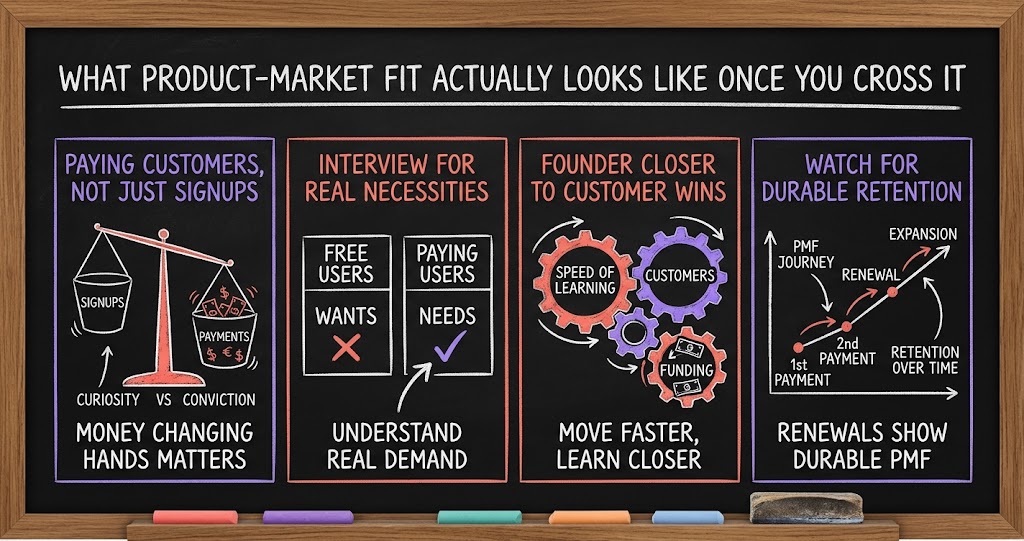
When I heard what this founder said about his own definition of product-market fit, my first reaction, out loud on the call, was that it was genuinely profound. Not because it was complicated. Because it cut through all the noise founders usually hide behind. As I told him on the call, "Congrats on getting people paying you, throwing money at you." That's the whole ballgame in the early days. Paying customers are the only metric that can't be gamed by a good landing page or a clever onboarding flow.
I told him a bit about our own path with this too, because it's a useful mirror. We'd started using our own internal AI teammate tool first, mostly because we already knew how to use it and it was sitting right there. But here's the honest admission: if we hadn't already been using our own tool and had found his product first, we would have just used his. They essentially do the same job. That's not a knock on either product, it's actually the whole point. When two tools solve the same real problem well enough that the choice between them comes down to which one you happened to find first, you're no longer debating whether the category has demand. You're just debating distribution. What struck me most, though, is that nobody had to chase this founder's customers down. They found the tool on their own and paid for it without a sales team pushing them there, and that kind of unprompted spend is demand you didn't manufacture, which tends to be the sturdiest kind.
There's a related signal worth sitting with too: word of mouth that shows up before you've built a referral program. If people are recommending your product on their own, that's marketing you didn't ask for, and it usually means the thing you built is actually working, not just being sold well. A lot of founders build elaborate referral incentives to manufacture word of mouth, and there's nothing wrong with that as a growth lever later. But in the earliest days, if you have to pay people to talk about your product, that's information too. It usually means the product hasn't yet earned organic advocacy.
The market question: how big is the blue ocean, really
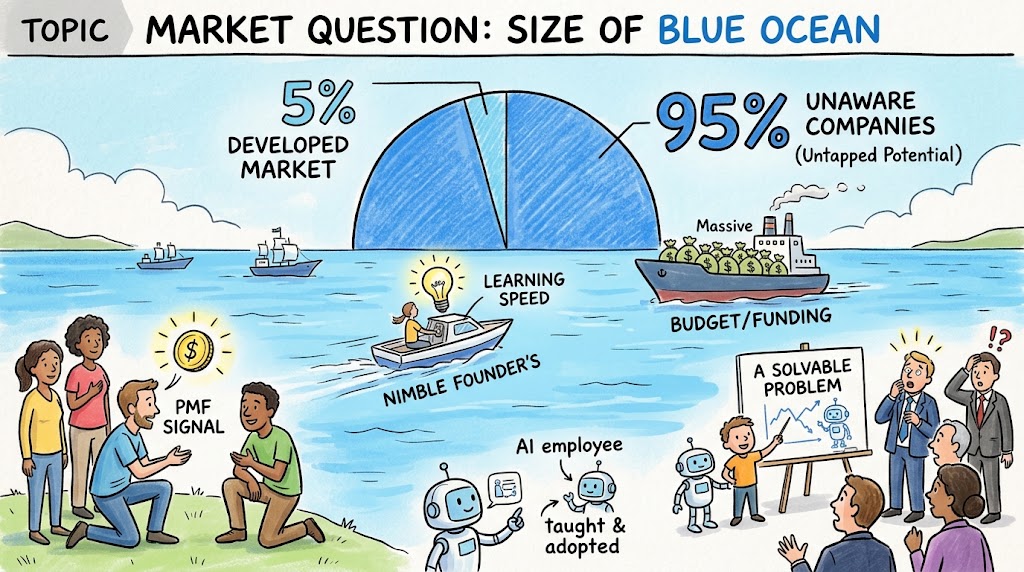
Once you've got a real signal that people will pay, the next question founders should ask is about the size of the opportunity in front of them, because PMF at a tiny scale and PMF in a massive category are very different businesses. In this founder's category, AI employee tools, the numbers are almost absurdly favorable right now. By most estimates, something like 95% of companies have not yet adopted an AI employee or AI agent tool into their workflow. That's not a mature market with a handful of incumbents fighting over scraps. That's a market where the overwhelming majority of potential buyers haven't even started shopping yet, and where a lot of the work right now is simply teaching people the problem is solvable in the first place. A market that early rewards speed of learning more than size of budget, and it means there's real room to build a lasting company here, not that it will be easy, just that it's available, provided that early PMF signal gets turned into a repeatable motion.
I mentioned to this founder that there's at least one well-funded competitor in his space who has raised significantly more capital than he has. And look, that's real, capital is an advantage. But I've watched enough of these categories play out over the years to know that funding advantage matters most in the growth and scale phase, after PMF, when you're racing to own distribution. In the pre-PMF and early-PMF window, the founder closest to the customer, moving fastest on what they're learning, usually has the real edge. Being underfunded relative to a competitor is a real disadvantage eventually. It is not a disqualifying one right now, and it's definitely not a reason to second-guess the signal you just got from a paying customer.
What to actually do once you believe you've hit it
Recognizing PMF is only useful if it changes your behavior afterward, and this is where a lot of founders stall out. They get the good signal, feel the relief, and then keep operating exactly like before, still splitting attention across ten experiments, still treating every feature request as equally important. Once you have real evidence that a specific type of customer will pay for a specific version of what you built, your job shifts from searching to repeating. You want to find out, in detail, why the customers who paid, paid, and then go find ten more people who look just like them.
- Interview your paying customers, not your free users. Ask the people who gave you money why they did it. Free users will tell you what's nice to have. Paying customers will tell you what's necessary.
- Look for the pattern in who converts. If a certain type of company, role, or use case keeps showing up among your payers, that's your beachhead, not a limitation.
- Resist expanding the product too early. The instinct after a PMF signal is to build more, to serve more people. Usually the better move is to go deeper with the segment that already said yes.
- Start tightening your unit economics. Once you know people will pay, start paying attention to what it costs you to find them and keep them, because that discipline gets much harder to build later.
This is also the phase when founders should be thinking hard about rebuilding their operations around what AI now makes possible, not just their product. I've said this to our whole group before: this is a whole new opportunity to rebuild our companies, and for those of you who haven't sold your business this year, that means you get to rebuild your company for the age of AI. A founder who's just found early PMF in an AI category has a real advantage here: they can build the internal processes, the support workflows, even the way they hire, around AI-native assumptions from day one, instead of retrofitting an older structure later the way most of us had to.
The honest caveat: one good sign isn't the whole story
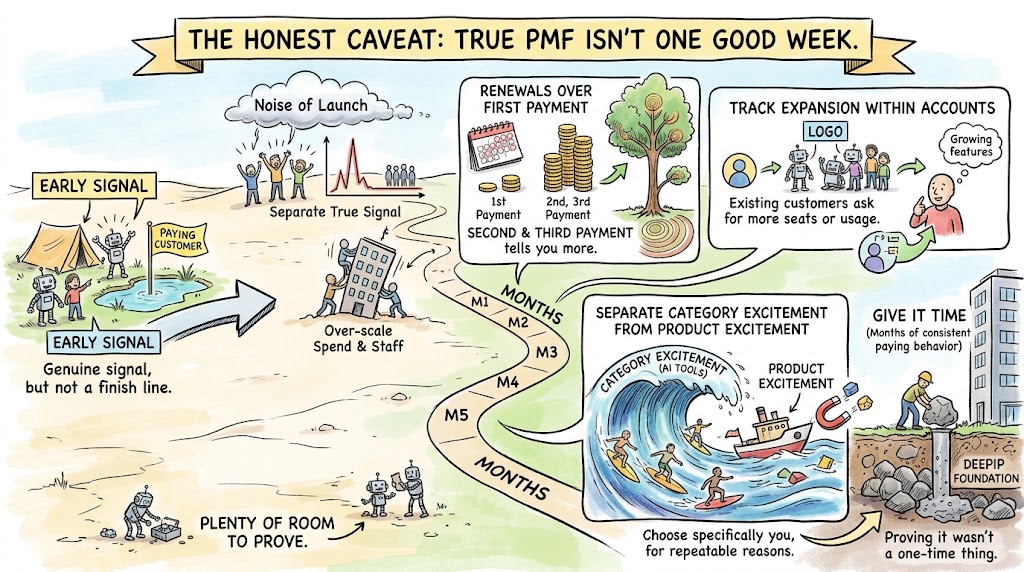
I want to be straight about something here, because it's tempting to hear a story like this and think the hard part is over. A handful of paying customers and a big blue ocean market is a genuinely strong signal, not a finish line. Real, durable PMF shows up over months, not one good week, and it shows up in retention as much as in acquisition. The founders who get in trouble are the ones who declare victory off an early spike of enthusiasm, staff up, spend up, and then watch the number quietly stall because they never separated the true signal from the noise of a good launch week.
- Watch renewal, not just conversion. The second and third payment tells you more than the first one did, since the first can still be goodwill or curiosity.
- Track expansion within accounts. If your paying customers start asking for more seats or more usage on their own, that's a stronger signal than a new logo.
- Separate category excitement from product excitement. In a hot space like AI tools, some of your early traction is riding the wave of general interest in the category. Make sure people are choosing you, specifically, for reasons you can repeat.
- Give it real time before you scale spend. A few months of consistent paying behavior across a growing set of customers is a much sturdier foundation to build on than a single great month.
None of that takes anything away from what this founder had already built. Getting people to pay you, especially in a category as new as AI employees, is a real accomplishment most founders never reach. It just means the next job is proving it wasn't a one-time thing, and given how much of that market hasn't shown up yet, he has plenty of room to do exactly that.