
What 28 Hours Without Email Is Worth Under Microsoft's Own Contract
A long Microsoft outage shows how a service level agreement turns downtime into a dollar figure. Here is the math, the catch most customers miss, and how to work out what the same outage would cost your own SaaS company.

How much is 28 hours without email worth under Microsoft's own contract? And what would the same outage cost your SaaS company? The outage began on a Thursday. Microsoft's first post about it has been viewed 21 million times. It was not a traffic spike. Microsoft said servers became unexpectedly unavailable, which put strain on the rest of the system, and then the problem spread.
Microsoft's status page listed 20 services as impacted. Twenty-eight hours after that first post, the status page still read service degradation. I want to use this event to look at something founders rarely examine until they need it, which is what a service level agreement actually promises, what it pays out, and what it says about the price of your own worst day.
What the contract promises
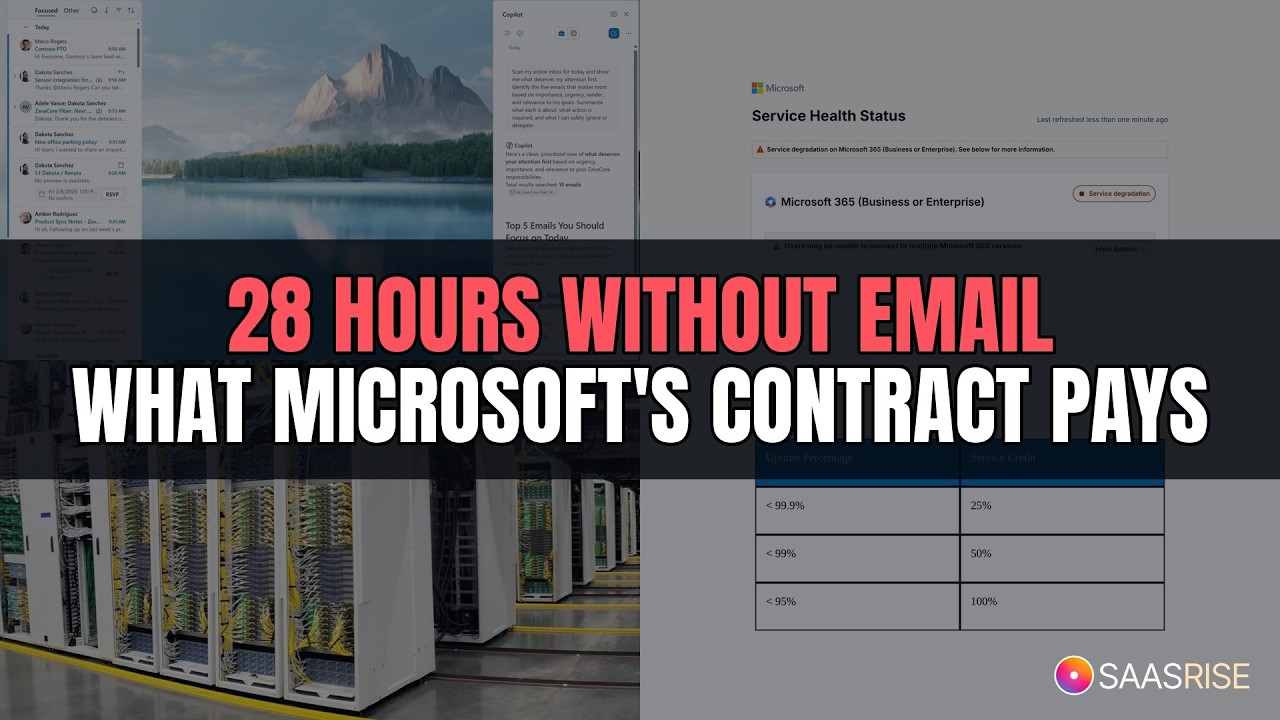
Microsoft's service level agreement, the SLA, promises 99.9% uptime. If the service misses that number, customers get a credit against that month's fee. The credit comes in tiers: 25%, then 50%, then 100% as uptime falls further. The structure is common across the industry, and the details differ from one vendor to the next.
Twenty-eight hours without email works out to about 96% uptime for the month. That lands in the 50% tier, which means half of one month's fee. That was the number that stood out to me, because an outage that felt enormous to customers translates into a credit that covers half of a single month.
- The promise is 99.9% uptime. Over a 30-day month, that allows roughly 43 minutes of downtime.
- Credits come in tiers. 25%, 50%, and 100% of the month's fee as uptime falls.
- 28 hours is about 96% uptime. That falls in the 50% tier, or half of one month's fee.
The arithmetic is worth checking yourself. A 30-day month has 720 hours. Twenty-eight hours of downtime is about 3.9% of that, which leaves roughly 96.1% uptime. The 99.9% promise would have allowed under an hour.
The catch: the credit is not automatic
The credit is not automatic. You have to file a claim. For this outage, the deadline is December 31st. Many customers will never file, either because they do not know about the process or because the amount seems small compared with the disruption they felt. The vendor's cost of the outage is lower than it looks, since a share of eligible customers never ask.
That detail matters if you are a customer of a large vendor, and it matters just as much if you are the vendor. Many SLAs put the burden of asking on the customer, with a deadline, and specific evidence requirements. If your company has an SLA like that, think about whether it is the policy you want to have, and whether your customers would describe it as fair.
- File the claim if you were affected. A credit you never request is money left on the table.
- Watch the deadline. For this outage the cutoff is December 31st.
- Read how your own SLA works. Check whether credits are automatic or require a request from the customer.
Your SLA is the price of your worst day
Here is the sentence I would pin on the wall: your SLA is the price of your worst day, and you set it in advance. When you write an uptime promise and a credit schedule, you are quoting a price for failure before it happens. If the promise is generous, a long outage gets expensive. If the credits are small, a long outage gets cheap for you and costly for customers, who may respond by leaving.
Both extremes can hurt. An SLA that promises more than your infrastructure can deliver creates real financial exposure. One that is too weak makes it harder to win larger customers, since enterprise buyers often read the SLA closely, and it gives them little reason to trust you with important work.
Working out what 28 hours would cost you
Try the exercise on your own contract. Take a typical customer on a $5,000-a-month plan, and suppose your SLA offers the same tiers Microsoft's does. A 28-hour outage would land in the 50% tier, which means a $2,500 credit for that customer. Now multiply across customers. If 200 customers are on similar plans, that is a $500,000 credit exposure from a single bad event, and the figure is invented for illustration, so replace it with your own.
- List your SLA tiers. Write down the uptime promise and the credit at each level.
- Pick a realistic outage length. Use 28 hours as a stress test, and also a shorter one that you are more likely to see.
- Multiply across your customer base. Add up credits for every affected account, using real plan prices.
- Add the indirect costs. Include support load, churn risk, and the engineering time spent on recovery.
The credit is only the visible part of the bill. Customers who lose a day of work often remember it at renewal, and a long outage can cost more in lost contracts than in credits. That makes uptime an investment question as much as a legal one.
Designing an SLA you can stand behind
If your exercise shows that your SLA is too generous or too thin, you can change it for new contracts and at renewal. The goal is a promise that you can keep in a normal year and afford in a bad one. Start from your real uptime record. If you have delivered 99.95% over the past year, promising 99.9% leaves a small cushion, while promising 99.99% invites a payout. Then choose credit tiers that grow with the severity of the outage and cap total exposure at a level the business can survive.
- Base the promise on history. Use your measured uptime over at least a year, and leave a margin for a bad month.
- Cap the exposure. A ceiling on credits, such as 100% of one month's fee, keeps one event from becoming a crisis.
- Define downtime clearly. State what counts, how it is measured, and what is excluded, such as planned maintenance.
- Decide on automatic or requested credits. Automatic credits build trust, and requested credits reduce cost, so pick the policy you can defend to a customer.
Whichever way you go, write the terms in plain language. Customers who understand the promise are less likely to feel tricked when something goes wrong, and that goodwill is worth more than the credit you saved by burying the details.
Communicating during a long outage
A long outage tests your communication as much as your infrastructure. Microsoft's own status page, still reading service degradation 28 hours after the first post, shows how a slow-moving incident leaves customers refreshing a page and guessing. You can do better at a smaller scale by deciding in advance who writes updates, how often they go out, and what they must include.
A useful update says what is affected, what you know, what you do not know yet, and when the next update will arrive. Customers can handle bad news much better than silence. If the next update is due in an hour, they can plan around it, and your support team gets fewer repeat questions. After the event, a short written summary of what happened and what you are changing tells customers that the problem has been taken seriously.
- Name an incident lead. One person owns communication, so updates do not stall while engineers work on the fix.
- Promise the next update time. Even when there is no news, a scheduled update calms customers.
- Publish a follow-up. A clear explanation of the cause and the changes you will make rebuilds trust.
Questions to ask your team
Once you know what a long outage would cost, a few follow-up questions can guide your next steps. They are practical, they do not require a large budget, and they tend to start useful conversations between engineering, finance, and customer success.
- Where are our single points of failure? Find the systems or vendors whose failure would take your whole service down.
- How quickly do we tell customers? A clear, honest status page reduces anger during an outage.
- Who decides on credits? Know whether credits are automatic, and who approves exceptions.
- Is our promise realistic? Compare the uptime you promise with the uptime you have actually delivered over the last year.
What to do this week
Open your own SLA and work out what 28 hours down would cost you. Do it with real plan prices and real customer counts, and write down the answer. Then compare it with what you have budgeted for reliability, and with what your largest customers have been told to expect.
If you are a SaaS CEO with $1 million or more in ARR, you can apply to join our growth mastermind at sasrise.com, and our community for AI founders and builders is at lounge.ai. Twenty-eight hours down, and a credit you have to ask for. What does your contract promise?