
Webinar Invitation: The B2B SaaS Growth Program
In The B2B SaaS Growth Program webinar, we will break down the 7 steps that align ABM list building, AI-personalized outbound, coordinated digital ads, and structured sales follow-up into one predictable customer acquisition engine — and explain how to implement it inside your company for scalable, measurable growth.

We will explain in detail how the upcoming Done-With-You SaaS Growth Program will work. If you are considering the program (or just want a good refresher on our scaling methods), be sure to be on the webinar!
To apply for the B2B SaaS Growth Program please visit: https://saasrise.com/growthprogram and see this updated program overview deck.
You can register for the webinar here
If you’re running a B2B SaaS company and growth feels harder than it should, it’s usually not because you’re missing effort.
It’s because your channels aren’t coordinated.
Over the past several years, we’ve used one structured system to help scale companies like iContact, Instantly, Clearstream, Tatango, RNL, and RXNT — in some cases to over $100M ARR.
This Thursday, I’m walking through exactly how that system works and how we implement it inside our 16-Week Done-With-You B2B SaaS Growth Program.
Before the webinar, here’s the core idea.
Why Most SaaS Growth Stalls
Most SaaS teams are doing some form of marketing. They’re running digital ads, sending outbound emails, posting on LinkedIn, and hiring SDRs to follow up. On the surface, it looks like a solid growth motion. But the problem isn’t effort — it’s coordination.
Each of those activities often operates independently. The ad team runs campaigns to broad audiences. Outbound targets a slightly different segment. Content gets published but isn’t distributed systematically. Sales follows up without clear visibility into which channels are actually driving intent.
When growth channels aren’t aligned around a clearly defined market, CAC starts creeping up and pipeline becomes unpredictable. The fix isn’t to add more tactics. It’s to build a coordinated system where every channel reinforces the others.
The 7 Core Techniques We Teach
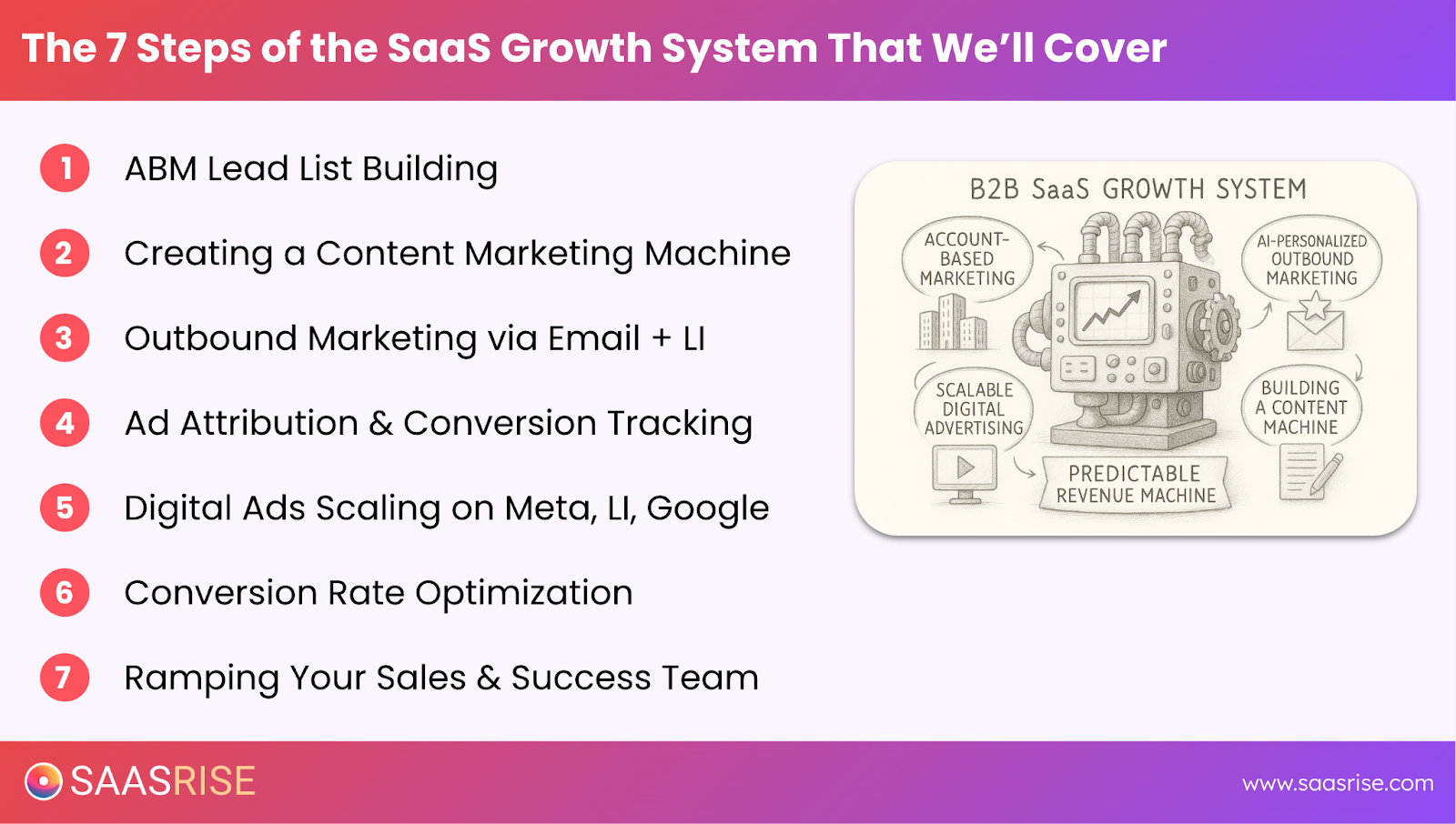
On the webinar, I’ll break down the seven most effective growth techniques we’ve seen work repeatedly across mid-market and enterprise SaaS companies.
They include:
- Building a comprehensive ABM list of your entire TAM
- Launching AI-personalized outbound to that list
- Running LinkedIn outbound to the same accounts
- Scaling matched audience and retargeting ads
- Adding paid search and lookalike expansion
- Tracking CPL and CAC with third-party attribution
- Building an SDR and AE team to convert pipeline
The power comes from targeting the same defined accounts across every channel.
What Omnipresence Actually Looks Like
One of the biggest shifts we teach is moving from isolated marketing to omnipresence inside your TAM.
That means:
- Outbound emails go to a defined ABM list
- LinkedIn outreach targets those same decision-makers
- Ads are shown only to that list
- Content reaches them consistently across platforms
When buyers repeatedly see your brand across email, LinkedIn, search, and paid media, trust builds before the sales call ever happens.
Conversion rates improve because familiarity increases.
The Economics That Make Scaling Possible
Growth only becomes scalable when you understand your numbers.
In the program and on the webinar, we emphasize:
- Scaling digital ads only when payback is under 50% of ACV
- Calculating CPL and CAC by channel and ad type
- Using third-party tracking tools for accurate attribution
- Allocating budget toward the highest-performing campaigns
When you know your true acquisition cost and payback window, scaling becomes rational instead of risky.
Beyond Marketing: Building a Revenue Machine
Marketing alone doesn’t create predictable growth.
We also cover:
- Building SDR and AE capacity to convert increased lead flow
- Funding profitable growth through equity or revenue-based financing
- Investing in R&D while scaling acquisition
- Turning early traction into a repeatable revenue engine
The goal is simple: build a system that compounds.
We give away the full strategy on the webinar because knowing the model isn’t the hard part — implementation is.
If 2026 is going to be your year for serious growth, this is the framework to understand.