Using AI Agents to Turn Events and Webinars Into a Lead Engine
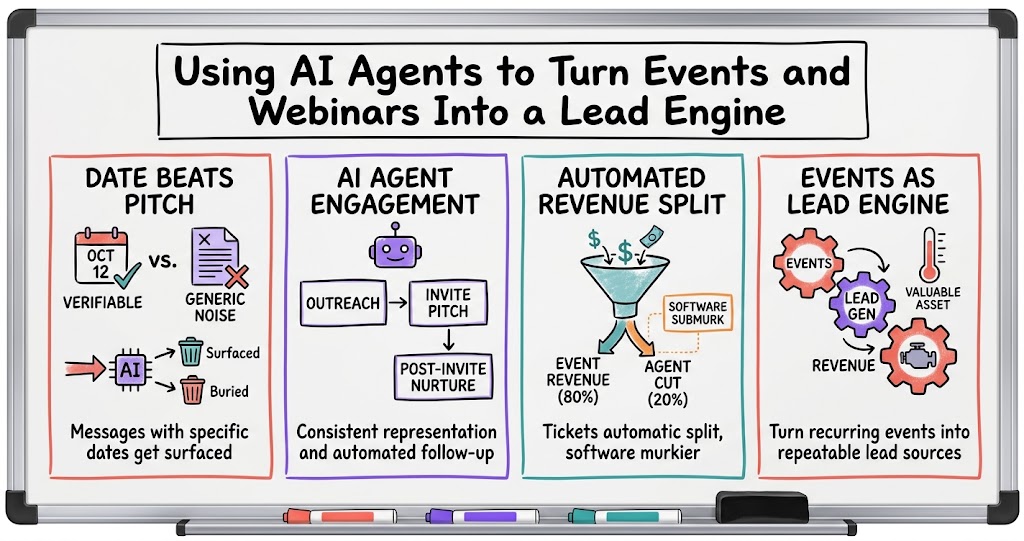
A founder who sold his last company and started fresh built an AI agent that turns event and webinar invites into a lead engine, because dated, specific asks get through people's AI filters when generic pitches don't.

A founder in our mastermind who recently sold his previous business and started a new one shared something at a recent call that stuck with me, because it points at a shift that's happening quietly underneath all the AI hype. He spent years doing cold outreach, sending a couple million emails over the life of his last company, so he has more data than almost anyone I know on what actually gets a response. His finding: messages with a specific date attached, an event, a webinar, a podcast taping, outperform everything else. And the reason isn't really about copywriting. It's about who reads the email first.
Why a date beats a pitch
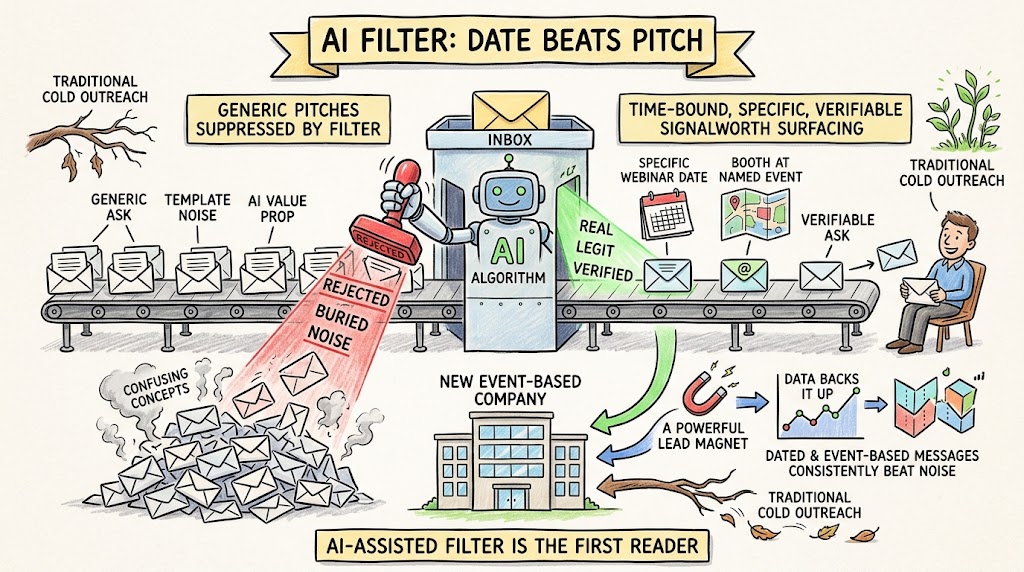
More and more of us have some kind of AI assistant triaging our inbox before we ever see it, deciding what's worth our attention and what gets buried. The founder pointed out that his own assistant tells him about podcast invitations and event invitations, but it filters out most of the generic pitches that used to at least get a skim. That's a real change in how outreach works. You're no longer writing for a person, you're writing for a person's filter, and that filter has learned to treat "time-bound, specific, verifiable" as a signal worth surfacing and "generic value prop" as noise to suppress.
- Dated asks read as real. A webinar on a specific date, or a booth at a named event, is easy for an AI assistant to verify and hard to fake, so it gets treated as legitimate.
- Generic pitches read as noise. Anything that sounds like a template, no matter how well written, is exactly what these filters are trained to catch.
- The data backs it up. After a couple million emails sent over the life of his last company, this founder found dated, event-based messages consistently beat everything else.
- The filter is now the first reader. Write copy that a human would love, and it may never reach a human at all if the filter kills it first.
That's the insight that led him to sell his old business and build something new around it. He didn't just start using events as a talking point, he built an entire company on the premise that events and webinars are one of the most effective lead magnets available right now, precisely because they get through the AI-assisted noise filtering that's killing traditional cold outreach.
What the agent actually does
He described the new business as essentially an agentic harness that's optimized to act as a brand ambassador for whatever event you're already doing. Instead of pitching a product cold, the agent pitches an invitation, which is a much easier ask for someone to say yes to, and it represents you consistently across outreach and follow-up rather than leaving every message to a founder typing case by case. The mechanism works for anything with a date attached, a conference talk, a webinar, a booth, because the pitch always comes back to a real, time-bound occasion rather than a generic value proposition. And a lot of the post-invite nurturing happens on the platform itself, not through a founder's personal inbox, so the follow-up that actually turns an invite into a customer is automated too. The event isn't incidental to the pitch anymore, it's the entire mechanism.
He's already closed his first customer on this new engine, a deal north of five thousand dollars, which is a solid proof point for a business that only recently launched. What's notable is that it validates the whole thesis in one sale: someone paid real money for a tool whose only job is to turn "we have an event coming up" into qualified leads who actually show.
The revenue-share mechanics
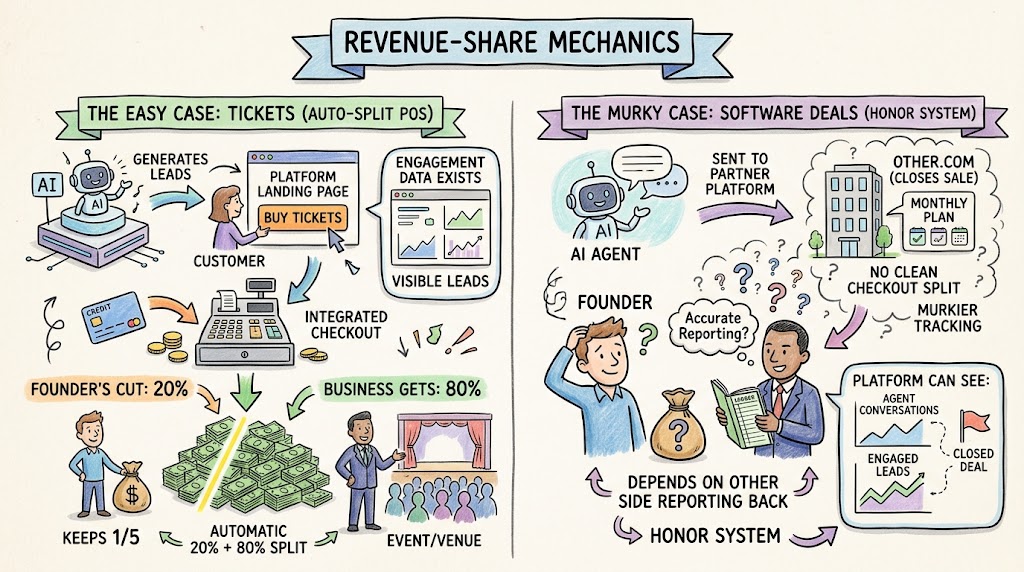
When another founder in the group, an experienced affiliate marketer, asked how the deal actually gets tracked, the answer revealed how early-stage this whole model still is. For something concrete like event tickets, it's straightforward: the platform sometimes builds the landing page itself, runs the transaction through a payment processor, and splits the revenue right there. The founder keeps 20 percent of what sells and passes 80 percent back to the event or business he's representing. Clean, automatic, no argument about who gets credit.
- Tickets are the easy case. When the platform builds the landing page and runs payment itself, the split happens automatically at the point of sale.
- The cut is 20 percent. The founder keeps a fifth of ticket revenue generated through the agent, and the business keeps the rest.
- Engagement data exists. Because a lot of the follow-up runs through his own platform, he can see which leads are actually engaging.
- But software deals are murkier. When the sale is a subscription rather than a ticket, there's no clean single transaction to split at checkout.
That last point is where it gets more interesting, and more honest. For software sales, where the buying process and the actual close happen on someone else's platform, he admitted it comes down to the honor system. He can see which conversations his agent generated and which ones looked engaged, but tying that directly to a closed deal, and getting paid the agreed share of it, currently depends on the other side reporting back accurately.
The attribution problem he still has to solve
This is the part every founder running any kind of revenue-share or affiliate model should pay attention to, because it's a solved problem in other industries and an unsolved one here. The affiliate marketer in the group immediately flagged it: there's a whole ecosystem of partner-tracking and reseller platforms built exactly for this, and without one, commission-based revenue has a way of quietly evaporating. Deals get attributed to the wrong source, or not attributed at all, and nobody downstream has much incentive to fix that on your behalf.
- Honor system doesn't scale. It might work when you personally know every partner, but it breaks down fast as volume grows.
- Tracking tools already exist for this. Partner-tracking and affiliate-tracking platforms are built specifically to solve attribution for exactly this kind of revenue-share arrangement.
- CRM integration matters. Some of these tools connect on the back end with a CRM, which is what lets cross-marketing between two companies actually get credited correctly.
- Unclosed deals are still valuable. As the founder put it, his agent isn't closing the sale, it's bringing the lead, and that distinction should be built into the tracking, not assumed away.
The founder was candid that this is something he still has to work out, and I think that candor is worth sitting with. It's easy to build the clever part of a business, the agent that gets attention past the filters and gets people to show up, and put off the boring part, the plumbing that makes sure you get paid fairly for it. But the boring part is usually what determines whether a good idea turns into a durable business or just a string of one-off deals that are hard to repeat at any real volume.
What this means if you're thinking about doing something similar
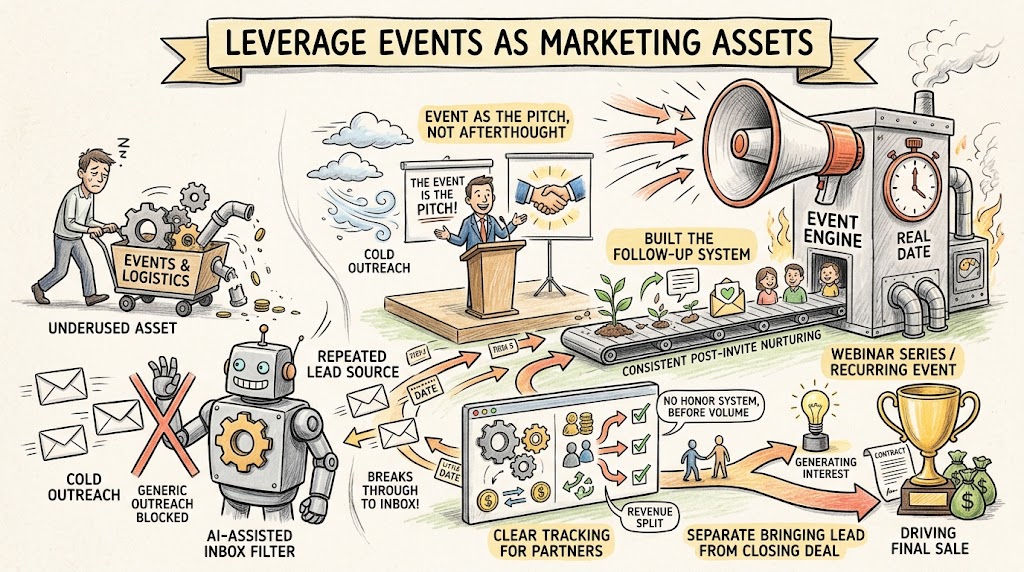
If you're a founder sitting on a speaking slot, a webinar series, or a recurring event of any kind, there's a real lesson here beyond the specifics of this one business. The event you're already doing is a marketing asset that most companies underuse, because they treat it as a one-time logistics project instead of a repeatable lead source. Building outreach and follow-up around the fact that it has a real date attached is a legitimate edge right now, precisely because it's one of the few message types still reliably getting through AI-assisted inboxes.
- Use your events as the pitch, not the afterthought. Any recurring speaking slot, booth, or webinar is a built-in reason to reach out that doesn't feel like cold outreach.
- Build the follow-up system before you need it. Most of the value in this kind of lead engine comes from consistent post-invite nurturing, not the invite itself.
- Decide on tracking before you scale a revenue share. If you're going to split revenue with partners, put a real tracking mechanism in place before volume makes the honor system unworkable.
- Separate bringing a lead from closing a deal. Your compensation model should reflect what your system actually does, whether that's generating interest or driving a final sale.
The bigger takeaway is that AI isn't just changing how you build product, it's changing which of your existing assets are suddenly worth more. An event you were already running for its own sake turns out to be one of the few remaining ways to reliably get a message through, and founders who build systematically around that will have a real edge over the ones still sending generic outreach into a filter that's specifically designed to catch it.