Trials That Never Activate: 90% of Your Trials Never Start
When more than nine in ten free trials do nothing after signup, the problem usually starts before the product. A group of SaaS founders shares how to find where users stall and what to test first.

Here is a problem that is deceptively frustrating. A founder in our mastermind has a product where signing up is easy. Paid ads bring in roughly a hundred trials a month at about thirty dollars each, and people create accounts and download the app without trouble. Then the activity stops. By his count, more than 90 percent of trials never invite anyone, never create anything, and never come back. He has checked for bugs and does not think the app is the issue. A minority of users activate easily, and the rest do nothing at all.
He asked the group whether anyone had hired a specialist to fix onboarding. The answers ranged from practical tools to a blunt suggestion that the question might be aimed at the wrong place. Together, they make a useful checklist for any founder sitting on a stack of dormant trials.
Begin with the customers who did activate
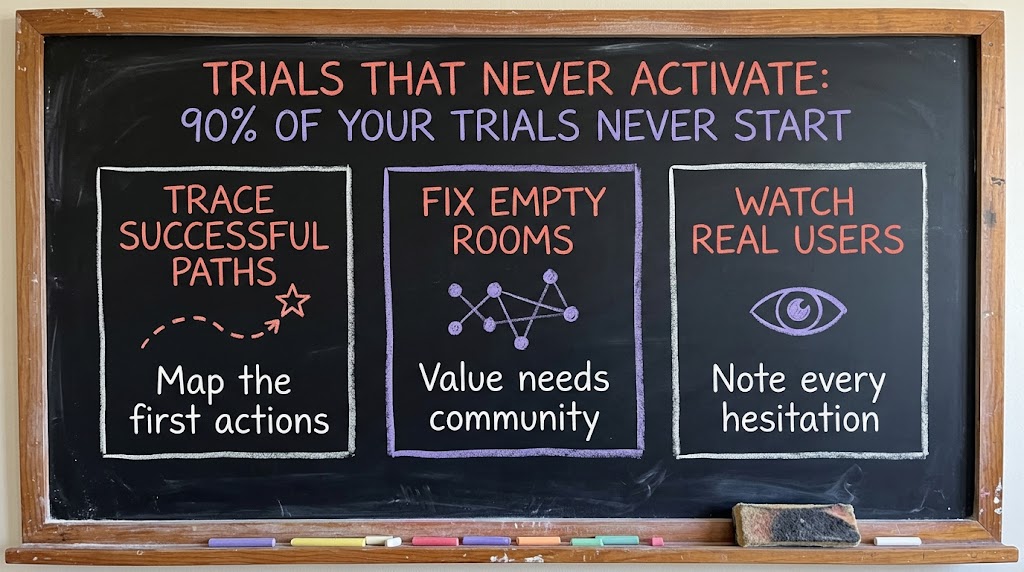
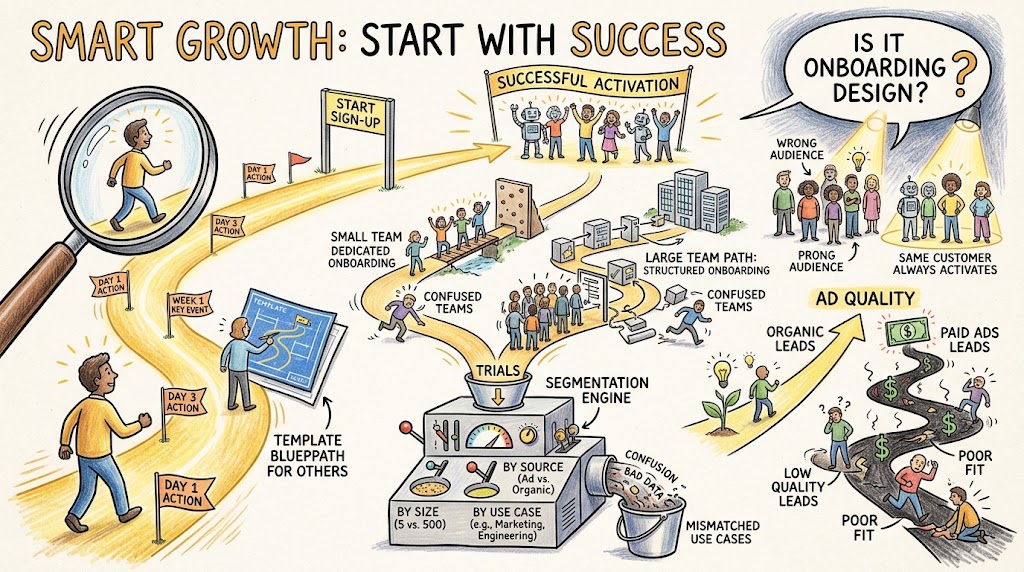
The first piece of advice came from a founder who has worked on product-led growth for years. Begin with the end in mind. Find the customers who succeeded, study what they did in their first days, and then rebuild that path for everyone else. There is almost always a reason people stop, and it could be any of several things: you are showing them the wrong thing, the channel is sending the wrong visitors, or the prospects themselves are a poor match. A five-person organization will behave very differently from a five-hundred-person one.
That last point deserves attention in this case, since the founder described a range of customers, from tiny new groups to much larger ones, and admitted he is still working out where the product fits best. A product with a broad audience cannot have a single onboarding path, because the first thing a small team needs is different from what a large one needs.
- Find your activation event. Look for the one or two actions that your best customers took in week one, and count how many trials reach them.
- Segment your trials. Break sign-ups down by size, source, and use case before you change the product. The problem may live in one segment.
- Check the ad quality. As one member noted, leads from paid ads tend to be lower quality than organic ones. If most of your sign-ups come from ads, ask whether the people clicking were ever a good fit.
Before you redesign anything, it is worth spending an afternoon on this analysis. If the same kind of customer activates every time, then the onboarding flow is not the only problem. The audience you are attracting may be.
Ask whether the product works alone
One member made an observation that changed the direction of the conversation. Based on what he saw on the product page, he suspected that users do not get value until other people are in the app. If that is the case, then a free trial of the software is a difficult way to learn it. A new user signs in, finds an empty space, and has no reason to come back. The product only starts to work when the community arrives, and inviting the community is precisely the step that is not happening.
His suggestion was to consider a different approach altogether: talk to these people. Call them. A demonstration can show the value that an empty account cannot. The founder had tried demos before and found that getting busy, part-time, non-technical buyers to show up to a video meeting was a whole different challenge. The reply was simple, and it made the founder laugh: why does it need to be a video meeting? Just pick up the phone.
- Check whether value depends on others. If the product feels empty until teammates or community members join, design the first session around getting them in, or show the finished version first.
- Match the channel to the buyer. If your audience struggles with video calls, use the phone. The format should suit them, not you.
- Consider a hybrid. A short call or a guided first session can carry a prospect through the point where trials normally go quiet.
It is an easy trap to assume a self-serve trial is automatically the right entry point. Sometimes the best activation strategy is a human being making a five-minute call.
Watch someone use it, and ask a specialist
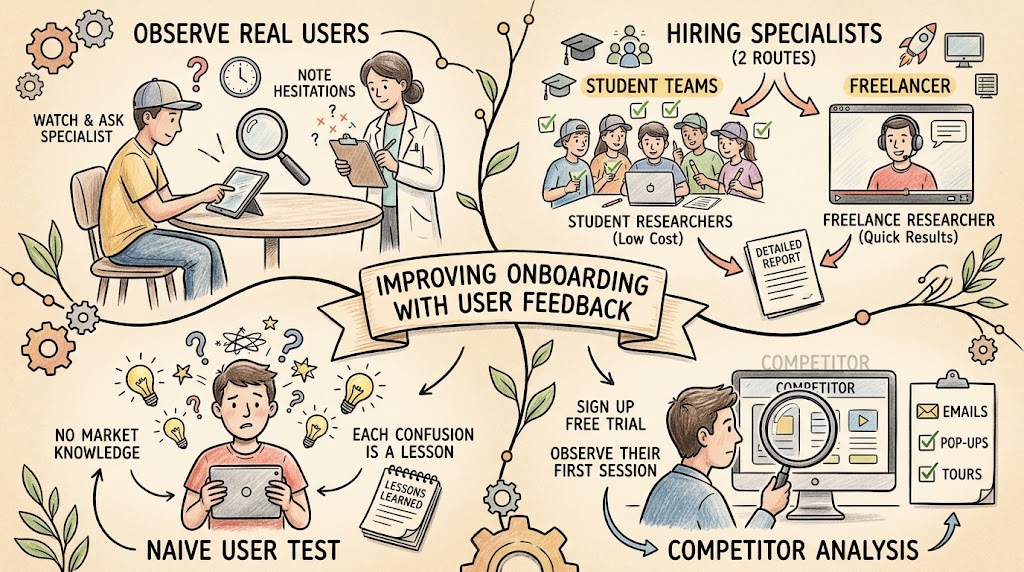
Several members recommended getting real users in front of the product and watching what happens. One founder suggested hiring a UX researcher, and described two routes. The first is to partner with a training program for UX researchers. Their students are always looking for real projects, and a team of four to six of them will interview people, test your application, and give you a detailed report. The second is to hire a researcher on a freelance platform. He has used both and said the cost is relatively low and the quality is good.
Another member shared a cheaper version of the same idea. He handed his product to someone who had no knowledge of his market and watched them use it. They were confused at many points, and each confusion was a lesson. Some things do require domain knowledge to understand, he said, but the experience still gives you plenty of ideas. The founder planned to do this after his next round of onboarding changes.
- Watch silently. Give someone the product, say nothing, and note every place they hesitate.
- Use student researchers. Training programs send teams to test products at low cost and deliver a structured report.
- Hire a freelancer for speed. An experienced researcher can test with real users and return findings before you ship any changes.
A related tip came from me. If your market has an established competitor with strong onboarding, sign up for their free trial and observe everything they do to get you started. I have worked with one such company in a similar space for several years, and it costs nothing to study what makes their first session work.
Use AI as a second researcher
One founder in the marketing technology space suggested pairing human researchers with AI. A person can call customers and interact with the product, he said, but an AI can absorb a large amount of data and find patterns a human would miss. His advice was to connect your tracking tools to an AI assistant, and ideally to give it access to the code so that it understands how events are recorded. Then ask it very specific questions, since a common mistake is trying to automate everything at once.
He also described a game he plays with the AI. He asks it to act as the customer at a specific step in the flow, armed with the average data for that step, and to say out loud what it is thinking. The AI might say it sees a button and does not know what it means. That sort of role play helps him brainstorm problems and ideas. The final piece of his advice was that the fixes are often small. Run A/B tests based on what the reports suggest, because little changes often make a big difference and you do not need to rebuild the whole app.
- Connect your analytics. Give the AI your event data and your code so that it can see the same thing your users see.
- Ask narrow questions. Focus on a single step at a time, such as why users who download the app stop before inviting anyone.
- Role-play the customer. Have the AI narrate a typical user's thoughts at each step and look for confusion.
- Test small. Try a changed button label, a shorter form, or a reordered first screen before investing in a redesign.
Make the first step visible
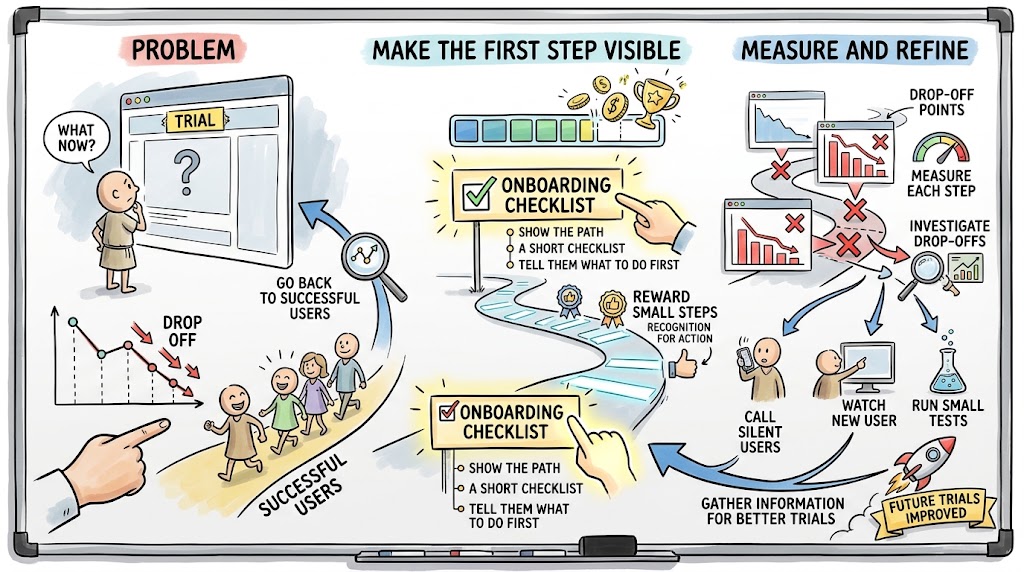
Two members suggested ways to make progress clear. One had considered gamification, which means rewarding users for trying features and showing a progress bar. Fitness apps do this constantly, handing out small achievements for extra steps. His team had not shipped it yet but was thinking about it as a way to raise engagement. The founder with the activation problem said an AI tool had suggested something similar, a checklist that new users work through, and he liked the pairing of a checklist and rewards.
- Show the path. A short checklist tells a new user exactly what to do first.
- Reward small steps. Recognition for completing an action can draw people further into the product.
- Measure each step. If you know where users drop off on the checklist, you know where to fix the flow.
If you are looking at your own trial data and seeing a wall of silence, go back to the people who did succeed, figure out what they did, and make that the default path. Check whether your product needs other people to be valuable. Watch someone new use it, call a few of the silent users, and then run small tests. The 90 percent may not come back, but some of them will, and the information you gather from the attempt will make your next trial better than this one.