
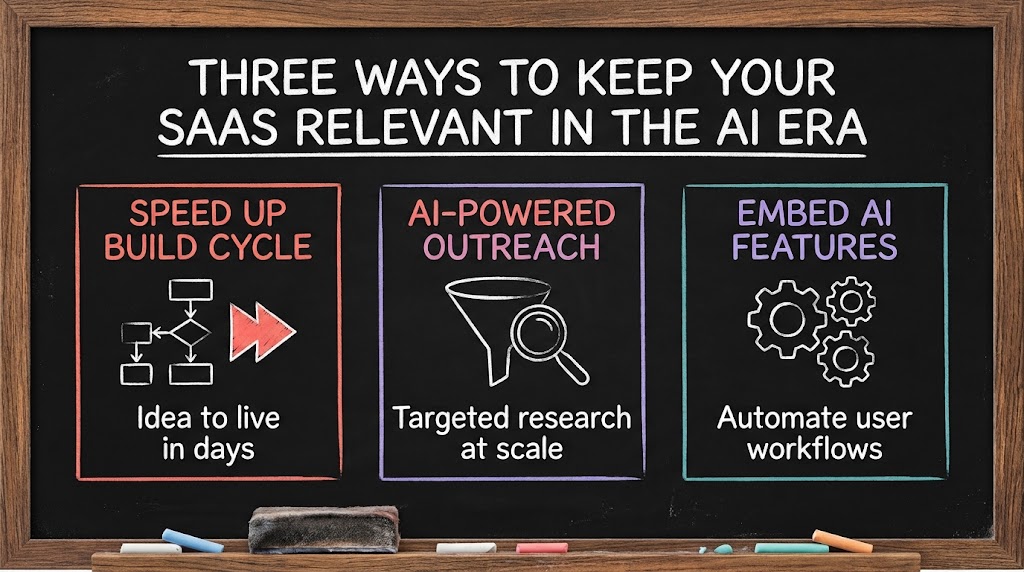
Three Ways to Keep Your SaaS Relevant in the AI Era
SaaS is not dying, but the way software gets built, sold, and priced is changing fast. Here are the three moves that keep an established software company ahead, and the margin trap that catches AI-only businesses.

A founder in our mastermind said something this week that I suspect a lot of you have felt. About a year ago, he was worried he would become irrelevant very quickly, and so were many of his peers. Since then his company has embraced building with AI and built AI into its product. Now the fear has eased a bit, because his product is still valuable, customers still use it, and he does not get the sense that his whole market wants to rebuild what he does with a prompt. Even so, he is not fully convinced about where things are going. He asked me where I have landed after going through the same exercise myself.
I think he is right to keep a healthy level of worry, and also right that some of the early panic was overdone. The so-called SaaSpocalypse that people talked about in February was overstated. But a company that does nothing differently will still lose ground. Here is how I see it, in three parts.
Why I am disrupting my own business
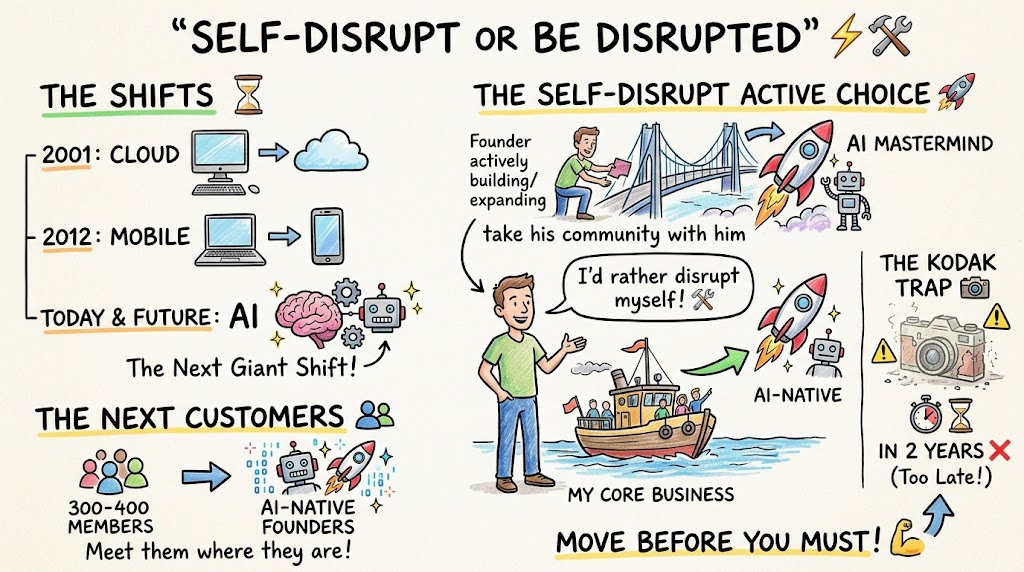
Let me start with why this question is personal for me. Cloud software disrupted desktop software around 2001 and 2002. Mobile disrupted web-based software around 2012. I believe AI is the next shift of that size, and it is the future of most software processes. I run a community with 300 to 400 members, and I want to reach the next generation of fast-growing software companies. Most of the high-growth, venture-funded software companies being built right now are AI-native, so I have to meet those founders where they are.
That is why I started a separate community and a weekly mastermind for AI founders. I think of it as a Kodak moment. If I wait too long, another community focused entirely on AI could appear in two years and put my business at risk. I would rather disrupt myself than be disrupted by someone else.
- Treat it as a platform shift. Cloud and mobile each reshaped who won in software, and AI looks to be doing the same.
- Watch your next customers. The founders you want in five years are building differently than the ones you serve today.
- Move before you must. It is far easier to adapt while your core business is healthy.
- Remember what has not changed. AI is a form of software delivered as a service, so the business model is alive and well.
With that backdrop, I see three concrete moves for any established software company.
Move one: shorten the road from idea to production
The first move is to rebuild how your team builds. The goal is for you, or any developer or product owner on your team, to prompt for a bug fix or a new feature, generate a product requirements document that fits your existing architecture and design system, and have working code minutes later. From there, the change goes to staging, where an AI quality check and your QA team review it, and a day or two after that it goes to production.
The number to watch is the time from a good idea to a live feature. For many companies it used to be about 90 days. With the right setup, I think it should be closer to three. If you can run that fast, you solve your customers' problems better and sooner than anyone else, and that is how you keep them.
- Make requests promptable. Anyone in product or engineering should be able to describe a change and get a draft implementation.
- Fit the existing system. Generated work should follow your architecture and design rules, so it blends in.
- Keep QA in the loop. Use both AI testing and your human QA team before anything goes to production.
- Measure cycle time. Track days from idea to production, and set a target of days instead of months.
Speeding up the build only pays off if your planning rhythm keeps pace, which is where many teams get stuck.
The old planning cadence will slow you down
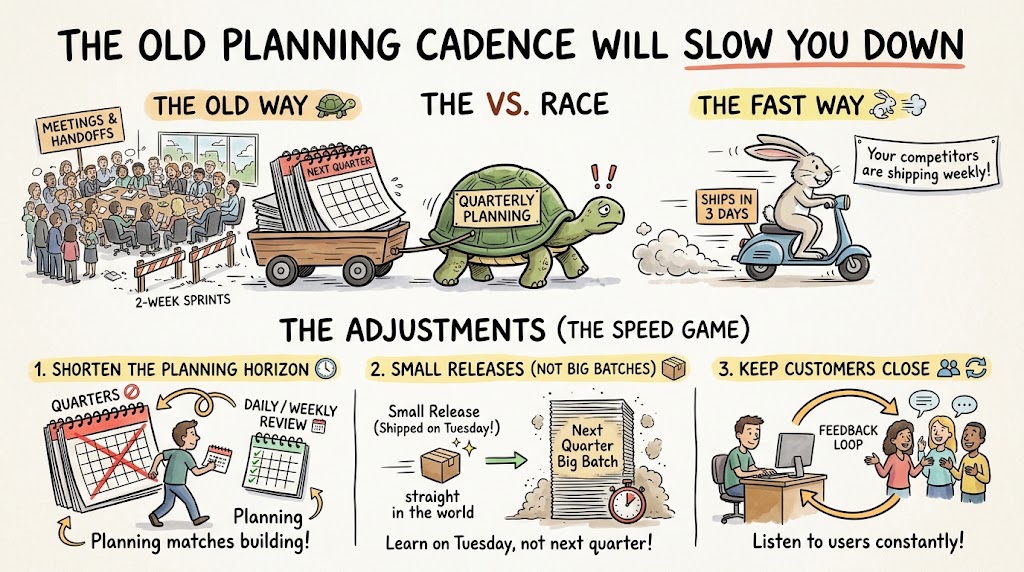
Plenty of companies still set quarterly goals once a quarter and run two-week sprints, using Agile in the form it took a decade ago. If your competitor can ship a feature in three days and you plan in quarters, you will be slow compared to them, and eventually someone will catch up and pass you. That is the quiet risk for an established company, because the old process feels responsible and familiar.
The adjustment does not mean giving up planning. It means letting the planning cycle match the building cycle, with shorter feedback loops and more room to respond to what customers say this week.
- Shorten the planning horizon. Review priorities weekly or even daily when you can ship that quickly.
- Replace big batches with small releases. A feature that ships on Tuesday teaches you more than one that ships next quarter.
- Keep the customer close. Fast shipping works best when you hear from users constantly.
If your build speed changes and your process does not, the speed gain gets lost in meetings and handoffs.
Move two: bring AI into your sales and marketing
The second move is to use AI in how you target, message, and advertise to customers. This is a large topic by itself, and the founder who asked said it was the area where he most wants help, so I will keep it brief here. The headline lesson from our own experience is that AI changes outbound from a volume game into a research game.
In practice that means using AI to find the right accounts, learn what matters to each one, and draft messages that are short and relevant. It also means feeding your marketing system with context from your real customer conversations, so the content sounds like it comes from someone who knows your market. AI can handle the heavy lifting of research and drafting, and your team supplies the judgment.
- Target with research. Use AI to build and score account lists from your ideal customer profile.
- Personalize with substance. Reference the buyer's role, competitors, and niche.
- Draw from real conversations. Calls with customers and prospects are the best source material for content and messaging.
- Keep a human on quality. Experts should shape the outline and edit the final result, or the output reads like generic filler.
Marketing improvements help you win new customers, and the third move helps you charge more for what they get.
Move three: put the model inside your product
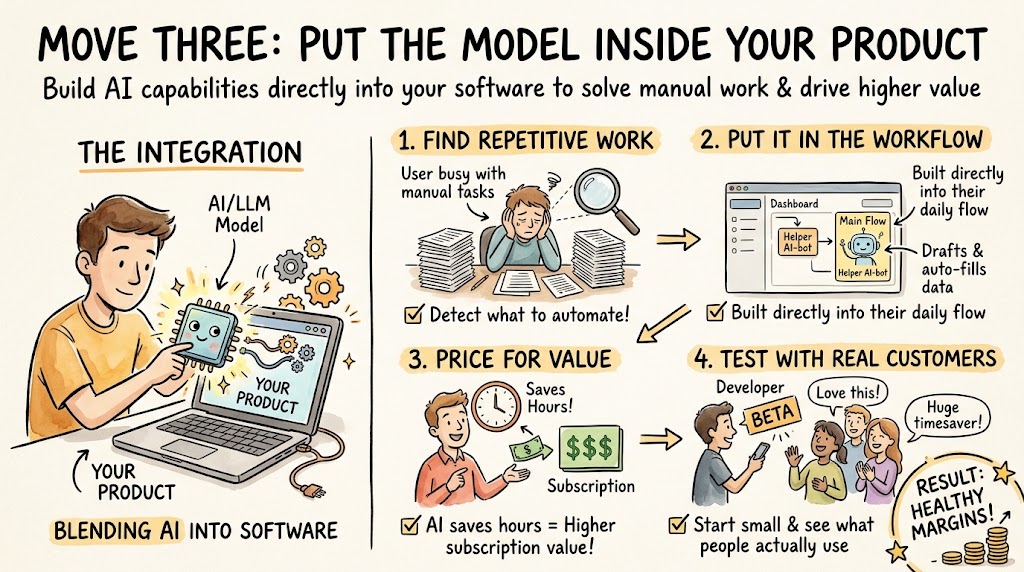
The third move is to build LLM capabilities into the product itself. That means creating features your customers can use that depend on what language models do well, so you serve them better than before. Done well, those features let you charge more, because they deliver more value. Customers will pay for a product that does part of the work for them.
This is where the founder's progress was strongest. He told me his team was making good headway on the product side and on the build speed, and that the sales and marketing pillar was the one he wanted to dig into more. That pattern is common. Teams naturally start with what is closest to the product and need extra help on go-to-market.
- Find the repetitive work. Look for tasks your users do by hand that a model could draft or automate.
- Make it part of the workflow. Features that live inside the main flow get used.
- Price for the value. If the AI feature saves hours, you can charge for that outcome.
- Test with real customers. Release small versions and learn quickly what people actually use.
Once you have all three moves in place, the question becomes what makes the business sustainable, and the answer lies in the margins.
Watch gross margins, because that is where AI-only companies struggle
One reason I am optimistic about traditional SaaS comes from what private equity and M&A firms are noticing. AI companies that make money from token usage, and AI wrappers in particular, often have low gross margins, 30% to 40% at best. The costs of running the models eat a large share of what customers pay.
A well-known legal AI company is a good example. It reportedly had a gross margin of around negative 50%, meaning it spent about $15 on cost of goods for every $10 of revenue. After it rebuilt on an open-weight model, its gross margin rose to roughly 60%, and it spent about $4 for every $10 of revenue. That shift reshaped the company's economics, and investors responded by putting in a lot of money.
Software as a service has the opposite pattern, with generally strong gross margins and a steady annuity stream when churn stays low. So the formula is not complicated. Keep churn low, keep the annuity stream growing, serve your market better than anyone else, and invest in great UI and UX with fast responses to what customers need.
- Know your cost of goods. Track what each AI feature costs to run per customer.
- Consider alternative models. Open-weight models can lower costs when the use case allows it.
- Protect your retention. Low churn is the foundation of a healthy SaaS business.
- Keep your margins visible. Investors and acquirers look at them closely, and so should you.
What to do first
If I were in your seat, I would pick the move where you are weakest and start there. For many teams that is sales and marketing. For others it is the speed of the build cycle. Set a measurable target, such as cutting idea-to-production from 90 days to 30 this quarter, and work toward it.
The founders who stay ahead are the ones who keep solving their customers' problems faster and better than anyone else, using every tool available. That has always been the game in software. AI changes the speed limit.