The SOC 2 Reality Check Every Founder Needs
SOC 2 has a reputation for being expensive, slow, and painful. A group of founders who've actually gone through it shared what it really costs, what it's really for, and one overlooked trick that can cut your annual audit down to under two hours a year.

A founder running a mobile data collection and analytics platform brought a simple question to our Enterprise mastermind: he'd just put money into a compliance platform and a consultant to help walk him through SOC 2, and he wanted to know what he should expect. Had anyone else gone through this? Was it as annoying as it looked from the outside, or was he missing something? What followed was one of the more useful exchanges we've had on the topic, partly because it included founders who'd already been through multiple audit cycles and had learned things the hard way that most compliance vendors never tell you up front.
Why founders actually do this
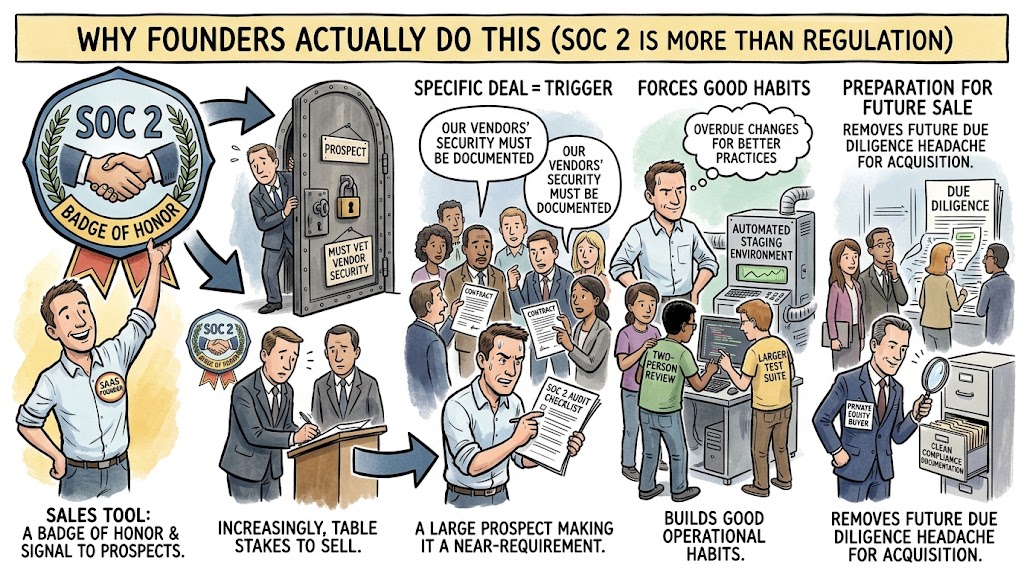
The honest answer for most SaaS companies has less to do with regulatory obligation and more to do with sales. One founder in the group put it plainly: SOC 2 functions as a badge of honor, a signal to prospects that you're following real security and operational practices, and increasingly, it's simply table stakes for selling into any company that is itself SOC 2 compliant. If your buyer has to answer for their own vendors' security posture, they need yours documented before they'll sign.
- A specific deal is usually the trigger. For the founder who raised the topic, a large prospect had made SOC 2 compliance a near-requirement, and rather than keep putting it off, he decided that was the moment to finally get it done.
- It forces good habits you should probably have anyway. Getting audit-ready pushed this founder's team to require two-person review before code hits production, set up automated staging environments, and build out a much larger automated test suite, changes that were overdue independent of the audit.
- It's also preparation for a future sale. Founders thinking about an eventual acquisition or investment noted that a private equity buyer or acquirer will expect clean compliance documentation as a matter of course, so getting it in order early removes a future due diligence headache.
What it actually costs, and how to sell without it yet
One of the more practical exchanges in the discussion was about real numbers and real timing, because most founders approaching this for the first time have no benchmark for either.
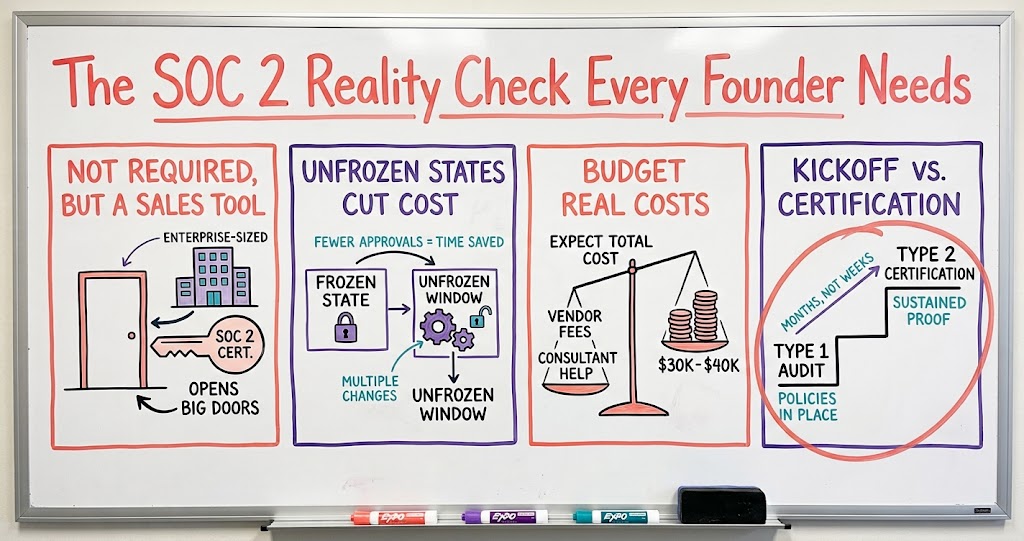
- Budget somewhere in the range of $30,000 to $40,000 all in. That range covers a compliance automation platform, several years of the required third-party audits bundled together, and hands-on help from a consultant getting you through the first round. Founders in the discussion described landing deals in that ballpark by timing their purchase near quarter-end, when compliance vendors are more motivated to close.
- You can sell before you're certified. Several founders described telling prospects directly that they'd engaged a compliance platform and were actively working toward SOC 2, with a target completion date, rather than waiting until certification was complete to have the conversation. Buyers who need the badge eventually are often fine with a credible commitment and timeline today.
- A Type 1 audit comes first, and comes fast. The first audit, called Type 1, essentially confirms you have the right policies in place at a single point in time, and you can typically get that scheduled and completed quickly once you're engaged with a vendor.
- Type 2 requires sustained proof over time. The second, deeper audit, Type 2, can only happen after you've operated under those policies for a real observation period, which is why the full process from kickoff to Type 2 certification takes months, not weeks.
The overlooked idea that can cut your annual cost dramatically
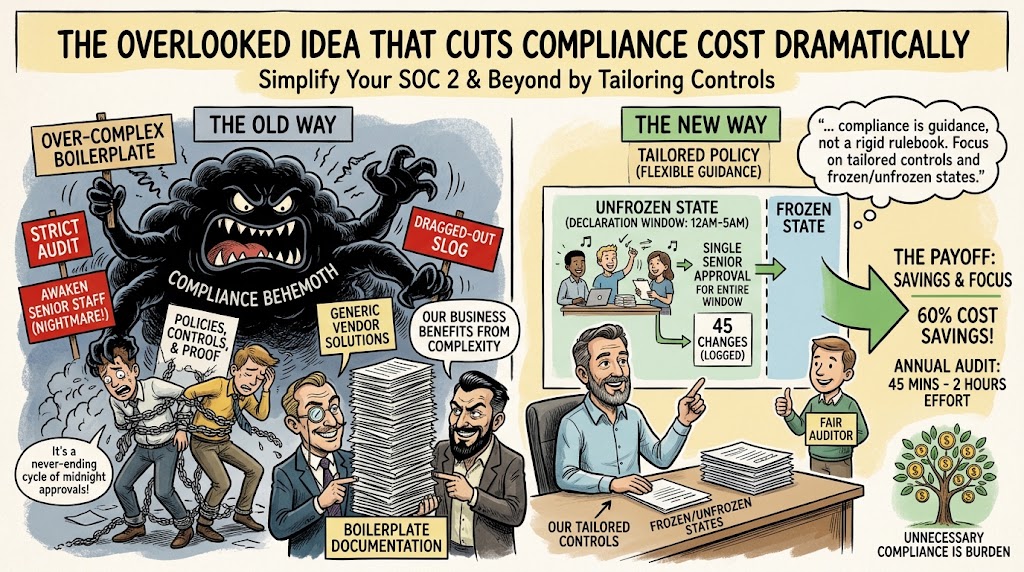
The most valuable piece of advice in the whole conversation came from a founder who has run SOC 2 and similar compliance regimes for years, both for his own company and for clients when he ran a tech services firm. His core insight: most compliance frameworks are guidance, not a rigid rulebook, and you have real latitude in how you design the policies and controls that satisfy that guidance. A lot of consultants and vendors, whose business model benefits from complexity, won't volunteer this.
- Every framework breaks down to the same three things. Policies, controls, and proof. Vendors often hand you generic, boilerplate versions of all three that are far more complex than your business actually requires, which drags out every future audit.
- Change control is usually the biggest cost driver. Most frameworks require documented approval for changes to production systems, which typically means waking up senior people in the middle of the night to approve routine fixes, an enormous and often unnecessary burden.
- Frozen and unfrozen states solve this elegantly. Borrowed from federal security guidelines, this approach lets a team declare a defined window, say, midnight to five a.m., as an unfrozen state where multiple changes can happen freely and get logged together. Once things stabilize, the team returns to a frozen state. A senior person approves the unfrozen window itself, once, instead of approving each individual change inside it.
- The impact compounds across your whole audit. One founder estimated this single change accounted for roughly sixty percent of the total time and cost savings his team found by scrutinizing their policies, turning what could have been forty-five separate approved incidents into one, dramatically reducing both audit complexity and the burden on engineering.
The payoff from applying ideas like this can be significant. One founder in the group described getting his own annual SOC 2 audit down to somewhere between forty-five minutes and two hours a year of real effort, passing every year, with only two minor findings across five years of audits. That's a dramatically different experience than the months-long slog most founders expect going in.
A few more practical details worth knowing before you start
Beyond the big structural idea, a handful of smaller, practical tips came up that are worth having on hand before you engage a vendor.
- Self-attestation is a legitimate interim step. Before you've completed a formal audit, it's common and acceptable to tell prospects you're self-attesting to a framework, meaning you're following the practices and telling them so directly, while formal certification is still in progress.
- You don't have to audit every twelve months. There's no rule requiring an annual third-party audit. Some companies stretch their audit cycle to eighteen months instead of twelve, which means paying for that additional audit less frequently without violating any requirement.
- You control the observation period, within reason. Auditors will audit whatever period you ask them to, whether that's a one-month, three-month, or twelve-month window, so there's flexibility in how you structure your compliance calendar.
- AI can meaningfully speed up the research. Reading through the full text of a compliance framework used to be a slow, painful process. Using AI tools to summarize and digest that guidance can get you to the same insight about where you have flexibility much faster than reading it cover to cover.
SOC 2 has earned its reputation as tedious, and for most founders going through it the first time, it will be. But the founders who come out the other side spending under two hours a year on it got there by treating the framework's guidance as a set of constraints they could design around, not a rigid checklist handed down from above. That mindset, more than any specific vendor or platform, is what separates a one-time compliance headache from a permanent, low-maintenance badge that keeps opening enterprise doors.
Deciding when it's actually time to start
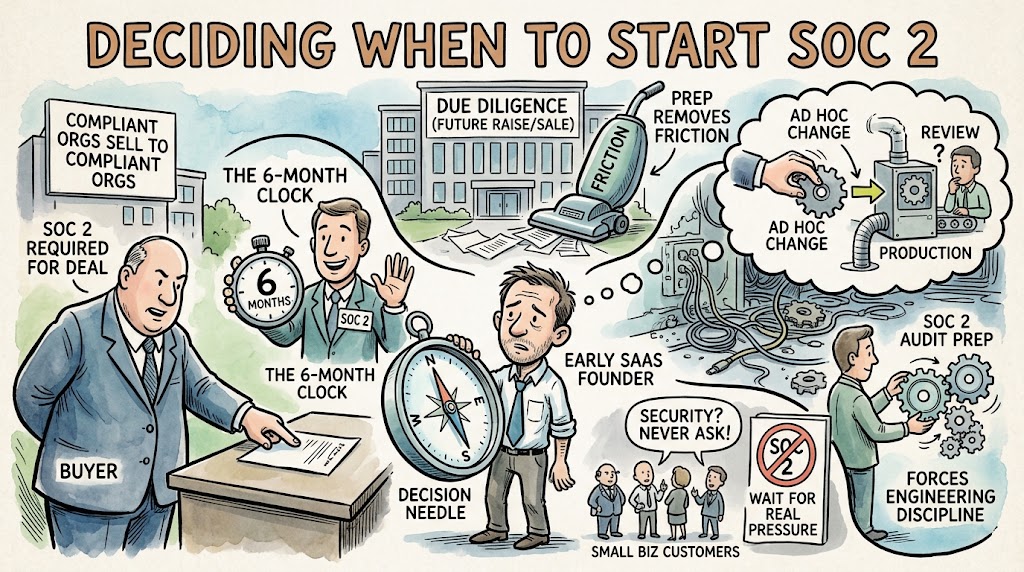
Not every SaaS company needs to start this process today, and the group was candid about that too. If you're selling primarily to small businesses or individual users who never ask about your security posture, SOC 2 can reasonably wait. The signal to watch for is much more specific than company size or revenue.
- A prospect explicitly asks for it. This is the clearest trigger. Once a real deal is genuinely at risk over the lack of certification, that's usually the moment to engage a vendor, even if certification itself takes months to complete.
- Your buyers are themselves compliant. Companies that are SOC 2 compliant frequently require the same of their vendors as a matter of internal policy, so selling into larger, more security-conscious organizations tends to bring this requirement with it.
- You're preparing for a future raise or sale. If an exit or investment is realistically on the horizon within the next year or two, getting compliance documentation in order ahead of time removes a predictable source of friction during due diligence.
- Your engineering practices already need the discipline SOC 2 forces. If you're still making ad hoc changes directly in production with no review process, the audit prep itself might be reason enough, independent of any specific sales trigger.
Waiting until the pressure is real, rather than pursuing certification speculatively, is a reasonable default for most early-stage SaaS companies. Just don't wait so long that a six-month certification timeline becomes the reason you lose the deal that finally asked for it.