
The Results Achieved From Implementing the B2B SaaS Growth System
This article breaks down the real results B2B SaaS founders achieved after implementing a structured growth system — including revenue growth, pipeline expansion, conversion improvements, and retention gains. If you want to understand what predictable SaaS growth actually looks like in practice (and what it takes to build a scalable revenue engine), this post shares the metrics, patterns, and lessons from companies that have done it successfully.

When founders ask me if the B2B SaaS Growth System “works,” what they usually mean is: will it produce measurable results that show up in pipeline and revenue, without torching unit economics?
That’s the bar. Not impressions for the sake of impressions. Not “we got busy.” Real, bankable outcomes.
The system is designed around one goal I repeat a lot because it’s the only thing that matters long-term: “The whole point of this system that we’ve invented is to make your brand omnipresent within a targeted market.”
And to be clear, omnipresent doesn’t mean everywhere. It means everywhere that matters.
“You can’t make a B2B brand omnipresent like Coca-Cola in the whole world, but what you can do is find the twenty to forty thousand people that really influence the buying decision within your target market and make your brand as well known as Coca-Cola for those forty thousand people.”
So what results do companies actually get when they implement this system properly?

The flagship outcome: profitable scale from ads (without CAC blowups)
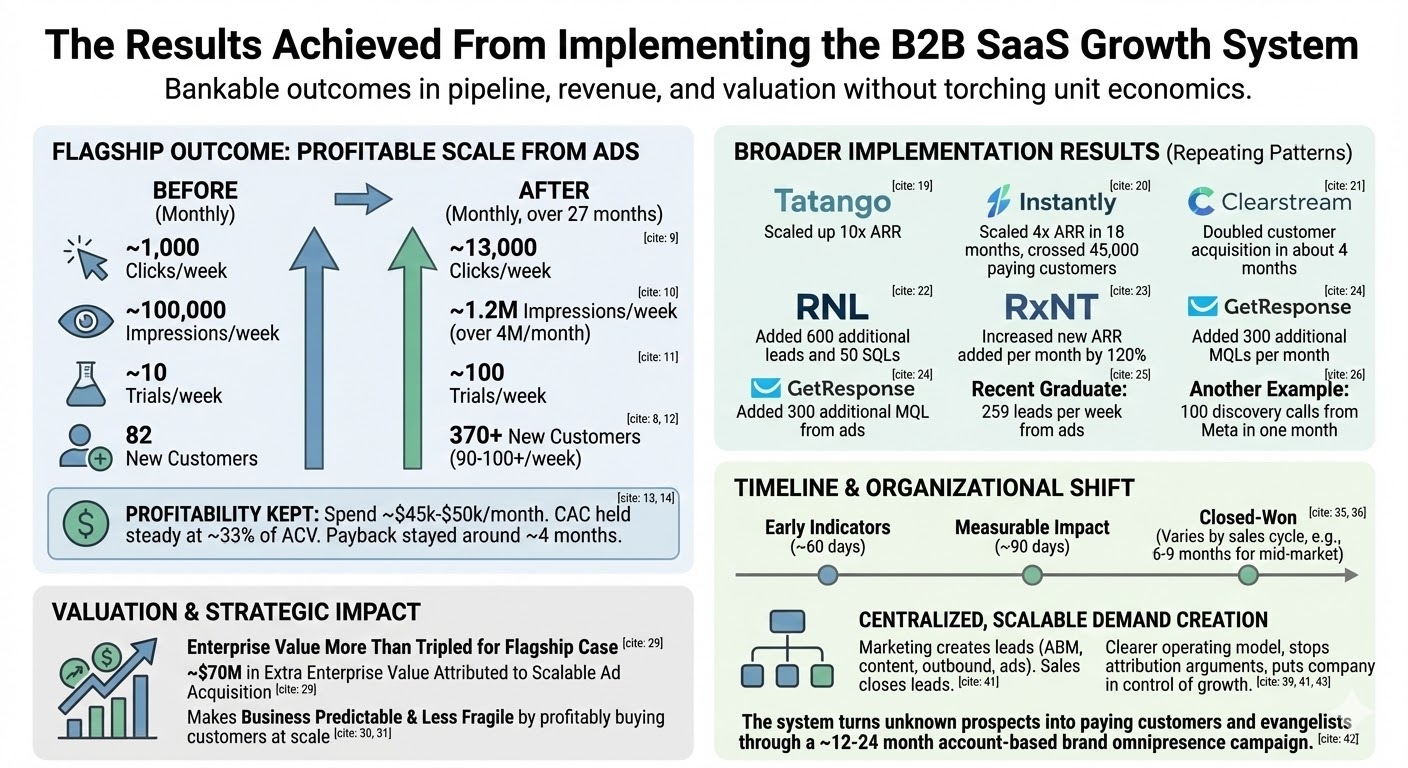
The cleanest “before/after” example from the webinar is a SaaS Rise member that implemented what we call a multichannel brand omnipresence campaign over 27 months. They scaled from 82 new customers per month directly from ads to 370+ per month.
That’s not a small lift. That’s turning paid acquisition into a core growth engine.
Here’s what changed operationally and what it produced:
- Clicks scaled from ~1,000/week to ~13,000/week.
- Ad impressions climbed from ~100,000/week to ~1.2M/week (over 4M/month).
- Trials from ads rose from ~10/week to ~100/week.
- New paying customers from ads went from ~20/week to 90–100+ per week.
- Spend reached roughly $45k–$50k/month, and the key point: it stayed profitable.
- CAC held steady at ~33% of ACV and payback stayed around ~4 months, helped by ARPA increasing over time.
If you’ve ever tried to scale paid, you know why that last line is the whole story. As I said on the webinar: “Usually, when you 10x ad spend, you at least 3x or 4x CAC. Here, we have been able to keep CAC steady at 33% of ACV.”
That’s what “results” means in SaaS. Not just more leads. More customers, with payback that still makes sense.
What companies see beyond the flagship case
The flagship case is one company. But we’ve now had 75 companies go through the program cohorts over the last ~year and a half, and you start to see repeating patterns in what happens when teams actually implement.
On the webinar, I shared several snapshots of outcomes from implementing the process:
- Tatango scaled up 10x ARR.
- Instantly scaled 4x ARR in 18 months, and crossed 45,000 paying customers (and we’re still working together).
- Clearstream doubled customer acquisition in about 4 months.
- RNL added 600 additional leads and 50 SQLs into the pipeline.
- RxNT increased new ARR added per month by 120%.
- GetResponse added 300 additional MQLs per month.
- One recent graduate highlighted 259 leads per week from ads.
- Another example referenced 100 discovery calls from Meta in one month.
Those are different businesses, different ACVs, different markets. The reason the outcomes rhyme is that the underlying mechanics rhyme: list → content → outbound → ads → conversion rate optimization → sales follow-through.
.jpg)
The valuation impact (why I’m so stubborn about ads + unit economics)
A lot of founders don’t really care about lead volume. They care about enterprise value. They care about optionality.
In the flagship ad-scaling case, I said this pretty bluntly: the firm’s valuation more than tripled because growth became predictable, and I referenced roughly $70M in extra enterprise value attributed to their ability to scale customer acquisition through ads.
That’s why I make the point that some people find controversial: “The difference between a three or five million ARR company and a forty to fifty million ARR company is making paid customer acquisition through digital ads scalable.”
It’s not because ads are trendy. It’s because once you can profitably buy customers at scale, the business stops being fragile.
And by the way, “profitable” has a definition. In our slides, we define it as ads paid back within 6 months of revenue or less (CAC < 50% of ACV and < 20% of LTV).
What to expect on timeline (and why patience is part of the system)
Another question I get constantly is: How fast do we see results? The honest answer is: you can see early indicators quickly, but closed-won depends on your sales cycle.
Here’s how I answered it on the call: you’ll typically see impact starting around 60 days, measurable impact around 90 days, and then closed-won often follows later depending on ACV and cycle length. In many mid-market motions, you might be looking at 6–9 months from initial influence to closed-won.
This is why we anchor to CPQL early. If you can measure cost per qualified lead by channel, you can scale the channels that are generating qualified pipeline efficiently, even before all revenue has matured.
The hidden result: a centralized, scalable way to create demand
One underrated outcome from implementing the system is organizational clarity.
Too many SaaS companies run growth like a relay race where no one owns the whole track. SDRs “do leads.” Marketing “does awareness.” Sales “does closing.” Then everyone argues about attribution.
The system forces a cleaner operating model. As I said in the webinar: “We like centralized scalable models… lead acquisition is the role of marketing, not the role of sales. The role of sales is to close leads. The role of marketing is to create the leads.”
When you build the ABM list centrally, run weekly content, layer outbound, and then run ads with real tracking, you stop guessing. You start managing a machine.
And that loops back to the real “north star” outcome: “Turn people who are in your target market, but you don’t know them and they don’t know you, into people who are paying customers and evangelizers over the course of about a twelve to twenty four month account based marketing brand omnipresence campaign.”
That’s what the results look like when the system is implemented for real: more pipeline, more customers, stable payback, and a company that feels like it’s in control of growth instead of hoping for it.
.jpg)
.jpg)