
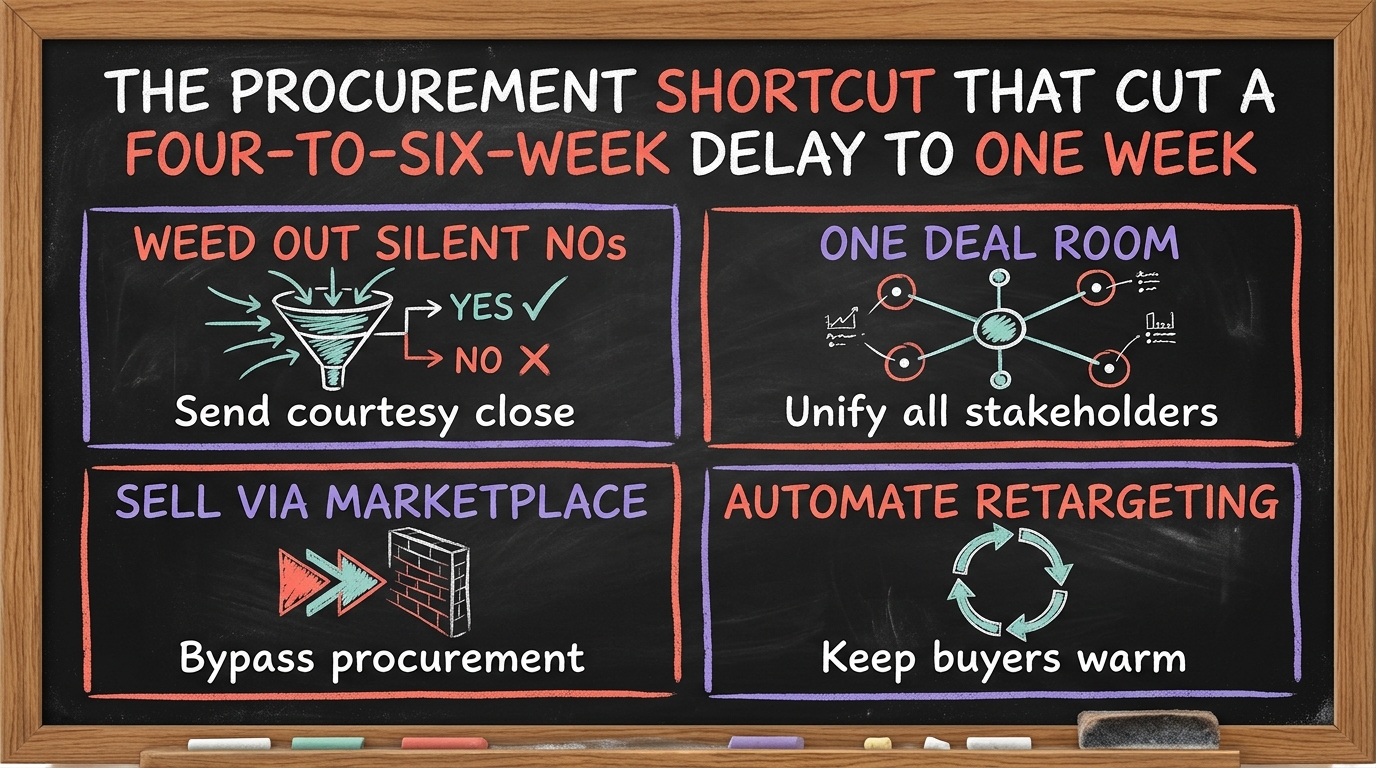
The Procurement Shortcut That Cut a Four-to-Six-Week Delay to One Week
Enterprise deals often stall after the buyer has already said yes. Selling through a cloud marketplace, running a deal room, and keeping prospects warm with retargeting and weekly content can shorten the whole cycle.

Every B2B founder has lived this one. The buyer says yes, the champion is excited, and then nothing happens for six weeks. Legal has questions, procurement has a form, and the deal that felt closed sits in a queue. In this month's mastermind, a few founders compared notes on how to shorten enterprise sales cycles, and the answers ranged from a single email to selling through a different channel entirely.
Some context helps. One founder was worried that his cycle had stretched from about six weeks to seven or eight, which felt long for his offer. For many of us on the call, a cycle of six to seven weeks sounds wonderful. Plenty of founders in the group see six to seven months, and deals above fifty thousand dollars can take twelve to fifteen months. One founder who replaces mission-critical systems of record described cycles that run for years. So the question is less about hitting a number and more about finding the specific places your deals lose time.
First, find out if the cycle is long or just undecided
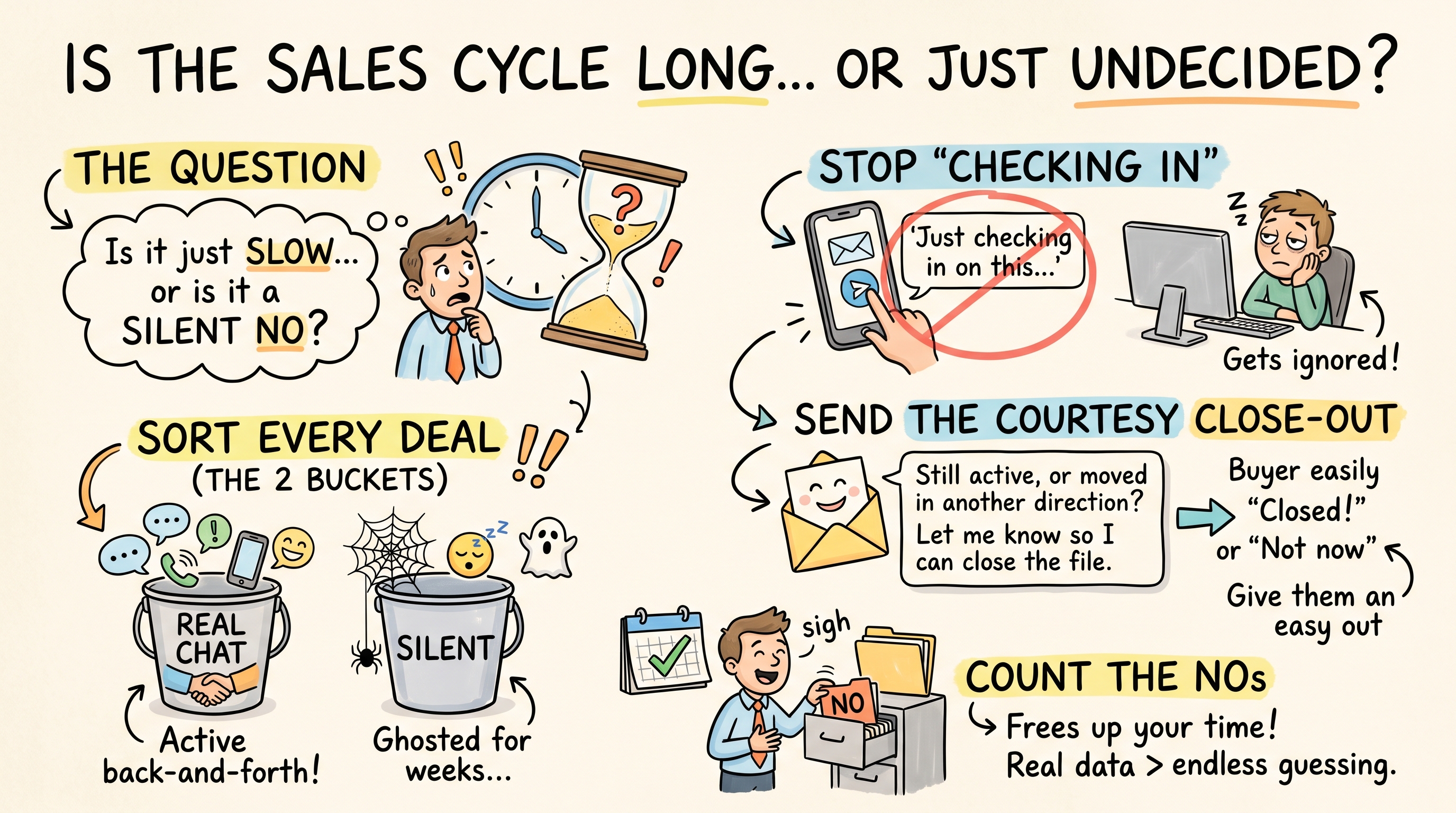
A founder who has been selling for a long time offered the first piece of advice, and it is the cheapest one. He said sales cycles have been longer for his company this year, with a lot of deals ending in no decision and timing problems, and he heard the same from other people. Then he asked a question that changed the conversation. When you say your sales cycle is getting longer, are those deals actually slow, or are they closed-lost deals that nobody has told you about yet? The end of a sales cycle includes a decision not to buy, a change of direction, or a project on hold. If a large share of your slow deals are really silent no's, your cycle may be shorter than it looks, just with an answer you did not want.
- Separate slow from silent. Sort every open deal into one of two buckets: a real conversation is happening, or you have not heard anything in weeks.
- Stop sending check-ins. Messages that say you are checking in or asking what is going on with the initiative tend to get ignored.
- Send the courtesy close-out email. Ask them to let you know if this is still an initiative or if they have moved in another direction, so you can close it out.
- Count the nos. A definitive no still gives you a real cycle length and frees your team's time.
The email works because it gives the buyer an easy way to answer. Nobody has to defend a decision or schedule a call. They just reply with a sentence, and you finally know where the deal stands. The founder who raised the original question said he suspected a significant share of his slow deals were exactly this kind, which is useful information on its own.
Deal rooms: one place for every stakeholder
A founder who sells enterprise software to large hotel companies described the problem with multi-team deals. His company often has to give two, three, four, or even five demos to different groups. The operations team wants to see operational functionality and the reporting tools. The accounting team wants to see how the general ledger connects to daily report data, along with accounts receivable and fixed assets. Each group needs to be convinced, and the person who championed the product inside the company is left trying to explain it to the others. His company is setting up a deal room to fix that. The champion gets a single place with the documentation, the demo recordings, and the materials for each team, so the people who did not attend a demo can still see it and get on board.
- One link per deal. Documents, recordings, and proposals live in a single place the champion can share.
- Demos on demand. Stakeholders who missed the live session can watch it later and ask better questions.
- Connected to your CRM. The tool they chose integrates with HubSpot, so sales and onboarding see the same history.
- Reused in onboarding. Customers who watched the demo understand why they are being asked to do work during implementation.
That last point matters more than it sounds. Implementing a system of record takes effort from the customer's team, and people who never saw the demo ask why they are doing any of it. Getting consensus across several teams before the contract is signed pays off again after it. The company expects about twelve to fifteen users on the tool, which is a small number against the size of the deals.
Selling through a cloud marketplace
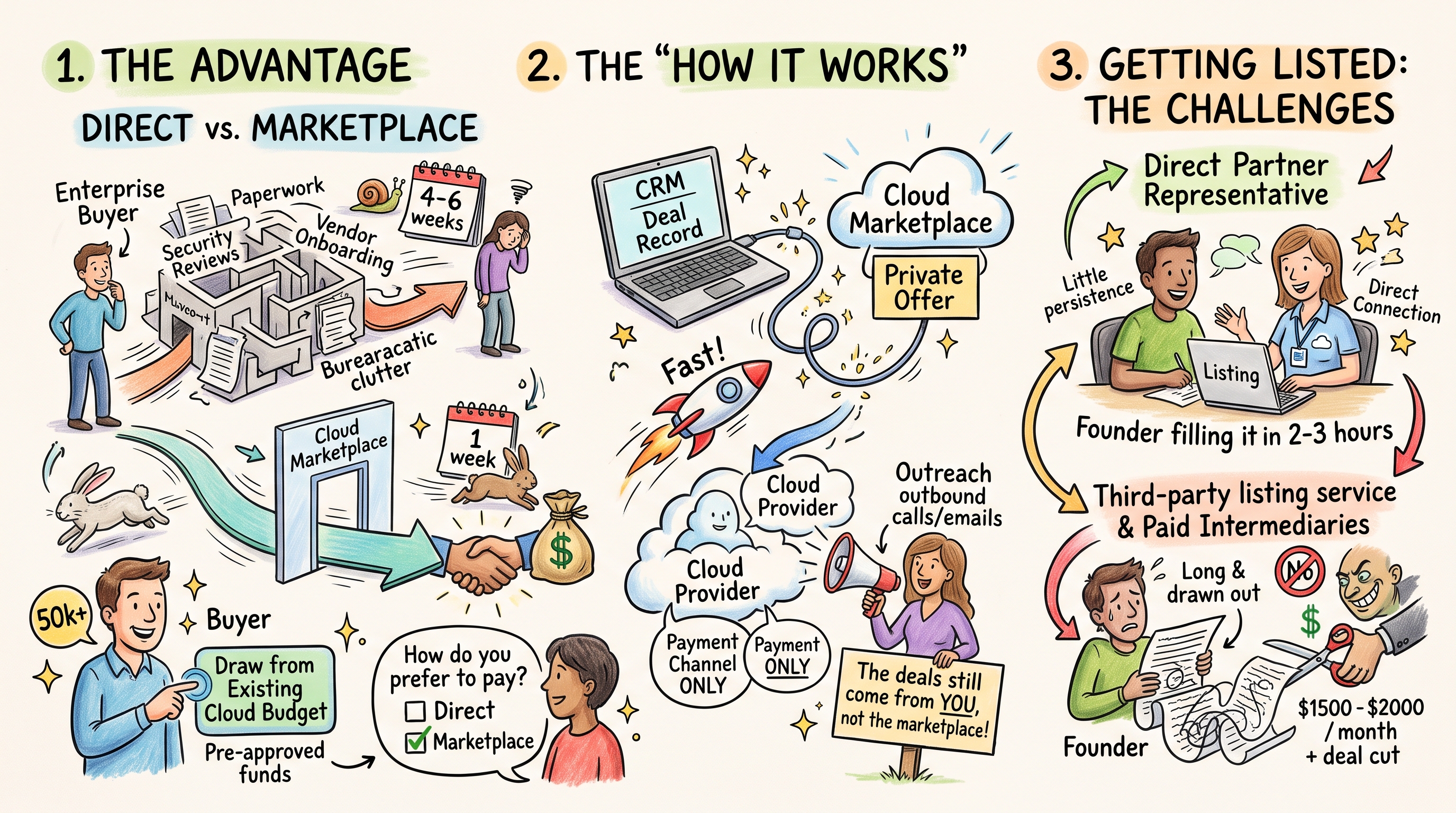
The most surprising idea came from a founder who sells through the major cloud marketplaces and connects them to his CRM. His company creates private offers, and the buyer pays through the marketplace instead of paying the vendor directly. Enterprise buyers often have spending commitments with the cloud provider already, so the purchase draws from a budget that has been approved. His team has done about six deals this way. His experience was that when a buyer above roughly fifty thousand dollars comes to them directly, the paperwork adds four to six weeks even after the buyer has agreed. When the same kind of buyer goes through the marketplace, the deal closes in about a week, because the procurement forms, security reviews, and vendor onboarding do not come up in the same way.
- Ask how they prefer to pay. During procurement, ask whether the buyer wants to contract directly or buy through a cloud marketplace.
- Expect larger buyers to say marketplace. Most enterprise buyers above about fifty thousand dollars preferred it because the budget was already set.
- Do not expect leads from the marketplace. In his experience the deals still come from your own outreach, and the marketplace is the payment channel.
- Connect it to your CRM. Creating the offer from the deal record keeps the process fast.
Getting listed is the harder step. His company already had direct contacts at the cloud providers, and they helped set up the listing in two to three hours with someone sitting down to fill out the document alongside them. Without that contact, a founder in the group has been working with a third-party listing service and finding the process longer and more drawn out than expected. There are also paid intermediaries who handle everything, but the founder who has done this does not recommend them. They charge roughly fifteen hundred to two thousand dollars a month and take a cut of each deal, and that adds up. His advice was to find the cloud provider's partner representative, which can take persistence, because they do not respond to cold requests very quickly.
Keep buyers warm while they wait
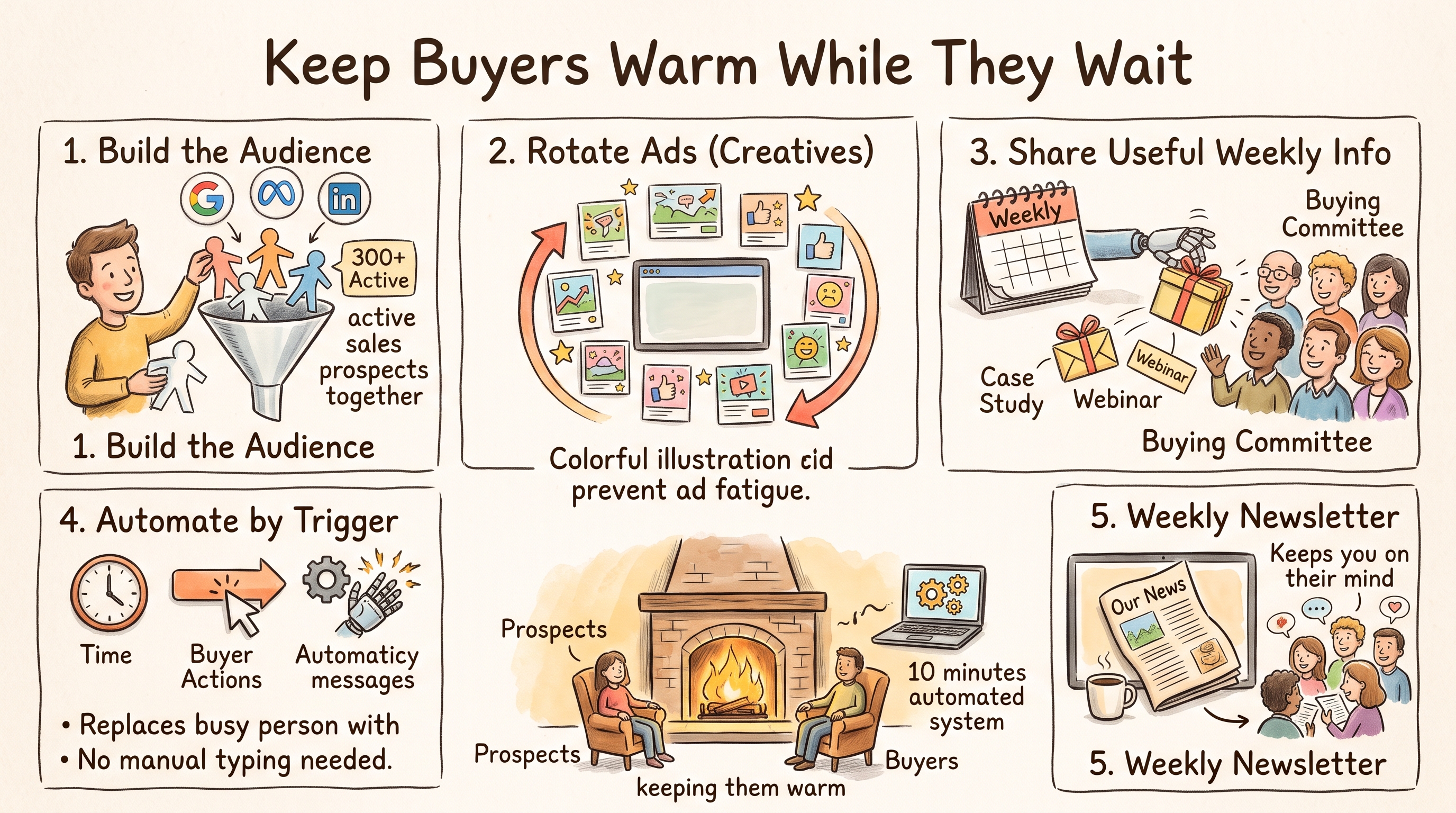
On the marketing side, I shared two things that cost very little and help while a deal moves through a long process. The first is retargeting. Make sure every prospect in an active sales process sees ads on Google Display, Meta, and LinkedIn. Display and Meta usually run about thirty to fifty dollars per thousand impressions, and LinkedIn is closer to one hundred to one hundred and fifty. You can build a matched audience from everyone engaged in your sales process, as long as it contains at least about three hundred people. Show those people ads more often than you would show ordinary site visitors, and use around ten different creatives so nobody sees the same message every time. That costs a few hundred dollars a month. The second thing is education. Once a week, everyone in the sales process should receive something useful, such as a case study or a webinar recording, delivered by automation and not only by a rep writing manually.
- Build the audience. Include everyone who has engaged in your sales process, as long as the list is large enough for the ad platforms.
- Rotate creatives. Around ten variations prevent fatigue.
- Send something useful weekly. Case studies, webinar recordings, and other educational content keep your company in front of the buying committee.
- Automate by trigger. Set follow-ups based on time, on actions the buyer takes, and on deal changes, along with broader sends to everyone in the funnel.
If you do not have a high-quality weekly newsletter, a real and warm one, start one. It does not shorten the contract review, but it keeps every person on the buying committee seeing your name between meetings.
When the cycle cannot be shortened, widen the funnel
One founder closed his remarks with an honest observation. Sometimes you cannot speed up how fast prospects move through the funnel, particularly when you are replacing a core system. His company is about to sign a large enterprise customer that it has been pursuing for more than three years, meeting at conferences and flying to their offices. When the cycle is that long, the only way to grow faster is to put more companies into the top of the funnel. Credibility is the other lever, and his team works on it by building an authority engine of content so buyers have fewer reasons to hesitate. None of these ideas is a magic fix. Together they reduce the number of weeks a deal spends waiting, which is where most of the time goes.