

The New Way to Build a SaaS With AI Coding
AI coding is changing how SaaS companies get built — but it’s not about replacing engineers. It’s about compressing the time between idea and validation. In this article, Ryan Allis breaks down how founders can use AI-assisted development to ship faster, iterate smarter, and combine product velocity with disciplined distribution to build scalable SaaS businesses in 2026 and beyond.

For most of the past two decades, building a SaaS company followed a predictable pattern. You either knew how to code, found someone who did, or raised enough money to hire a team that could turn your vision into software. Engineering capacity dictated speed. Roadmaps were gated by sprint cycles. Every feature carried opportunity cost.
I’ve built SaaS companies inside that model. It works. But it’s no longer the only way to play.
AI coding has fundamentally altered the early stages of SaaS creation. It hasn’t eliminated the need for engineers, nor has it magically made product-market fit easier. What it has done is compress the distance between idea and execution. And when you compress time in a startup, you change everything.
The founders who understand this shift are not simply building faster. They’re learning faster. And learning velocity is what ultimately drives revenue.
The Old Bottleneck Was Technical Execution
In the traditional SaaS model, engineering was the constraint. You could have perfect clarity about your market and a strong thesis about your solution, but if your team needed six weeks to ship a feature, you waited six weeks. If customers gave you feedback that required structural changes, you scheduled another cycle and burned more capital.
That friction forced caution. It encouraged founders to overplan, to design elaborate v1 products, and to delay customer exposure until everything felt polished.
AI coding changes the economics of that decision.
Today, a focused founder can scaffold an application, wire up authentication, integrate APIs, and iterate on features with the assistance of AI copilots and code-generation tools in a fraction of the time. You can describe functionality clearly and receive a usable draft. You can refactor quickly. You can test variations without dedicating entire engineering sprints.
But here’s the nuance: AI removes repetitive effort. It does not remove the need for judgment.
The bottleneck has moved. It is no longer “Can we build this?” It is “Should we build this, and for whom?”
That’s a much more strategic question.
%20(1).png)
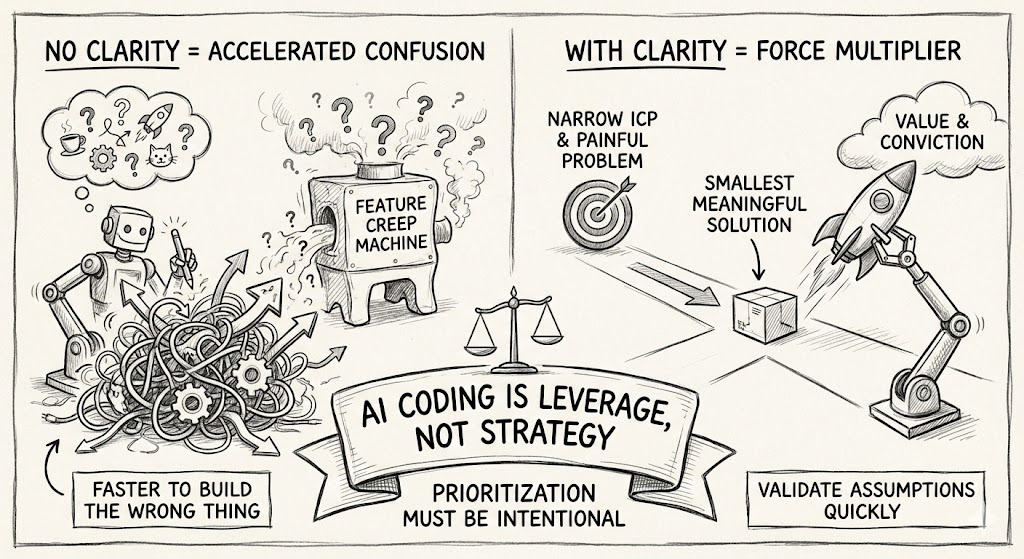
AI Coding Is Leverage, Not Strategy
There’s a real risk emerging right now. Because it’s easier to build, it’s easier to build the wrong thing faster.
When engineering is expensive, prioritization happens naturally. When engineering becomes cheaper, prioritization must become intentional.
The founders who will win in this AI-assisted era are the ones who are relentlessly clear about three things:
- A narrowly defined ICP with specific characteristics
- A painful, expensive problem that this ICP actively wants solved
- The smallest possible solution that delivers meaningful value
Everything else is noise.
AI coding allows you to move from concept to functional product quickly. That speed should be used to validate assumptions, not to indulge feature creep. The goal isn’t to ship more code. The goal is to reach conviction about what the market will pay for.
If you don’t have clarity, AI accelerates confusion. If you do have clarity, AI becomes a force multiplier.
The Real Advantage Is Learning Velocity
The most powerful outcome of AI coding is not cost reduction. It’s iteration speed.
In the past, you might talk to five customers, collect feedback, then wait weeks before you could implement meaningful changes. Now, you can speak with customers in the morning, adjust logic in the afternoon, and deploy improvements the same day.
That changes the founder’s daily workflow.
Instead of managing tickets and coordinating timelines, you spend more time:
- Refining positioning and messaging
- Conducting customer interviews
- Testing small feature increments
- Adjusting pricing or packaging based on real conversations
This tighter loop between feedback and execution compounds over time. Over 90 days, dozens of micro-adjustments create a dramatically different product than a static roadmap ever could.
Iteration speed becomes a competitive moat.
Build With AI, Validate With Revenue
One of the biggest mistakes I still see founders make is waiting too long to sell. AI makes this temptation even stronger because it’s now so easy to keep improving the product in isolation.
But SaaS businesses are validated by revenue, not by completeness.
The new way to build a SaaS with AI coding looks less like “build, polish, launch” and more like “define, build small, test, adjust.”
Start with a tightly scoped problem. Build the minimum version that allows someone to experience value. Then immediately put it in front of your defined market.
That means building your account list before your product feels finished. It means crafting messaging while you’re still refining features. It means activating outbound and LinkedIn outreach as soon as there’s something real to demonstrate.
The founders who move fastest are the ones who are comfortable shipping imperfect but useful versions, then improving them in public.
AI Changes Who Can Enter the Game
Historically, the ability to build software filtered who could start a SaaS company. Technical co-founders were scarce. Early capital was required. The barrier to entry was high.
AI coding lowers that barrier.
A non-technical founder with product clarity can now build a credible v1. A small team can prototype ideas that would have required significant resources just a few years ago.
But lowering the barrier to entry doesn’t guarantee success. In fact, it raises the importance of distribution and discipline. When more products can be built, differentiation shifts away from code quality and toward market presence.
Which brings us to the part that hasn’t changed.
Distribution Still Wins
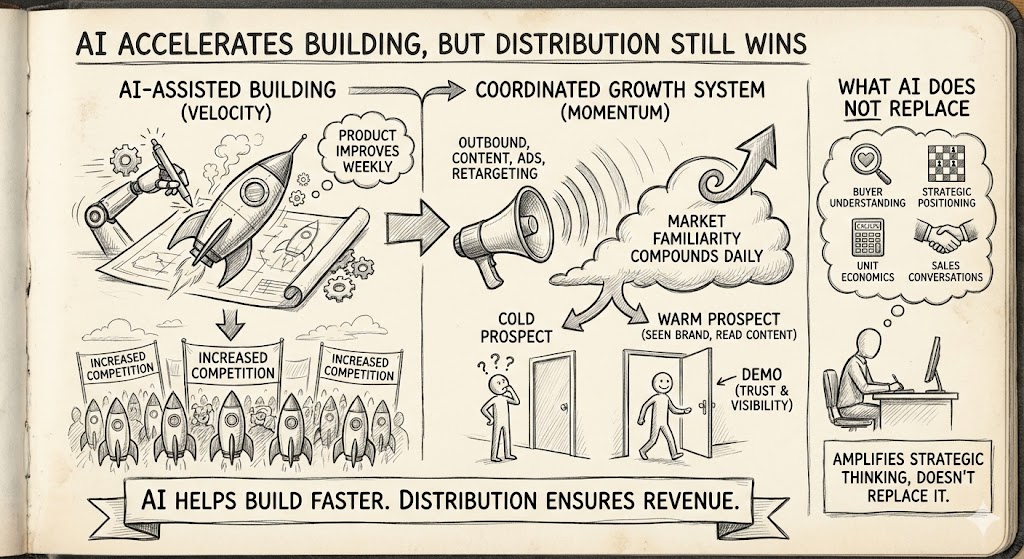
If AI makes product development easier, it also increases competition. More founders will ship tools. More solutions will exist for every niche.
The companies that win will not be the ones with the most elegant codebase. They will be the ones who build visibility and trust inside their market early.
That means pairing AI-driven product velocity with a coordinated growth system.
Outbound should not wait until your roadmap is complete. Content should not be treated as an afterthought. Matched audience ads and retargeting should reinforce your message while you’re still iterating on features.
When you combine AI-assisted building with structured distribution, you create momentum on two fronts at once:
- Product improves weekly
- Market familiarity compounds daily
That dual motion is powerful.
A prospect who has seen your brand consistently, read your content, and clicked your outbound emails will approach a demo very differently than someone encountering you for the first time.
AI helps you build faster. Distribution ensures that speed translates into revenue.
What AI Does Not Replace
It’s worth being explicit about what remains unchanged.
AI coding does not replace deep understanding of your buyer. It does not replace thoughtful positioning. It does not eliminate the need to track unit economics, customer acquisition cost, and lifetime value carefully. It does not close deals.
As you scale, you will still need experienced engineers to harden infrastructure, improve performance, and manage complexity. You will still need sales conversations to uncover nuance and handle objections.
AI removes friction from early execution. It does not remove the need for strategic thinking.
If anything, it amplifies it.
A Founder’s Perspective
When I built earlier SaaS companies, including iContact, the pace of product development was simply slower. Every meaningful shift required coordination across teams. Every iteration consumed time and capital.
If we had access to today’s AI tools, we would have tested more ideas earlier. We would have validated faster. We likely would have reached scale sooner.
But what ultimately drove growth wasn’t just product improvements. It was disciplined marketing, outbound execution, paid acquisition, and constant feedback from customers.
That remains true.
AI coding changes the front end of the journey. It shortens the path from idea to traction. But sustainable SaaS growth still requires a structured system around it.
Final Thoughts
The new way to build a SaaS with AI coding is not about replacing engineers or chasing every shiny tool. It’s about removing unnecessary delay.
You can now move from concept to usable product quickly. You can iterate in days instead of weeks. You can test pricing, features, and workflows with minimal friction.
The real opportunity is not in building more. It’s in learning faster than your competitors.
If you combine AI-assisted development with clarity of market focus and a coordinated go-to-market system, you can compress what used to take years into a much shorter window.
Build narrowly. Ship quickly. Talk to customers immediately. Track your numbers weekly. Improve relentlessly.
AI is the accelerator. Your thinking is still the engine.
And the founders who master both over the next few years are going to build very meaningful companies.