
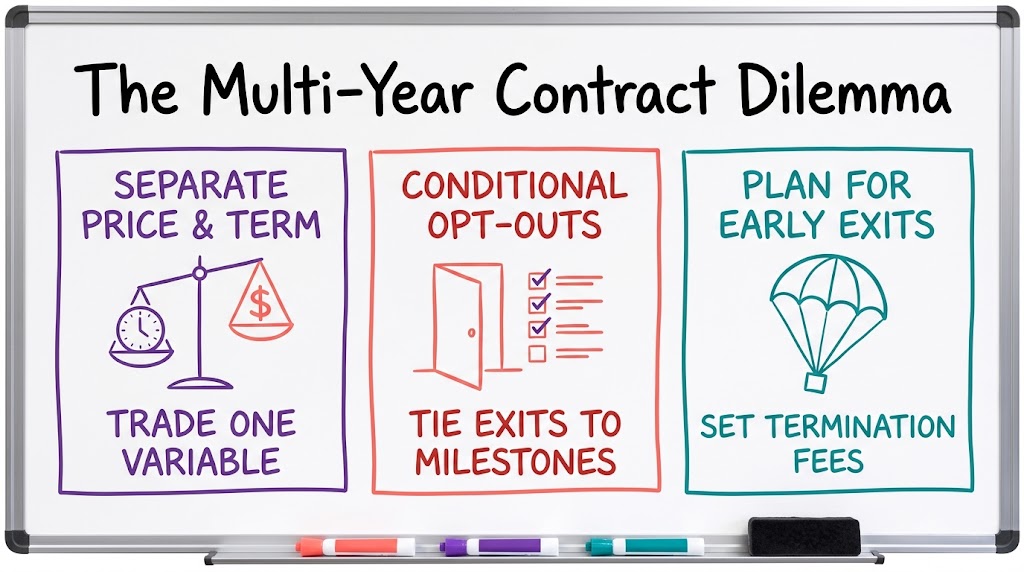
The Multi-Year Contract Dilemma
Holding out for a three-year term can add two months to an enterprise sales cycle, but giving it up can cost more. Here is how founders compromise on contract length without handing customers a free exit.

Every founder who sells to larger companies eventually has the same argument with a prospect. You want a three-year commitment because your sales cycle is long, your onboarding is heavy, and you need time to earn back what it cost to land the account. The buyer says their company never signs multi-year deals. One founder in our Enterprise SaaS mastermind put a number on what standing firm costs him: it adds roughly two months to the sales process, because the contract goes through a full internal review. He held the line, the deal was approved, and he still described the experience as painful.
Our group spent a good chunk of a recent call on this question, and what came out of it was less a single answer than a set of tools. Here are the ones that held up under questioning, starting with the idea that contract length and price are two separate negotiations.
Commitment and price are separate conversations
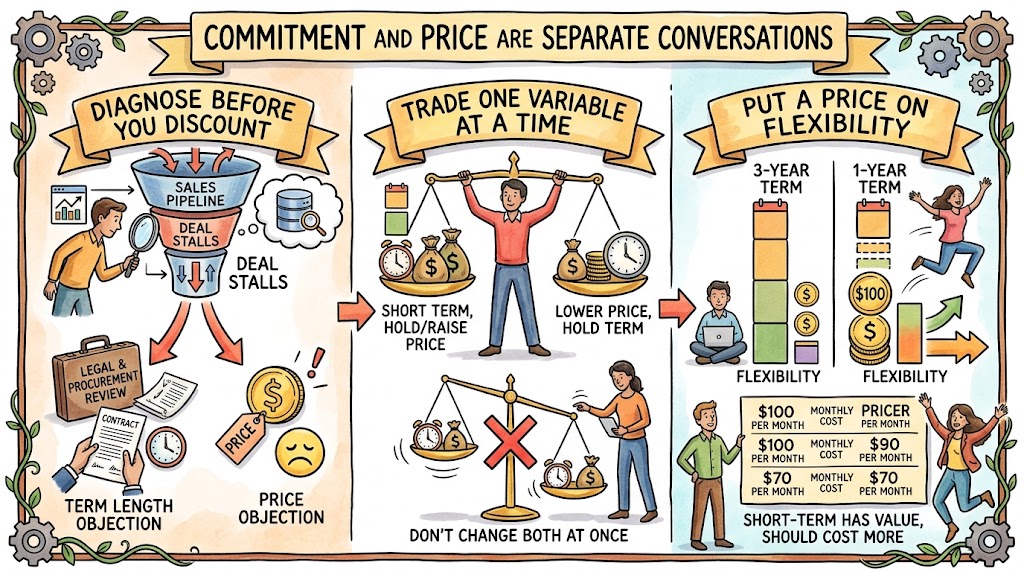
When a founder asks whether a cheaper first-year offer might get a hesitant buyer through the door, the answer depends on what is actually slowing the deal. One member asked the obvious diagnostic question: can you confirm from your own sales data that the three-year term is what stretches the cycle, or is it the price? In this case the founder felt fairly sure it was the term, since plenty of buyers say up front that they never do multi-year deals. That matters, because a discount does nothing for a buyer whose real objection is the length of the commitment, and a shorter term does nothing for a buyer whose objection is budget. Mixing the two means you might give away price to solve a term problem.
- Diagnose before you discount. Pull the last ten or fifteen deals and look at where they stalled. If the delay shows up at legal and procurement review, the term is the issue. If it shows up at the budget conversation, price is.
- Trade one variable at a time. If you shorten the term, hold the price or raise it. If you lower the price, hold the term. Changing both in one move gives away more than you meant to.
- Put a price on flexibility. As one founder said in the room, if you are going to shorten the time, you need to up the price. A customer who wants the option to leave early is asking for something of value.
That last point is worth a beat of reflection. Founders often treat a shorter term as a concession made out of weakness, when it is really a different product with different economics. You carry more risk on a one-year deal, so the one-year deal should cost more per month than the three-year deal. Once you frame it that way, the conversation with the buyer gets a lot calmer.
The conditional opt-out is the compromise that works
The most useful idea of the call was the conditional opt-out. One founder described it this way: when a client pushes hard and you really want the business, you can come down to six months or offer an opt-out, with the condition that the customer does the things you both agree they need to do to be successful. If they skip the onboarding work, stop using the product, or never roll it out to their team, the opt-out goes away. A second member said this has been a good compromise in his own deals, where the opt-out sits in the contract as one line item among many and, in his experience, half of those conditions never come into play.
- Tie the exit to customer behavior. Name specific milestones, such as completing onboarding, hitting a usage threshold, or assigning an internal owner. The opt-out only applies if the customer has held up their side.
- Keep the contract anchored at three years. You can still sign the long term and let the opt-out sit at month twelve. The buyer gets a parachute and your paper still says three years.
- Write it into the standard contract. Adding it as one of many terms keeps it from looking like a special favor, and it keeps your reps from inventing a new version of it in every deal.
The logic underneath is that most buyers asking for a short term are really asking for protection against a bad outcome. If you give them a clear, conditional way out, many will never use it, and a good number will stop asking for it once they see it on paper.
Ask why they want the shorter term
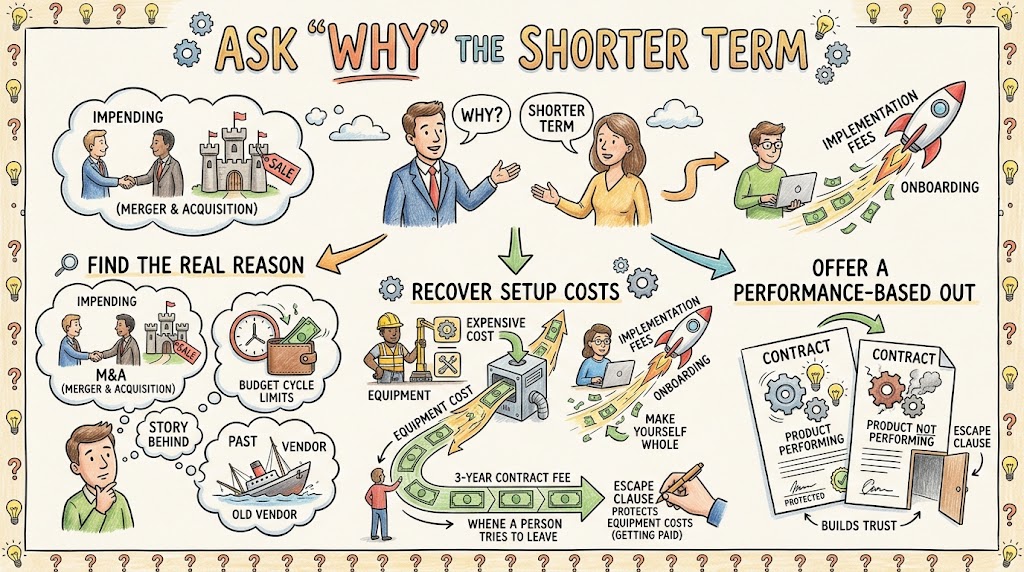
One CEO in the group shared a habit that cuts through a lot of negotiation. When a customer asks for a shorter term, he asks why. Is something happening in the business? Are you planning to sell the company in a year? He sells to a lot of private equity backed firms, and often the answer is yes, they are heading toward a transaction and do not want a long vendor commitment on the books. Once he knows that, he can write an escape clause for that specific event instead of discounting the whole agreement, and he can protect himself with terms that cover the goods and setup he has already put into the account.
His own product requires a physical component installed at the customer's site, so he has a structural reason for wanting three years: the cost of that equipment is built into the monthly price. His answer to early exits is to make sure he gets paid for what he installed. The software-only founders on the call heard this and asked the fair follow-up, which is why they would not do the same with implementation fees.
- Find the real reason. A request for a shorter term usually has a story behind it: an acquisition, a budget cycle, a failed vendor in the past. Each one has a different fix.
- Recover your setup costs. If an early exit is possible, charge implementation, onboarding, or equipment so that you are made whole when a customer leaves in year one.
- Offer a performance-based out. Several members noted that customers always get an escape if the product is not performing. Making that explicit builds trust without giving up the commitment when things are going well.
What happens when a customer leaves early
The harder conversation came when one founder asked whether anyone had seen customers cancel for convenience and simply refuse to pay the remaining years. The honest answers were not comforting. One CEO said he speaks to his lawyer every week. He has had large enterprise customers, with years still left on their contracts, send immediate termination notices for weak reasons, and in two cases he settled for a fraction of what was owed. His point was that when a much larger company decides to walk, the cost of fighting can be higher than the recovery, and they know it.
- Set the termination fee in advance. One founder put a 50 percent termination fee in the contract, so a customer who wants out simply pays half of what remains. That removes the argument before it starts.
- Expect pushback even with a clause. Another member had a 75 percent escape clause and still had a customer cite a questionable breach. Language helps, but enforcement against a larger counterparty is expensive.
- Convert to usage-based pricing. One CTO said that when a customer wants to cancel mid-term, his team moves them to usage-based pricing with a premium on top. It has worked both times they tried it, and the customer keeps some flexibility while he keeps some revenue.
- Do not accept cancel for convenience. A member who has been through this said he would rather negotiate a clear, mutual statement of exit terms than leave that language open.
Notice that none of these fixes depend on winning a lawsuit. They are all about deciding, before signing, what leaving costs, so that neither side has to argue about it later.
Sometimes the right answer is a customer you do not close
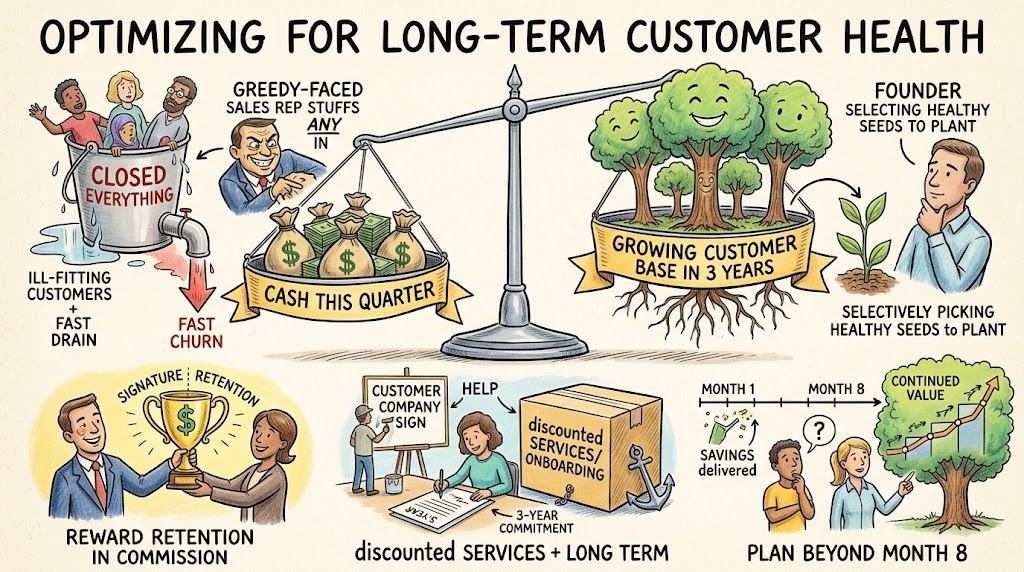
One of the more thoughtful contributions came from a founder who had been through a stretch of unusually high churn. He looked into it and found that the cause was that his team had closed nearly everyone. Sales reps were commissioned on every deal, so they closed every deal. The company covered its implementation costs and collected a few months of payments, and then the customers left, because they were never going to grow with the product. He later overcorrected and started turning away business, and admitted that he now thinks he swung too far. His conclusion was that there is no perfect answer, only a choice about what you are optimizing for: cash in the bank this quarter, or a base of customers who will still be there and growing in three years.
Another member who bundles services with software described the same risk from a different angle. Some clients sign up for a year of services, extract the value, and then move to a different system. That is a year of onboarding spent on customers who were never interested in the software itself. His rule now is that he gives away services only with a three-year commitment, because the services are what jump-start the customer and the commitment is what makes that investment worth making.
- Check what your commission plan rewards. If reps are paid on every signature, expect them to sign customers who will churn. Consider tying part of the payout to retention.
- Protect the services you bundle. Free or discounted onboarding should come with a longer term, since it is the most expensive thing you give customers.
- Plan for month eight. One CEO pointed out that the real test often comes partway through the term, when the first round of savings has been delivered and the customer asks what else you have. Continued value is a customer success problem as much as a sales problem.
A practical way to handle this on your next deal
If you are preparing for a multi-year negotiation, it helps to decide before the call what you will trade and what you will not. Start with a three-year term at your standard price. If the buyer pushes back, ask why, then pick from a short menu: a conditional opt-out at month twelve, a higher price for a one-year term, a termination fee schedule, or usage-based pricing as a fallback for early cancellation. Whichever you choose, keep the concession tied to something the customer commits to in return.
The two months you might lose holding out for a longer term are real, and so is the cost of a customer who signs for one year, never gets fully onboarded, and leaves. The founders in our room who seem calmest about this are the ones who have decided in advance which customers they want and what a fair exit looks like. That decision makes the contract a tool for building a good customer relationship instead of a fight at the end of the sales cycle.