
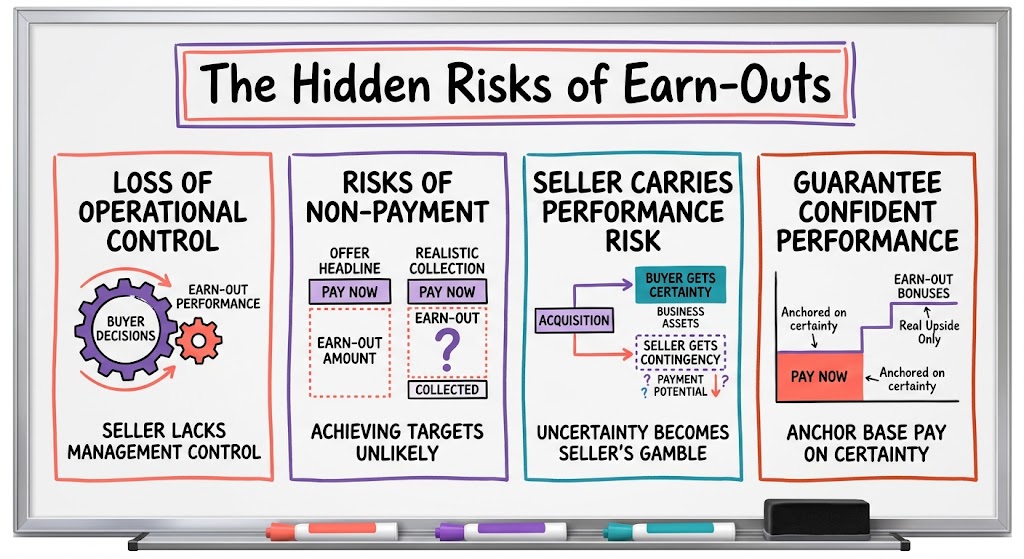
The Hidden Risks of Earn-Outs
Earn-outs are showing up in more SaaS deals, especially for companies that aren't growing fast. Here is what founders in our mastermind have learned about how earn-outs fail, how buyers use them, and how to structure one you can actually collect.

If your SaaS company isn't one of the hot, fast-growing names in your category, there's a good chance any acquisition offer you get will include an earn-out. The buyer pays part of the price at closing, and the rest depends on how the business performs over the next year or three. On paper, it looks like a fair way to bridge the gap between what you think the company is worth and what the buyer is willing to pay today.
In practice, earn-outs are one of the riskiest parts of any deal. That came through clearly in a recent Enterprise Mastermind session, where several members shared what they've seen, from offers that looked generous until you read the fine print to earn-outs that were never paid at all. If you're heading toward an exit, this is worth understanding before the first letter of intent arrives.
Why Earn-Outs Are Becoming So Common
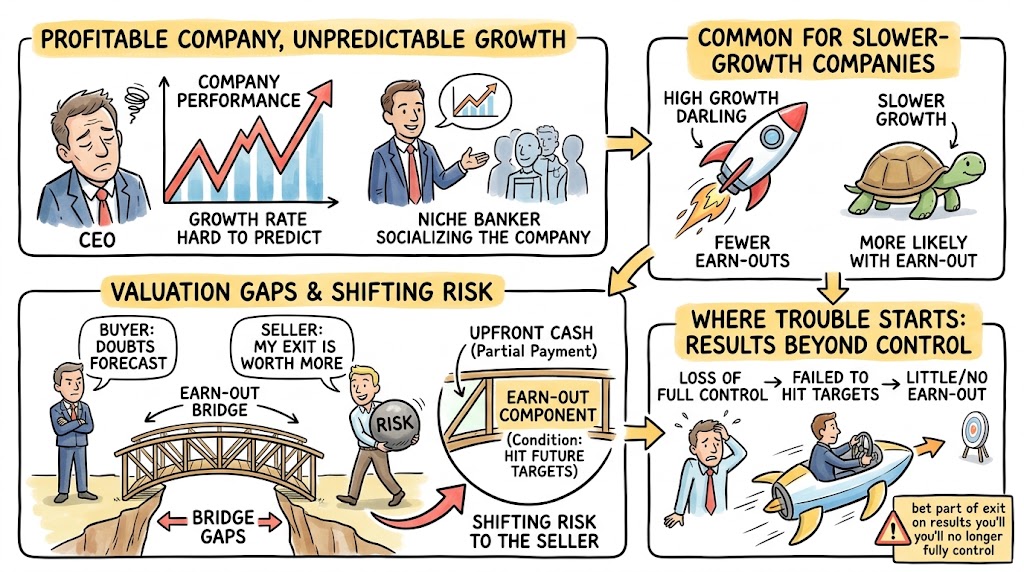
One CEO preparing for a sale was candid about his situation. His company is profitable but not a high-growth darling, and his growth rate has been hard to predict for years. A banker specializing in his niche is already socializing the company with potential acquirers. His expectation is simple: there will be an earn-out component, for sure.
That's the typical pattern. When a buyer can't get comfortable with your growth forecast, they shift risk back to you. Instead of paying for the growth you say is coming, they pay for what exists today and promise to pay more if the growth shows up. For a founder whose growth has been volatile, that can look like a reasonable compromise.
- Buyers use earn-outs to manage uncertainty. If they doubt your forecast, they'll tie part of the price to hitting it.
- Slower-growth companies see them most. Companies that aren't fast-growing are more likely to get deals with a performance component.
- They bridge valuation gaps. An earn-out lets both sides agree on a headline number without agreeing on the future.
- They shift risk to the seller. You're betting part of your exit on results you'll no longer fully control.
That last point is where most of the trouble starts, so it's worth spending some time on how these deals go wrong.
How Earn-Outs Go Wrong
One founder in the session didn't mince words. He said that, in his experience, about half of earn-outs end up in lawsuits or some other kind of legal dispute, or they simply don't get paid. Whatever the exact figure is across the market, members who have seen deals up close agreed with the spirit of it. Earn-outs carry a lot of risk.
The reasons are structural. After closing, the buyer controls the business. They decide on budgets, hiring, pricing, product roadmap, and how your product gets integrated into theirs. Any of those decisions can make an earn-out target harder to hit, even if nobody intends to undermine you. And when the numbers come in short, both sides often have very different views about why.
- You no longer control the levers. The buyer makes the decisions that determine whether you hit the target.
- Integration changes the numbers. Moving customers, changing pricing, or merging teams can make the metrics hard to measure cleanly.
- Definitions become disputes. How revenue or EBITDA is calculated after the deal can become a fight.
- Some earn-outs just don't get paid. Members have seen deals where the extra money never showed up.
The Earn-Out Designed Not to Pay
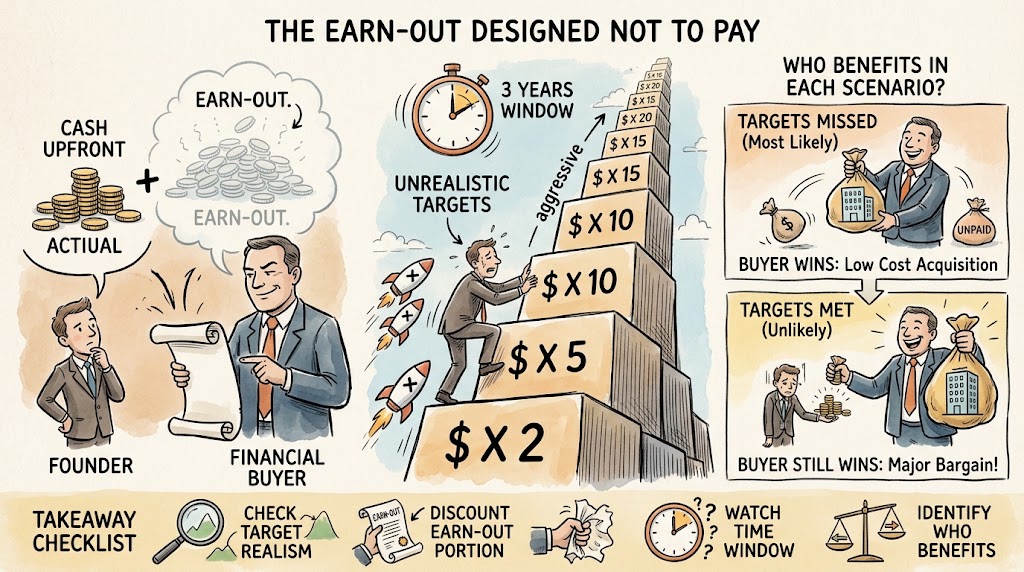
A longtime member told a story that every founder should hear before signing. His company, a small and already profitable business, received an offer where the overall price seemed reasonable. The catch was that a large share of it, around a third, was an earn-out. And the earn-out didn't kick in until the company multiplied its EBITDA several times over within a three-year window.
His read on it was sharp. The buyer had built an earn-out they didn't believe was achievable. And if by some chance he did hit it, the buyer would be thrilled to pay it, because the company would then be worth far more than they had paid in the first place. In other words, the earn-out cost the buyer almost nothing in the likely scenario and was a bargain in the unlikely one.
- Check whether the targets are realistic. If hitting them would require a transformation of the business, treat that money as unlikely.
- Discount the earn-out portion heavily. When you compare offers, value the earn-out at what you really expect to collect.
- Look at the time window. A short window with an aggressive target makes success even less likely.
- Ask who benefits in each scenario. If the buyer wins whether or not you hit the target, the structure is tilted against you.
He also noted that financial buyers in particular tend to structure earn-outs this way. Unless you're a fast-growing company that can reliably hit their numbers, the earn-out can end up taking away much of what you thought you were getting.
How to Structure One You Can Collect
The same founder who warned about disputes offered a practical way to think about structure. Instead of letting the buyer set a stretch target and hanging a big part of the price on it, anchor the base price on what the business can deliver no matter what. As he put it, figure out what you can guarantee "hell or high water." If that's 20% growth, get paid for 20% growth at closing. Then, if you hit something much higher, say 40%, the earn-out works as a bonus paid after a set number of months.
That approach flips the risk. The guaranteed portion reflects the business as it actually performs, and the earn-out becomes upside rather than a large share of the value you're counting on.
- Anchor the base price on what's certain. Get paid at closing for the performance you can confidently deliver.
- Treat the earn-out as a bonus. Tie it to real upside, so missing it doesn't hurt your core outcome.
- Keep the targets achievable. Push for goals that reflect your realistic trajectory, not a best-case projection.
- Define the metrics precisely. Agree up front on exactly how revenue or EBITDA will be calculated after close.
Beyond structure, work closely with your deal attorney on protections. That might include commitments on how the business will be operated and resourced during the earn-out period, and what happens if the buyer makes changes that affect your ability to hit the targets. These are the details that decide whether an earn-out gets paid or turns into a dispute.
Earn-Outs When Your Growth Is Hard to Predict
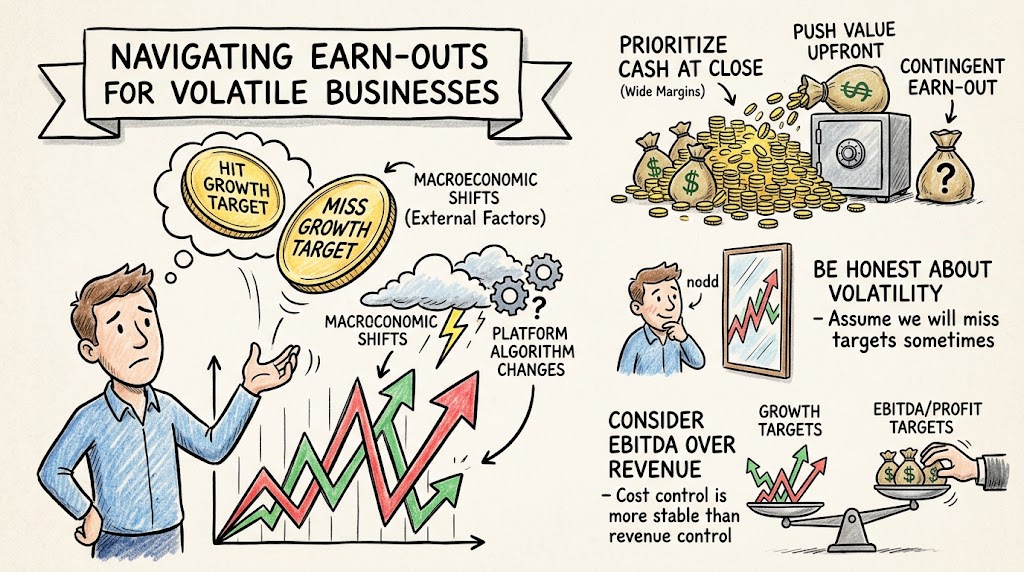
Earn-outs get especially tricky for founders whose growth swings from year to year. The CEO expecting an earn-out in his deal has struggled for more than a decade to forecast growth, because so much of it depends on factors outside his control, from macroeconomic shifts to algorithm changes at the platforms that send him customers. Some years he beats his plan by a wide margin. Other years he falls far short.
For a founder in that position, a growth-based earn-out is close to a coin flip. You could run the business perfectly and still miss the target because of something that happened outside your company. That's why the guaranteed floor matters so much. The more volatile your history, the more of the price you want paid at closing.
- Be honest about your volatility. If your growth swings widely, assume you'll miss aggressive targets some years.
- Push value into the upfront payment. Volatile businesses should prioritize cash at close over contingent payments.
- Consider EBITDA over growth targets. If you control costs better than revenue, a profit-based target may be easier to hit.
Strategic Buyers Can Make Earn-Outs More Realistic
The type of buyer also matters a lot. Members pointed out that earn-outs with a strategic buyer can be much more realistic than earn-outs with a financial buyer. A strategic acquirer often plans to plug your product into their distribution, their customer base, or their product line. If you fill a niche they're missing, you may get a good bit of organic growth from being part of their business, and that growth helps you hit the target.
With a financial buyer, you're more often on your own after the deal. You get their capital, and you still have to generate the growth yourself. That makes an aggressive earn-out much harder to reach.
- Strategics can help you hit targets. Access to their customers and distribution can accelerate growth after the deal.
- Financial buyers leave you on your own. The growth still has to come from your team.
- Match the earn-out to the buyer. An aggressive earn-out is more reasonable when the buyer is actively helping you get there.
Go In With Clear Eyes
The main lesson from this discussion is to treat every earn-out dollar with skepticism until you understand exactly how it gets earned and who controls the outcome. When you compare offers, focus on the cash at closing and value the earn-out at a realistic discount. Push the base price toward what the business can deliver no matter what, and make the earn-out true upside rather than a big share of the value.
If the growth you believe in is real, you'll have a chance to be rewarded for it. If it isn't, you'll still walk away with a fair price for the company you actually built. That's a far better position than signing a deal where a third of the value depends on targets the buyer never expected you to hit.