
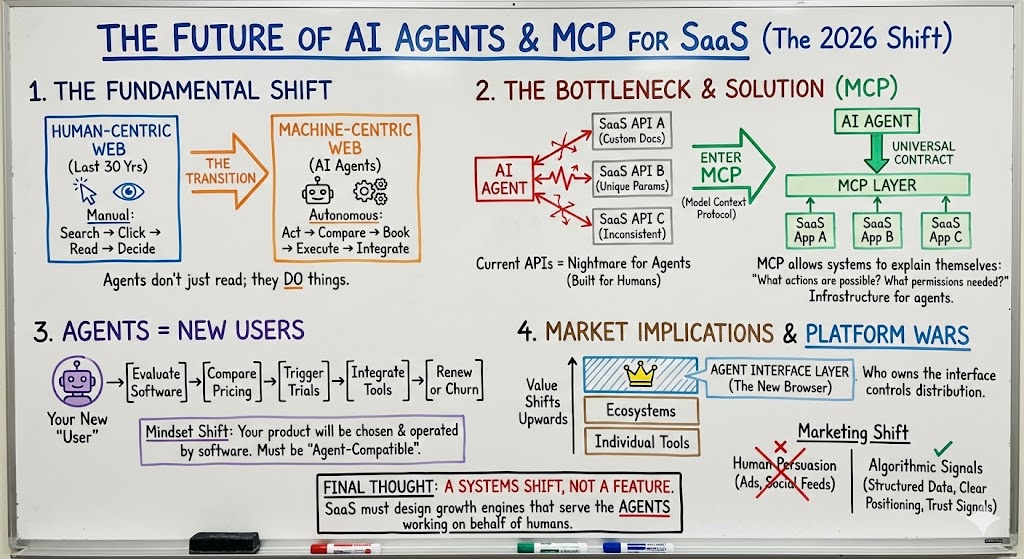
The Future of AI Agents and MCP for SaaS
If you’re building SaaS in 2026, you can feel it in the air: we’re moving from a “people click buttons” internet to a “software gets things done” internet. That sounds abstract until you zoom in on what’s actually changing. For the last few decades, software assumed a human would do the work: log in, navigate the UI, make decisions, copy/paste, reconcile, repeat.

Now a new user is showing up. Not a person. An AI agent.
And agents don’t browse. They execute.
That’s the shift worth paying attention to.
From “answering” to “doing”
A lot of us got excited about LLMs because they cut down research time. You ask a question, you get a clean summary, you stop opening 12 tabs.
But advice isn’t the end game.
The real leap is when the system can move from:
- “Here’s what you should do next”
to:
- “Done. Here are the results.”
That’s what agents are about. They can take a goal (“get this customer onboarded,” “book this trip,” “reconcile these invoices,” “run this outbound play”), break it into steps, and use tools to complete the work.
If you’ve ever watched a smart operator on your team who just handles things—agents are basically trying to replicate that behavior at scale.
And once agents can act, your product isn’t just something humans use. It becomes something agents operate inside of.
The bottleneck: the internet wasn’t built for agents
Here’s the part that matters for SaaS founders: yes, we already have APIs. But APIs were designed for human developers reading docs and wiring up integrations by hand.
Agents don’t want to do that. They need a predictable way to discover:
- What actions exist
- What inputs they need
- What permissions are required
- What the system will return
- How to fail safely when something’s missing
Right now, every SaaS product is its own dialect. And that’s fine when you have engineers bridging the gaps. But if we’re heading toward a world where agents orchestrate workflows across dozens of tools, the “every app is bespoke” approach doesn’t scale.
We need a shared contract layer.
That’s where MCP comes in.
MCP, in plain English
MCP (Model Context Protocol) is about standardizing how AI systems connect to tools and context so agents can reliably take actions across software.
Think of it like a common interface between models and the systems they interact with.
Instead of your product being “an API + docs + good luck,” MCP pushes toward a world where a tool can describe itself in a structured way: here’s what I can do, here’s how you call it, here’s what I require, here’s what you’ll get back.
For SaaS, the implication is straightforward:
If agents become a major way work gets done, then “agent compatibility” becomes a distribution advantage.
Just like being mobile-friendly wasn’t optional once mobile traffic took over, being agent-friendly won’t be optional once agent-driven workflows become normal.
Agents are about to become your new buyer (and your new user)
Most founders still picture the user as someone staring at a dashboard.
That’s already changing.
In the near future, a lot of your product interactions will be initiated by:
- a personal agent representing an individual user,
- a work agent representing a team,
- or a specialist agent representing a function (support ops, finance ops, recruiting ops, security ops).
Humans will still define goals, budgets, constraints, and approvals. But the execution? The day-to-day clicking and coordinating? That’s where agents shine.
And when agents are the ones running the workflows, they’re also the ones evaluating tools:
- What’s the fastest path to completion?
- What’s the cheapest plan that still works?
- Which product is the most reliable?
- Which tool integrates cleanly and fails gracefully?
That last line is the silent killer: agents won’t tolerate messy workflows the way humans do. Humans improvise. Agents follow rules. If your product is confusing, inconsistent, or fragile, an agent won’t “figure it out.” It’ll route around you.
The next platform war won’t look like the last one… but it rhymes
In the early web, browsers became the gateway. Whoever owned the gateway controlled distribution.
We’re heading toward a similar dynamic with agent platforms: the default layer that coordinates tasks, permissions, tools, and outcomes across the SaaS stack.
If you squint, you can already see the path:
- People will start with “tell my agent to do X”
- The agent will choose tools, execute tasks, and report back
- The platform that owns that interaction becomes the “new browser”
That doesn’t mean every SaaS company gets crushed. It means the rules of leverage change.
If you’re building a SaaS product, you’ll want to be the tool agents prefer, not the tool they avoid—and you’ll want to integrate into the platforms where agents live.
Marketing and growth will shift when the decision-maker shifts
Traditional SaaS growth has been a fight for human attention: SEO, social proof, webinars, referrals, content, ads, outbound.
That stuff doesn’t disappear. But it evolves.
When agents are involved, your “marketing” starts to include a new category: machine-readable trust and value.
Because an agent doesn’t get persuaded by clever copy. It gets persuaded by signals and structure:
- clear positioning,
- predictable integrations,
- transparent pricing logic,
- strong reliability and security posture,
- and a product that can be evaluated quickly.
You’re not just telling a story to a human anymore. You’re making it easy for software to choose you.
The risk side: agents need boundaries
Agents taking action is powerful… and that also makes it dangerous if you’re sloppy about permissions.
The best products won’t be the ones that let agents do everything. They’ll be the ones that let agents do the right things safely.
In practice, that means you’ll need to design for controlled autonomy. Here’s a simple way to think about it:
- Read-only access is cheap and safe.
- Low-risk actions can be automated.
- High-risk actions need explicit approval.
- Anything involving money, data exports, or destructive changes needs guardrails.
If you build those boundaries into your product early, you’ll move faster later. If you ignore them, you’ll end up bolting on safety after the fact—usually right after something breaks.
The opportunity: more software usage, not less
Here’s the optimistic bet: agents don’t just automate tasks. They increase how much work gets done.
Agents don’t get tired. They don’t procrastinate. They don’t stop at “good enough.” They can run workflows continuously, monitor systems, catch issues earlier, and optimize processes daily.
That can mean more SaaS adoption and more usage—especially for tools that are easy to integrate, easy to operate, and easy to trust.
But there’s a flip side: products that depend on a human tolerating friction (extra steps, unclear flows, messy configuration) will feel increasingly obsolete.
Agents will route around friction.
If I were building SaaS today, here’s how I’d pressure-test my roadmap
I’d ask a handful of questions that are brutally practical:
- Can an agent understand what my product does in under a minute?
- What are the core actions an agent should be able to take inside my app?
- What’s the safe “read mode” vs the safe “action mode”?
- How consistent are my workflows and edge cases?
- If agents compare tools, what signals make me the obvious choice?
If you take nothing else from this: start designing for the fact that the “user” might be software.
Bottom line
The internet is shifting from click-driven workflows to goal-driven workflows.
AI agents are the interface. MCP is part of the plumbing that makes agents practical across the SaaS world.
And the SaaS winners won’t just build great products for humans.
They’ll build products that agents can understand, trust, and operate—without drama.