
.png)
The Full Steps Required to Launch a Successful Outbound Email & LinkedIn Campaign
Outbound email remains one of the most reliable and scalable ways to reach your ICP, generate early-stage intent, and build pipeline. But in B2B, how you structure your outbound sequence matters as much as the content itself.

A successful outbound motion is a coordinated system—a combination of warmed inboxes, verified lists, clean enrichment, simple sequences, smart LinkedIn automation, and consistent follow-up. When these elements work together, outbound becomes one of the highest ROI channels in B2B. When even one piece is missing, results fall apart quickly.
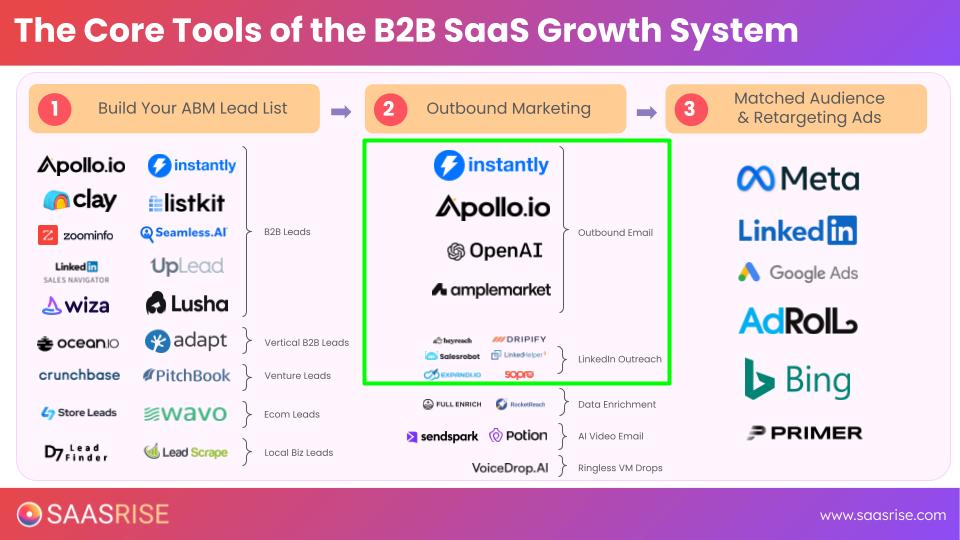
In this guide, we’ll walk through the full set of steps required to launch a modern, high-performing outbound email and LinkedIn campaign—from infrastructure to messaging to automation—based on the precise workflows taught inside the B2B SaaS Growth Program.
By the end, you’ll have a clear picture of how to build a reliable, scalable outbound engine that generates pipeline week after week.
Step 1: Set Up and Warm Your Inboxes
Outbound success begins long before the first email is ever sent. The technical infrastructure behind your campaign determines how many messages reach the inbox—and how long your domain reputation survives.
To send cold email at scale, you need multiple inboxes. A simple guideline is one inbox for every 30 emails you plan to send per day. If you want to send 300 cold emails daily, you’ll need around ten inboxes. High-volume teams often run a hundred or more.
.jpg)
But quantity is only half of the equation. Every inbox must be properly warmed up for at least two to three weeks. This gradual warm-up period shows providers like Google and Microsoft that your domain behaves like a normal sender, not a spammer suddenly blasting thousands of emails.
Skipping warm-up is the fastest way to end up in spam—and to burn the domain entirely.
Step 2: Build and Verify Your ABM List
Your outbound results are shaped heavily by the quality of your list. The best practice is to construct an Account-Based Marketing list built around your ICP: the right industries, job titles, company sizes, and buying roles.
.jpg)
Once the list is built, it must be verified.
Even a small number of hard bounces—invalid or non-existent emails—can damage your deliverability. Verification tools remove these risky addresses and ensure your campaign starts from a clean foundation.
Verification protects your domain. It improves inbox placement. And it prevents your entire outbound engine from collapsing in the first week.
Step 3: Enrich Your Contacts for Personalization
After the list is verified, it should be enriched with useful details—especially LinkedIn profile URLs.
Why LinkedIn URLs? Because they unlock full-profile enrichment inside tools like Instantly or Clay. With one URL, you can pull a recipient’s headline, summary, job history, education, and even interests. This makes AI personalization possible at scale.
Personalized first lines, subject lines, and PS lines consistently outperform generic outreach. In many cases, personalization can double click or reply rates.
Enrichment also makes LinkedIn follow-up far easier, since you now have accurate URLs for connection requests and automated sequences.
Step 4: Write a Short, Clear Outbound Sequence
High-performing outbound sequences don’t try to say everything—they try to say the one thing that matters.
The best sequences:
• Stay under 75 words
• Lead with something relevant to the recipient
• Alternate between emails designed for replies and emails designed for clicks
• Offer value (a case study, insight, guide, survey result, or teardown)
• Use a single, simple call to action
.jpg)
Most outbound campaigns perform best with 3–5 total touches. Anything longer tends to dilute engagement.
Outbound email is not persuasion. It’s discovery. You’re not trying to close on email—you’re trying to identify who cares.
Short, clear messages make that easy.
Step 5: Load Your Sequence Into Instantly and Enable Slow Ramp
Once your sequence is ready, you’ll load it into Instantly. This is where you’ll:
• Map your merge fields
• Add multiple variants for A/B testing
• Organize your steps
• Assign inboxes
But the most important setting comes next: Campaign Slow Ramp.
.jpg)
This feature gradually increases your daily sending volume over two to three weeks, instead of sending at full capacity on day one. Slow ramping protects your deliverability and stabilizes inbox placement.
Many teams burn their domains simply because they forgot to enable slow ramp. It is one of the simplest and highest-impact settings in the entire platform.
Step 6: Launch the Campaign and Monitor Deliverability
With your infrastructure, list, enrichment, and sequence in place, you’re ready to launch.
But outbound isn’t a “set it and forget it” activity. Checking deliverability is essential. Instantly provides an inbox placement test that shows whether your emails are landing in the inbox, promotions tab, or spam.
Checking this every two weeks is best practice.
If placement drops, you may need to rest certain inboxes, slow down sending, or swap in new domains. Maintaining high inbox placement is the secret to consistent outbound performance.
Step 7: Layer in LinkedIn Outreach Using HeyReach
Outbound email identifies the people who are paying attention. LinkedIn outreach turns that attention into a relationship.
Once your outbound campaign begins generating clicks, those engaged contacts should flow directly into HeyReach or similar tools. They’ll automatically receive connection requests from your founder, CEO, or sales leader—the people with the highest acceptance rates.
.jpg)
After they accept the request, HeyReach can send a short, friendly sequence of messages. These aren’t sales pitches. They’re soft introductions, content shares, or gentle follow-ups to the topic of your email.
LinkedIn adds a human layer to your outbound motion. It builds familiarity, establishes trust, and increases the likelihood that your next email or SDR touch converts.
Step 8: Activate Retargeting and Matched Audience Ads
Once prospects begin clicking your outbound emails, you have a second strong signal: intent.
This is the perfect moment to activate retargeting ads on LinkedIn, Meta, Google, and Bing. Your clickers now start seeing your brand across every platform they use.
Meanwhile, your broader ABM list can be fed into matched audience ads. This ensures every high-value account in your ICP sees consistent messaging, even if they haven’t engaged yet.
Together, ads, email, and LinkedIn create the omnichannel effect that turns cold prospects into warm ones—and warm ones into buyers.
Step 9: Move Engaged Prospects into a Warm Email Sequence
Outbound is the spark. But your warm email newsletter is the long-term nurturing engine.
Once someone clicks your outbound message, connects on LinkedIn, or downloads a resource, they’re no longer cold—they’re now a warm contact. This is where your weekly newsletter or long-form content begins delivering real value.
Warm emails can be longer. They can include images, multiple links, charts, and deep insights. They can showcase case studies, frameworks, or teardown videos. Their goal is simple: keep prospects engaged until the moment they’re ready to act.
This is where your outbound effort compounds into something far more powerful: ongoing trust.
Step 10: Follow Up With Human Conversation
Even the best automation system eventually leads to a human moment. Once your outbound email, LinkedIn presence, retargeting ads, and warm sequences create enough familiarity, your SDRs have a dramatically easier job.
They’re no longer reaching out cold. They’re following up with prospects who:
• Have already clicked your content
• Have seen your brand multiple times
• Recognize your company name
• Understand your value proposition
• Have already interacted with you on LinkedIn
These conversations convert better, move faster, and result in healthier pipeline.
Outbound is no longer guesswork. It becomes predictable.
Final Thoughts
A successful outbound email and LinkedIn campaign is not built on one great email or one clever message. It’s built on a repeatable system—a system that includes verification, enrichment, short sequences, slow ramping, LinkedIn follow-up, and consistent nurturing.
When these steps come together, outbound becomes one of the most reliable and scalable growth channels in B2B. It produces not just clicks and replies, but recognition, trust, and pipeline.
The companies that win with outbound aren’t sending more emails—they’re building better systems.
If you follow the steps above, you’ll have everything you need to build an outbound engine that continues producing meaningful results month after month.