
The EXACT System To Build a SaaS From 0 to $100M Exit
A step-by-step breakdown of how to build a SaaS company from zero to a $100M exit, based on real patterns from high-growth founders. This post walks through each stage from product-market fit to scaling, unit economics, and exit prep, with a clear focus on building systems, not founder-dependent businesses.

Most SaaS founders want a $100 million exit, very few actually build their company in a way that makes that outcome likely. And it’s not because they lack ambition. It’s usually not even because of product or product-market fit. The real issue is they misunderstand what actually drives large SaaS exits. As I shared in the video, “The founders who get to nine figures and ten figures in valuation tend to do a few specific things really well.” This post is the system behind those outcomes.
This isn’t theory. It’s a sequence. If you follow it, you dramatically increase your odds of building something that is actually exit-ready instead of just operationally exhausting.
Step 0: Decide what game you’re playing
Before you build anything, you need to decide what kind of company you’re building.
A lot of founders lose years here because they build one type of company while expecting a completely different outcome. As I said in the video, “There are different games you can play.” You can build a lifestyle business that generates cash flow and freedom, or you can build an exit-ready business designed to be acquired.
Those are two very different paths. If you want a $100M+ exit, you’re not building a job. You’re building a system. “A buyer doesn’t pay $100 million for a founder… what companies pay for is the system.” That means revenue systems, growth systems, and a team that can operate without you.
- Choose between a lifestyle business or an exit-driven business early
- Optimize for systems, not personal output
- Build a company that can run without you for 30+ days
- Make decisions early that compound toward exit readiness
If your company depends on your hustle, your relationships, or your constant involvement, it will always be worth less. That’s just how buyers think.
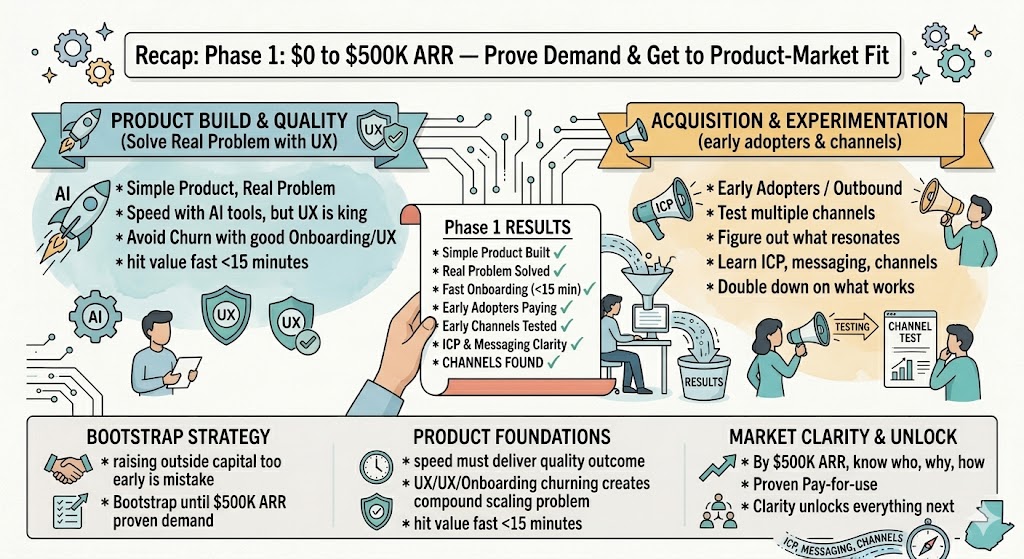
Phase 1: $0 to $500K ARR — Prove demand and get to product-market fit
At the beginning, the goal is simple: prove that people will pay for what you’re building.
This is a bootstrapped phase. You don’t need outside capital yet. In fact, raising too early is one of the most common mistakes I see. As I explained, “The smartest path here is to bootstrap until you hit $500,000 in ARR.” At that point, you’ve proven demand.
On the product side, speed matters, but so does quality. AI tools now let you build much faster, but you still need to deliver a real outcome for the customer. One thing I emphasized is that poor onboarding and weak UX create churn early, and that compounds as you scale. You want users to hit value fast, ideally within the first 15 minutes.
On the acquisition side, you’re experimenting. You’re selling to early adopters, doing outbound, testing channels, and figuring out what resonates. This is where you learn your ICP, your messaging, and your early channels.
- Build a simple product that solves a real problem
- Use AI tools to accelerate development, but don’t sacrifice UX
- Focus on fast time-to-value and strong onboarding
- Test multiple acquisition channels and double down on what works
By $500K ARR, you should know who buys, why they buy, and how to reach them. That clarity is what unlocks everything next.
Phase 2: $500K to $1M ARR — Nail your unit economics
Once you’ve proven demand, the next step is making the business actually work economically.
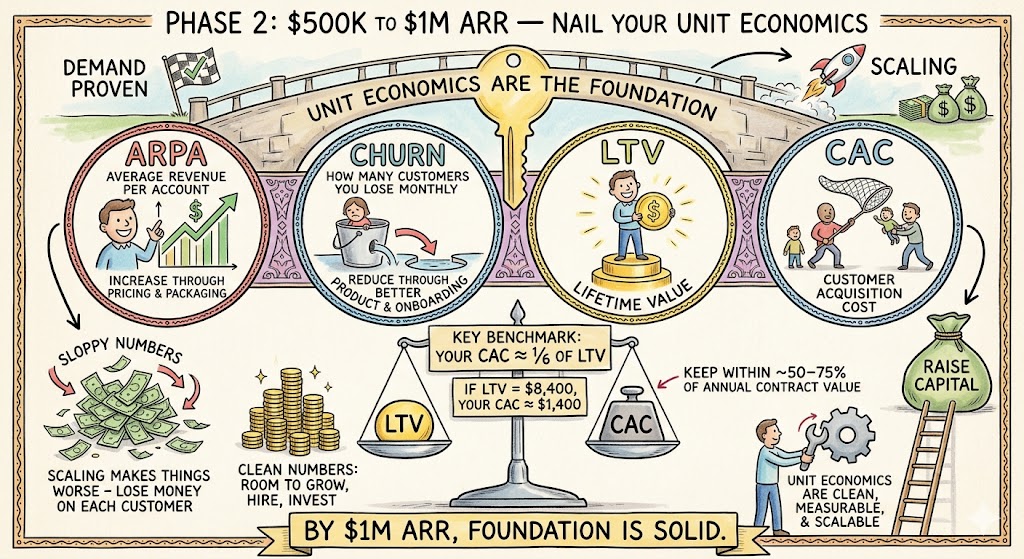
This is where most founders get sloppy, and it costs them later. As I said in the video, “Unit economics are the foundation of everything.” They determine whether your company is worth $10M or $100M.
There are four core metrics you need to understand deeply:
- ARPA (average revenue per account)
- Churn (how many customers you lose monthly)
- LTV (lifetime value of a customer)
- CAC (customer acquisition cost)
The key benchmark is this: your CAC should be about 1/6 of your LTV. If your LTV is $8,400, your CAC should be around $1,400. That gives you room to grow, hire, and invest.
If your numbers don’t work, scaling will only make things worse. “No amount of growth fixes losing money on each incremental customer.”
- Target CAC ≈ 1/6 of LTV
- Keep CAC within ~50–75% of annual contract value
- Reduce churn through better product and onboarding
- Increase ARPA through pricing and packaging
By the time you hit $1M ARR, your unit economics should be clean, measurable, and scalable. That’s when raising capital starts to make sense.
Phase 3: $1M to $5M ARR — Build a repeatable acquisition system
This is where companies either break out or stall.
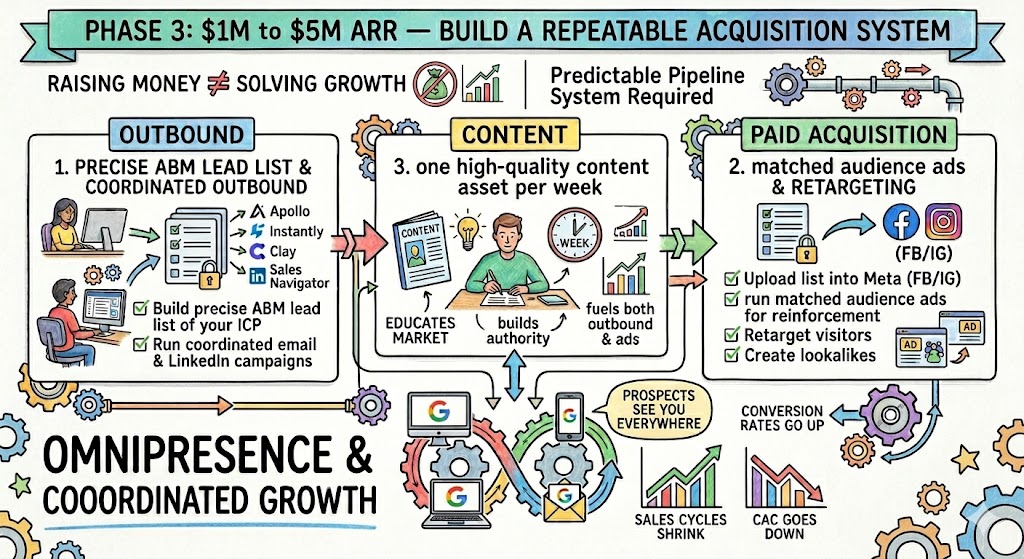
The biggest misconception here is that raising money solves growth. It doesn’t. What you need is a system that generates predictable pipeline. As I laid out, that system has three parts: outbound, paid acquisition, and content.
Outbound starts with building a precise ABM list using tools like Apollo, Instantly, Clay, and LinkedIn Sales Navigator. Then you run coordinated email and LinkedIn campaigns.
Paid acquisition uses that same list. You upload it into Meta, run matched audience ads, retarget visitors, and create lookalikes. The key is consistency across channels.
Content ties it all together. One strong piece per week that educates your market, builds authority, and fuels both outbound and ads.
- Build a precise ABM lead list of your ICP
- Run coordinated outbound across email and LinkedIn
- Use matched audience ads + retargeting for reinforcement
- Publish one high-quality content asset per week
When these channels work together, you create what I call omnipresence. Prospects see you everywhere. Conversion rates go up, sales cycles shrink, and CAC goes down.
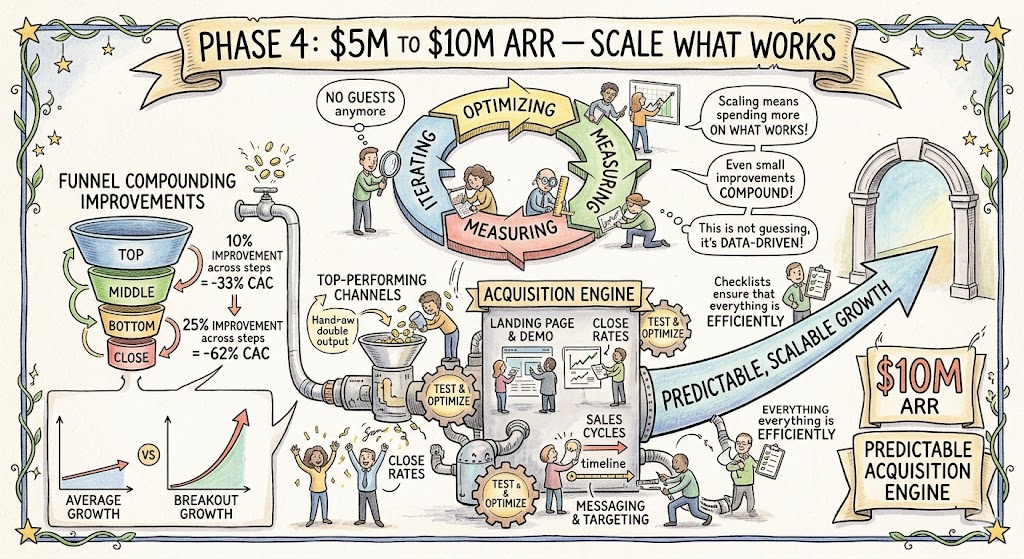
Phase 4: $5M to $10M ARR — Scale what works
At this stage, you’re not guessing anymore. You’re optimizing and scaling.
A lot of founders think scaling means spending more. It doesn’t. It means spending more on what already works. You’re constantly testing, measuring, and iterating across your funnel.
Even small improvements compound. As I explained, a 10% improvement across funnel steps can reduce CAC by 33%, and a 25% improvement can reduce it by 62%. That’s the difference between average growth and breakout growth.
- Double down on top-performing channels
- Improve landing page, demo, and close rates
- Shorten sales cycles through better messaging and targeting
- Continuously test and optimize every funnel step
By $10M ARR, you should have a predictable, scalable acquisition engine that runs efficiently.
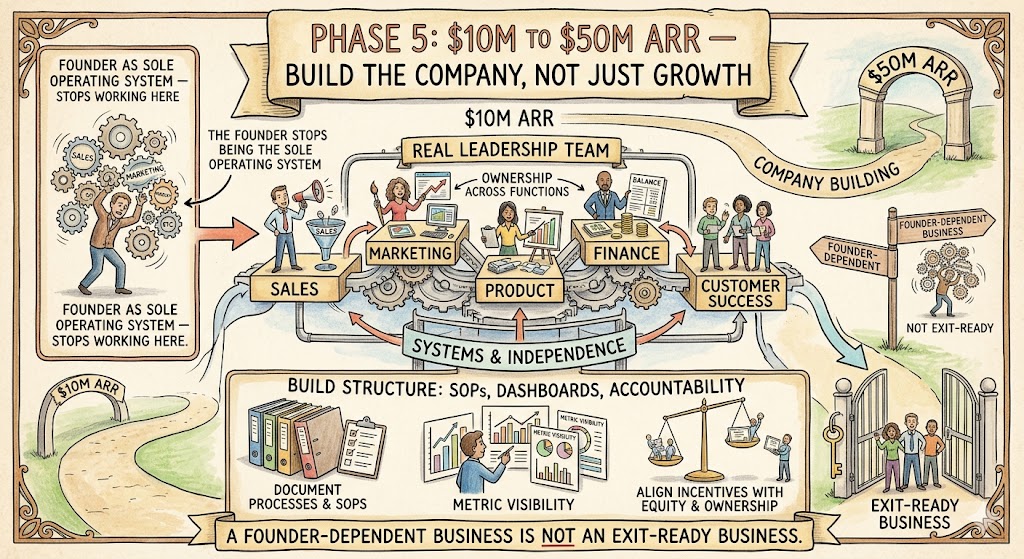
Phase 5: $10M to $50M ARR — Build the company, not just growth
This is where your role as a founder fundamentally changes.
Up to this point, you’ve probably been deeply involved in everything. That stops working here. As I said, “The founder stops being the sole operating system.” You need a real leadership team.
You need ownership across functions: sales, marketing, product, finance, and customer success. And you need systems that allow those teams to operate independently.
This is also where you build structure: SOPs, dashboards, clear metrics, and accountability. You’re turning your company into something that can run without you.
- Hire strong functional leaders (sales, marketing, product, finance, CS)
- Document processes and build SOPs
- Create dashboards and metric visibility across the company
- Align incentives with equity and ownership
This is one of the hardest transitions for founders. But it’s essential. A founder-dependent business is not an exit-ready business.
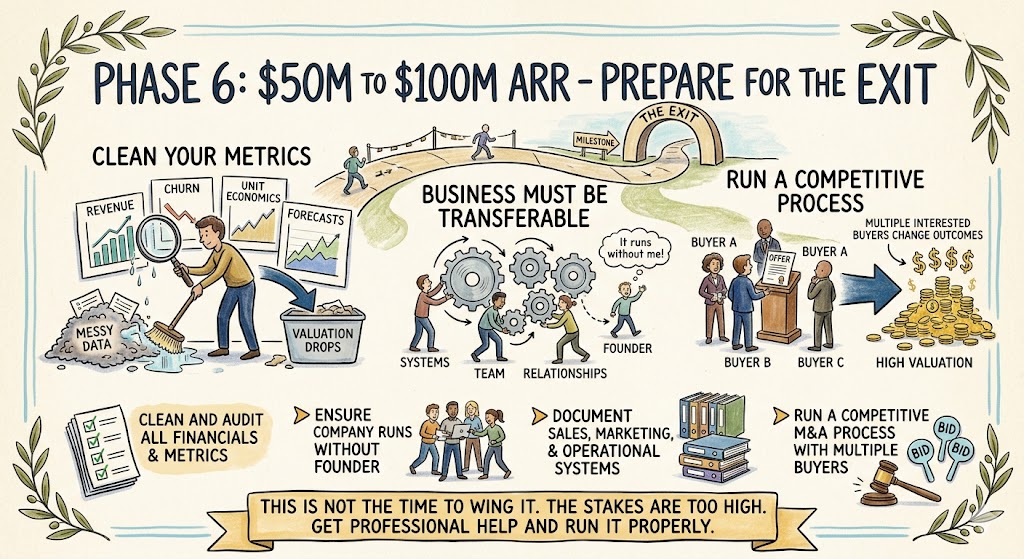
Phase 6: $50M to $100M ARR — Prepare for the exit
At this stage, you’re not just growing. You’re preparing to sell.
An exit is not automatic. It’s a process, and how you run that process can change the outcome by tens or even hundreds of millions of dollars.
First, your metrics need to be clean. Buyers will scrutinize everything: revenue, churn, growth, forecasts, and unit economics. If your numbers are messy, your valuation drops.
Second, the business needs to be transferable. The systems, team, and relationships must work without you.
Third, you need to run a real process. As I explained, “You want to have multiple interested buyers… a competitive process changes outcomes dramatically.”
- Clean and audit all financials and metrics
- Ensure the company runs without founder involvement
- Document sales, marketing, and operational systems
- Run a competitive M&A process with multiple buyers
This is not the time to wing it. The stakes are too high. Get professional help and run it properly.
The system that ties it all together
Across all these phases, there’s a consistent system.
As I laid out, it comes down to six core principles:
- Nail your unit economics early and protect them
- Build repeatable, predictable customer acquisition
- Layer in content to drive inbound demand
- Scale only what works and cut what doesn’t
- Build a real organization with systems and leadership
- Prepare intentionally for the exit process
This system isn’t flashy. It’s disciplined. And it works.
The final piece is something most founders underestimate: community. As I said in the video, building a $100M company is hard, and “most founders feel incredibly isolated.” Getting around the right operators can compress years of learning into months.
If you follow this sequence, stay disciplined with your metrics, and build systems instead of dependencies, you give yourself a real shot at a nine-figure outcome. Not by luck, but by design.