
.png)
The Difference Between Warm Email & Cold Email
Most people treat warm email and cold email like they’re the same thing—and that’s exactly why their deliverability tanks. This guide breaks down the real differences between the two worlds, how each one works under the hood, and why understanding this distinction is the key to scaling your outbound without burning your domain or your audience.

Most people think email is email. You write a message, load your list, press send, and hope for the best. But in B2B growth—especially in SaaS—there are two entirely different worlds operating under the same word “email.” And misunderstanding the difference is one of the biggest reasons founders burn their domains, tank their deliverability, and sabotage their own pipeline before it ever has a chance to grow.
Warm email and cold email may both arrive in a person’s inbox, but everything about them—their infrastructure, their psychology, their rules, their goals—is completely different. Treating them the same is like assuming a commuter scooter and a Boeing 747 operate with the same mechanics because they both move people from point A to point B.
To build a scalable outbound engine, you must understand these differences deeply. You must know which rules govern each world, which tools belong to each system, and what the inbox providers expect from you in each scenario.
Once you see warm email and cold email as separate ecosystems—not interchangeable tactics—you’ll be able to unlock both channels’ full potential.
Let’s break down the real distinction.
Warm Email: The Familiar, Trusted, Permission-Based Channel
Warm email is the inbox equivalent of walking into someone’s house because they invited you. They know your name. They recognize your face. They’re expecting you to show up.
In warm email, the relationship is already established. Your subscribers opted in somewhere—your website, your product, an event, a content download, a webinar. They might even look forward to hearing from you. They recognize your brand and have decided that what you send them is useful enough to keep receiving.
This dynamic completely changes how you send to them.
Warm email lives inside platforms like Mailchimp, HubSpot, Brevo, Beehive, SendGrid, or your CRM. These tools assume:
- You have a preexisting relationship with your list.
- The list has been acquired ethically.
- Your subscribers tolerate, expect, or enjoy your content.
- Complaint rates will remain extremely low.
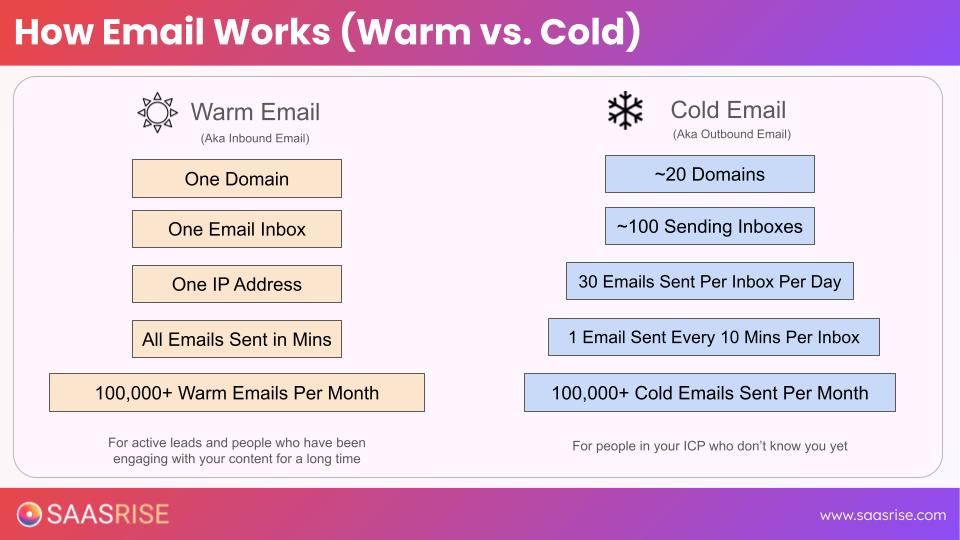
Because of that trust, warm email providers allow you to send a massive volume of messages in a tiny amount of time. You can send 100,000 emails in five minutes, from one domain, on one IP, without raising alarms. They allow this because the recipients have shown, historically, that they want your emails.
.jpg)
Warm email is broadcasting.
Warm email is relationship maintenance.
Warm email is content distribution.
Warm email is maximizing the reach of people who already chose you.
A warm email list can become one of the most valuable assets in your business—your own private distribution channel to tens or hundreds of thousands of people who want to learn, buy, or engage.
But that privilege comes with rules. And this is where people get into trouble.
Warm email is governed by strict compliance: opt-in, honor unsubscribes, protect your deliverability reputation, avoid surprising users with content they didn’t ask for. Break these rules, and your warm email provider will shut you down faster than you think.
But cold email?
Cold email operates on a different planet.
Cold Email: The Unknown, Unfamiliar, Invitation-Seeking Channel
Cold email is the digital equivalent of knocking on a stranger’s door. They don’t know you’re coming. They may not recognize your name, company, or brand. And they certainly did not ask to hear from you.
.jpg)
Because of that, everything about cold email must be handled with care, strategy, and precision.
Cold email is not sent from your main domain.
It is never sent from your main inbox.
It cannot use warm email tools.
It cannot be sent at high frequency or high volume from a single IP.
Cold email platforms—like Instantly—are built specifically to avoid triggering spam filters, maintain deliverability across multiple domains, and drip messages slowly enough to appear human.
Cold email requires:
- Additional domains (20, 30, sometimes more)
- Dozens of inboxes
- Sequenced sending at slow intervals
- Warming systems that mimic natural email behavior
- Distributed sending across multiple SMTP sources
Instead of sending 100,000 emails in 5 minutes, cold email sends 1 email every 8–12 minutes, per inbox, over a 9-hour window.
The logic is simple:
Cold email must look like natural, manual outreach.
Warm email is allowed to look like automation.
Cold email is not.
This slow-drip architecture is what keeps your emails from landing in spam, what protects your primary domain, and what allows you to scale outbound without destroying your deliverability reputation.
Cold email isn’t broadcasting.
Cold email is permission-earning.
Cold email is awareness-building.
Cold email is value-forward introduction.
When done well, cold email is one of the most powerful top-of-funnel creation mechanisms in SaaS. It puts your value in front of thousands of ICP buyers who otherwise would never know you exist. It places your content, your ideas, your insights directly into inboxes of people who have the problems you solve—even if they’re not yet searching for a solution.
But it must be done with empathy, tact, and engineering.
The Role of Relationship in Warm vs. Cold Email
Warm email leverages an existing relationship.
Cold email attempts to create one.
That difference shapes everything about the tone, content, and purpose of each message.
Warm email can be longer, more narrative, more educational. It can promote launches, announce features, share long-form insights, recap events, highlight customers, or teach frameworks. Because the reader already trusts you, they’re willing to give you more attention.
Cold email must immediately earn attention.
Cold email must show value upfront.
Cold email must avoid sounding like corporate spam.
The cold email reader is asking:
- Who are you?
- Why are you reaching out to me?
- How did you get my email?
- Should I trust you?
- Is this worth 10 more seconds of my time?
The warm email reader is asking:
- What’s new?
- What’s relevant?
- What should I know today?
They are entirely different states of mind.
This is why cold email requires personalization, specificity, and brevity. Warm email, meanwhile, thrives on depth, consistency, and brand reinforcement.
Trying to write cold email like warm email makes it sound long and unfocused.
Trying to write warm email like cold email makes it sound shallow and transactional.
Each channel requires its own craft.
Infrastructure: The Invisible Engine Behind Both Systems
Another massive distinction between warm and cold email is the infrastructure that enables them.
Warm email runs on:
- One domain
- One IP
- One sender reputation
- High-volume instant sends
As long as your engagement metrics remain healthy, your warm deliverability stays strong. But if you suddenly upload a large list of cold contacts into a warm system, your provider will:
- Flag your account
- Suspend sending
- Require verification
- Potentially blacklist the domain
- Reduce deliverability for all future emails
All because you broke the cardinal rule: warm email is only for warm audiences.
Cold email, meanwhile, requires engineering:
- Multiple domains configured with perfect DNS
- Several inboxes per domain
- Warm-up systems running daily
- Sending caps and throttling
- A sequencer distributing volume safely
- Gradual ramp-up to full scale
Cold email is a decentralized machine working behind the scenes to protect your reputation while still delivering outbound volume. It is infrastructure-heavy because inbox providers are hypersensitive to unexpected behavior.
Warm email is centralized and high-trust.
Cold email is distributed and low-trust.
Understanding that distinction protects your domains, improves your open rates, and ultimately safeguards your brand.
Content Strategy: What You Can Say Warm vs. Cold
Warm email allows you to say almost anything:
- Long stories
- Product updates
- Thought leadership
- Full articles
- Event invites
- Detailed case studies
- Deep-dive industry insights
- Offers and promotions
- CTA-heavy content
Your audience has opted into this experience. They expect to hear from you weekly or biweekly. They know who you are.
Cold email, on the other hand, must stay laser-focused on one thing: delivering value without assumption.
Every cold email message must pass one test:
Would this be worth reading if I knew nothing about you?
Cold email content structures typically include:
- A personalized opener
- A short value insight
- A meaningful resource or asset
- A single soft CTA
- A friendly tone
- Zero fluff
- Zero self-congratulation
- Zero corporate-speak
Warm email deepens affinity.
Cold email initiates curiosity.
Warm email nurtures the relationship.
Cold email earns the right to begin one.
When you respect the reader’s mindset, cold email becomes far more effective—and far less intrusive.
Warm Email Success Measures vs. Cold Email Success Measures
Because the psychology and purpose of each system differ, the way you measure success also diverges.
Warm email success looks like:
- High open rates
- Engagement over time
- CTRs on content
- Replies and conversations
- Healthy list growth
- Low unsubscribe rates
- Revenue influenced by nurture
Cold email success looks like:
- Open rate sufficient to prove deliverability
- Click rates that reveal interest
- Replies that indicate intent
- Volume of new ICP touches
- Number of engaged leads moving to next steps
- Pipeline created
- Meetings booked (eventually)
Cold email is not a one-touch conversion channel.
It’s a discovery channel.
.jpg)
The cold email job is to introduce people to your world, help them self-identify as interested, and then allow your other systems—ads, SDRs, warm email—to take over.
Warm email is a relationship-deepening channel.
Cold email is a relationship-initiating channel.
Mixing the two creates confusion.
Using each channel for its proper purpose creates compound growth.
Why You Need Both
Some companies lean entirely on warm email, believing cold outreach is intrusive or outdated. Others rely entirely on cold outbound, ignoring the nurturing and compounding value of a warm list.
The truth is that the highest-performing SaaS GTMs use both, working in harmony.
Cold email introduces.
Warm email educates.
Cold email identifies intent.
Warm email nurtures intent.
Cold email drives early awareness.
Warm email drives long-term conversion.
Cold email expands your universe.
Warm email strengthens your orbit.
When these channels work together—supported by retargeting ads, content, and SDR follow-up—you build a full-stack acquisition engine that never sleeps.
Final Thought: Treat Warm Email Like a Garden and Cold Email Like a Net
If you want both channels to thrive, imagine warm email as a garden and cold email as a net.
Your warm email list must be cultivated.
It must be fed with great content.
It must feel like a privilege to receive.
It must deliver value consistently.
It must never be abused.
Your cold email system must be cast wide, carefully, and strategically.
It must catch new people who may one day enter the warm garden.
It must respect the people it reaches.
It must add value, not noise.
It must play the long game.
Warm email keeps your community alive.
Cold email grows that community over time.
Both channels matter.Both channels are powerful.And both channels—when understood deeply—can unlock a level of growth that most SaaS companies underestimate.