
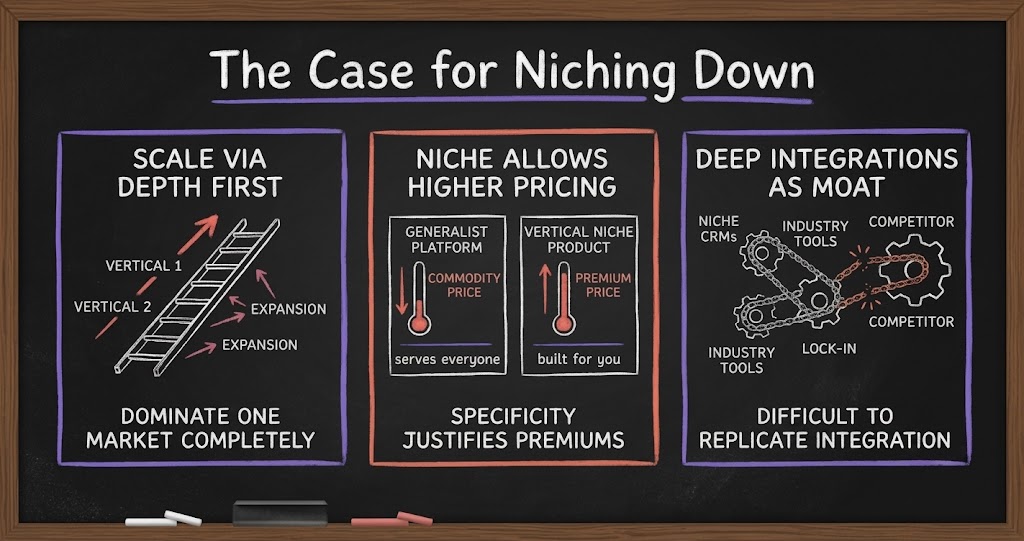
The Case for Niching Down
A founder weighing whether to go broad with a new brand or narrow into a single vertical got pointed advice from the mastermind: the founders winning with focus aren't spreading thinner, they're charging more for going deeper into one specific audience.

A founder building a community platform for churches came to a recent mastermind call wrestling with a freemium pivot and, along the way, a bigger strategic question: should he keep building one broad product for a wide range of churches, or should he lean harder into specific niches within that market? He mentioned in passing that he was also weighing whether to spin up separate brands for different segments. One member's response reframed the whole conversation, and it's advice that applies well beyond churches or community software.
The niche competitor who won by going narrower, not wider
A founder in the group described someone he knows who built a substantial business in a very similar space, online reviews and business tools, by doing the opposite of what most founders instinctively do when growth stalls. Rather than broadening the target market to capture more volume, that founder super-niched into a single vertical, chiropractors specifically, and built his entire business around serving that one type of customer extremely well. Only once that business reached real scale did he start branching out, and even then, cautiously, adding just a couple of adjacent verticals like optometrists rather than opening the doors to every industry at once.
- Scale came from depth in one vertical, not breadth across many. The business grew by dominating a single niche completely before considering any expansion.
- Expansion happened only after the core niche was proven and profitable. Adjacent verticals were added deliberately and slowly, not as a parallel bet made early.
- The founder saw this pattern as the better path for his own church-focused product. Rather than diluting focus across many small segments, narrowing further looked like the more durable strategy.

Niching lets you charge more, not less
The founder sharing this story was explicit about why narrowing works: when you're the specific person or product built for one business model, you can charge more for it. That's a different instinct than the one that usually drives founders toward broadening. Going broad often feels like the safer, more scalable choice, more total addressable market, more potential customers. But going broad also means competing as a generalist against everyone else who's also decided to serve everyone, and generalist products tend to compress toward commodity pricing because no single customer segment feels like the product was built specifically for them.
A niche product doesn't have that problem. When you're the platform built specifically for chiropractors, or hospitality companies, or law enforcement agencies, the value proposition writes itself in the customer's mind before you've even finished the pitch. You already understand their workflow, their compliance requirements, their vocabulary. That specificity is worth paying a premium for, and customers in a well-served niche tend to know it.
- Specificity justifies premium pricing. A product built for one type of customer can charge more than a generalist product trying to serve everyone adequately.
- Niche products sell themselves faster. When the product is obviously built for a customer's exact workflow, less time is spent convincing them it's relevant.
- Going broad compresses pricing toward commodity. The more generic a product's positioning, the more it competes on price against every other generalist option.
The other reason niching down works: integrations compound
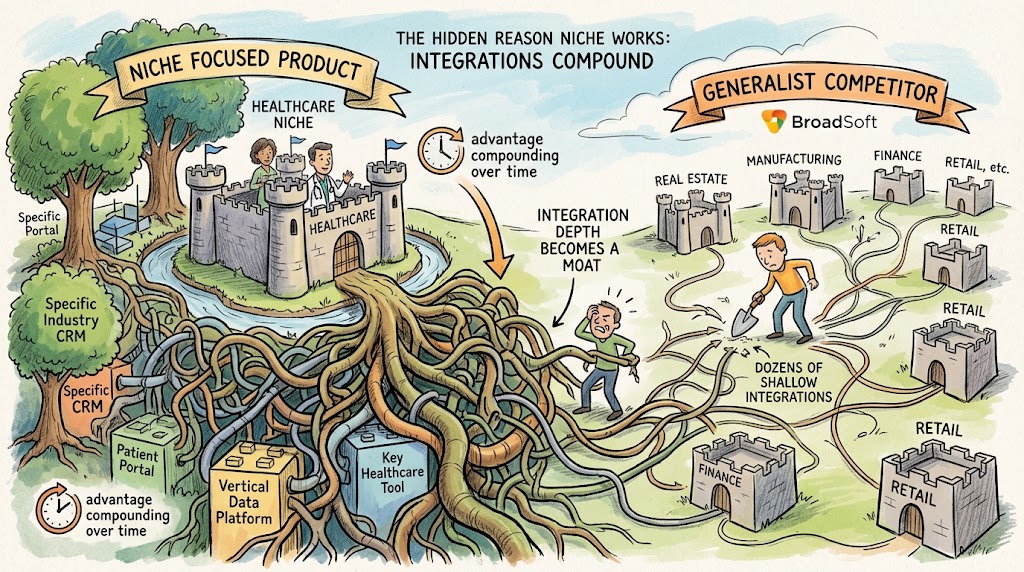
A separate founder in an earlier part of the same conversation made a related point that's easy to miss if you're only thinking about niching as a marketing or positioning play. Going deep into a specific industry has operational advantages too, particularly around integrations. His own business is naturally stronger in certain verticals because of the specific CRMs and platforms those industries already run on. Once you've built deep integrations with the tools a particular industry actually uses day to day, that becomes a form of lock-in that's genuinely hard for a generalist competitor to replicate, because a generalist has to build shallow integrations across dozens of tools instead of deep ones with the handful that actually matter to one industry.
- Deep integrations are easier to build for one industry than many. Focusing on the specific tools one vertical actually uses lets you go deeper than a generalist competitor ever could.
- Integration depth becomes a moat. Once a product is woven into the specific software stack an industry relies on, switching away from it gets harder for the customer.
- This advantage compounds over time. The longer a niche-focused product invests in an industry's specific ecosystem, the harder it becomes for a broad competitor to catch up.
Watch the trap of managing too many brands at once
It's worth naming the counterargument that came up in the same conversation, because niching down isn't automatically the right call in every shape. The church-platform founder had been considering spinning up entirely separate sub-brands for different price points and segments, partly to avoid channel conflict with existing partners. Another founder pushed back on that specific idea, pointing out that managing a portfolio of separate brands creates its own overhead: more marketing to run, more positioning to maintain, more operational complexity spread across a founder's limited attention. His suggestion was simpler. If you want to serve a different price point or segment, consider doing it within the same brand and infrastructure rather than standing up something new from scratch, unless there's a specific structural reason, like avoiding conflict with an existing partner or white-label agreement, that requires the separation.
That distinction matters. Niching down into a specific vertical is a focusing move, it narrows what you build and who you build it for. Spinning up a separate brand for every segment is closer to the opposite: it multiplies the number of things you're managing even as each individual thing gets narrower. The founders who benefit most from niching are the ones who use it to concentrate effort, not the ones who use it as an excuse to run several smaller businesses under one roof.
- A single founder's attention is the real constraint. Running multiple brands or product lines divides focus in a way that can undercut the benefits of niching down in the first place.
- Reserve separate branding for real structural reasons. Channel conflicts, white-label agreements, or genuinely distinct buyer personas can justify a second brand. A desire to reach a slightly different price point usually doesn't.
- Concentration, not multiplication, is the goal. The value of niching comes from going deeper into one focused offering, not from spreading a founder's attention across several narrower ones.
How to think about niching down in your own business
If your product currently serves a broad market and growth has started to feel like a grind, the question worth asking isn't whether to add more features or expand into more segments. It's whether there's a specific vertical inside your current customer base that you could serve so well, with positioning, integrations, and pricing built specifically for them, that you become the obvious choice for that group rather than one option among many generalists. That's a harder discipline than it sounds, because it means deliberately walking away from some potential customers to serve a smaller group exceptionally well. But the founders in this conversation who'd actually done it, or watched a competitor do it successfully, all told the same story: the narrower business ended up more profitable, more defensible, and easier to sell than the broader one it grew out of.
Niching also makes your brand easier to build
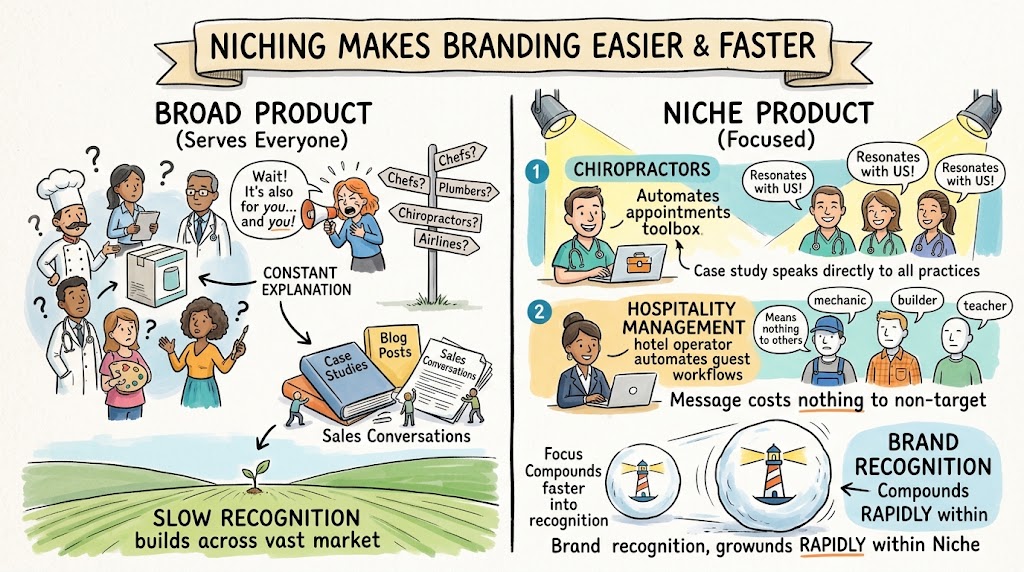
There's a knock-on benefit to niching that doesn't get talked about as much as pricing power or integration depth, and it showed up indirectly in the same conversation: a focused product is simply easier to talk about. When your product serves everyone, your marketing has to work harder to explain who it's actually for, and every piece of content, every case study, every sales conversation has to do double duty convincing a prospect the product applies to their specific situation. A niche product skips that step almost entirely. A case study about a chiropractic practice speaks directly to every other chiropractic practice evaluating the same tool. A blog post about automating a workflow specific to hospitality management resonates immediately with hotel operators and means nothing, and costs nothing, to everyone else. That focus compounds into brand recognition within the niche far faster than the same marketing effort would build recognition across a broad, undifferentiated market.
It also changes how referrals work. Inside a tight-knit industry, word travels fast when a product genuinely fits the way that industry operates, and one satisfied customer in a niche tends to know several others who face the exact same problem. That kind of organic, peer-driven awareness is expensive to manufacture in a broad market and often shows up for free in a narrow one, simply because the niche is small enough that everyone eventually hears about the tool built specifically for them.
- Focused marketing does less explaining and more converting. A niche product doesn't need to convince prospects it applies to them. That work is done by the positioning itself.
- Case studies carry more weight inside a tight industry. A single success story in a niche can resonate with dozens of similar prospects who recognize themselves in it immediately.
- Word of mouth travels faster in small, connected markets. Peer referrals inside a niche industry can outperform paid acquisition in a broad one, simply because everyone eventually hears about the tool built for them.