
.png)
The Best Marketing Strategy for B2B SaaS in 2026
If you’re building a B2B SaaS company and trying to scale in 2026, I want to save you a lot of wasted time and money: The winning companies are not relying on one channel. They’re not “cracking” ads. They’re not betting everything on outbound. And they’re definitely not hoping an algorithm figures out their ICP for them.

The B2B SaaS companies scaling from $5M to $50M+ ARR right now are doing something very different.
They’ve built a coordinated growth system that makes their brand impossible to ignore inside their target market.
In this article, I’ll break down exactly what that system looks like, why the old approaches no longer work, and how you can implement the most effective B2B SaaS marketing strategy heading into 2026.
Why Traditional B2B SaaS Marketing Is Breaking Down
Most founders still approach marketing the same way they did five years ago — and it’s quietly killing their growth.
Here’s what that looks like in practice:
- Running paid ads without a clearly defined account list
- Sending outbound emails with generic messaging
- Producing content inconsistently (or not at all)
- Treating every channel as a separate experiment
The symptoms are predictable:
- Rising CAC
- Low lead quality
- Poor attribution
- Little to no brand recognition in-market
The core issue isn’t effort. It’s lack of coordination. Your buyers don’t wake up one day, see a single ad, and book a demo. They buy after repeated exposure across multiple channels — email, ads, content, LinkedIn, search — over time.
In 2026, frequency plus relevance beats everything else.
The Shift That Defines B2B SaaS Marketing in 2026
The best marketing strategy for B2B SaaS in 2026 is not a tactic. It’s a system. High-growth SaaS companies are moving away from channel-first thinking and toward market-first execution.
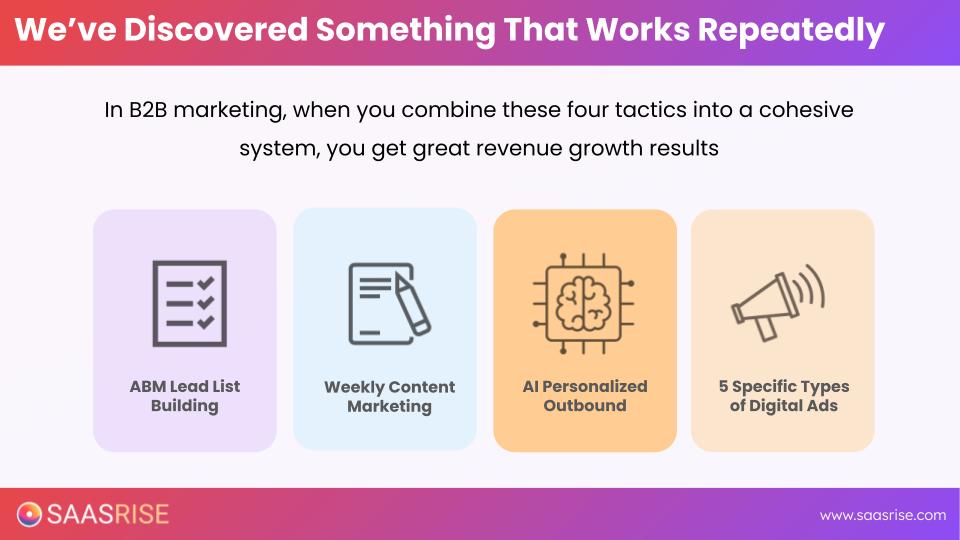
That system has four core components:
- Account-Based Market coverage
- AI-powered outbound distribution
- Layered, profitable digital advertising
- A consistent content engine
Together, these create what matters most in B2B buying today: omnipresence.
When your buyer is ready to evaluate solutions, you’re already the brand they know, trust, and recognize.
Step 1: Define and Own Your Entire Market with ABM
Everything starts with precision.
Instead of letting ad platforms guess who your ideal customer is, you define it explicitly:
- Job titles
- Company size
- Industry
- Geography
Then you build a complete Account-Based Marketing (ABM) list of every relevant buyer and account in your market.
.jpg)
This list becomes the foundation for everything:
- Outbound email
- LinkedIn outreach
- Matched-audience ads
- Retargeting
- Lookalike modeling
Modern tools make this fast and affordable. The real advantage isn’t cost — it’s control.
You stop marketing “to whoever clicks” and start marketing to your market.
Step 2: Build a Weekly Content Engine (This Is No Longer Optional)
In 2026, content is not a brand exercise. It’s a demand multiplier.
High-performing SaaS companies produce at least one high-value content asset every week. Not fluff — substance.
.jpg)
That content might be:
- A case study
- A short founder-led video
- A webinar or workshop
- A data-backed report
- A tactical blog post
.jpg)
The purpose is simple:
- Educate your buyer
- Demonstrate expertise
- Reduce perceived risk before the sales call
One strong content asset should be repurposed across:
- LinkedIn (organic + paid)
- Email (newsletter + outbound)
- Ads
- Blog
- YouTube
Consistency compounds. By 2026 standards, visibility is table stakes.
Step 3: Use AI-Personalized Outbound to Create Relevance at Scale
Outbound still works — but only when it feels human. Generic, mass-blast cold emails are no longer competitive.
.jpg)
The companies winning with outbound today are using AI personalization to tailor:
- Subject lines
- First lines
- Contextual references
At scale.
The goal of outbound in 2026 isn’t just replies — it’s engagement.
Clicks matter because they:
- Warm accounts for sales
- Trigger retargeting ads
- Reinforce brand familiarity
Outbound is no longer a standalone channel. It’s a distribution layer for your entire marketing system.
.jpg)
Step 4: Track CAC the Right Way (Or You’ll Scale the Wrong Things)
One of the biggest mistakes SaaS founders make is trusting platform-level attribution.
In a multi-touch world, every channel tries to take credit.
In 2026, you need visibility into:
- First-touch influence
- Last-touch influence
- Multi-touch contribution
Your CAC should be anchored to LTV, not gut feel.
A healthy benchmark remains:
- Target CAC ≈ 1/6 of LTV
Without accurate attribution, you’ll overinvest in the wrong channels and underfund what’s actually working.
Step 5: Launch Ads in Layers — Not All at Once
The best B2B SaaS marketing teams don’t “test everything.”
They roll out ads in a specific order:
- Retargeting (site visitors, email clickers)
- Matched audiences from your ABM list
- Lookalikes based on best customers
- Paid search (brand + competitors)
- LinkedIn thought-leader ads
- Sponsored messages to high-intent accounts
Each layer reinforces the others.
.jpg)
.jpg)
.jpg)
.jpg)
.jpg)
The goal isn’t clicks. It’s familiarity.
By the time a prospect is sales-ready, your brand already feels established.
Step 6: Optimize the Funnel Before You Scale Spend
Scaling spend without funnel optimization is how CAC explodes.
In 2026, top SaaS teams obsess over:
- Ad CTR
- Landing page conversion
- Lead → SQL conversion
- Opportunity close rates
Early CTAs should reduce friction:
- Short recorded demos
- Interactive demos
- High-value reports
- Trials (for PLG motions)
.jpg)
The difference between an average and elite growth engine isn’t budget — it’s optimization discipline.
Why This Is the Best B2B SaaS Marketing Strategy for 2026
When you combine:
- Market-level targeting
- Personalized outbound
- Consistent content
- Coordinated ads
You don’t just generate leads.
You build market dominance.
Your buyers see you everywhere — not because you’re loud, but because you’re deliberate.
In 2026, the SaaS companies that win won’t be the ones chasing channels.
They’ll be the ones who own their market.