The AI-Native Services Model
One SaaS founder is building an outbound and lead-gen agency where internal AI tooling drives service costs down toward software margins. Here's the model, and what it takes to actually build it.

A founder in our mastermind said something recently that I haven't stopped thinking about. He's running an AI native outbound and lead generation business, the kind of company that used to be a pure services shop: you pay a team to research prospects, write emails, manage sequences, and book meetings. He'd just closed a funding round through a well known European startup accelerator, one of a small handful of founders selected into that program, and when I asked him how it felt, he was happy, but what he said next was the more interesting part. He described the actual mechanics of what his company does, and it's a model I think a lot more services founders should be paying attention to.
The idea: make the service cost like a software cost
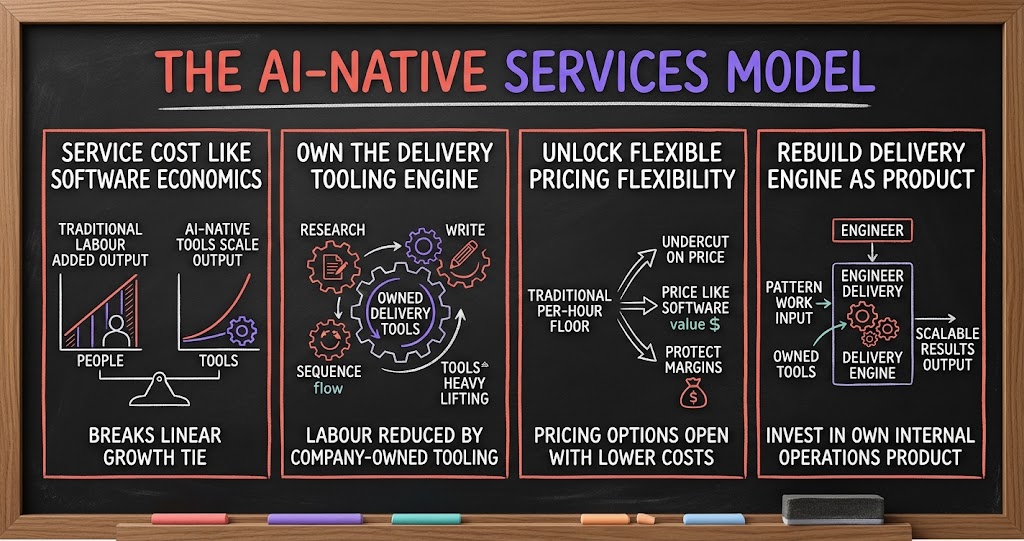
Here's how he put it. His company is making what he called an AI native services play. Basically, they are building their own tooling to be so efficient at delivering the service that the cost of delivering it starts to look like the cost of running software, not the cost of running a team of people. That's a genuinely different way to think about a services business, because it breaks the assumption most of us grew up with, which is that services scale linearly with headcount and software scales without it. If you can build internal tools that do most of the heavy lifting, the services business starts to inherit some of software's economics.
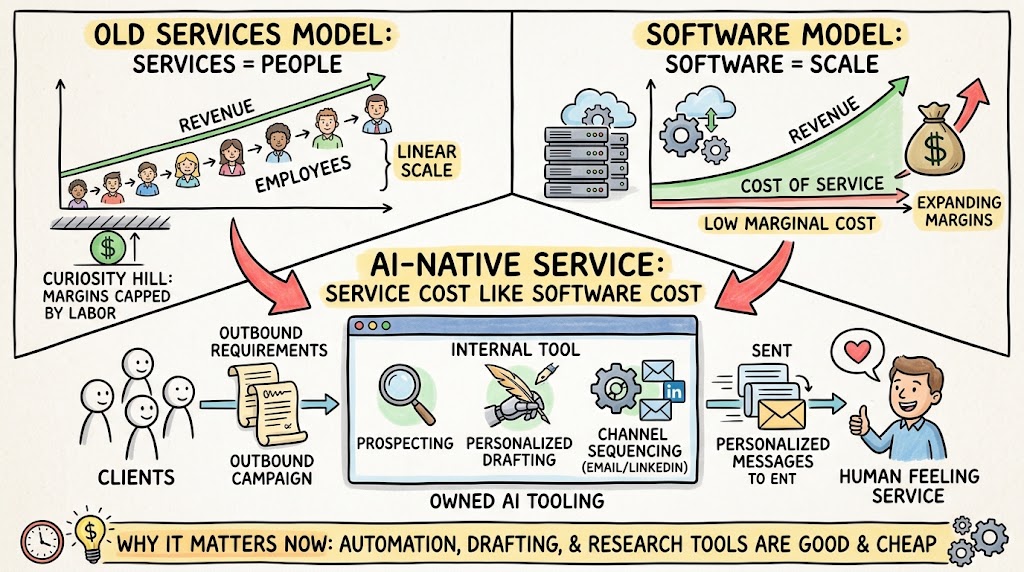
- The old assumption. Services businesses grow revenue by adding people, so margins are capped by labor cost and headcount stays tied to output.
- The software assumption. Once you've built the product, each additional customer costs you very little to serve, so margins expand as you grow.
- The AI native middle ground. You still deliver a human feeling service, but the labor behind it is replaced or massively reduced by tooling you own.
- Why it matters now. The tools to build that kind of automation, research, drafting, sequencing, personalization, are finally good enough and cheap enough to make this real.
In his case, the concrete example is outbound email. His team is doing prospecting and outreach for clients, primarily through email today, and they're adding LinkedIn as a channel, with more platforms likely down the road. On paper that sounds like a normal outbound agency. What makes it different is that the work of finding prospects, writing personalized messages, and running sequences isn't sitting on a team of humans doing it one email at a time. It's sitting on tooling his company built, which means the marginal cost of running another campaign, or serving another client, or adding another channel, doesn't scale the way it would if you had to hire another person for every chunk of volume.
Why this changes how you can price
When your delivery cost drops toward software economics, your pricing options open up in a way that simply isn't available to a traditional agency. A traditional outbound shop has to price around the hours it takes a human to research and write, which puts a floor under what they can charge and a ceiling on how many clients one team can handle well. If your own tooling is doing most of that work, you get room to move. You can price lower and still protect margin, which makes you more competitive against traditional agencies. You can price closer to what the client would pay for software, which is often a very different number than what they'd pay for a team of humans. Or you can hold your price steady and let more of it fall to the bottom line, since you're not adding headcount at the same rate you're adding revenue.
- Undercut on price. Win on cost against agencies that still price around human hours, because your delivery cost is structurally lower.
- Price like software. Anchor to the value delivered rather than the hours worked, since the client is often comparing you to a SaaS tool anyway.
- Protect your margin. Keep pricing where it is and let efficiency show up as profit instead of passing all of it back to the client.
- Mix all three. Different segments of your client base can justify different approaches, and you're not locked into one pricing model the way a pure labor business is.
The part worth sitting with is that this isn't just a cost saving trick, it actually changes your competitive position. A services company that still delivers everything by hand is competing on the same axis as every other agency in its category: who has better people, who works harder, who charges less per hour. A company with real tooling behind it is competing on a different axis entirely, closer to how software companies compete, on product quality, on speed, on how well the system performs, not just on labor rates.
What it actually takes to build this
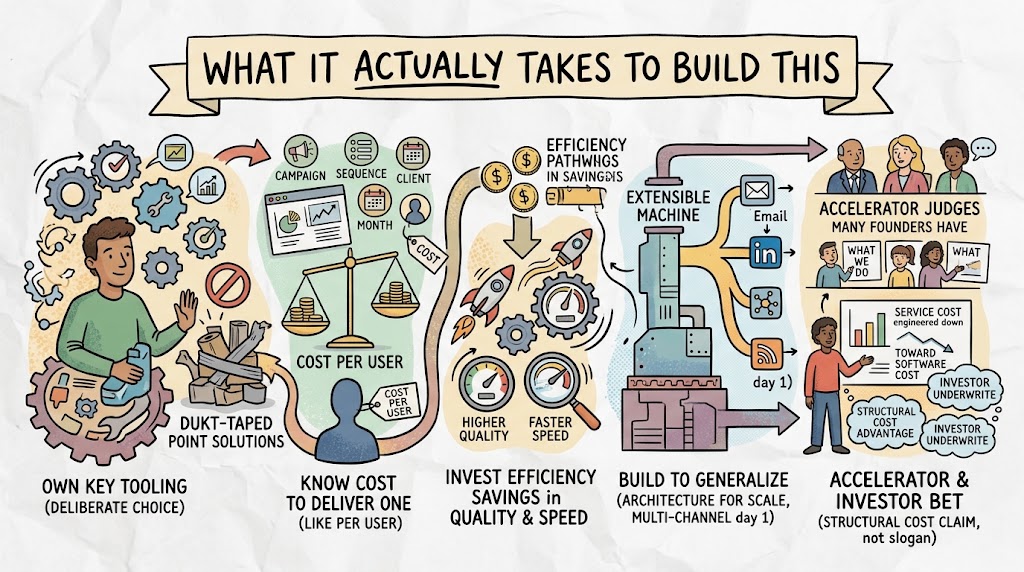
None of this happens by accident, and it's worth being honest about what it takes, because “build your own tooling” is easy to say and genuinely hard to do well. The founder in our mastermind didn't describe some magic shortcut. He described a company that had made a deliberate choice to own the tooling for the steps that actually drive outcomes, rather than duct tape together a stack of third party point solutions everyone else has access to, and that choice shapes almost everything else about how the business runs. It means knowing what it actually costs to deliver one campaign, one sequence, one client month, the same way a software company tracks cost per user, and it means putting the savings from that efficiency back into quality and speed instead of just pocketing the margin. It also means building the system to generalize from the start, so extending from email to LinkedIn and beyond is a natural next step rather than a rebuild, because the underlying architecture was designed for more than one channel from day one.
This is also why I think the accelerator he went through made a smart bet on his company. Programs like that see a lot of pitches, and most founders describe what they do. Fewer founders describe how their cost structure actually works and why it's different from everyone else doing something that looks similar on the surface. When a founder can explain that their service cost has been engineered down toward a software cost, that's not a slogan, it's a structural claim about the business that an investor can actually underwrite.
Where this applies beyond outbound
Outbound email and lead generation happen to be a clean example, because the work is repeatable, text heavy, and easy to measure, which makes it a natural first place to apply this kind of tooling. But the underlying pattern isn't specific to outbound at all. Any services business built around research, writing, analysis, or structured repeatable work is a candidate for the same move. The question to ask yourself is simple: which parts of what you deliver are genuinely novel judgment calls that need a human, and which parts are pattern based work that a well built internal tool could do most of?
- Content and creative services. Drafting, editing, and formatting can often be automated to a first draft, with humans focused on judgment and final quality.
- Research and analysis services. Gathering and structuring information is exactly the kind of repeatable work that tooling handles well, freeing people for interpretation.
- Customer facing operations. Support, onboarding, and account management all have repeatable components sitting alongside the parts that genuinely need a human.
- Recruiting and sourcing. Finding and qualifying candidates rhymes closely with finding and qualifying leads, which is the exact problem this founder is solving for outbound.
If you're running a services business today, the honest exercise is to map your delivery process step by step and ask where the actual labor is going. Most founders have a rough sense of this, but a rough sense isn't enough to make good decisions about where to invest in tooling. You want real numbers on where the hours go, because that's what tells you which steps are worth building for.
The bigger shift for services founders
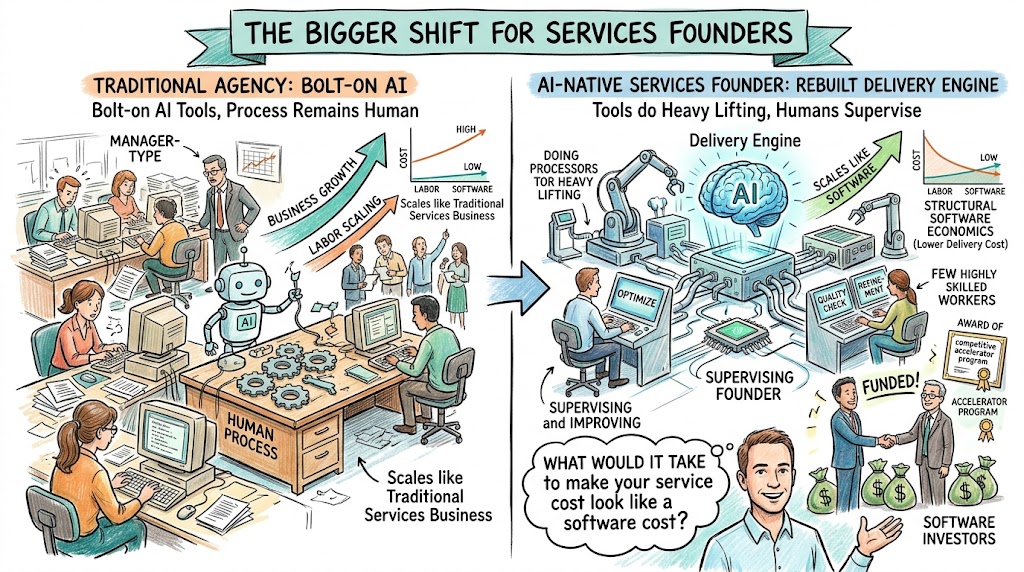
I think we're at the start of a real re-sorting of the services industry, and it's going to reward founders who treat their own operations like a product, not just founders who happen to use AI tools. Plenty of agencies are bolting a chatbot or an AI writing assistant onto their existing process and calling it innovation, but if a human still does every step and just gets a little faster, the business still scales like a services business, tools bolted on top rarely change the underlying cost structure. That's not what this founder is doing. He's rebuilt the actual delivery engine so the tooling does the heavy lifting while humans supervise and improve it, and when that happens the economics start to resemble software rather than labor, which is a fundamentally different unit economics than a traditional agency's. Investors notice that difference too, because a pitch built around structurally lower delivery cost is a different conversation than a pitch built around a good team, and that difference is what let him raise money from investors who evaluate software companies for a living. Getting there took real building, not a subscription: investing in his own systems rather than adding another SaaS tool to the stack.
Congrats to the founder in our mastermind on the progress, the funding, and getting into a competitive accelerator program on top of everything else he's building. What stood out to me wasn't the news itself, it was the clarity of the model underneath it. If you're running a services business right now, ask yourself the same question he answered for his: what would it take to make your service cost look like a software cost? For a lot of founders in our community, that question is going to matter a lot more over the next few years than it has in the past.