
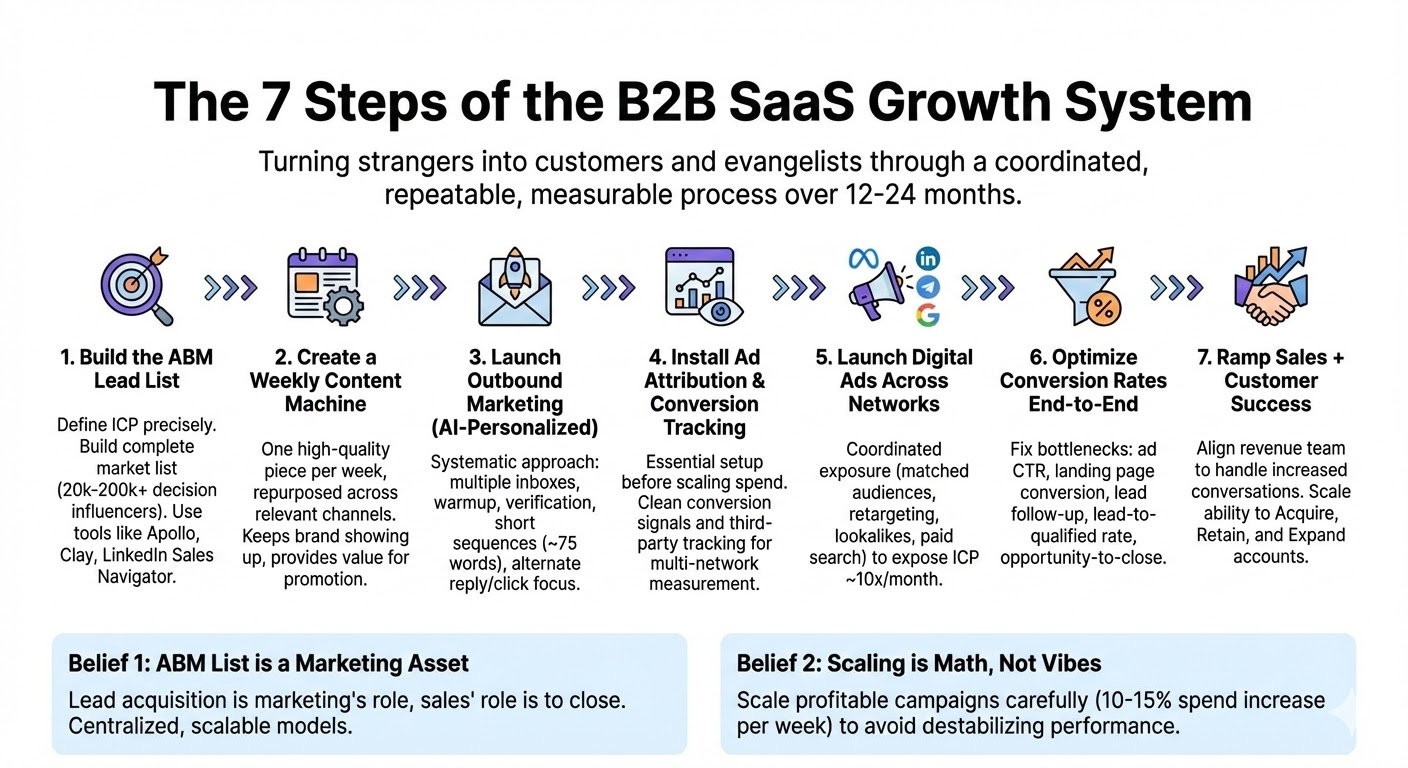
The 7 Steps of the B2B SaaS Growth System
A clear walkthrough of the full growth system from audience creation to sales follow-through, showing the exact sequencing that turns unknown brands into familiar brands inside a defined market over 12–24 months.

When people ask me what’s “working” in B2B SaaS right now, they’re usually hoping for a channel answer. LinkedIn ads. Cold email. Webinars. SEO. Something they can point at and say, “That’s the thing.”
But the truth is, the companies scaling predictably in 2026 are doing something less exciting and way more effective: they’re running a coordinated system. On the webinar, I framed it like this: “The whole point of this system that we’ve invented is to make your brand omnipresent within a targeted market.”
Not omnipresent to everyone. Omnipresent to the people who matter.
“You can’t make a B2B brand omnipresent like Coca-Cola in the whole world, but what you can do is find the twenty to forty thousand people that really influence the buying decision within your target market and make your brand as well known as Coca-Cola for those forty thousand people.”
That’s what the 7-step system is built to do: turn strangers in your market into customers (and eventually evangelists) through a repeatable, measurable process.

The big idea: four channels, seven steps
On the call I laid out the core structure: there are four channels (ABM, content, outbound, ads), but seven steps to implement them properly.
And importantly, this isn’t a “two-week growth sprint.” It’s a longer campaign with compounding effects. As I put it in the webinar, the philosophy is to “turn people who are in your target market, but you don't know them and they don't know you, into people who are paying customers and evangelizers over the course of about a twelve to twenty four month account based marketing brand omnipresence campaign.”
If you’re looking for a clean breakdown, here are the seven steps exactly the way we teach them.
The 7 steps
- Build the ABM lead list (the full market, not “a thousand leads”)
This starts with defining your ICP precisely (industries, job titles, company size, regions), then building the complete list of the market you want to win. I’m talking 20,000–40,000 decision influencers in many mid-market and enterprise categories, sometimes 200,000+ in larger markets.
This is where tools like Apollo, Clay, ListKit, LinkedIn Sales Navigator, ZoomInfo, and others come in.
- Create a weekly content machine
One high-quality piece per week, repurposed across the channels your buyers actually use. This is what keeps you showing up even when people aren’t “in market” today. It also gives your outbound and ads something valuable to promote instead of a constant “book a demo” ask.
- Launch outbound marketing via email (AI-personalized, infrastructure first)
Outbound still works, but only when you respect deliverability and you do it like a system. That means multiple inboxes, warmup, verification, enrichment, and short sequences. A practical guideline we use: one inbox per ~30 cold emails/day, with 2–3 weeks of warmup before meaningful volume.
And the copy itself matters: sequences are typically under ~75 words, and you alternate between emails designed for replies vs. clicks.
- Install ad attribution and conversion tracking (before you scale spend)
This is the step most teams skip, then wonder why Meta or Google “stopped working.” You need clean conversion signals and (ideally) a third-party tracker when you’re multi-network, so you’re not making decisions on wishful thinking. On the webinar, I called this “essential setup” before you really scale ads.
- Launch digital ads across Meta, LinkedIn, Google (optionally Bing + AdRoll)
Once you have the ABM list and tracking in place, you can run a multi-network approach: matched audiences, retargeting, lookalikes, paid search, thought leader/content boosting, and so on.
The key is coordinated exposure. As I said on the call, the goal is “exposing your entire ICP to your messaging about ten times per month.”
- Optimize conversion rates end-to-end (not just ads)
At this stage, growth becomes a series of conversion rate problems you can actually fix: ad CTR, landing page conversion, lead follow-up speed, lead-to-qualified lead rate, and then opportunity-to-close.
This is where a lot of “ads aren’t working” complaints disappear, because the ad wasn’t the real bottleneck.
- Ramp sales + customer success to acquire, retain, and expand
Finally, you align the revenue team around the reality that the marketing system is going to produce more conversations, and you need the right structure to handle it. I referenced Dan Martell’s framing in the webinar: “acquire, retain, expand.”
You’re not just scaling lead flow, you’re scaling the company’s ability to close, keep, and grow accounts.
Two beliefs that make this system work (and stop a lot of expensive mistakes)
First: the ABM list is a marketing asset, not an SDR project.
.jpg)
I said it directly on the webinar because it’s a major operating principle for how we run this: “We like centralized scalable models… lead acquisition is the role of marketing, not the role of sales. The role of sales is to close leads. The role of marketing is to create the leads.”
Second: scaling is math, not vibes.
Once you have profitable campaigns, you scale carefully and predictably. One of the rules I gave on the call is to scale spend about 10–15% per week when you’re scaling what’s working, because bigger jumps can destabilize performance.
That’s the system. It’s not seven random tactics. It’s a sequence that turns an unknown brand into a familiar brand inside a defined market, then converts that familiarity into pipeline and revenue over 12–24 months.