
The SaaS Pricing Report 2026
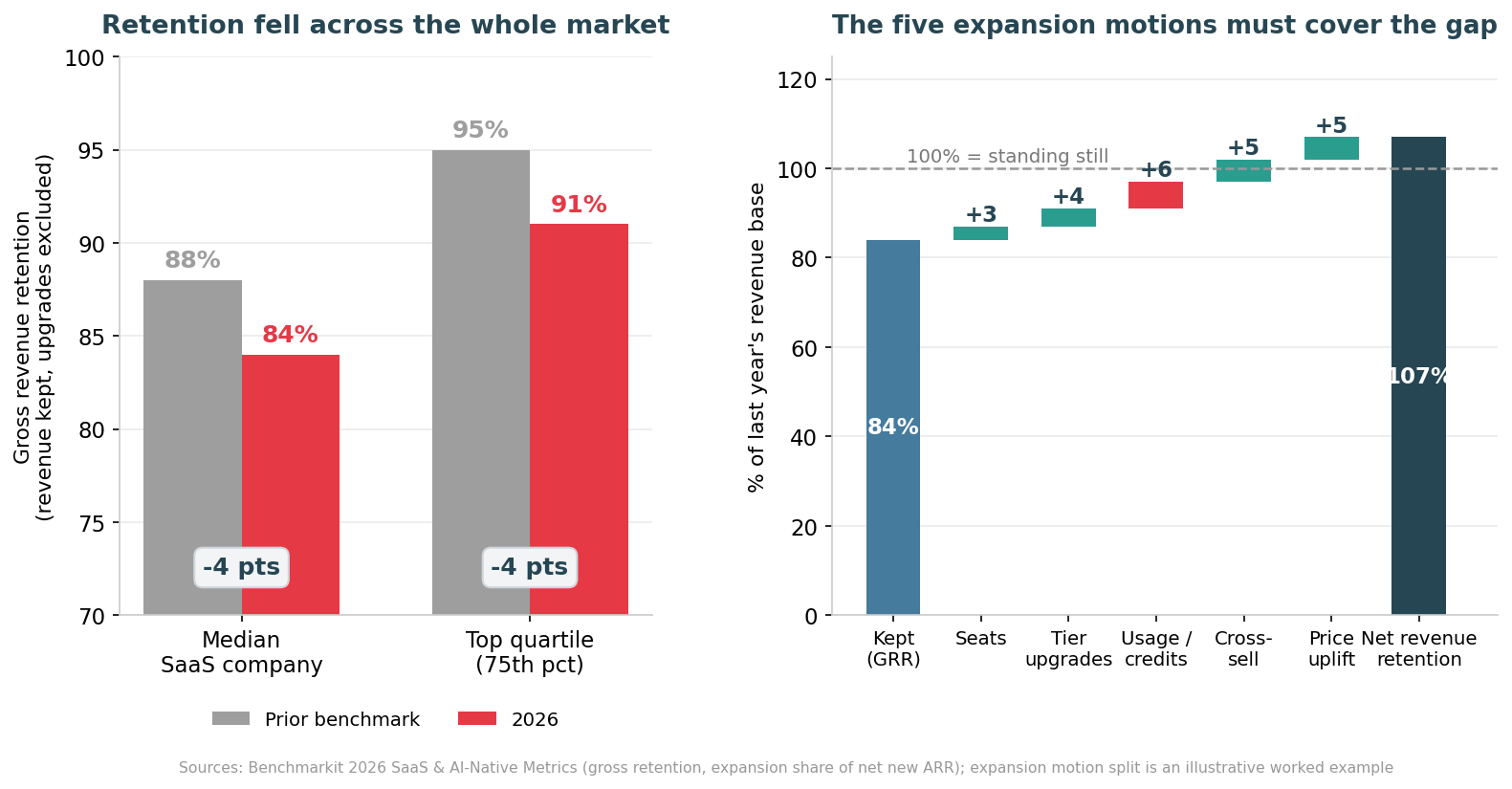
SaaS pricing changed more between April and August 2026 than in the previous five years. ServiceNow said half its net-new business is no longer sold by seat. Salesforce put a price on a single agent resolution. HubSpot cut its own price to charge only for conversations its AI resolved, and took a guidance hit for it. GitHub, Notion, monday.com, Gong and Docusign all rebuilt their billing around credits. This report has four conclusions. The price list moved much faster than the invoice, and seats are still 65 to 75 percent of what buyers actually spend. What replaced the seat is the credit, not the outcome. Usage-priced companies keep 108 percent of their revenue base each year against 98 percent for seat-priced companies, which is the real argument for changing anything. And the largest recoverable number in most companies this year is not a new pricing model at all. It is the four points of gross retention the market lost since last year, plus the annual price increase you are entitled to and never applied.
This report is published by SaasRise, the #1 mastermind community for SaaS CEOs with $1M–$100M+ in ARR. Members have collectively raised $1B+ and have $3B+ in ARR.
The Gap Between the Price List and the Invoice
What It Does to Your Numbers
How to read the numbers in this report
Skip ahead if you already speak this language. Everything below is defined the way an operator uses it, not the way a banker does.
Net revenue retention (NRR). Take the customers you had a year ago. What do those same customers pay you today, after upgrades, downgrades and cancellations? 108% means that group now pays you 8% more without you selling anyone new.
Gross retention (GRR). The same group, but upgrades don't count. It only measures what you lost, with nothing to hide behind.
Gross margin. Of every dollar of revenue, what is left after the cost of actually delivering the product. Classic software runs 75–85% because serving one more customer costs almost nothing. AI changes that, because every answer burns compute you pay for.
ARPA and ACV. ARPA is average revenue per account across your whole base. ACV is the annual value of a single contract. Expansion raises both, but ARPA is what tells you whether your installed base is getting more valuable.
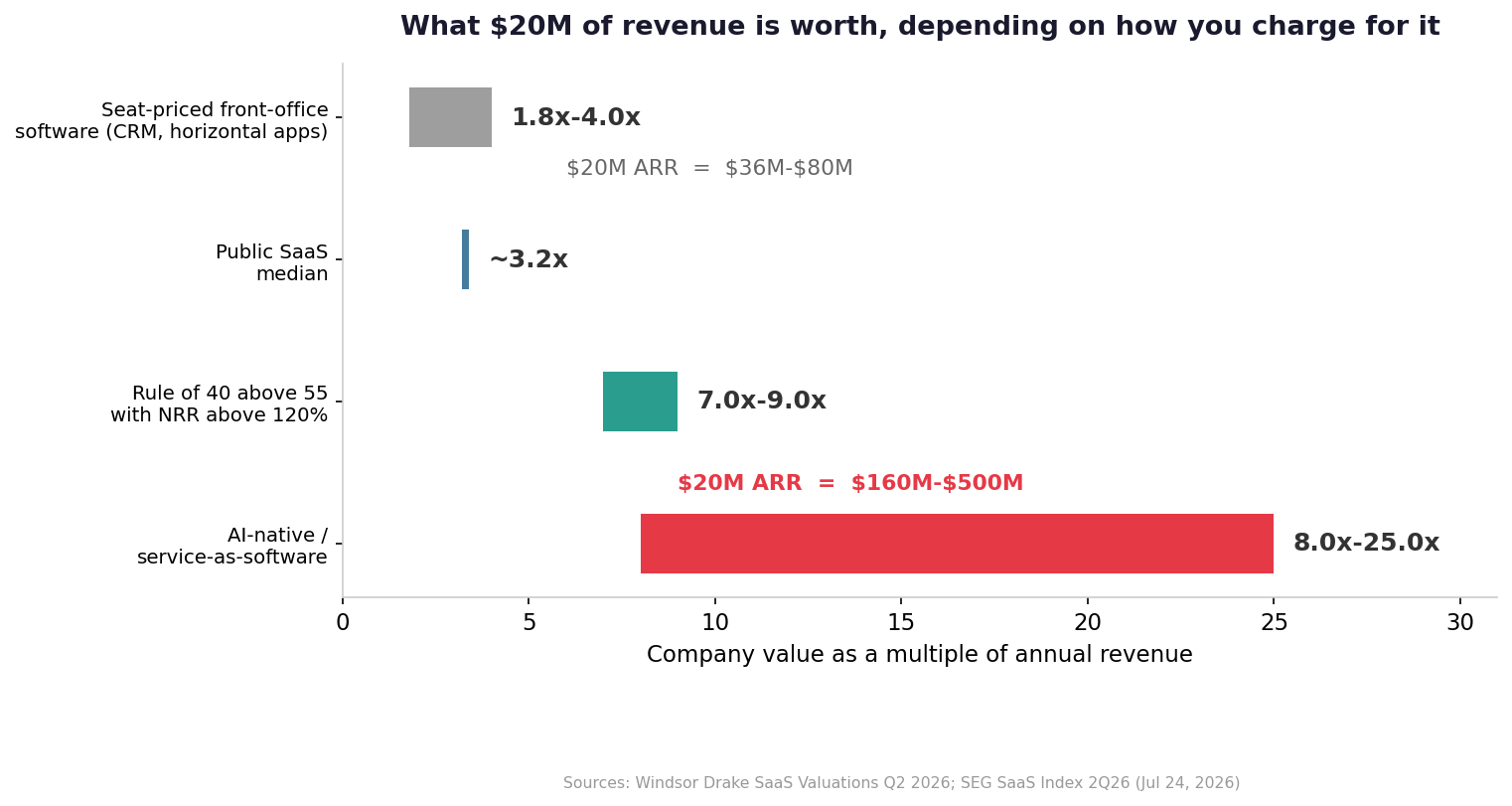
Revenue multiple. What a buyer pays for your company, expressed as a number of years of revenue. At 3x, $20M of revenue is a $60M company. At 8x, it is $160M. Same revenue.
Rule of 40. Growth rate plus profit margin. 30% growth at 15% margins is 45, which clears it.
A resolution. One customer request an AI agent finished without a human stepping in. It is the unit several vendors now bill by, and how each one defines "finished" is the most important sentence in their contract.
A credit. A private currency the vendor sells you in advance. You buy a balance, and each thing the software does draws it down at a rate the vendor sets and can change.
Capacity, consumption, outcome. Three ways to charge. Capacity: you commit to a volume up front and pay overage past it. Consumption: you pay for what you used, after you used it. Outcome: you pay only when something specific gets done.
📋 Table of Contents
- The week the argument broke open
- What the biggest vendors actually did
- Three meters, not one
- What actually replaced the seat: the credit
- Five ways credit pricing goes wrong
- The ten-point question: 98% vs 108%
- Your customers haven't switched
- What counts as an outcome?
- What it does to your gross margin
- Where net revenue retention actually comes from
- Growing ARPA and ACV through the customer success motion
- Three levers that raise ARPA without a new pricing model
- The services line nobody wanted, and everybody is now building
- Four private companies that repriced in 2026
- The migration playbook
- What the market pays for
- Should you change your pricing at all?
Key Findings
Seat pricing is not dead, and the companies telling you it is are usually selling you something. What has actually happened is narrower and more useful: the largest vendors in software have added a second meter next to the seat, almost always denominated in credits, and buyers have been slow to move any real money onto it. Consumption is still 4–6% of software spend on a 200-vendor panel, unchanged over twelve months. But the companies that did move their pricing are keeping 10 more points of revenue from their existing customers every year, and the market is paying them four to six times more per dollar of revenue than it pays seat-priced front-office software. Both of those things are true at once, which is why this decision is hard.
1. The week the argument broke open
On Friday, August 7, 2026, CNBC ran a piece under the headline "'SaaSpocalypse' debate intensifies as software stocks swing wildly." That week HubSpot, Datadog and Figma all fell on earnings. Atlassian and Twilio each popped well over 20%. Cloudflare rose 5.6%. Salesforce, whose revenue growth has been accelerating, has lost more than 40% of its value since the end of 2024.
Look at what the two ends of that week actually were. HubSpot got punished in the same quarter it shipped outcome-based pricing on its Breeze agents, cutting the price of a customer conversation from $1.00 to $0.50 and charging only when the conversation is resolved. Atlassian beat and raised while selling software per seat: $1.766 billion in Q4 revenue, up 28% year over year, cloud revenue up 31% to $1.213 billion, subscription ARR of $6.6 billion.
Aaron Levie put it plainly to CNBC: "There was a misplaced thesis over the past 6 months that somehow agents would be bad for certain categories… many were parsing this poorly."
So the question worth your time is not "are seats dead." It is narrower and much more expensive to get wrong: what are you selling a unit of, and can you count it?
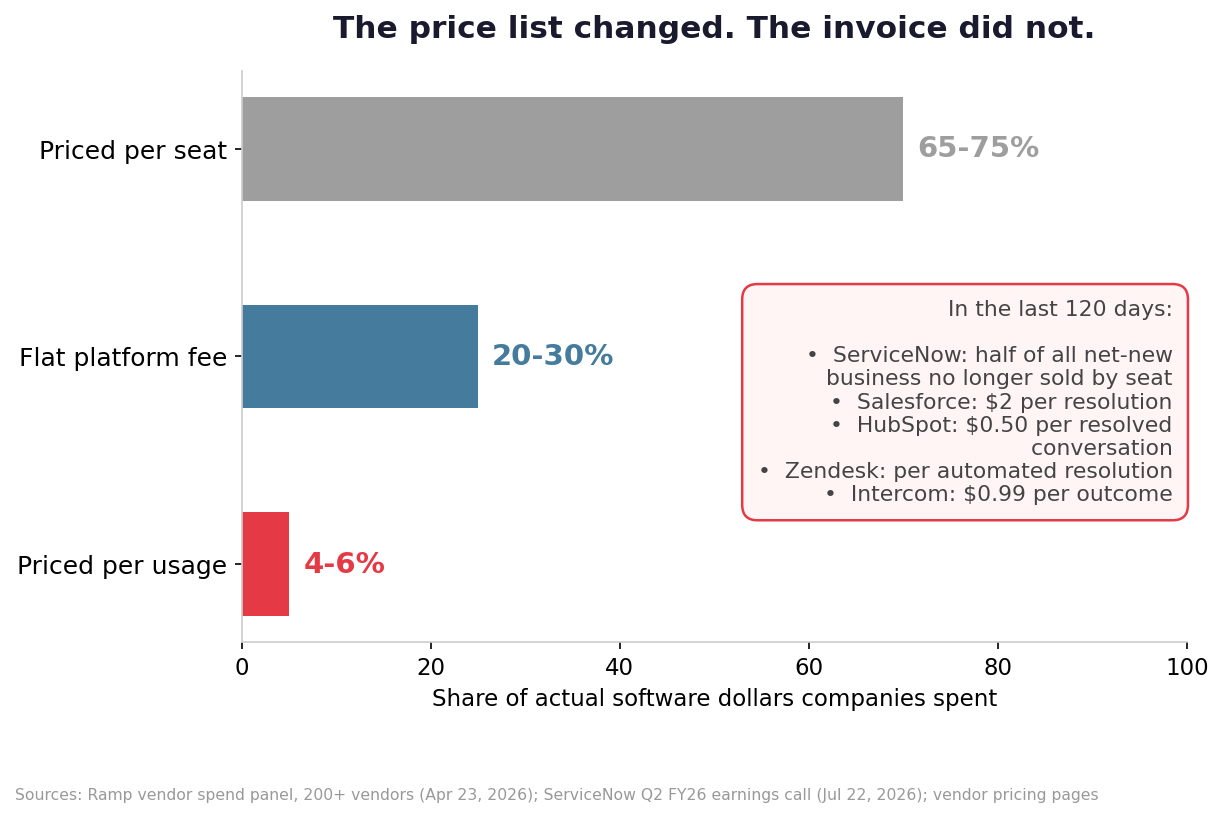
The one line to take from this report: the price list has changed and the invoice has not. Vendor announcements are running years ahead of buyer behavior. If you price off the announcements you will move too early and break your own revenue. If you ignore them you will be the last seat-priced company in a category that stopped counting people.
2. What the biggest vendors actually did
Here is the last 120 days, from earnings calls and pricing pages rather than from commentary.
| Company | What changed | When |
|---|---|---|
| ServiceNow | Bill McDermott on the Q2 FY26 call: "Are we worried about seat compression? Not at all. Our addressable user base is growing and 50%, five zero, of our net new business is already non-seat based." Pro Plus carries a pricing uplift above 30%; AI-native SKUs 20–30%. Renewals held at 97%. He also said they keep seats because customers prefer them for predictability. | Jul 22, 2026 |
| Salesforce | Agentforce moved to pay-per-resolution: $2.00, or 400 Flex Credits, flat no matter how many actions the agent takes. Flex Credits sell at $500 per 100,000 and are fungible across actions, prompts, translations and voice. A $5/user/month Agentforce license still requires a credit balance behind it. | Jun–Jul 2026 |
| HubSpot | Breeze Customer Agent and Prospecting Agent moved to outcome pricing: from $1.00 per conversation to $0.50 per resolved conversation, and $1 per lead recommended. HubSpot says the agent resolves 65% of conversations and cut resolution time 39% across 8,000+ customers who turned it on. | Apr 14, 2026 |
| Zendesk | Bills per automated resolution, meaning a request an AI agent closed with no human escalation. On May 18, 2026 it introduced resolution tiers that price by the value delivered, drawn from a dollar-denominated allowance pool, with an assisted-escalation tier that does not draw against the allowance. | May 18, 2026 |
| Intercom | Fin charges $0.99 per outcome — a resolution, a procedure handoff or a disqualification — and $9.99 for a qualified lead. One charge maximum per conversation. Seats still exist at $29–$139. Claims a 76% average resolution rate across 8,000+ customers. | Jul 2026 |
| Docusign | Enterprise IAM moved to pure consumption. No seats at all, unlimited users, buy a bucket of credits and deploy across departments. | Jun 2026 |
Read that table twice and you notice something the headlines miss. Only one company on it removed the seat. Everyone else added a meter next to the seat and kept charging for both. ServiceNow said the quiet part on its own earnings call: half of net-new is non-seat, and they are keeping seats anyway, because customers want a number they can budget.
Pricing changes are the fastest way to move ARR — or break it
SaasRise members compare real pricing experiments, migration sequencing and renewal data with other CEOs running $1M–$100M+ ARR SaaS companies. Weekly calls, no theory.
3. Three meters, not one
Most of the confusion in this debate comes from treating "usage-based" as one thing. Bain's August 2026 work splits it into three, and the split is the most useful framework we found all year.
Effort, output, outcome
- Effort is what the machine burned: tokens, compute minutes, API calls. Easy for you to measure, meaningless to your customer.
- Output is what the machine produced: a draft, a summary, a recommended lead. Countable, and the customer can see it.
- Outcome is what actually changed for the business: a resolved ticket, a qualified lead, a closed contract.
Bain's own example: a recommended lead is an output. A qualified lead is an outcome. Intercom prices exactly that gap — $0.99 for a resolution, $9.99 for a qualified lead. Ten times the price for the same underlying machine, because one of them is a business result and the other is a piece of work.
There is a fourth model Bain argues is quietly winning, and it barely gets written about: capacity pricing. The customer commits to a volume for the year and pays overage past it. It gives the buyer a budget number and the vendor a revenue floor, which is precisely what both sides asked for and neither consumption nor outcome pricing delivers.
If you are choosing a meter, the test is not which one is most modern. It is which one your customer can count without calling you.
4. What actually replaced the seat: the credit
Here is the finding that reframed this whole report for us. Everyone is writing about outcome pricing. Almost nobody is buying it. The model that actually spread across software in 2026 is the credit: a private currency the vendor issues, sells in advance, and spends down at rates it controls.
Between June 1 and July 20, 2026, GitHub, OpenAI and Anthropic all moved flagship products onto credit metering. Seven weeks, three companies, no coordination between them. That is not a product decision, that is an industry settling on a standard.
The reason is mechanical. Per-seat breaks under agents because the work stops tracking headcount, which produces the inversion every SaaS CEO should be afraid of: your customer pays you less as your software does more. But raw per-token pricing terrifies buyers, because nobody can picture what a million tokens costs or how many they will need. The credit sits in the middle. As one pricing analyst put it, credits won "because they let vendors sell a number that feels fixed while metering everything underneath it."
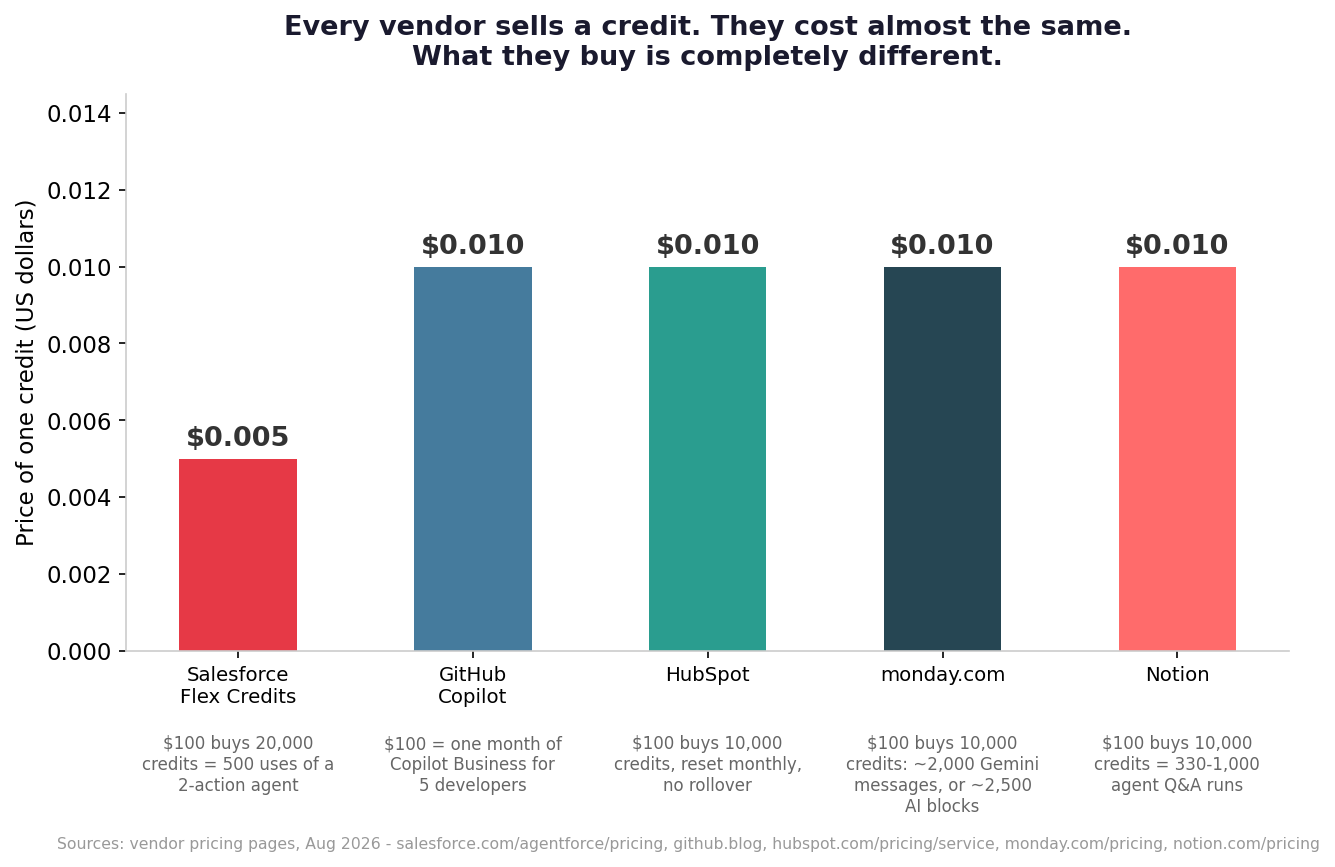
The rate cards, side by side
| Company | Price per credit | The mechanic worth copying |
|---|---|---|
| Salesforce | $0.005 $500 / 100k | Credits are fungible across actions, prompts, translations and voice. Salesforce publishes its own worked example: a two-action use case costs 40 credits, or $0.20 per use; at 20 uses a day that is $120 a month. A three-action case at scale runs $1,800 a month. |
| HubSpot | $0.010 $9.00 / 1,000 annually | Starter includes 500 credits, Pro 3,000, Enterprise 5,000 — but included credits are not additive across products. Buy three hubs and you get the highest single allotment, not the sum. Credits reset monthly and do not roll over. Global and per-agent spend caps, and any feature can be paused. |
| monday.com | $0.010 | Credit cost varies by task and by the model you pick: roughly 10–20 credits per message on Gemini Flash, 30–50 on Claude Sonnet. AI blocks are a flat 8 credits. monday.com estimates a typical three-person team burns 800–1,200 credits a month. |
| GitHub Copilot | $0.010 | On June 1, 2026 GitHub scrapped "premium request units" for AI Credits drawn against real token consumption at published API rates. Seat prices did not change — Pro $10, Business $19/user, Enterprise $39/user — and each plan now includes credits equal to its own price. Code completions stay free. |
| Notion | $0.010 $10 / 1,000 | Publishes dollar cost per agent run: a Q&A agent runs $0.03–$0.11, a daily brief $0.10–$0.30. Credits pool across the workspace and agents auto-pause at zero rather than billing on. |
| Gong | By data volume | 2,000 credits per paid core seat per year, pooled company-wide. A call over 10 minutes costs 1 credit, under 10 minutes costs half. Everyday AI — rephrasing an email, meeting prep, the assistant — stays covered by the license; credits only apply to agents working in the background. Purchased credits die at the end of the term. |
| Docusign | By output metric | No seats. Rate card tied to outputs the customer could estimate before signing, not tokens. |
| Replit | Tiered | Core $20/month includes $25 of credits; Pro $100/month includes $100, scaling to $4,000/month at bigger discounts. Unused credits roll over one month. Economy, Power and Turbo modes let the customer control their own burn. |
| Zapier | Model multiplier | From June 15, 2026 AI steps cost by model tier: Standard 1x, Advanced 3x, Premium 5x — and 1x if you bring your own AI account. A step that hits 75 tasks in one run pauses and asks for approval. |
monday.com: how a legacy seat business migrates
monday.com ran the cleanest migration in this set, and it took two years in two deliberate acts.
Act one, early 2025. Give 500 free AI credits to every paid tier — the same allowance whether you were on Basic or Enterprise. This made no revenue sense, which was the point. It was a data-collection exercise: find out what people actually do with agents before pricing any of it.
Act two, May 6, 2026. Ship seats plus credits across the line. Basic bundles 1,000 credits at $10, Standard 2,000 at $20, Pro 3,000 at $30, and each bundle is offset by a matching monthly discount, so nobody's bill jumped on the day the model changed.
That second detail is the one to steal. They introduced a whole new billing dimension without a single customer seeing a higher invoice in month one. If you are planning a pricing change this year, that sequence — measure for a year, then land the new model at neutral cost — is the lowest-churn path anyone has published.
Docusign: the only one that actually killed the seat
Docusign is the exception that proves how rare real seat removal is. In June 2026 its enterprise IAM product went to pure consumption: no users counted, unlimited seats, buy a bucket of credits and deploy them across departments. Across the roughly 1.9 million customers on eSign and IAM, per-user pricing still works fine for small teams and web buyers. It broke at the top of the pyramid, where the people generating the most volume on the platform are often the ones who never log in.
Their pricing lead, Bhooshan Wabgaonkar, framed it in a way worth quoting to your own team: charging for a seat "to power a workflow they never see is a tax on automation."
Two restraints in their design matter more than the model itself. The rate card is tied to output metrics a customer could estimate before signing, not to tokens. And they deliberately do not charge for searching an agreement, asking questions about it, editing terms, or sending by SMS, all of which cost Docusign real money on the underlying model. They know. They chose adoption over monetization for now. They also refused to build the hundred-line rate card that a platform with that many possible actions invites.
The operator takeaway from Gong: decide loudly what is free. Gong keeps everyday AI inside the license and charges credits only for background agent work. Docusign leaves search and Q&A free despite real cost. Both are making the same bet: if your customer has to think about money every time they touch the AI, they will use it less, and low usage kills renewals faster than low pricing does.
5. Five ways credit pricing goes wrong
Credits solve a real problem. They also create five new ones, and the failure modes are well documented enough by now that you can avoid all of them.
1. A credit spanning multiple meters is currency creation, not billing
If you price one metric and sell credits against it, that is just prepayment. Nothing changes. The moment a single credit pool covers tokens and agent runs and tool calls, you have declared an exchange rate between things that are not comparable, and you will defend that rate forever.
The phone-carrier analogy makes it concrete. Carriers sold minutes, then sold texts separately, on their own meter. Suppose instead they had said: you get 1,000 credits, a voice minute costs 2, a text costs 1. That is not a billing convenience, it is a declaration that one minute of voice is worth exactly two texts. When texting exploded, the carrier would have been trapped defending its own published ratio.
2. Credits expose your margin instead of hiding it
The pitch for credits is that they abstract your pricing away from raw infrastructure cost. In practice they do the opposite. If your credits roughly track tokens, and your customer can read your cloud provider's published token price, they can calculate your markup on the back of an envelope. You are no longer selling your product, you are selling a spread, and your customer's job at renewal is to compress it. Renewal calls stop being about ROI and start being about why generating an image costs 50 credits and a blog post costs 25.
3. Cursor: what happens when the abstraction moves
In June 2026 Cursor changed its $20 Pro plan from 500 fast requests to "$20 of usage at API rates." Users burned through the allowance in a handful of complex Claude prompts and got surprise bills. The CEO apologized publicly within weeks and refunded unexpected charges from a three-week window.
The underlying reason was legitimate: newer models spend far more tokens per request on long-horizon tasks, and Cursor had been eating the difference. But the credit abstraction meant customers could not see the change coming until the invoice arrived. A price rise you can explain is survivable. A price rise your customer discovers on a statement is not.
4. Nobody publishes what happens on a failed run
If an agent runs, burns credits and produces nothing useful, does the customer pay? Pricing designers flag this as the single biggest trust issue in credit models, and most rate cards are silent on it. Put your answer in writing before a customer asks, because the first time they ask it will be while they are angry.
5. Expiry is churn risk dressed up as revenue
HubSpot credits reset monthly with no rollover. Gong's purchased credits die at the end of the contract term. Replit rolls over for one month. Every one of those policies converts unused capacity into a renewal conversation about waste, and unused capacity is exactly what a customer who has not adopted the product yet is holding.
The accounting trap your auditor will find
Prepaid credits are not revenue when you sell them. They are a contract liability (deferred revenue), recognized only as the credits are consumed.
Credits that expire unused require breakage accounting under ASC 606. You can use the proportional method, recognizing the expected unused share as the rest gets consumed, but only with documented historical redemption data to support the estimate. Without that history you fall back to the remote method, recognizing only when redemption becomes unlikely.
And if your credits never expire, or your contract gives customers a rollover right, you may have handed them a material right that requires separate accounting treatment. Decide your expiry policy with your auditor before it goes on your pricing page, not after.
Need help executing the growth plan behind the pricing change?
The SaasRise Growth Agency works directly with SaaS companies on demand generation, positioning and pipeline: the work that has to land after you decide what to charge for.
6. The ten-point question: 98% vs 108%
Benchmarkit's 2026 annual report surveyed 342 companies and found the number that makes this whole debate worth having: seat-based companies averaged 98% net revenue retention. Usage-based companies averaged 108%.
On $10M of revenue that is the difference between last year's customers paying you $9.8M this year and paying you $10.8M. A million dollars of ARR, every year, from the same customers, decided by how you count. Their framing: "pricing architecture is not a neutral commercial choice. It determines whether revenue compounds or decays."
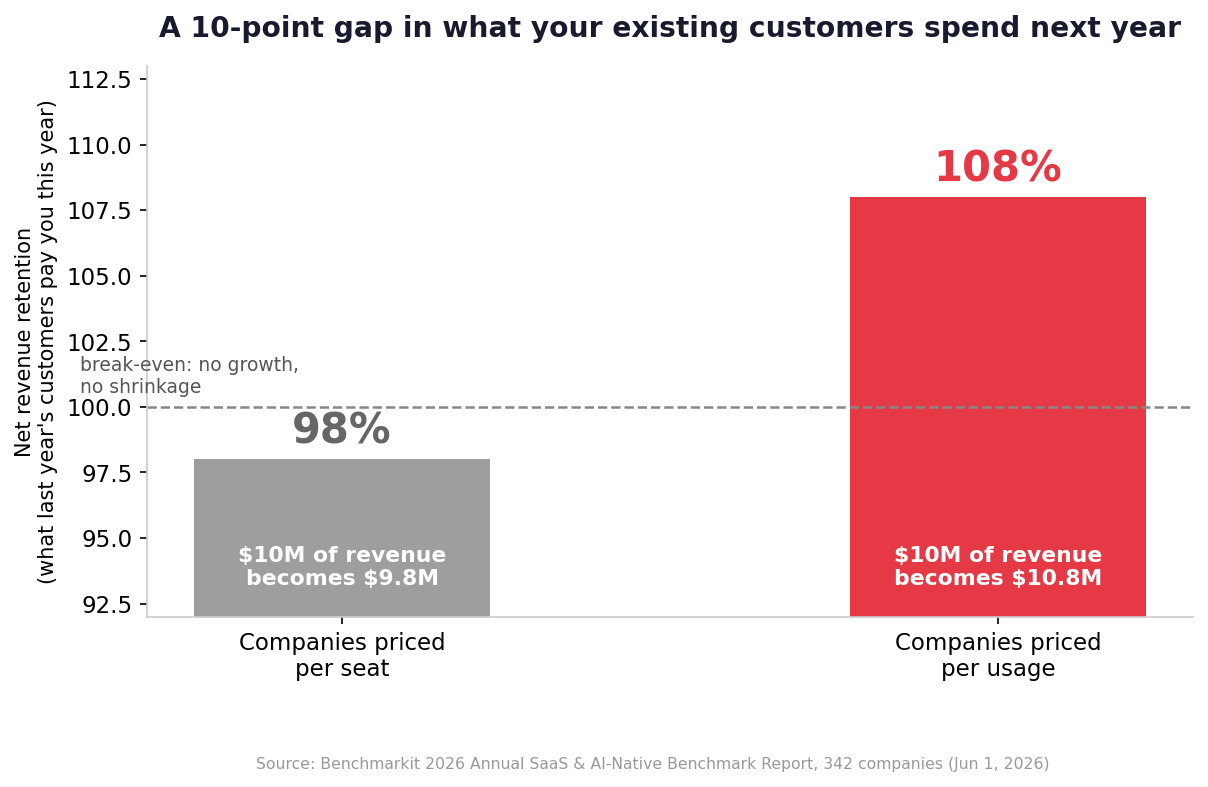
Two caveats, because this number gets abused. First, it is correlation across 342 companies, not a promise. Usage-priced companies skew toward infrastructure and AI-native categories that were growing faster anyway. Changing your meter does not import their growth rate.
Second, the same report carries a much less quoted finding: gross retention fell four points in the year efficiency hit a five-year high. Companies got more profitable and less defensible at the same time. Expansion revenue is doing more of the work while the base leaks faster underneath it, and a usage meter amplifies both directions. Usage pricing grows with your customer, and it shrinks with them too. In a year when your customers cut headcount, seat pricing hurts. In a year when they cut usage, consumption pricing hurts more, because there is no floor.
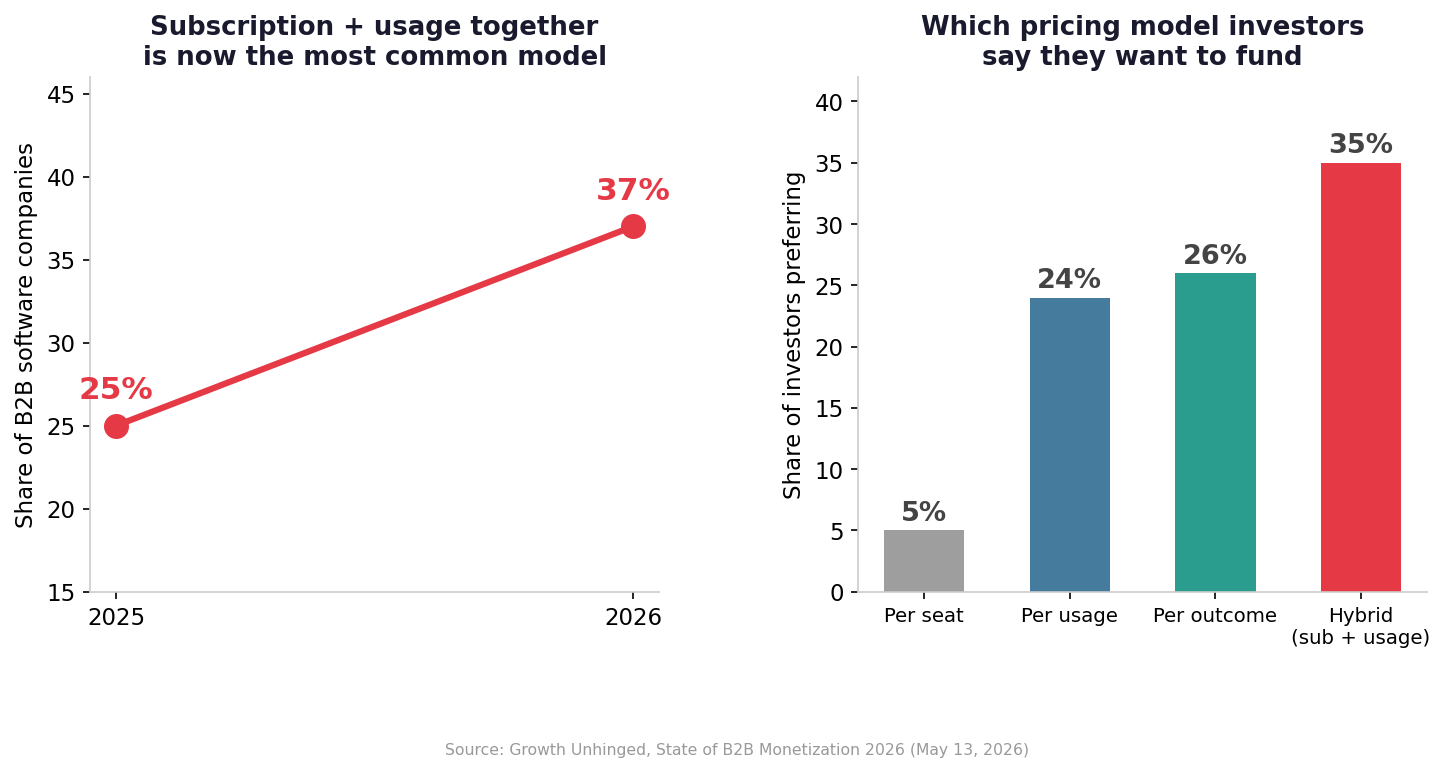
The mix data says the same thing from a different angle. Subscription plus usage is now the single most common model in B2B software at 37%, up from 25% a year earlier. The companies still holding out on pure per-seat are the large ones: 29% of companies above $150M in ARR. And among investors, only 5% prefer seat-based pricing, against 35% for hybrid, 26% for outcome and 24% for usage.
That investor number is worth sitting with if you plan to raise or sell in the next two years. It is not a statement about your business quality. It is a statement about what a buyer believes your revenue will do after they own it.
7. Now the bear case: your customers haven't switched
Everything above describes what vendors did. Here is what buyers did, which is much less.
Ramp analyzed spend across a panel of more than 200 vendors including Salesforce, Atlassian, HubSpot, Adobe, Docusign, Zoom and Oracle. Seat-based contracts account for 65–75% of spend. Flat platform subscriptions take 20–30%. Consumption-based pricing is stuck at 4–6%, and in their words the lines have barely moved in twelve months. 99% of Adobe billing is still seat-based. HubSpot's own filings put less than 2% of revenue in the line item that contains Breeze usage.
Bain's August 2026 read is consistent: about one in five AI-native software companies still relies mostly on per-seat licensing, and most of the companies expanding past seats are layering meters on top rather than replacing anything.
And at the largest vendor of all, seats are growing. Microsoft 365 Copilot went from roughly 20 million paid seats in April to more than 30 million in the June quarter, the fastest quarterly seat addition in the product's history, sold per seat. Two caveats belong next to that number: seat count is not revenue, and these deals carry heavy displacement discounts. A leaked internal memo from July 3 put paid Copilot penetration under 4.5% of 450 million commercial Microsoft 365 users, with only 20–30% using it weekly.
Why the price list moves before the invoice. Pricing pages change in an afternoon. Contracts change at renewal, procurement changes over a budget cycle, and finance teams change when someone forces them to. There is a two-to-three year lag built into this structurally, and vendors announcing new models in 2026 are pricing for buyers who will not be ready until 2028. That lag is the single most common reason pricing changes fail: the vendor moves, the buyer doesn't, and the vendor blinks.
8. What counts as an outcome?
This is the part your vendors will not volunteer, and the part you must answer if you plan to charge this way.
Intercom's Fin counts a resolution when no further help is requested after the last AI answer. Zendesk's version: no further communication for 72 consecutive hours, plus an automated check. Read those definitions carefully. Silence is being billed as success.
The customer who got a perfect answer and the customer who gave up and bought from your competitor produce exactly the same billing event. Neither vendor is being dishonest — there is no cheap way to verify satisfaction at scale — but if you adopt outcome pricing you are choosing which silence you get paid for, and you should choose it deliberately rather than copying someone's help-center article.
Three things to settle before you ship an outcome price:
- Who verifies? If the answer is "our system," expect your largest customers to ask for an audit right, and expect to give it.
- What is the failure case? A wrong answer that ends the conversation looks identical to a right one in the data.
- Do you cap it? Capping is the most expensive instinct in outcome pricing, because a cap removes your upside precisely in the accounts where the model performs best. If you need the cap to close the deal, price the cap.
Outcome pricing is a risk transfer. You are taking performance risk off your customer's books and onto yours. That is a genuinely attractive offer, which is why outcome clauses moved from a rare ask to close to a default request in AI vendor negotiations this year, driven by finance and procurement rather than by vendors. Just be clear that you are selling insurance now, and price it the way an insurer would.
The budget reality behind all of this
SpendHound surveyed 172 finance and procurement leaders alongside spend data from more than 1,300 companies. AI budgets overrun more than any other software line, while only 37% of traditional software budgets were exceeded. Nearly half of finance leaders cannot point to measurable ROI from their AI spend.
The conclusion they draw is the one that should shape your pricing: AI is showing up as a new layer of spend, not a replacement for the old one. Your buyer is not swapping their seat budget for your credit budget. They are adding your credits on top and getting nervous about it.
Benchmark your retention against 300+ SaaS companies
SaasRise members share real NRR, GRR and pricing data with peers at the same stage. The numbers nobody publishes in a report.
9. What it does to your gross margin
Every argument in this report ultimately comes back to one change: software used to cost nothing to deliver, and now it doesn't.
ICONIQ's 2026 State of AI, based on roughly 305 executives building AI products, puts average gross margin on AI products at 53% in 2026, up from 45% in 2025 and 41% in 2024, and projects around 59% by 2027. Traditional SaaS sits at 75–85%.
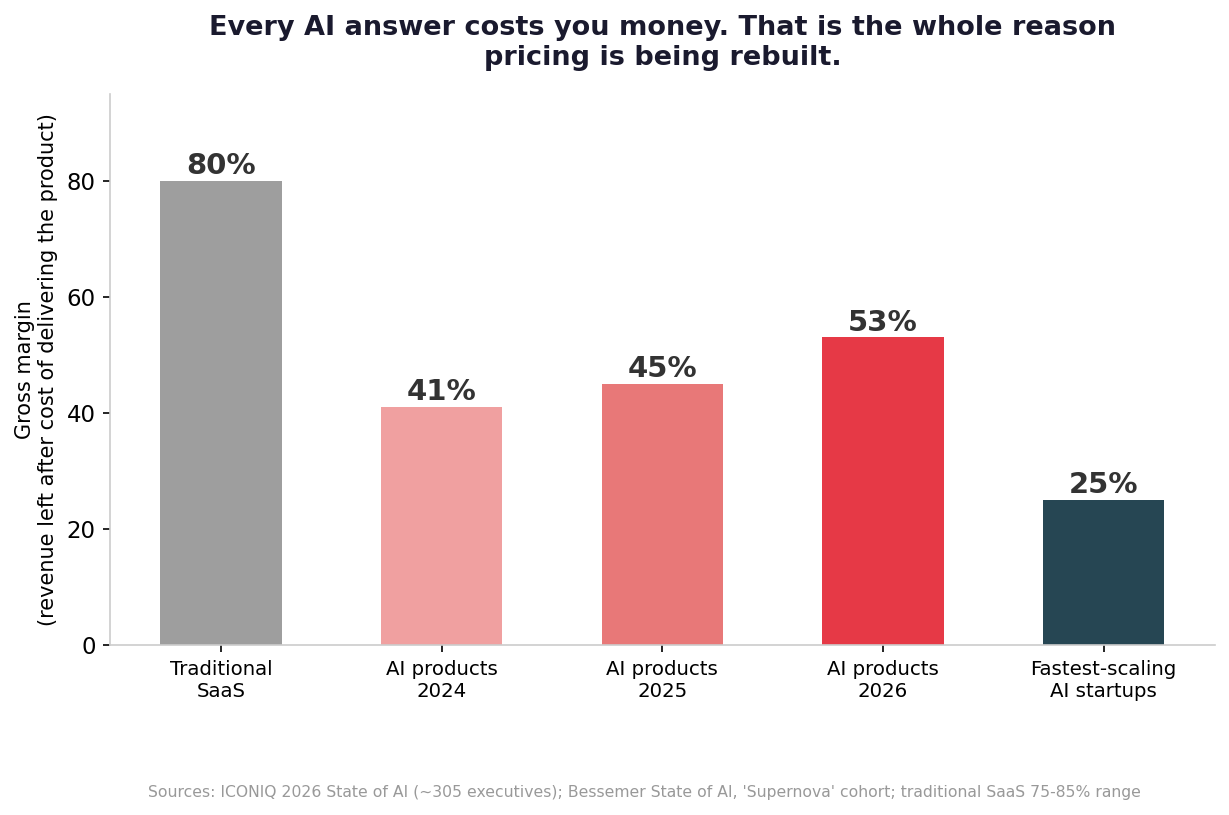
The improvement is real and it is fast. What makes it fragile is the cost structure underneath. In ICONIQ's data, talent (the one largely fixed cost) is only 26–28% of the cost base for companies at the growth and scaling stages. Almost everything else is variable: inference, cloud, ongoing model training. There are too few fixed costs to produce classic software economics, which means the margin improves through better engineering rather than through operating leverage.
Bessemer's data shows the same split more starkly. Their fastest-scaling cohort — companies reaching roughly $40M of ARR in year one — averages about 25% gross margins, sometimes negative, trading margin for distribution. Their capital-efficient cohort, growing from $3M to around $100M over four years, holds about 60%. Two very different businesses, both called AI companies.
Bessemer's own warning about 2026 is the one to write down: much of today's AI revenue sits in soft-ROI territory. Through 2025 most companies bought in adoption-at-all-costs mode with almost no price sensitivity. Those contracts are hitting their first real renewal cycles now, and pricing will have to reflect delivered value rather than promise.
The operator test. Take your AI feature and divide the revenue it generates by what you pay in inference to deliver it. If you are AI-infused SaaS, you want that ratio at 8:1 or better. If you are AI-native, 4:1. If you cannot calculate it, that is the actual finding, and it means you cannot price this feature yet, because you do not know whether more usage makes you more money or less.