The 2026 SaaS Funding Guide

Venture came back in 2026, but not for everyone. 83% of software dollars went to AI. Here's the real bar at seed, Series A and Series B for everyone else.

The 2026 SaaS Funding Guide

By Ryan Allis, CEO of SaasRise · August 2026

Venture capital came back in 2026, but not for everyone. Carta counted $30.4 billion in the first quarter and down rounds fell to 11.4%, while 83% of software dollars went to AI companies. This report takes the bar apart stage by stage: the ARR, growth rate and retention a seed, a Series A and a Series B actually require in 2026, what each round costs you in ownership, where the gross margin bar now sits for SaaS versus AI, and what sixteen companies that closed rounds this year had on the board when they did.


SaasRise is a mastermind community for SaaS CEOs growing from $1M to $100M in ARR.


$80MMedian Series A post-money valuation, software rounds, last six months (Carta)
17%Share of the 2022 seed cohort that reached Series A within 24 months (Carta)
80% vs 53%Median gross margin, traditional SaaS software revenue versus AI products in 2026 (Benchmarkit; ICONIQ)

How to read the numbers in this report

Skip ahead if you already speak fluent term sheet.

ARR is annual recurring revenue: your monthly subscription revenue times twelve. Everything in venture is priced off it. Pre-money is what an investor says your company is worth before their check lands; post-money is pre-money plus the check. If you raise $4M at a $20M pre-money, your post-money is $24M and you sold 16.7% of the company.

Dilution is the percentage of the company you give up in a round. NRR (net revenue retention) is what a cohort of customers pays you this year versus last year, including upgrades and cancellations; above 100% means the base grows without any new logos. Burn multiple is net cash burned divided by net new ARR added. Burn $2M to add $2M of ARR and your burn multiple is 1.0.

A SAFE is a simple agreement for future equity: money now, shares later, at a valuation cap that sets the worst-case price the investor converts at. Most pre-seed and much of seed is done this way, with no formal valuation at all.

The bar at a glance


Everything in this report expands on the rows below. They are the numbers a 2026 round is priced against for a B2B SaaS company that is not a foundation-model business. Sections 2 to 4 explain where each figure comes from and how much room there is around it.

What you needSeedSeries ASeries B
Recurring revenue$300K–$500K ARR. Below $250K you are selling the team and the wedge.$1M ARR is the floor. $2M–$3M gets you a competitive process; $4M gets you a choice of terms.$10M–$30M ARR, with $12M–$15M the most common entry point.
Growth rateConsistent month-over-month growth on a visible curve. 15%+ MoM off a small base reads as traction.100%+ year over year, and stable or accelerating rather than decaying.80%+ at $10M ARR; 50–70% is acceptable at $25M+ if efficiency is strong.
RetentionEight or more weeks of flat cohort retention. Logo counts matter less than the shape.NRR 100% floor, 110–120% to be competitive. GRR above 85%.NRR 110%+ segmented by cohort. GRR 91%+ below $250K ACV, 95%+ above it.
EfficiencyBurn multiple under 1.5x. Know your COGS per customer.Burn multiple under 1.5x, CAC payback under 18 months on a gross-margin basis.Burn multiple at or below 1.5x trailing four quarters; Rule of 40 in sight.
Gross marginDirectionally credible.70%+ on software. AI-native benchmarks against 45–60% with a stated path up.75–85% software, 45–60% AI-native with a mechanism for improvement.
Round and price$3M–$5M at a $15M–$25M post (or a SAFE cap in that range).$10M–$20M at a $25M–$50M pre for non-AI B2B SaaS.$25M–$40M at a $150M–$200M post.
Dilution~18%~18%~12%
What is really being boughtEvidence that customers want it.Evidence that the growth curve continues.Evidence that capital converts to revenue without you.

Ranges are for B2B SaaS raising in 2026, drawn from Carta round benchmarks, Crunchbase seed and Series A data, SaaS Capital and Benchmarkit. AI-native companies are priced against a different set of comparables, covered in sections 1 and 5.

Key findings


The bar rose at every stage, but it rose unevenly and for different reasons. At seed the change is that revenue is now expected where a prototype used to be enough. At Series A the change is scarcity: fewer companies graduate, they take longer to do it, and the ones that clear are priced against an AI comparison set that has nothing to do with them. At Series B the change is that growth alone stopped being sufficient. The round is underwritten on whether a dollar of capital reliably becomes a dollar of durable recurring revenue.

The one number that changed most between last year's playbook and this one is gross margin. It used to be a single expectation: 75% or better, or explain yourself. In 2026 it is two separate bars: traditional SaaS software revenue still runs at an 80% median, while the average AI product runs at 53%. Section 5 covers how investors are now underwriting that gap, because getting it wrong in either direction costs you the round.

Three things are worth internalising before you read the stage sections. Median seed post-money on Carta rose from $15.0M in 2021 to $21.6M by Q1 2026, which means the price you set at seed is now a much higher hurdle to grow past. Only 17% of the 2022 seed cohort reached a Series A inside two years, against 25–30% in a normal vintage. And a non-AI startup raising a Series A in Q1 2026 was priced at a $55M median while an AI foundational-model company at the same stage was at $300M. You are not competing with that company for capital, but your board will still see its valuation on a slide.

1. The market you are raising into

Carta's Q1 2026 data describes a market that has fully cleared the 2022 hangover. Down rounds fell to 11.4%, back in line with 2019 and 2020. Median dilution across seed through Series C dropped from about 18% to 16% over the year, and at Series B it fell to 12.9%. Terms favour founders again. Series B and Series C pre-money valuations rose 17.2% and 12.5% respectively year over year.
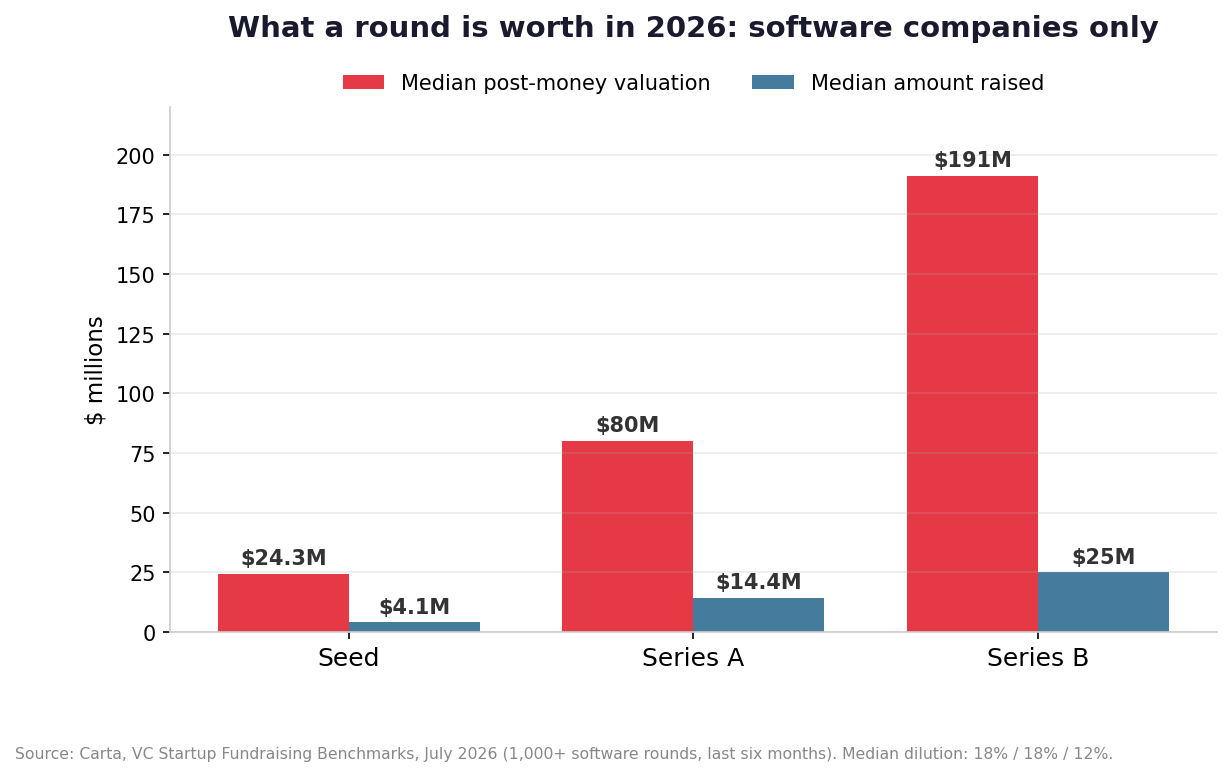
Median round size and post-money valuation by stage, 2026
Median software rounds over the past six months. Dilution: 18% at seed, 18% at Series A, 12% at Series B.

Those are good numbers. The problem is what sits underneath them. The PitchBook-NVCA Venture Monitor for Q2 2026 puts the concentration in plain terms: AI accounted for 86% of all venture dollars in the quarter, and three firms (Andreessen Horowitz, Thrive Capital and Founders Fund) took in 48.1% of all capital raised by venture funds. First-time fund formation is on pace for its lowest year since 2016. The market is setting records at the very top and contracting almost everywhere underneath it.

Total round count in 2025 fell to a six-year low, and the same pattern held into 2026: more money into fewer companies. In pre-seed, U.S. startups on Carta raised $3.19 billion across roughly 11,500 instruments in Q2 2026, against $3.22 billion across 14,825 instruments a year earlier. Nearly identical dollars, 22% fewer deals. AI took half of pre-seed dollars.

For an operator this has a specific consequence. Median statistics now describe a barbell rather than a middle. When Carta reports a $80M median Series A post-money for software, that median is pulled by a cohort of AI companies raising at prices your business will never see, and it sits alongside a long tail of $25M–$50M pre-money rounds that look nothing like the headline. Benchmark yourself against the non-AI figure, $55M median at Series A in Q1 2026, and treat the blended median as market colour, not as a target.
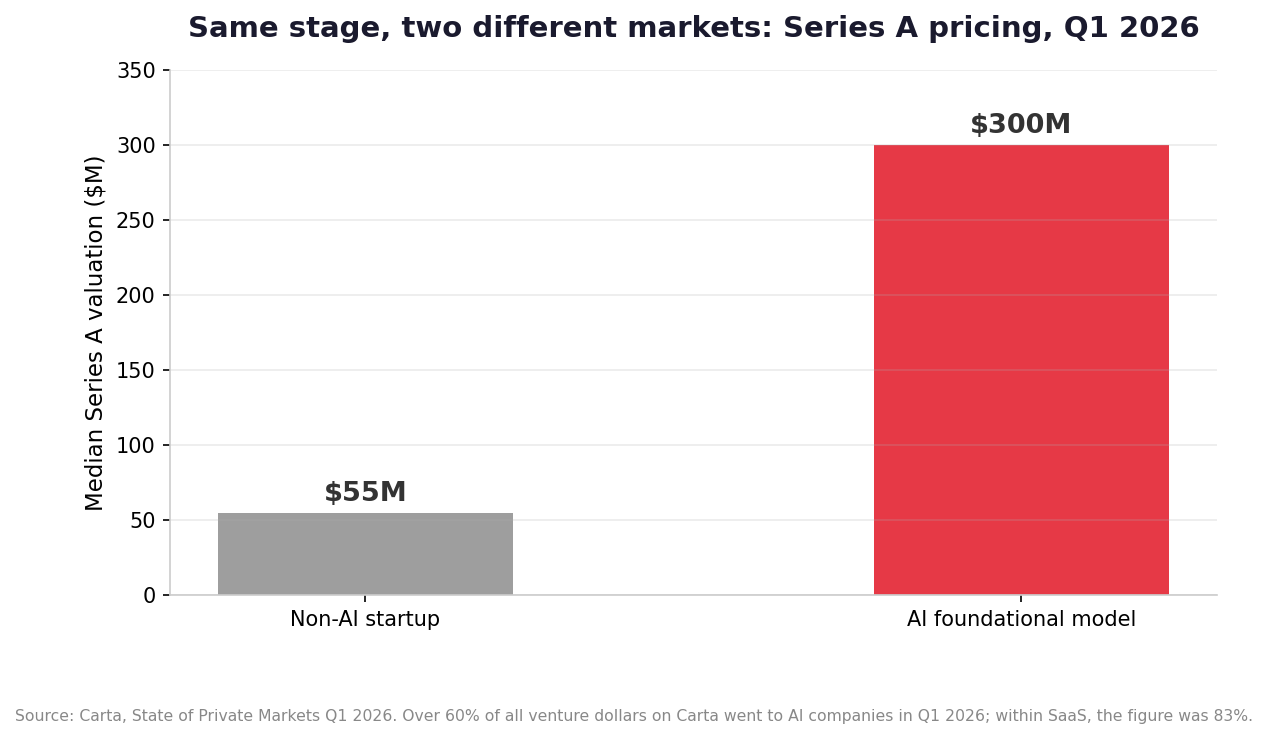
Series A valuation, non-AI versus AI foundational model, Q1 2026
Two companies at the same stage, priced five and a half times apart.

Why this matters to you as an operator: if you set a valuation cap in 2024 or 2025 at the top of the market, that cap is now the floor you have to grow past. A first-time founder who took a $40M cap on a $2M pre-seed has to build a company worth well above $40M before a priced round is anything other than a down round. Carta's own pre-seed team flagged this in August 2026: the 90th-percentile cap on SAFEs above $2.5M has reached $100M.

Growing from $1M to $10M ARR?

SaasRise runs weekly calls where SaaS CEOs work through the exact problems in this report — pricing the round, hitting the milestone, choosing the lead.

2. Seed: the bar is now revenue, not a deck

The clean line between pre-seed and seed in 2026 is whether an investor needs to look at a customer list to say yes. Pre-seed still buys a team, a thesis and a prototype, typically $500K to $2M on a post-money SAFE with a cap around $10M–$15M. Seed buys evidence. The median U.S. seed round is roughly $3M by Crunchbase's count and $4.1M in Carta's software-only sample, priced at a $24.3M median post-money, with 18% dilution.

What has actually changed is the revenue expectation. Andy McLoughlin, managing partner at Uncork Capital, told Crunchbase in May 2026 that his firm's typical seed check has almost doubled in 18 months, from $2.5M or less to $4.5M, while the firm still targets at least 10% ownership. Bigger checks at higher prices mean more proof required. The working expectation for institutional B2B software seed rounds now sits around $300K–$500K of ARR with ten to twenty paying customers, where $200K would have carried the day two years ago.

That is the median case. The rounds that got written about in 2026 cleared it by a wide margin.

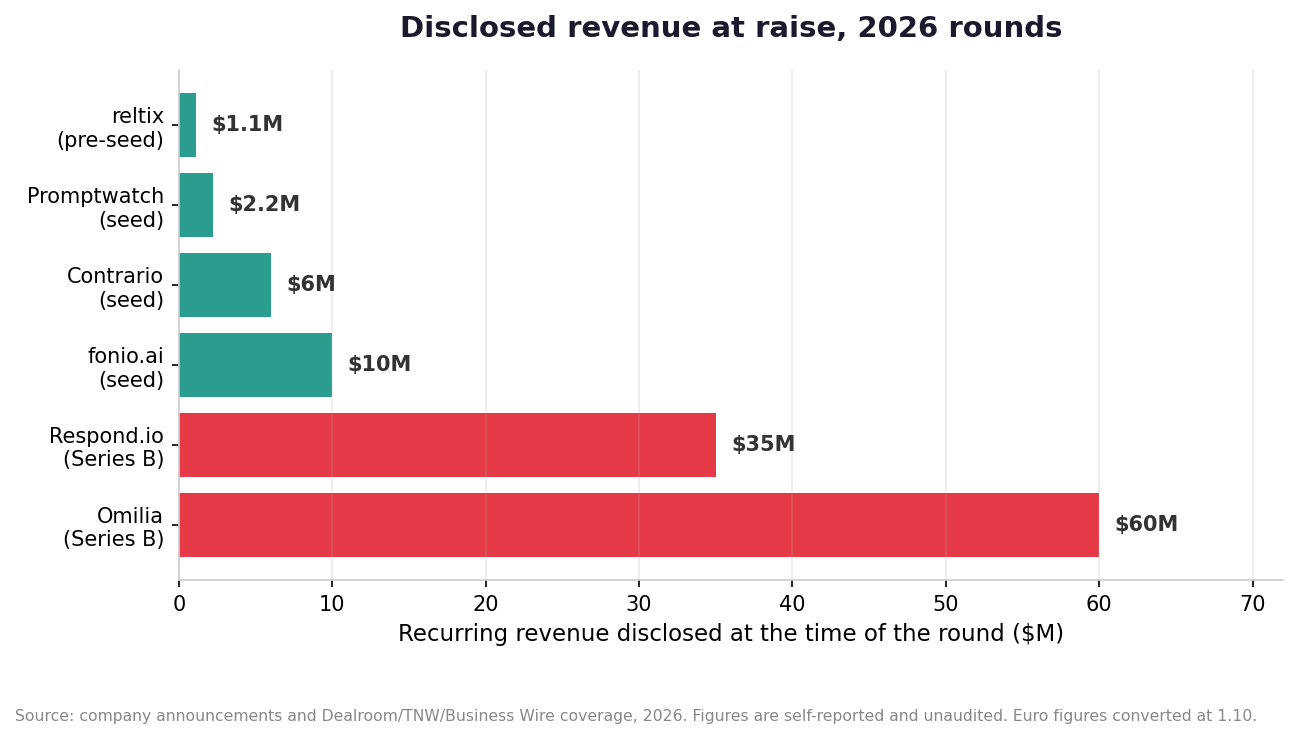
CompanyRoundDisclosed traction at raiseDate
fonio.ai
Voice AI, Vienna
$17M seed led by 20VC at a $140M valuationPassed $10M ARR in under twelve months of subscriptions, growing more than 30% month over month. Self-reported and unaudited.Jun 2026
Promptwatch
AI search optimisation, Amsterdam
€6M seed led by seed + speed Ventures€2M ARR twelve months after launch, built on €1.2M of prior funding. Both lead investors publicly cited the capital efficiency as the reason they invested.Jul 2026
Contrario
AI recruiting, San Francisco
$2.3M seed led by Nexus Venture Partners$6M annualised revenue and more than $1M paid out to recruiters, in under six months.2026
reltix
AI property management, Germany
€3M pre-seed backed by Tenity€1M ARR less than a year after entering the market, running properties directly rather than selling software.Jun 2026
Opine
Technical sales automation
$5M seedSeven-figure ARR roughly two years from founding; named enterprise reference customer in Saviynt.2026
Disclosed recurring revenue at the time of the round, 2026
Every figure here comes from the company's own announcement or first-party press coverage. None are audited.

Notice what the investors quoted in these rounds actually talked about. Alexander Kölpin at seed + speed said Promptwatch convinced them because the team "achieved more than 2 million euros in ARR with limited capital and personnel resources." Blum Ventures' André Hammerer made the same point: €2M in twelve months on €1.2M and a small team. Neither mentioned the model, the market size or the roadmap. They priced the ratio of output to input.

What a seed investor is underwriting

Strip away the deck advice and there are four things a seed lead is checking in 2026, in this order:

  • Retention with a curve you can show. Eight or more weeks of stable or rising cohort retention is the hardest signal to fake, which is exactly why it carries the most weight. Cumulative signups carry none.
  • Money that actually changed hands. A $2K paid pilot from a named buyer outranks a $200K letter of intent. LOIs without a specified scope and date get discounted to zero.
  • Capital efficiency. The Promptwatch pattern. At seed, investors want a burn multiple comfortably under 1.5x, meaning less than $1.50 of cash for each $1 of new ARR.
  • A named wedge, not a category. A proprietary dataset that compounds, a distribution advantage, an integration nobody else has. Feature-level differentiation does not survive diligence in a market where competitors ship weekly with AI assistance.

The seed round to plan for

  • Raise: $3M–$5M priced, or a SAFE at a $15M–$25M cap. AI-adjacent companies price higher; that is a premium on the category, not on you.
  • ARR at raise: $300K–$500K minimum for a competitive institutional round. Below that you are pitching a pre-seed regardless of what the deck says.
  • Runway to buy: 18–24 months, and plan the milestone at the end of it, not the money.
  • What you are selling: the shape of the revenue curve and the cost of producing it.

3. Series A: the hardest round in venture

The Series A is where the 2026 market breaks most founders' plans. Not because the money disappeared. Median Series A round size in Carta's software sample is $14.4M at an $80M post-money, and Crunchbase puts the all-sector median at $15M with an upper quartile of $25M. The money is there. The problem is who gets to see it.
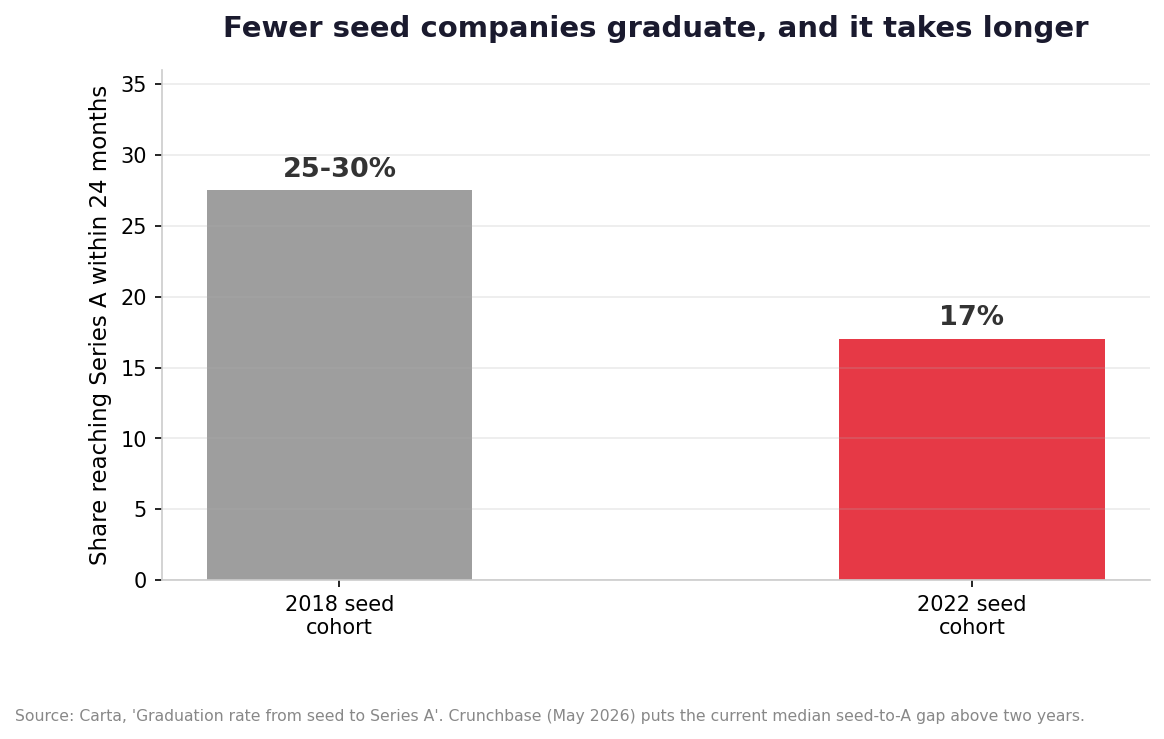
Seed to Series A graduation rate by cohort
Graduation within 24 months, by seed vintage. The 2022 cohort had the metrics bar move underneath it mid-flight.

Carta's own analysis is blunt about the cause: "The metrics needed to raise a Series A shifted underneath many of these founders and they've struggled to keep up with the new, higher requirements." The picture worsened steadily and then began to turn. Among startups raising a Series A in Q4 2024, the median interval since the seed round was 774 days, about 2.1 years and 84% longer than the 420 days a company raising in Q4 2021 had taken. By Q4 2025, across 9,843 rounds, Carta had the median seed-to-A gap back down to 1.9 years. It is improving, but it is still five to eight months longer than the eighteen-month runway most seed rounds are sized for.

That arithmetic is why seed extensions stopped being a distress signal. A $1.5M–$3M top-up on a flat or slightly stepped-up SAFE is now a normal planning instrument, because the distance between what a seed round bought and what a Series A demands takes longer than one seed round to cover. If you need one, price it as a deliberate step rather than a rescue, and be specific with your existing investors about the milestone it buys.

What ARR do you actually need?

There is no audited survey publishing a median ARR at Series A close. The tables circulating online that claim one trace back to content-marketing sites recycling each other. What does exist is a consistent practitioner range and a set of disclosed rounds, and between them they give you a usable answer.

McLoughlin's version, on the record: "The threshold for raising a successful Series A is no longer $1 million in annual recurring revenue. In the AI era, startups are expected to show $2 million to $3 million — even $4 million — in ARR as proof that the business has the momentum to scale." That matches what founders report from processes in the first half of 2026: roughly $1M is the floor to get meetings if the growth curve is loud, $2M–$3M is where a competitive process happens, and below $1M you are raising a seed extension whatever you call it.

The trade you can actually make: ARR and growth rate substitute for each other, and growth wins. $1.5M growing 3x with 120% net revenue retention prices above $2.5M growing 1.5x with churn. If you are at $1.5M–$2M and growing 100%+, you have a Series A. If you are at $3M growing 40%, you have a good business and a hard fundraise.

What the 2026 Series A announcements had on the board

CompanyRoundDisclosed numbersDate
Netris
GPU network automation
$15M led by Andreessen Horowitz800% ARR growth over twelve months, 35+ live deployments across neoclouds and sovereign AI operators. Founded 2018.Jun 2026
Convey
AI operational teammates
$38M led by Andreessen Horowitz, with Khosla and Pear1.1 million hours of real work delivered inside NBCUniversal, Samsara, Unity, Faire, ChargePoint and TelevisaUnivision. One customer, Savoya, lifted EBITDA 40% year over year. Founded 2025.Jun 2026
Prelude
Identity and trust infrastructure
$20M led by 20VC; $27M raised in total6x revenue growth and 6x customer growth over twelve months; every new customer replaced an incumbent verification provider.Aug 2026
Alta
AI go-to-market agents
$25M led by IN VentureFirst $1M of revenue within months of commercialising; on track for 800% revenue growth in the year. Customers include Snowflake, Deel and Atlassian.Jul 2026
Caruso
Fund administration, ANZ
$11.2M at a valuation near $100MRevenue up 400%, assets under administration 10x to $100B+, 80+ fund managers including ASX-listed Centuria. Led by existing backers Icehouse Ventures and GD1, with private credit manager Balmain participating.Apr 2026
ProLine
Vertical AI for roofing contractors
$9.6M led by Growth Street PartnersARR up more than 4x since its seed investor's entry in 2023, taking share from legacy vendors in a traditional industry.Jul 2026
Abstract Security
Security operations
$25M at 3x the prior valuation, co-led by Cheyenne Ventures and AVPARR up 380%, net revenue retention 264%, customer base tripled, 40 hires. Total raised now near $50M.Jul 2026

Two patterns run through that table. First, almost none of these announcements led with an ARR number. They led with a growth multiple. Netris said 800%, Prelude said 6x, Caruso said 400%, ProLine said 4x. Companies disclose the metric that flatters them, and in 2026 the flattering metric is the slope. Second, three of the seven are not AI-model companies at all. ProLine sells to roofing contractors and Caruso does fund admin in Australia and New Zealand. Vertical software solving a mission-critical workflow inside a traditional industry is still a fundable Series A, and it clears at $9M–$12M round sizes rather than $38M.
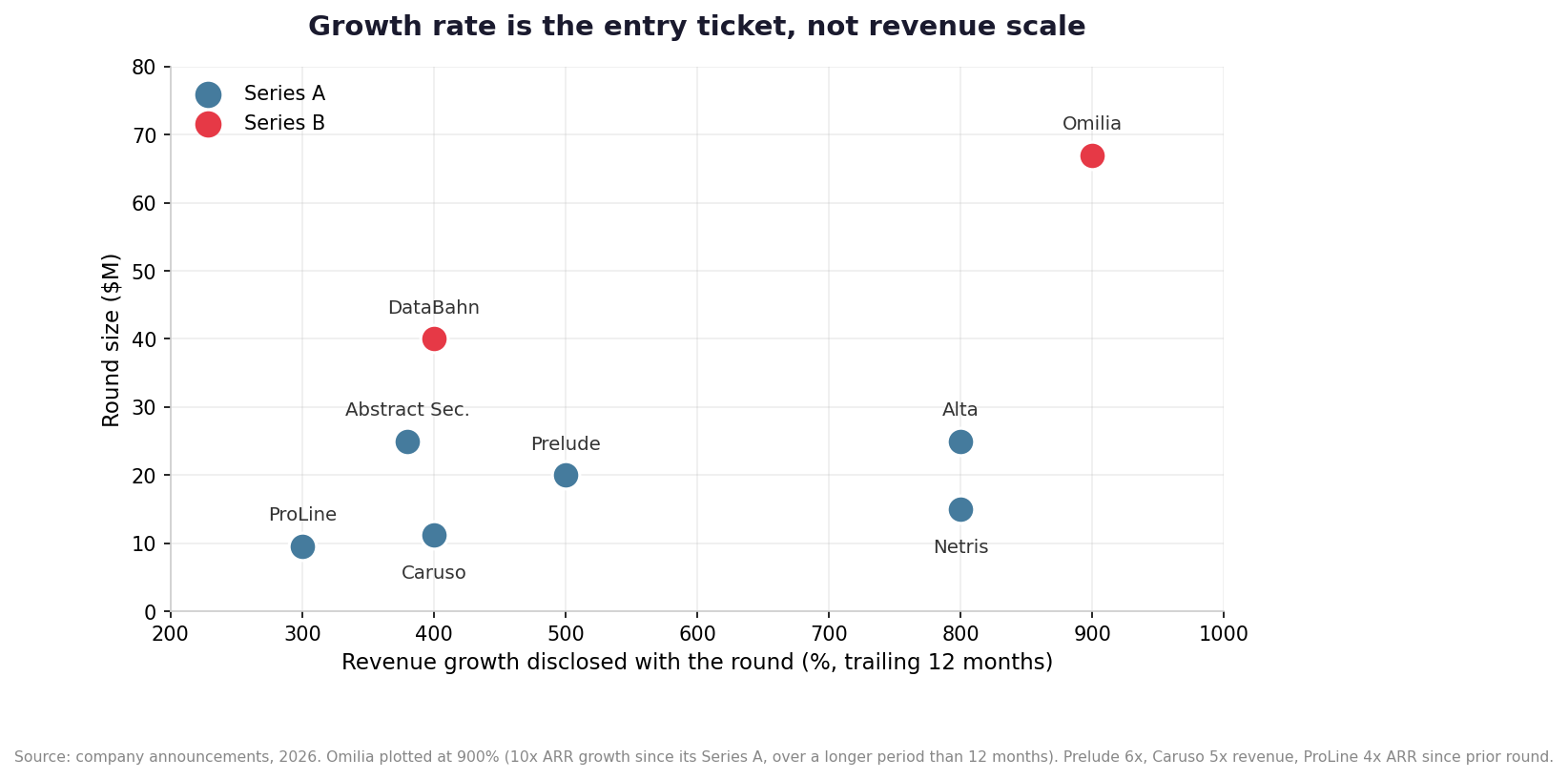
Disclosed growth rate versus round size, 2026 Series A and B rounds
Round size tracks the growth number in the press release far more closely than it tracks revenue scale.

The Series A round to plan for

  • Raise: $10M–$20M at a $25M–$50M pre-money if you are non-AI B2B SaaS. Benchmark to the $55M non-AI median, not the $80M blended post-money.
  • ARR at raise: $1M floor to enter a process, $2M–$3M to run a competitive one.
  • Growth: 100%+ year over year, and the trajectory has to be stable or accelerating, not one good quarter.
  • NRR: 100% is the floor, 110–120% is competitive.
  • Timing: start outreach two quarters before you need the money, and assume the process itself takes three to six months.

Need the growth curve, not the benchmark?

The SaasRise Growth Agency runs demand generation, outbound and paid acquisition for B2B SaaS companies scaling toward their next round.

4. Series B: proof that the machine works without you

Series B pricing improved in 2026. Pre-money valuations rose 17.2% year over year, the median software Series B in Carta's sample closed at a $191M post-money on $25M raised, and dilution at the stage fell to 12%. Founders are selling less of the company for more money than at any point in the last few years.

What they are selling has changed. A Series A is underwritten on a growth curve. A Series B is underwritten on a system: whether a dollar of sales and marketing spend reliably produces a predictable dollar of recurring revenue when the founder is not in the room. That shift shows up in which metrics kill deals. Growth below 60% year over year at this scale makes a competitive process very hard to run. NRR below 110% invites questions the topline cannot answer. A burn multiple above 2.0x, more than $2 of cash burned per $1 of new ARR, reads as a company that has bought its growth rather than built it.

The disclosed 2026 Series B rounds sit at very different revenue scales, which is what a stage looks like when $10M and $60M of ARR can both clear.

CompanyRoundDisclosed numbersDate
Omilia
Agentic customer experience, Athens
$67M led by Expedition Growth CapitalARR above $60M, more than 10x growth since its Series A — with no equity raised in between. Deployed across 1,000+ Taco Bell drive-thrus in 38 states. Prior round was $20M in 2020.Aug 2026
Respond.io
Customer conversation platform, Kuala Lumpur
$62.5M led by Camber Partners$35M ARR, 169% year-over-year growth, and a 30% profit margin. Its Series A was $7M in 2022 — this round is nearly nine times larger.Jun 2026
DataBahn
Enterprise telemetry pipelines
$40M led by Insight PartnersRevenue growth above 400%, net revenue retention of 180%, no customer churn to date, 97% win rate on proofs of concept. Total funding now $59M.Jul 2026
Unframe
Enterprise AI platform
$50M led by Highland EuropeMore than $100M in total contract value over twelve months and a reported 400% net revenue retention. Founded 2024.May 2026
Higgsfield
AI video and image creation
$400M at a $5.4B valuation, led by DST Global$700M annualised revenue. Quadrupled the $1.3B valuation from its Series A and extension.Aug 2026

Read the Unframe line carefully. $100M+ in total contract value is not $100M of ARR. TCV counts the full value of signed contracts across their whole term; a three-year deal books three years of revenue into one headline. Several outlets blurred the two when the round was announced. If you are benchmarking yourself against a competitor's press release, check which number they chose, and expect a Series B investor to do the same to you.

Omilia and Respond.io are the two worth studying if you run a private SaaS company outside the Bay Area. Omilia grew from roughly $6M to over $60M of ARR on a $20M round raised in 2020 and nothing since. Respond.io reached $35M ARR at a 30% profit margin before taking growth capital, on a $7M Series A from 2022. Both went to market from a position where the round was optional. That is what produced the pricing, not the AI label.

The Series B round to plan for

  • Raise: $25M–$40M at a $150M–$200M post-money for a company on trend; larger if you are multi-product with an enterprise mix.
  • Revenue: the disclosed 2026 rounds cluster between $10M and $60M of ARR. Below roughly $8M you are usually negotiating an extension, not a B.
  • Growth: 80%+ year over year at $10M scale; 50–70% is defensible at $25M+ if efficiency is strong.
  • Retention: NRR above 110% segmented by cohort, with documented expansion mechanics. Gross retention above 90% underneath it.
  • Efficiency: burn multiple at or below 1.5x on a trailing four-quarter basis, CAC payback inside 18 months by channel on a gross-margin basis, gross margin above 70% with a credible path higher.
5. Gross margin: the SaaS bar and the AI bar are now different numbers

For fifteen years gross margin was the least interesting slide in a SaaS deck. You showed 75% or better, the investor nodded, everyone moved on. That single expectation has split in two, and mixing the two up is now one of the more expensive mistakes a founder can make in a diligence process.

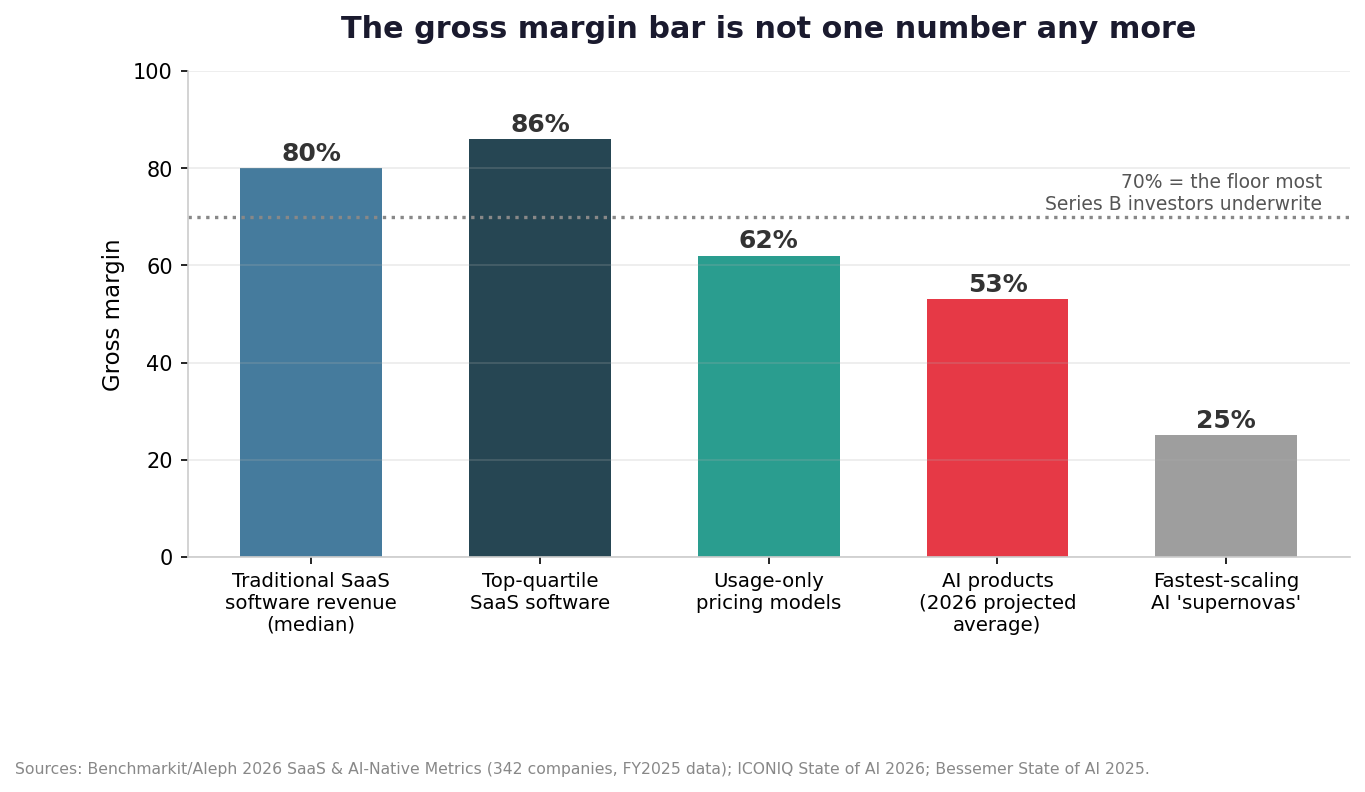
Start with traditional software, because the news there is better than the noise suggests. Benchmarkit's 2026 SaaS and AI-Native Metrics study, covering 342 companies on full-year 2025 data, puts median software gross margin at 80%, flat across four years. Blended across total revenue, including services, the median is 76%. The top quartile clears 86%. Industry-wide AI infrastructure costs have not compressed software margins at the median, and any investor telling you otherwise about a subscription business is arguing with the data.

Two exceptions inside that dataset matter. Companies on usage-only pricing run at 62%, because compute and infrastructure scale directly with consumption. And the bottom quartile of all software companies sits at 50%, which is where per-customer customisation, heavy services and unmanaged infrastructure end up.

Gross margin bands: traditional SaaS versus AI companies, 2026
Five different businesses that all get described as software. Investors no longer benchmark them against each other.

The AI numbers, and why they are rising

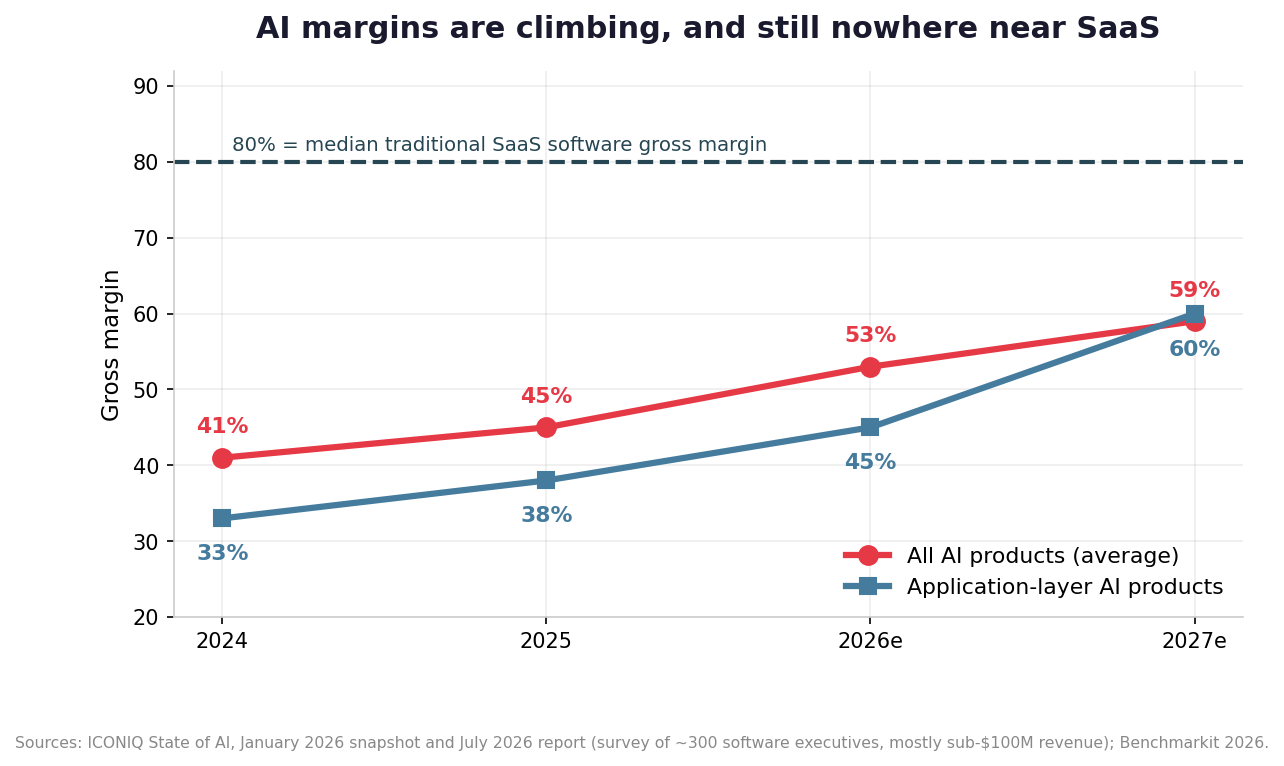
ICONIQ surveys roughly 300 software executives, mostly at companies below $100M of revenue, for its State of AI research. Its picture of AI product margins is a clear upward line: 41% in 2024, 45% in 2025, a projected 53% in 2026, and 59% forecast for 2027. That is fourteen points of expansion in two years, and ICONIQ attributes it to falling inference costs, model routing and caching strategies, and revenue scale, not to pricing power. The supporting detail is convincing: 66% of respondents improved their cost per query by 10% or more, and 19% improved it by 30% or more.

AI product gross margin trajectory, 2024 to 2027
The margin panic of 2024 is over, but the gap to traditional SaaS is still more than twenty points.

The layer you operate at changes the number materially. Application-layer AI products ran at 33% in 2024 and 38% in 2025, with roughly 45% projected for 2026 and 60% by 2027. Infrastructure and platform AI products are projected to reach 67% by 2027, higher than the application layer, which inverts the usual assumption that infrastructure is the capital-heavy, low-margin end of the stack. High-growth companies are projected at 64% in 2027 against 58% for everyone else, so the margin and the growth rate move together rather than trading off.

At the extreme end, Bessemer's State of AI research found that the ten fastest-scaling AI startups it surveyed — companies reaching roughly $40M of ARR in their first commercial year and $125M in their second — averaged about 25% gross margins, sometimes negative, deliberately buying distribution. The same cohort produced $1.13M of ARR per employee, four to five times a typical SaaS benchmark. Bessemer's slower, more capital-efficient group, which it calls Shooting Stars, reached around $3M of ARR in year one at roughly 60% gross margins. Two completely different financial profiles, both raising at premium valuations.

Two real disclosures worth studying. Wix told investors in its Q2 2026 results that Base44, its AI app-building product, entered the year at near-zero non-GAAP gross margin and expects roughly 60% in the second half, after deploying its own proprietary model to cut inference cost. And Anthropic, per PitchBook analysis, is tracking toward roughly 44% gross margin, having spent $0.71 of compute per dollar of revenue in Q1 and a projected $0.56 in Q2. Both are the same story at different scales: AI gross margin is not a property of your business model, it is an engineering result you can move quarter by quarter.

What to actually target, by what you sell

What you sellGross margin to targetWhat breaks the number
Subscription B2B SaaS, no meaningful AI in COGS75–85% on software revenue; 80% is the median, 86% is top quartileServices revenue bundled into the topline, per-customer infrastructure, over-provisioned cloud spend
SaaS with AI features inside a subscription price70–80%, with the AI-attributable COGS shown separatelyUnlimited AI usage inside a flat seat price; power users can cost ten to fifty times a light user
Usage-based or consumption pricing60–70%Volume discounts at the top of the customer base outrunning your unit cost curve
AI-native application layer45–60% today, with a credible route to 60%+Frontier-model dependency with no routing, caching or fine-tuned fallback
AI infrastructure or platform55–67%GPU commitments taken before demand is contracted
Human-in-the-loop or outcome-priced services40–55%Review labour sitting in COGS and scaling one-for-one with revenue

Three things follow for a fundraise. First, segment the number before an investor does: show software margin, AI-attributable COGS and services margin as separate lines, because a blended 62% reads as a broken SaaS business and reads as a healthy AI business, and the difference is entirely in the presentation of facts you already have. Second, show the trend and the mechanism. A margin that went from 38% to 52% because you moved 70% of calls to a smaller routed model is a far stronger slide than a static 60%. Third, name the floor. Most Series B investors underwrite a path to 70%+ for anything sold as software. If your architecture cannot get there, you need to be raising against the AI benchmark set and saying so explicitly.

Scaling acquisition ahead of a raise or an exit?

Investors and acquirers price the trajectory you show them in the two quarters before the process opens. The SaasRise Growth Agency builds and runs the digital ad engine — paid search, paid social, retargeting and demand capture — that puts a steeper curve and a lower blended CAC on that slide.

6. Growth, efficiency and the metrics that decide the round

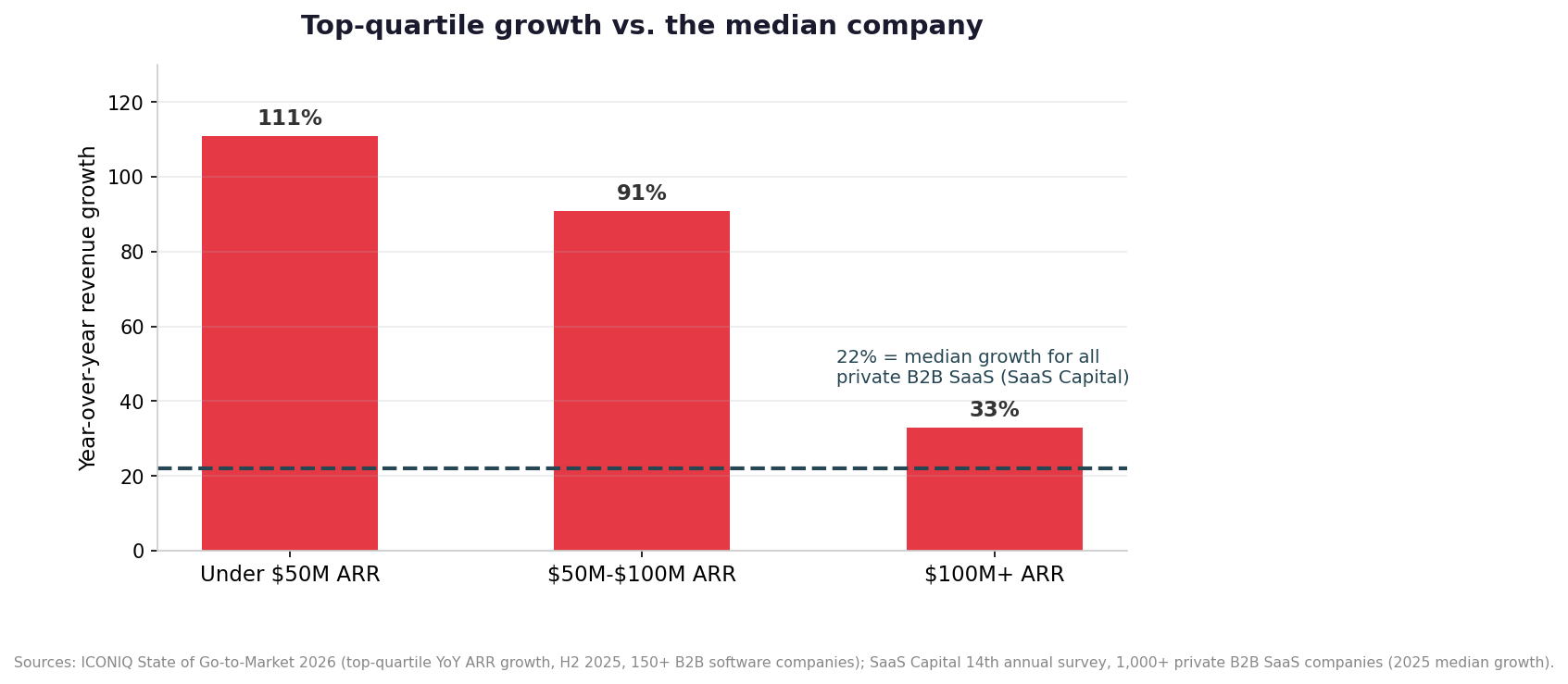
SaaS Capital's 14th annual survey of more than 1,000 private B2B SaaS companies put the 2025 median growth rate at 22%, down from 25% the year before and 30% in 2023. Only 7.3% of companies reported flat or negative growth, so this is not a market falling apart. It is a market growing steadily and slowly. Bootstrapped companies between $3M and $20M of ARR grew at a 15% median, with net revenue retention of 103% and gross revenue retention of 91%.

Now compare that with the growth rates venture investors are pricing.

Top-quartile growth by ARR band versus the private SaaS median
ICONIQ's top-quartile companies under $50M ARR grew 111% in H2 2025. The median private B2B SaaS company grew 22%.

The gap between those two lines is the whole story of the 2026 funding bar. Venture-priced rounds are underwritten against the top quartile of a top-decile investor's portfolio, not against the market. A company growing 40% a year at $8M of ARR is performing above the median of every private SaaS survey published this year and is still, in venture terms, an awkward fundraise. That is not a judgement about the business. It is a statement about which pool of capital fits it.

The four numbers that get argued about in the partner meeting

Retention, benchmarked by contract value rather than by stage. SaaS Capital's retention brief makes the useful point that companies sharing a price point have more in common than companies sharing an age or an ARR band. Median gross revenue retention is 95% for companies with average contract values above $250K and roughly 91% below that. Benchmark yourself against your own ACV band; a 91% GRR on a $15K ACV product is normal, and the same number on a $400K enterprise contract is a problem.

Burn multiple, where the distribution is stranger than the median. Lighter Capital's analysis of its private B2B SaaS portfolio found a median burn multiple of 0.79x, but among cash-burning companies the distribution is bimodal: about half burn more than $1 for every dollar of new ARR, about a quarter burn less than $0.33, and almost nobody sits in the middle. There is no gentle slope here. Companies are either efficient or they are not, and investors have learned to read the number as a binary.

CAC payback, on a gross-margin basis and by segment. Before the numbers, the definition, because half the arguments about this metric are really arguments about arithmetic. Every benchmark quoted below is gross-margin adjusted — months of gross profit, not months of revenue. The standard formula, as defined by the SaaS Metrics Standards Board and used by Benchmarkit, is sales and marketing spend for the prior period divided by (new ARR added × gross margin %), expressed in months. The customer-level version is the same idea: CAC ÷ (monthly ARPU × gross margin %).

That distinction is not academic. At an 80% gross margin, dividing by revenue instead of gross profit makes your payback look about 20% better than it is. At a 50% AI-native margin it makes it look twice as good. Two companies with identical CAC and identical ARPU can report 12 months and 19 months purely because one is a subscription business and the other is running inference. That is why the margin section above changes your payback number without anything in your sales motion changing at all. If you show the revenue-basis version in a deck, label it, because an investor will recalculate it on gross profit and the correction is not a good moment.

On that basis: Benchmarkit's 2026 study, using full-year 2025 actuals from 342 SaaS and AI-native companies, puts the median CAC payback at 16 months, with the first quartile at 10 months and the fourth quartile at 24 months or more. Optifai's larger sample of 939 B2B SaaS companies, using the customer-level formula, puts the median at 15 months and breaks it out by segment: 8–12 months for SMB products under a $15K ACV, 14–18 months for mid-market, and 18–24 months for enterprise deals above $100K. Under 12 months is best in class; above 24 months is a conversation you will not win. Benchmarkit publishes its methodology and Optifai is a vendor dataset, so use Benchmarkit for the level and Optifai for the segment shape.

The Rule of 40, and how companies actually clear it. Standard Metrics ran the framework across 1,377 venture-backed private companies with over $1M of annualised revenue and found that when private companies clear the Rule of 40, 89% of them do it through growth alone. Only 11% clear it through the balance of growth and margin the rule was designed to reward. If you are planning to make the number by cutting your way to profitability at a 15% growth rate, you will be in a category of one in the room, and not in the flattering sense.

Why this matters to you as an operator: if you are growing 20–40% with positive cash flow, the realistic options are debt, a growth-equity partner who prices on profitability, or not raising. Running a venture process against a top-quartile bar and losing costs six months of management attention and leaves a trail of passes that follows you into the next round.

Revenue-based financing, for the companies venture is not built for

If you do not want to sell equity, or your growth rate will not clear a venture bar, revenue-based financing is the instrument that fits the gap. You borrow a fixed amount and repay it as a percentage of monthly revenue until you hit an agreed cap, so payments flex down in a slow month and up in a fast one, and nobody takes a board seat or a liquidation preference. Lighter Capital, one of the longer-running lenders in the category, describes the standard shape: facilities up to roughly $4M, repayment as a set share of monthly revenue, terms of up to three years, and a cap usually between 1.35x and 2x the principal. That cap is the whole cost of the capital, which makes the arithmetic unusually easy to compare against the alternative. SaaS Capital, which both lends and publishes research on the question, puts the cost of equity for a private SaaS company well above the cost of debt, and notes that a company above about $3M of ARR with predictable retention can usually access a credit facility priced below a revenue-based loan.

The trade-off is real: the money comes out of cash flow from month one, so it funds things that pay back inside the term, sales hires into a working motion, a proven ad channel, an acquisition of a small competitor. It does not fund a two-year platform rebuild. Used the wrong way it is expensive money for a company that cannot service it. Used the right way, on a business growing 20% to 40% with 90%+ gross retention, it buys the growth without resetting the cap table, and it leaves the equity round available later at a price your own progress has set.

Benchmark your numbers against the room

SaasRise members compare real growth, retention, margin and efficiency metrics with other SaaS CEOs at the same stage — before an investor does it for them.

7. What each round costs you in ownership

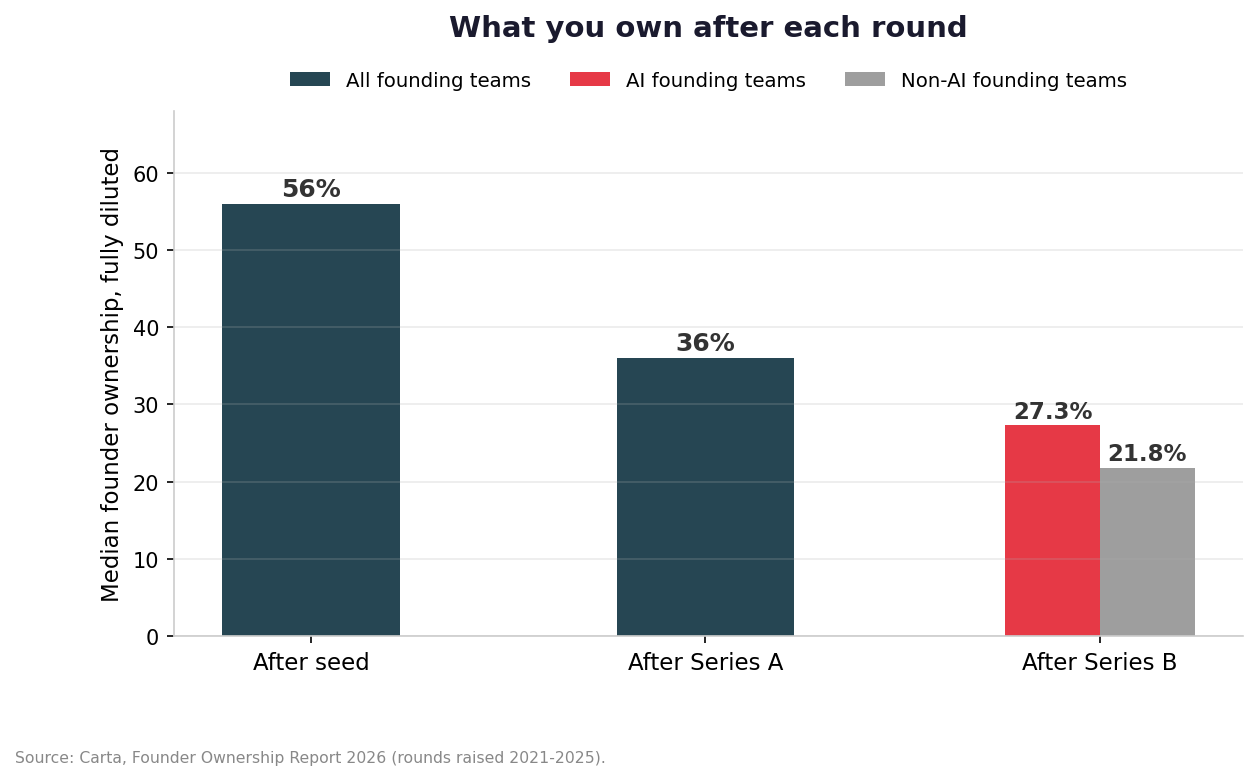
Dilution is the quietest number in a term sheet and the one founders regret most. Carta's Founder Ownership Report puts median founding-team ownership at 56% after a seed round and 36% after a Series A, based on rounds raised from 2021 through 2025. By Series B, AI founding teams hold a 27.3% median stake and non-AI teams hold 21.8%. At Series C the median employee option pool (16.8%) overtakes median founder ownership (16.1%). The sector split shows up earlier than most founders expect: at Series A, founders in digital industries retain 37.5% while founders in physical industries retain 30.5%.

Median founder ownership by stage
Founder ownership through the stages. The AI premium buys founders roughly five and a half points more of their own company by Series B.

The good news is that per-round dilution keeps falling: 18% at seed and Series A, 12% at Series B in Carta's recent software sample, against roughly 19% across those stages two years ago. Put a dollar figure on it. Sell 18% at an $80M post-money Series A and you have given up $14.4M of value at today's price. If the company is worth $500M at exit, that same 18% is $90M. Every point of dilution you avoid at the A is worth roughly $5M of exit value in that scenario, which is why the cheapest capital is almost always the revenue you generate before you raise.

8. If the goal is an exit rather than a round

Not every company on this path is raising a Series B. For plenty of SaasRise members the real question is what the business is worth to an acquirer, and the answer in 2026 is more sobering than the venture headlines suggest. Aventis Advisors put the median public SaaS EV/Revenue multiple at 3.4x as of March 2026, a significant decline as public investors discount software on AI disruption fears. Across 543 private SaaS M&A transactions with disclosed multiples since 2015, the median is 4.5x revenue, with a first quartile of 2.4x and a third quartile of 8.1x on a median deal size of $80M.

That spread — 2.4x to 8.1x — is where the work is. The same revenue base sells for three times more or three times less depending on growth rate, retention, gross margin and how concentrated the customer list is. Every metric in this report that gets you a better round also gets you a better multiple, and the two processes reward the same twelve months of preparation. The difference is that an acquirer will also look hard at whether your growth survives without the current spend, which is an argument for building acquisition channels that keep producing after the diligence closes.

Build the growth curve before you open the process

Whether the next step is a Series B or a sale, buyers price the trend line. The SaasRise Growth Agency scales customer acquisition and revenue through digital advertising for SaaS companies preparing to raise or exit.

9. The bear case

Everything above describes a market that works if you are on the right side of it. Four things could make this report look optimistic within a year.

The concentration is extreme and it is new. AI took 86% of venture dollars in Q2 2026 by PitchBook's count, and three firms raised 48.1% of all new fund capital. If AI valuations reset, the money does not automatically redistribute to non-AI SaaS — funds mark down, LPs slow commitments, and the whole early-stage market gets quieter. The 2022 seed cohort is the case study for what happens when the bar moves after you have already raised.

Enterprise AI revenue has not proved it is durable. Madrona surveyed 150 senior enterprise decision-makers in August 2026. Three quarters plan to expand AI budgets over the next twelve months, and 83% converted fewer than half of their AI pilots into production over the last twelve months. More than a third converted fewer than one in four. Just 1% got past three quarters. A lot of the ARR being priced at a premium right now is pilot revenue that has not yet survived a renewal cycle.

Fewer deals is the signal, not more dollars. Round counts fell to a six-year low in 2025 and pre-seed deal counts dropped 22% year over year while dollars stayed flat. Rising medians in a market with falling deal counts partly reflect survivorship: the companies getting priced are the ones that could get priced.

The valuations set in 2025 and 2026 have to be grown into. A $24M median seed post-money means the next round needs to clear roughly $50M to feel like a step up. Down rounds are at 11.4% today, but today's rate reflects companies raised at 2022 and 2023 prices. The cohort priced at 2026 highs has not faced its next round yet.

None of this argues against raising. It argues for raising an amount you can grow into, and for treating the milestone rather than the money as the point of the round.

10. Running the round once the numbers are there

Everything above is about being fundable. This section is about the ten to sixteen weeks in which being fundable turns into money in the bank, which is a separate skill and the one most first-time raisers underrate. A company with a Series A metric profile and a badly run process routinely loses to a weaker company with a well run one, because a fundraise is priced on competition and competition is something you manufacture.

Start when the metric arrives, not when the cash runs low. Work the arithmetic backwards. A process takes three to four months from first meeting to wired funds, diligence and documents included. You want to be negotiating with at least six months of runway behind you, because the moment an investor can calculate that you have ten weeks of cash left, your valuation stops being a function of your growth rate. That means the trigger to begin is a milestone on the board, not a number in the bank account. If you are four months from the ARR that makes the round obvious, wait the four months and raise a bridge if you have to. If you are fourteen months away, you are not preparing a Series A, you are preparing an extension, and pretending otherwise burns your best investor relationships on a pitch they will remember when you come back.

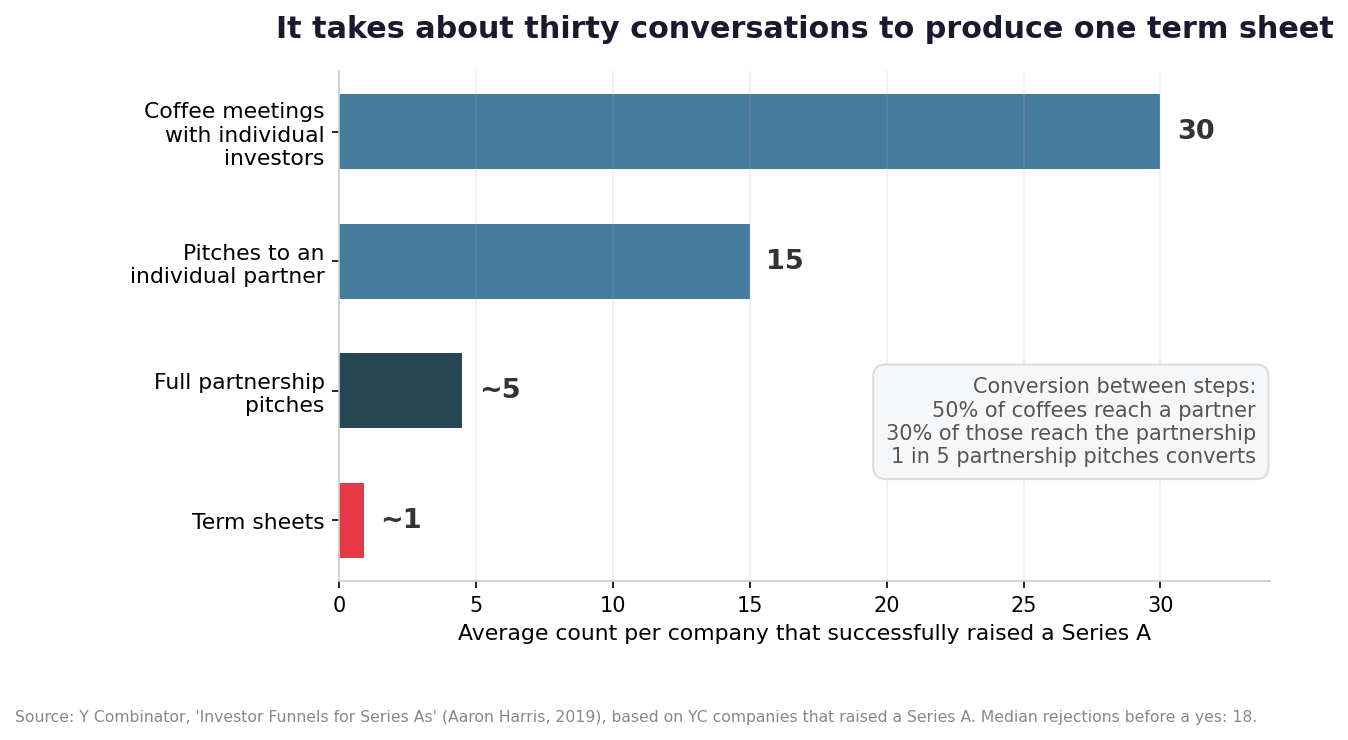
The funnel is much wider than founders expect. Y Combinator tracked its own companies through the Series A process and published the conversion rates. Companies that raised took an average of 30 coffee meetings with individual investors. Half of those produced a pitch to an individual partner, about 30% of partner pitches got to a full partnership meeting, and one in five partnership pitches produced a term sheet. That is roughly thirty first conversations for one offer. The median company in that dataset heard no 18 times before hearing yes, and one company was rejected 30 times before getting a term sheet it was happy with.

Series A investor funnel: coffee meetings to term sheets
The Series A funnel measured across Y Combinator companies. The numbers date from 2019 and the shape has not improved since.

Two things follow. First, build a target list of 60 to 80 firms, not 15, and qualify them properly: check that the fund invests at your stage, in your category, at your cheque size, and that it has not already backed a direct competitor. Second, do not read early rejections as a verdict on the company. In a funnel with those conversion rates, a run of five no's is the expected outcome, not a signal to reprice.

Run it in parallel or do not run it. This is the single most important mechanical decision in a fundraise. YC's guidance to its own founders is to compress each stage into a window: all first pitches inside one to two weeks, all partnership pitches inside a separate one to two weeks, so that offers arrive at roughly the same time. Sequential processes, where you talk to one firm, wait, then talk to the next, produce exactly one term sheet at a time and hand the timing advantage to the investor. Parallel processes produce simultaneous offers, and simultaneous offers are the only reliable source of negotiating leverage a founder has. Practically: do not take a single meeting until the list, the deck, the model and the data room are all finished, because the first meeting starts a clock that runs on the investor's calendar, not yours.

Diligence now happens before the term sheet, not after. This is the change that catches founders who last raised in 2021. Customer reference calls, cohort retention analysis and competitive work that used to sit in the four weeks between signing and closing have moved forward into the decision process. Madrona, writing to founders in January 2026, describes what firms now expect to see up front: clean metrics, clear momentum, a coherent wedge, and customers who would genuinely struggle without you. The practical implication is that your data room needs to be complete on day one of the process, not assembled in week nine. Monthly P&L, balance sheet and cash flow for 24 months, a cohort file that ties to your ARR number, the cap table, customer contracts, and a reference list of five to eight customers who have agreed in advance to take a call. Metrics that shift between your deck and your data room are the most common way a warm process goes cold.

Know what is actually negotiable. Cooley publishes deal terms from the venture financings it handles, which makes it one of the few running counts of what is market rather than what is rumoured. In Q2 2026, across 166 financings, 95.8% of deals carried a 1x liquidation preference and 96.4% used nonparticipating preferred. Redemption rights appeared in 5.4% of deals and accruing dividends in 3%. Structure, in other words, is rare. If you are offered a 2x preference or participating preferred, that is not the market, it is a statement about your company, and the right response is to ask what the investor is worried about rather than to accept it as standard. What is worth your energy instead: the option pool, because a pool created pre-money is dilution paid entirely by you and existing holders, and board composition, because it outlives the valuation. Pro rata rights and standard four-year vesting with a one-year cliff are not worth burning credibility over.

Expect the price to move underneath you. In Cooley's data the median Series B pre-money valuation went from $152.5M in Q1 2026 to $185.2M in Q2, a 21% swing in a single quarter, and the share of deals priced above $100M pre-money rose from 41% to 48%. Up rounds ran at 83.6% of deals in Q2, flat at 4.3% and down at 12.1%. A quarter-to-quarter move that size means the comparable you anchor on in January may not be the comparable that applies in April. Anchor your ask on your own metrics and the round size you can deploy, and let the price come from the competition you have created.

If the round is not the answer, liquidity might be. Not every capital need is a priced round. Carta administered 71 tender offers in the first half of 2026 worth roughly $3 billion, the highest H1 figures in at least six years, with transaction count up 34% year over year and value up 200%. If your problem is that the team has been building for six years without a payday rather than that the company needs cash, a structured secondary is now a normal instrument rather than an admission of anything. Section 8 covers the case where a sale beats a round.

PhaseWhat happensWhat you should be doing
Weeks −8 to 0Preparation, no investor contactDeck, model, cohort file and data room finished. Target list of 60–80 firms built and qualified. Intro paths mapped. References briefed.
Weeks 1–2First meetings, all of themBatch every first pitch into a two-week window. Same story every time. Log objections and fix the deck between weeks, not during.
Weeks 3–5Second meetings and deep divesMetrics reviews with the partner and an associate. Open the data room. Expect the cohort file to be pulled apart.
Weeks 5–7Partnership meetingsCluster these too. Firms meet on Mondays or Tuesdays, so a one-week spread is realistic. Reference calls run in parallel.
Weeks 7–9Term sheetsSet a decision date and tell everyone the same one. Compare offers on pool, board and preference, not on headline valuation alone.
Weeks 9–13Confirmatory diligence and documentsLegal, IP, employment and financial confirmation. Mostly a document exercise if the data room was accurate.

Two failure modes account for most broken processes. The first is starting before the material is ready, which turns your best-fit investors into your practice meetings. The second is letting the process drift past twelve weeks, at which point firms that passed early start hearing that you are still out, and being visibly still out is its own signal. Set the window, hold it, and if the round is not coming together by week ten, stop, go back to the metric, and return when it has moved.

Raising in the next twelve months?

SaasRise members compare term sheets, benchmarks and investor lists with CEOs who ran the same process last quarter.

11. The checklist before you open a process

 SeedSeries ASeries B
Recurring revenue$300K–$500K$1M floor, $2M–$3M for a competitive process$10M–$30M typical range
GrowthConsistent month-over-month with a visible curve100%+ YoY, stable or accelerating80%+ at $10M; 50–70% acceptable at $25M+ with efficiency
Retention8+ weeks of stable cohort retentionNRR 100% floor, 110–120% competitiveNRR 110%+ segmented by cohort; GRR 91%+ under $250K ACV, 95%+ above
Gross marginDirectionally credible; know your COGS per customer70%+ software, or the AI benchmark with a stated path75–85% software; 45–60% AI-native with a mechanism for improvement
EfficiencyBurn multiple under 1.5xBurn multiple under 1.5x, CAC payback under 18 months by segment, gross-margin adjustedBurn multiple at or below 1.5x trailing four quarters; Rule of 40 in sight
Round size$3M–$5M$10M–$20M$25M–$40M
Valuation to expect$15M–$25M post (cap, if a SAFE)$25M–$50M pre for non-AI B2B SaaS$150M–$200M post on trend
Dilution~18%~18%~12%
Time to the next roundPlan for 24 months of runwayMedian seed-to-A is 1.9 years, so raise for 24+18–24 months to a C or to default alive
What is really being boughtEvidence that customers want itEvidence that the growth curve continuesEvidence that capital converts to revenue without you

Work backwards from the row that applies to you. If a Series A needs $2M of ARR and you are at $700K growing 8% a month, you are fourteen months out, which means you need eighteen months of runway and you should be raising an extension now rather than a Series A in the spring. The founders who cleared the bar in 2026 did not out-pitch anyone. They arrived with a number that made the decision obvious.

Planning your next round?

SaasRise brings together SaaS CEOs from $1M to $100M in ARR for weekly calls, benchmarking and introductions — including to the investors who write these checks.

Need to scale customer acquisition before you raise or sell?

Sources

  1. Carta, State of Private Markets: Q1 2026
  2. Carta, VC Startup Fundraising Benchmarks From 1,000 Rounds, July 2026
  3. Carta, The Round Benchmarking Tool
  4. Carta, State of Pre-Seed: Q2 2026
  5. Carta, Graduation rate from seed to Series A
  6. Carta, Time Between Startup Rounds Is Finally Trending Down, February 2026
  7. Carta, Typical Time Between VC Rounds
  8. Carta, Founder Ownership Report 2026
  9. Carta, State of Private Markets: 2025 in Review
  10. PitchBook-NVCA, Q2 2026 Venture Monitor
  11. Y Combinator, Investor Funnels for Series As, Aaron Harris, May 2019
  12. Y Combinator, Process and Leverage in Fundraising
  13. Cooley, Q2 2026 Venture Financing Report, August 2026
  14. Carta, Tender-Offer Activity Reaches a Four-Year High, August 2026
  15. Lighter Capital, What Is Revenue-Based Financing and How Does It Work?
  16. SaaS Capital, Exploring the Cost of Capital for SaaS Companies
  17. Madrona, The New Rules for Fundraising in the AI Era, January 2026
  18. Crunchbase News, Seed Deals Keep Getting Bigger As Odds Of Reaching Series A Fall, May 2026
  19. SaaS Capital, 2026 Private B2B SaaS Company Growth Rate Benchmarks
  20. SaaS Capital, 2026 Benchmarking Metrics for Bootstrapped SaaS Companies
  21. SaaS Capital, Research Brief 32: B2B SaaS Retention Benchmarks
  22. Benchmarkit, 2026 SaaS & AI-Native Metrics; summary via Aleph
  23. ICONIQ, State of AI 2026, as reported by SaaStr and Upstarts Media
  24. ICONIQ, State of Go-to-Market 2026, as reported by SaaStr
  25. Bessemer Venture Partners, The State of AI
  26. Wix, Q2 2026 results (Base44 gross margin)
  27. Morningstar / PitchBook, Anthropic's Gross Margin Is the Most Important Number in Tech, June 2026
  28. Lighter Capital, Cash Efficiency Benchmarks for Private B2B SaaS Startups, June 2026
  29. Standard Metrics, Private Market Report: Rule of 40, Revisited, July 2026
  30. Optifai, CAC Payback Period Benchmark (939 companies); CAC payback methodology per the SaaS Metrics Standards Board definition used by Benchmarkit
  31. Madrona, From Pilot to Production: The ROI of AI, August 2026
  32. Aventis Advisors, SaaS Valuation Multiples 2015–2026
  33. Netris, Series A announcement, June 2026
  34. Andreessen Horowitz, Investing in Convey, June 2026
  35. Prelude, Series A announcement, August 2026
  36. Alta, Series A announcement, July 2026
  37. NBR, Caruso closes $11.2m Series A at $100m valuation, April 2026
  38. CreativeCo, ProLine closes $9.6M Series A, July 2026
  39. PR Newswire, Abstract raises $25 million, July 2026
  40. Omilia, Series B announcement, August 2026
  41. respond.io, $62.5M Series B, June 2026
  42. DataBahn, $40M Series B, July 2026
  43. Highland Europe, Unframe raises $50M, surpasses $100M TCV, May 2026
  44. PR Newswire, Higgsfield raises $400M Series B, August 2026
  45. The Next Web, fonio.ai hits $10m ARR, August 2026
  46. Promptwatch, €6 million seed announcement, July 2026
  47. Dealroom, Contrario, reltix and Opine round notes, 2026

All company revenue and growth figures are as disclosed by the companies themselves or their investors and are unaudited. Where a widely circulated benchmark could not be traced to a primary source, it was excluded rather than softened. Benchmark studies are identified by name and sample size so you can judge how much weight each one carries.