
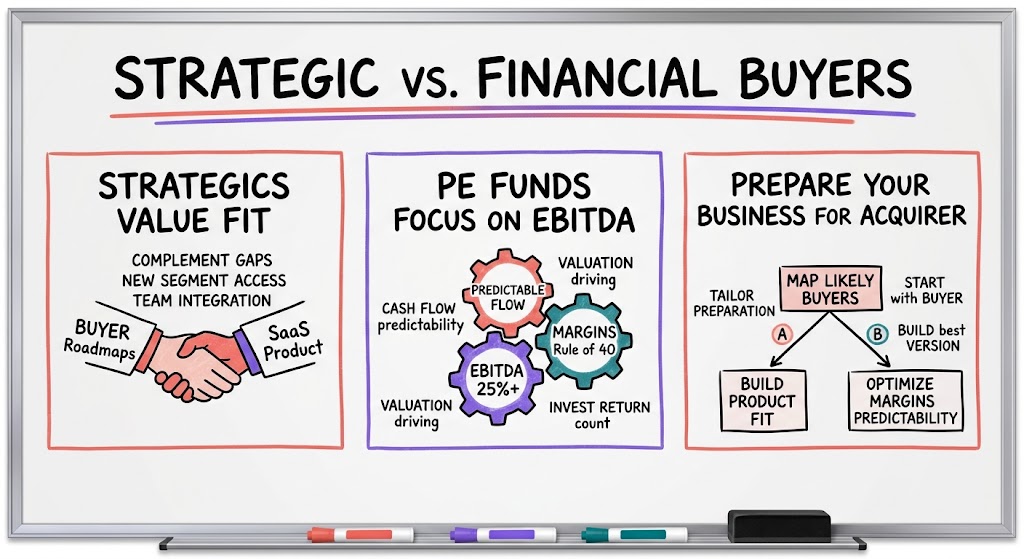
Strategic vs. Financial Buyers
Private equity buyers and strategic acquirers value a SaaS company in very different ways. Here is how to figure out which one is your best buyer, and why the answer should shape your exit prep long before you run a process.

Most founders start thinking about an exit by thinking about the price. How many times revenue, how many times EBITDA, what did a comparable company go for last year. A better first question, and one that came up again and again during a recent Enterprise Mastermind call, is who your buyer is going to be. The answer changes what you should optimize for, how you prepare the business, what kind of deal structure you'll be offered, and even what happens to your team afterward.
There are two broad buckets. Financial buyers, usually private equity firms, buy a company as an investment and underwrite it mostly on cash flow. Strategic buyers are operating companies that buy you because your product, customers, or team fill a gap in what they already do. Both can be great outcomes, but they look at your business through very different lenses.
How Financial Buyers Look at You
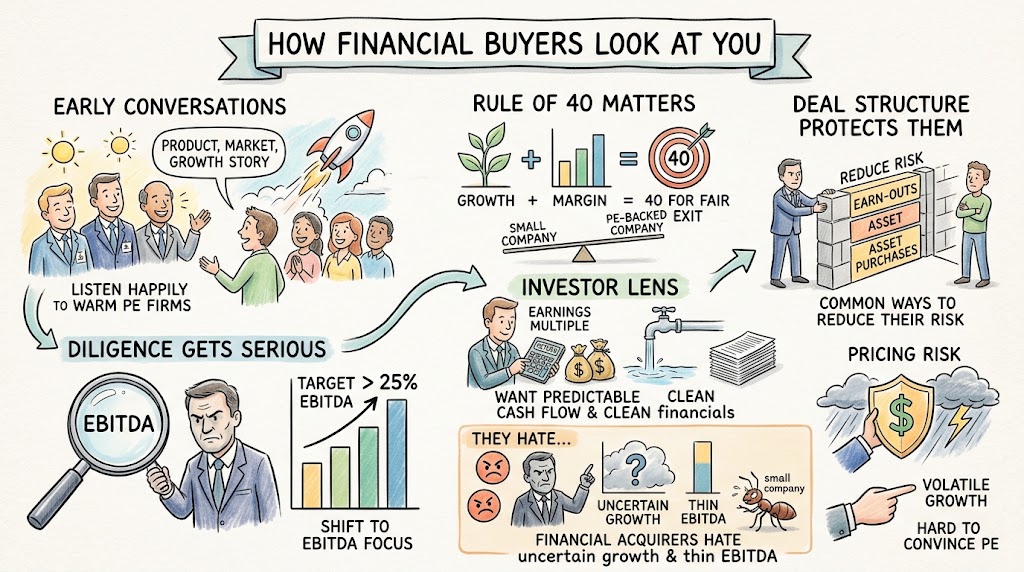
Members who have been talking with PE firms described a consistent pattern. The early conversations are warm. The firms love the product, the market, and the growth story. Then the diligence gets serious, and the focus shifts to EBITDA. One founder who has built relationships with several PE firms over three or four years said they're all asking for at least 25% EBITDA, and he was surprised at how heavily that number is weighted compared with growth.
That's the lens of an investor who is paying a multiple of earnings and needs to hit a return. They want predictable cash flow, clean financials, and a business that fits their model. If your growth is volatile or your margins are thin, they will either pass or price that risk into the offer.
- They underwrite cash flow. EBITDA margin and its predictability drive the valuation.
- Rule of 40 matters. In this climate, growth plus margin needs to add up to 40 for a fair shot at a financial exit.
- They dislike volatility. A founder who can't forecast growth will have a hard time convincing a PE firm to pay for it.
- Deal structure often protects them. Earn-outs and asset purchase structures are common ways for financial buyers to reduce their risk.
For a smaller company with unpredictable growth, those preferences can be a tough fit. One member put it bluntly: a financial acquirer will hate uncertain growth, and they'll hate thin EBITDA.
How Strategic Buyers Look at You
Strategics care about a different set of things. The question they ask is how your product makes their business better. That might mean filling a hole in their product line, getting them into a new customer segment, or saving them the two years it would take to build what you've already built.
A member shared a story that illustrates this well. A CEO friend of his recently sold his company with no growth and roughly 5% EBITDA, and still got a price of about 3x revenue. A financial buyer would never have paid that. The acquirer was a strategic partner he had done business with for years. They didn't buy the company for its growth or its margins. They bought it because it complemented what they were doing, and they needed it badly.
- They buy fit. Your value comes from what you add to their product, customers, or roadmap.
- They're buying time. If building your product would take them years, that time has real value to them.
- Margins matter less. A strategic can often run your product more efficiently inside their business, so your current EBITDA is less important.
- Relationships matter a lot. The best strategic deals often come from partners who already know and trust you.
That member's advice to a CEO facing a tough exit decision was simple: find the companies that are strategically complementary to what you do, that will value what you've built, and that don't want to build it themselves.
What Each Buyer Means for Your Team and Your Deal
A longtime member who has been through these conversations added an important perspective. He said it's critical to decide what kind of buyer you want, because it affects far more than price. A strategic buyer can be a better home for your employees and your product. You might fill a niche they're missing, which can bring a good bit of organic growth after the deal. And if there's an earn-out, it's often more realistic to hit because the combined business is helping you get there.
With a financial buyer, he explained, you're still largely on your own after the deal. You get their capital, and you're expected to keep growing quickly. Unless you're a fast-paced company that can reliably hit their numbers, the parts of the deal tied to future performance can end up taking away what you thought you'd get. He described an offer his company received where the overall price looked reasonable, but a large share of it depended on an earn-out with growth targets he considered unrealistic.
- Strategic buyers can provide growth. Plugging into their distribution and customer base can help the product grow faster than it would alone.
- Financial buyers leave you on your own. You get capital, but the growth still has to come from your team.
- Earn-outs behave differently. They tend to be more achievable when a strategic's resources are helping you hit them.
- Culture and people outcomes differ. Think about where your team will do best after the deal.
He also mentioned that there's a category of software acquirers, several of them based in Canada, that buy and hold companies for the long term. They're another option worth understanding if you want a stable home for the business rather than a quick flip.
Size Often Decides for You
One CEO in the session was preparing his company for a financial buyer with the help of a fractional CFO from private equity. His chairman, an experienced investor in the industry, agreed with the prep work but pointed out that at their size, the deal would most likely be strategic. A banker specializing in their niche had already heard informal interest from several strategic acquirers in Europe.
That's a common pattern for smaller SaaS companies. Many PE firms have minimum size thresholds, and below those, the most likely buyers are companies in or next to your market. The CEO found himself trying to prepare the business for both kinds of buyers at once and landed on the realization that it might be impossible to fully optimize for both. Cutting deep to hit PE-style margins could weaken the growth engine and product investment that a strategic buyer would value most.
- Know the size thresholds. Below a certain scale, PE interest thins out and strategics become the main market.
- Talk to a specialized banker early. Someone who knows your niche can tell you who's likely to be interested.
- Don't over-optimize for the wrong buyer. Prep that pleases a PE firm might hurt your appeal to a strategic.
Use Both Buyer Types to Your Advantage
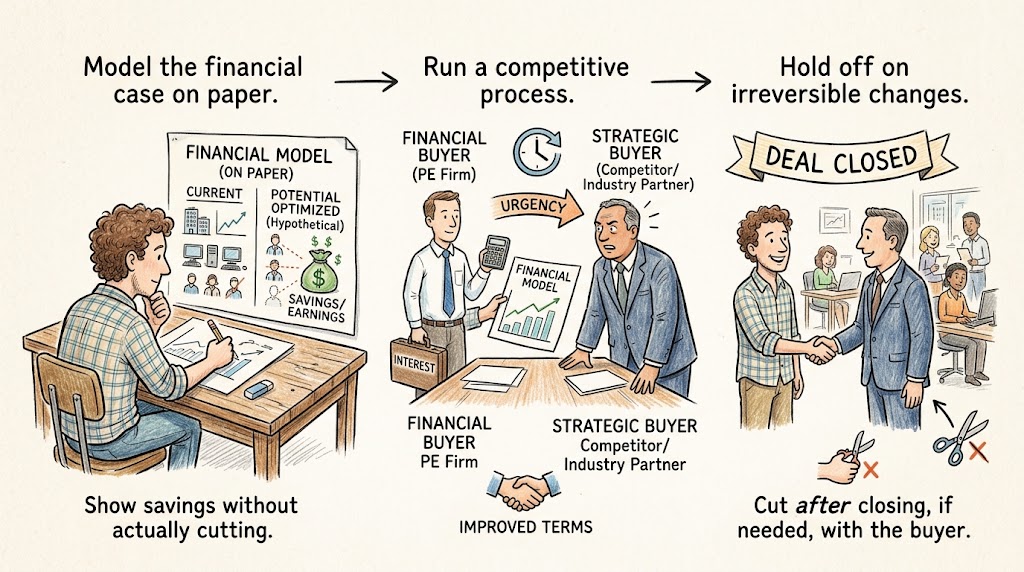
You don't always have to choose one path exclusively. One founder described how his first company handled it. They built a financial model showing what the business would look like after cost reductions, used it to get a financial buyer interested, and then brought in a strategic buyer and used the financial buyer's interest to create urgency. They closed with the strategic and never made the cuts until after the transaction.
That's a smart approach because it gives you a real alternative at the table. A strategic buyer who knows a PE firm is interested has a reason to move faster and pay a fair price. And you avoid making deep cuts that could hurt the business if a deal falls through.
- Model the financial case on paper. Show what the business could earn without actually making the cuts.
- Run a competitive process. Having both buyer types interested creates urgency and improves terms.
- Hold off on irreversible changes. Cut after the deal closes, or when a buyer commits to a plan with you.
Start With the Buyer, Then Prepare
If exiting in the next 18 months or so is on your mind, spend time mapping out who the likely buyers are before you decide how to prepare. List the companies for whom your product would fill a gap. Talk to a banker who knows your space. Be honest about whether your growth profile and margins make you a candidate for PE.
- List likely strategic acquirers. Focus on companies whose product, customers, or roadmap you complement.
- Look at your existing partners. The strongest strategic deals often come from companies that already know you.
- Assess your PE readiness honestly. Compare your margins and growth predictability to what PE firms are asking for.
- Talk to a specialized banker. They can tell you which buyers are active in your niche today.
Once you know your optimal buyer, preparation gets much clearer. For a financial buyer, you focus on EBITDA, clean financials, and predictability. For a strategic buyer, you focus on the product, the customers, and the relationships that make you valuable to them. Trying to be everything to every buyer usually leaves you less attractive to all of them, while knowing your buyer lets you build the version of your company they'll pay the most for.