Skip the Team Retreat, Lose Your Culture
Remote teams run fine on Slack and Zoom, until they don't. Founders in our mastermind who've run in-person gatherings for distributed teams explain what actually makes them worth the cost, and it's rarely the agenda.

A founder running a hospitality-focused software company brought a question to our Enterprise mastermind that a lot of remote-first founders eventually face. His team of around forty people is spread across the United States, Central America, Spain, and the Philippines, with most collaboration happening remotely and monthly all-hands calls holding things together. He'd never brought the entire company together in person, and he wanted to know whether anyone else had, and whether it was actually worth doing.
Picking the location is its own puzzle
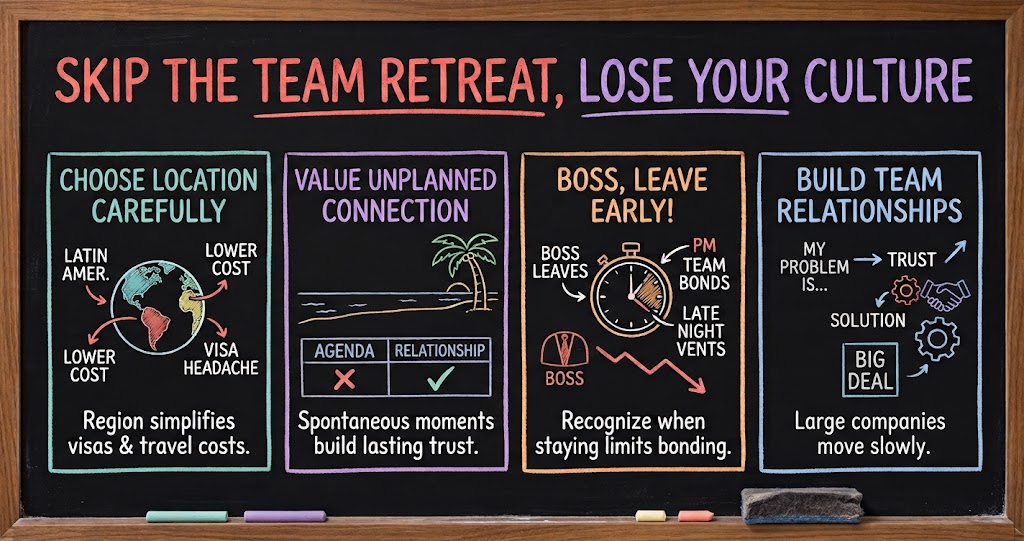
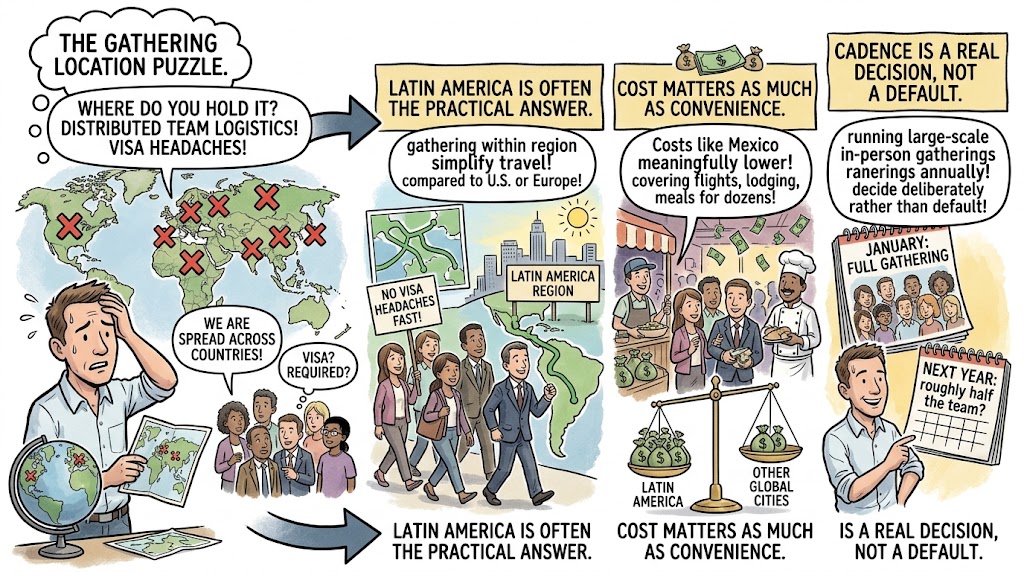
Before you get anywhere near an agenda, there's a logistics problem that trips up a lot of distributed teams: where do you even hold it? One founder running a similarly distributed team, with people spread across multiple countries including several in Latin America, shared that visa requirements end up driving most of the decision. Where your team can actually travel to without a visa headache narrows the map fast.
- Latin America is often the practical answer. For teams with several employees based in Latin American countries, gathering somewhere within the region tends to simplify travel significantly compared to trying to bring everyone to the United States or Europe.
- Cost matters as much as convenience. Beyond the visa logistics, the same founder noted that costs in a location like Mexico have been meaningfully lower than comparable options elsewhere, which matters when you're covering flights, lodging, and meals for dozens of people.
- Cadence is a real decision, not a default. One founder described running a large-scale, mostly-in-person gathering annually, having done roughly half the team the first year and planning a fuller gathering the following January. There's no single right cadence, but it's worth deciding deliberately rather than defaulting to whatever feels easiest to schedule.
What actually creates the value isn't the agenda
The most striking part of the discussion was how consistently founders pointed away from the structured parts of these gatherings, the keynotes, the planned breakout sessions, the carefully scripted talking points, and toward the unplanned moments instead.
- The goal is the relationship, not the deliverable. One founder put it directly: the main goal of getting people together in person is the people being together, not any single project getting finished during the trip. The team accomplishing something specific was never what people remembered afterward.
- What people remember is each other. A year and a half after one gathering, team members were still referencing specific moments with specific colleagues, going from barely knowing someone to genuinely working well with them, sparked by something as simple as spending time together outside a work context.
- Small, human moments outperform planned ones. The interactions that actually changed how people worked together weren't the exact speeches or planned project sessions a founder might prepare in advance. They were things like two colleagues going to the beach together and realizing they actually liked each other.
- Treating people like humans first pays off in collaboration later. One founder framed it as getting to know people as people, which then produces longer-lasting improvements in how the company communicates internally, well beyond the days of the trip itself.
This matters because it changes how you should plan one of these gatherings. If the real value comes from unstructured connection, over-scripting every hour of the trip may actually work against you. Leave real space for people to just be around each other.
The one piece of advice every founder repeated
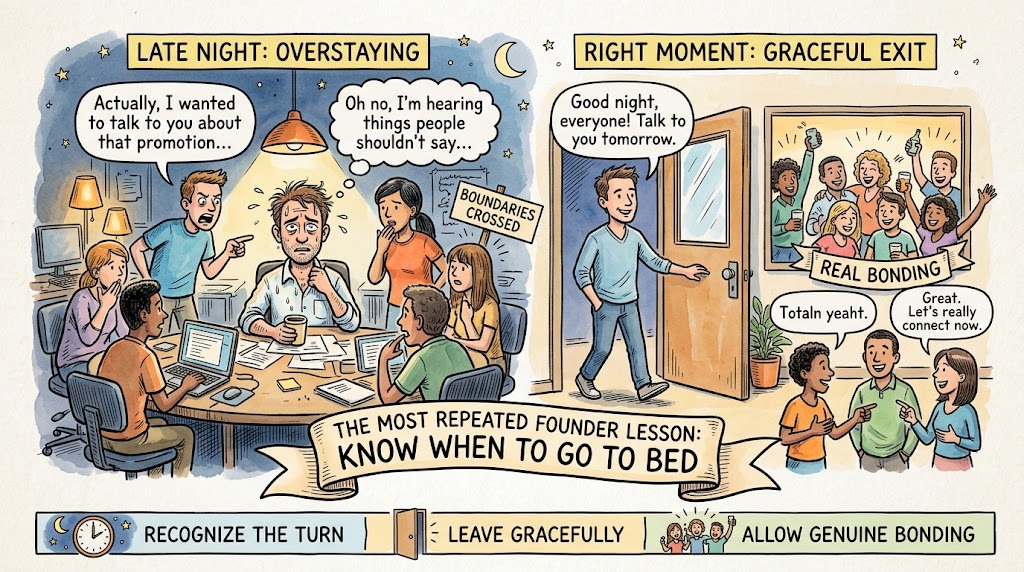
If there was a single most-repeated lesson in the discussion, it was surprisingly specific: know when to go to bed. One founder described the pattern candidly. The instinct as a leader is to stay up late with the team, being part of every conversation and every moment of bonding. But as the night goes on and inhibitions drop, conversations shift, someone brings up a promotion they want, someone vents about a coworker, and suddenly you're not a peer in a fun moment anymore. You're the boss hearing things people wouldn't normally say to your face.
- Your presence can change the room, and not always for the better. Once the emotional temperature rises later at night, having the founder still in the room can shift what people are willing to say and how freely the team bonds without you.
- Stepping away at the right moment lets the team bond on its own. The advice wasn't to skip the social time entirely, just to recognize the point where staying stops adding value and starts limiting it, and to leave gracefully at that point.
- This applies to how you run the whole trip, not just the evenings. The broader lesson is knowing which moments genuinely need your presence as a leader, and which ones work better, and feel more genuine to the team, without you.
Why this is worth the cost even for a small team
It's worth connecting this back to something a founder shared as a quote he'd picked up elsewhere: you can't really build a successful software company directly, what you can build is the team that will build the successful software company. That framing captures why an in-person gathering earns its place on the budget even when it produces nothing you could point to on a roadmap. You're not flying people in to finish a sprint. You're building the relationships that make every remote sprint after that one go more smoothly.
- Run one day for everyone, and one day for leadership alone. One founder described a long-running practice of splitting an annual gathering into a full-company day and a separate day reserved just for the senior leadership team, giving each group the focused time it actually needs.
- Don't skip it because the team is remote by design. Being a distributed team by choice doesn't remove the need for occasional in-person connection. If anything, it makes deliberate gathering more important, since the daily friction points that build trust in an office simply don't happen naturally over Slack.
- Measure it in collaboration, not in output from the trip itself. The real return shows up months later, in how smoothly cross-functional work happens, not in anything you can point to from the days of the retreat itself.
If your team has never gathered in person, or hasn't in a while, the case for doing it isn't really about strategy sessions or roadmap planning. It's about giving people the chance to stop being a name on a Slack channel and become a person your team actually knows. Everything else, the smoother handoffs, the faster trust, the fewer misunderstandings over text, tends to follow from that on its own.
Making the case to yourself before you make it to your board
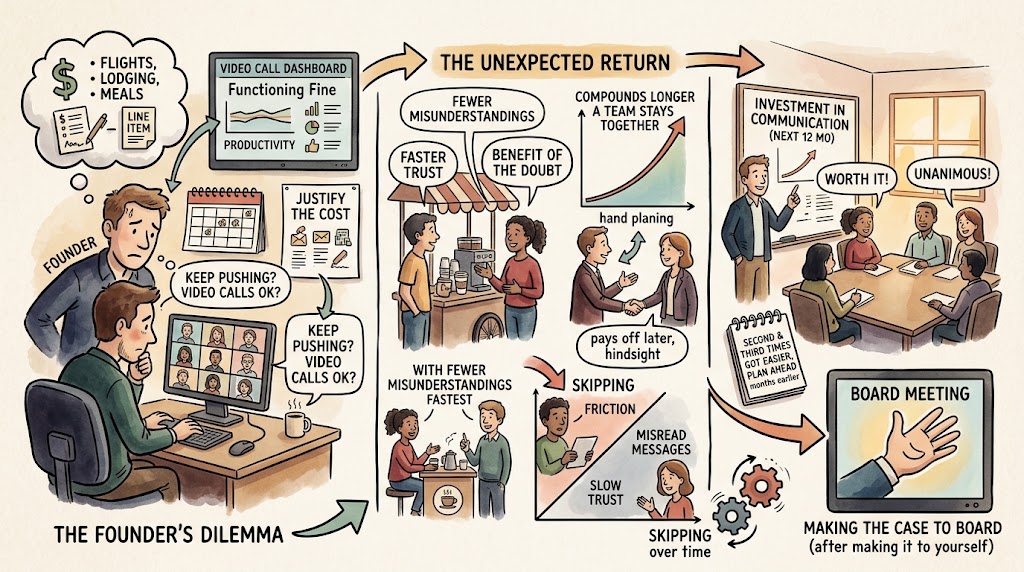
For a lot of founders, the hardest part of committing to an in-person gathering isn't the logistics. It's justifying the line item. Flights, lodging, and meals for dozens of people add up fast, and it's tempting to keep pushing the decision another quarter while the team keeps functioning fine on video calls. The founders in this discussion who'd already made the investment were unanimous that it was worth it, but they were also honest that the return doesn't show up anywhere you'd normally look for it.
- You won't find it in a productivity metric. The value shows up as fewer misunderstandings, faster trust when a hard conversation is needed, and people giving each other the benefit of the doubt, none of which show up cleanly in a dashboard.
- It compounds the longer a team stays together. The relationships built during one gathering keep paying off well after the trip ends, which means the return on a single retreat is easiest to see in hindsight, a year or more later, not in the immediate aftermath.
- Skipping it doesn't show up as a cost either, until it does. Teams that never gather in person don't usually fall apart dramatically. They just accumulate more friction, slower trust, and more misread messages over time, in a way that's easy to attribute to other causes.
If you're a founder weighing whether this year is the year to finally bring your distributed team together, treat the cost as an investment in how well your company communicates for the next twelve months, not as an expense tied to a single week. Judged that way, for most growing remote teams, it's one of the easier calls to make.
One last practical note from the discussion: start planning further ahead than feels necessary. Visa timelines, flight costs, and simply finding a week that works for a team spread across several countries and time zones all take longer to coordinate than most founders expect the first time around. Founders who'd run these gatherings more than once said the second and third times got noticeably easier, mostly because they'd learned to start the planning conversation months earlier than instinct would suggest.