
Should You Token Max? What to Spend Per Software Engineer on AI Coding Tools
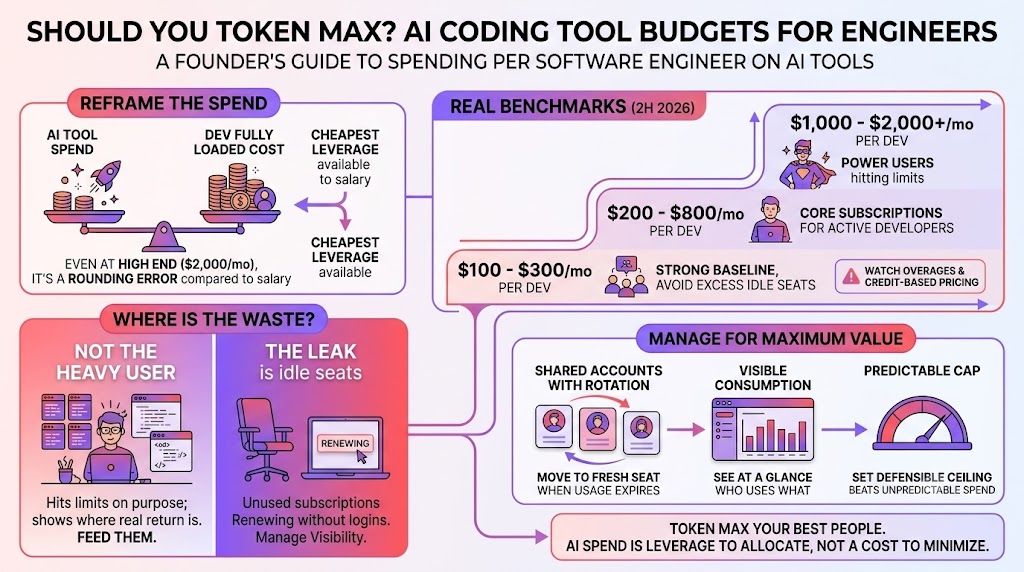
A practical look at what SaaS founders are actually spending on AI coding tools per engineer — from $200–800/month on core subscriptions up to $1–2K for power users — and how to think about it. The takeaway: AI spend isn't a cost to minimize but leverage to allocate. Max out your best engineers, give everyone a solid baseline, and control waste through visibility rather than caps.

One of the most interesting questions that came up in our Enterprise Mastermind this week was deceptively simple: how much should you actually be spending per engineer on AI coding tools?
It came from a founder who has been running his company for more than two decades. Nine months ago, when his team first got the push to adopt AI, about half of his developers wanted nothing to do with it. Today it's the opposite problem. Everyone is AI-crazy. They're all spending, on Copilot, on Claude, on ChatGPT, on Grok, on a dozen tools he's never heard of. And his honest question to the group was, "I don't even know what's appropriate anymore. Is it $300 a month per person? Is it $500? Is there a bellwether yet for what a quality dev team should be spending?"
I think that's the right question to be asking in the second half of 2026. Before I get into the numbers, here's the short version of where I land:
- Token max your best people. The engineers hitting their limits are showing you exactly where the return is.
- Don't token max the whole org by default. A strong baseline for everyone beats a random tool for everyone.
- The waste isn't the heavy user, it's the idle seat. Manage visibility, not austerity.
- At these prices, this is the cheapest leverage you'll ever buy. Relative to a developer's salary, it's a rounding error.
Now let me share what I actually heard from the room.
The real numbers founders are spending
The honest answer is that nobody has a clean, universal rule of thumb yet. This is still young. But when I went around the room and asked people to pull their real numbers, a pattern emerged pretty quickly. Here's roughly what the different teams reported:
- Lean, high-output team: developers rotate across four subscription accounts, topping out around $800/month. The CTO runs four accounts, the head of backend three, most developers two (~$400/month). Marketing sits on a single $200 Max seat.
- Small seven-person team: twelve accounts total, split across Claude Max and a competing coding agent, all on the $200/month tier. Two power users each burn the equivalent of four accounts; the rest barely touch one.
- The deliberate minimalist: GitHub Copilot, one $100 collaborative-AI seat, and ChatGPT for everyone. Not a "token maxer" and proud of it.
- From the written comments: one founder at $300–500/month per developer plus $400–800 on automated testing with no human attached; another around $600 per developer and $100 per non-developer; a third keeping his whole tech team near $300/month.
If you want a range to anchor on, here it is: most serious teams are spending $200 to $800 a month per developer on core AI coding subscriptions, and your genuine power users will push $1,000 to $2,000 a month once you count everything. That's the market as of right now.
Why I don't lose sleep over the number
Here's the reframe I'd offer, and it's the same thing I told the group.
Compare that spend to the fully loaded cost of a software engineer. Even at the high end, $2,000 a month is a rounding error next to a developer's salary. If an extra few hundred dollars of tokens makes one of your best engineers 20% or 30% more productive, you didn't overspend, you got the single best return available to you anywhere in the business. This is the cheapest leverage most of us will ever buy. I would much rather have a CTO who is maxing out and shipping than a CTO I've capped to save $400.
So the "should you token max" question, for me, is mostly answered by looking at who is doing the spending. If your best people are hitting their limits and rotating through accounts to keep working, that is not a cost problem. That is a signal that they are getting real value, and you should feed it.
Where the waste actually is
The waste is not the heavy user. The waste is the seat nobody opens.
The founder who kicked off this conversation put his finger on the real issue without quite naming it: when you let everyone buy whatever tool they want, a lot of those tools quietly go unused. That's the actual leak. It's not the developer running four accounts flat out; it's the eleven half-used subscriptions scattered across the team that renew every month while nobody logs in. A few practical habits keep that under control:
- Run shared accounts with rotation. Keep a set of accounts on a simple spreadsheet and have developers move to a fresh one as soon as theirs runs out of usage for the period.
- Squeeze full value from every seat. Rotation means you're actually consuming what you pay for instead of letting limits sit unused.
- Get a live picture of who's using what. The same system shows you at a glance who's a power user and who's idle.
- Match the approach to how your team codes. If your developers live in the terminal, rotating accounts is nearly seamless. If they don't, it can be more friction than it's worth.
A note on the metrics themselves
One thing I'd gently flag. A lot of these tools now sell you credits that convert into tokens, with overage charges layered on top, and the pricing can move underneath you fast. One founder described a service that started at $25 a month, jumped to $250, and then to $750, and he was still paying overages on top of that. When your unit of billing is an abstract credit that turns into an abstract token, it is genuinely hard to forecast your costs. A few things to watch:
- Credit-to-token pricing. If billing is measured in abstract units, your spend is hard to predict by design.
- Overages on top of tiers. The headline price is rarely the real price once you cross the included allotment.
- Prices that move fast. A tool can 10x its cost in a few billing cycles, so re-check it regularly.
- When in doubt, set a cap. A predictable ceiling you can live with beats a "correct" spend you can't forecast.
So, should you token max?
Here's where I land, in one clean list you can take to your next budget conversation:
- Token max your best people. The developers hitting limits and rotating accounts to keep shipping are pointing straight at the return. Give them the tools.
- Don't token max the whole org. Buy everyone a strong baseline, almost everyone should have at least a Max-tier account, then let real usage tell you where to add.
- Meter through visibility, not austerity. Use shared accounts and rotation so you can see consumption clearly and stop paying for idle seats.
- Benchmark to a "max," then work backwards. Put a defensible ceiling in your plan, in the range the market is actually spending, and let real behavior pull the number down.
We are very early in figuring this out, and I suspect the numbers will keep moving as the tools get more capable and the pricing keeps shifting. But the underlying principle isn't going to change: AI coding spend is not a cost to minimize, it's leverage to allocate. Point it at your highest-output people, keep a clear line of sight on who's actually using what, and you'll almost never regret the spend.