
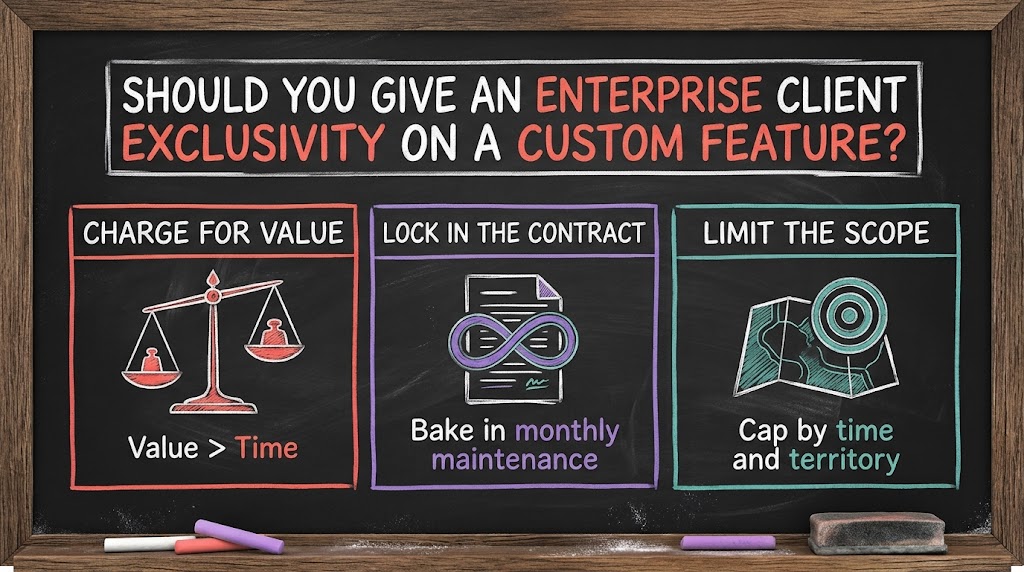
Should You Give an Enterprise Client Exclusivity on a Custom Feature?
A big prospect will fund a custom feature, but wants exclusive rights to it. Here's how SaaS CEOs price custom builds in the AI era and negotiate exclusivity so one deal doesn't cap your future market.

At some point, most SaaS founders get this call. A large prospect wants a feature you don't have yet. They're willing to pay for the engineering to build it. And then comes the catch: they want exclusive rights to that feature in their market so their competitors can't buy it from you.
A founder in our weekly mastermind brought exactly this situation to the group. A major prospect had scoped a significant custom build, priced in engineering months, and wanted to take the finished feature to market themselves. The customer would only need exclusivity on the one big standout feature, not on the smaller items in the requirements list, but that standout feature would be an industry first. The founder's question was how to push back on exclusivity, or at least shrink it, without losing the deal. It's a great example of a negotiation where the instinct to take the money and the instinct to protect the future pull in opposite directions.
Custom features cost something different now
My first question was whether most of the team's production code is written by AI. The answer was yes, all of it. That matters a lot, because custom features are a whole different topic now than they were ten years ago. A decade ago, a custom feature could take many months. Today, you can build most custom features in a couple of weeks. A year ago, I'd estimate about 90% of our community had their code written mostly by humans. Today, I'd say 90% have it written mostly by AI.
- Your cost to build has dropped. AI-assisted development means the real engineering cost of a custom feature is probably far lower than it used to be.
- Your pricing may not reflect that. If you're pricing on old assumptions about engineering time, you may be leaving margin on the table or mispricing risk.
- Maintenance is the unknown. One member pointed out that nobody is quite sure yet what it costs to maintain AI-built code over years, so build a buffer in.
That shift changes the negotiation. What the customer is really paying for is your expertise, your existing platform, and the fact that you can deliver something they couldn't find elsewhere. The hours are a small part of it.

Price the build as if you don't want to do it
The founder was pricing the work at roughly cost plus a modest markup. Several members thought that was too cheap. One CEO said he has generally stayed away from custom features entirely, and when a customer asks, he inflates the price significantly to discourage it. In this case the prospect was still comfortable with the price, which is a signal in itself. When a buyer accepts your number without blinking, it usually means you're delivering more value than you're charging for.
Another member raised the opposite risk. If you push the price too high, a customer with its own developers might decide to try building the feature themselves or go looking for another vendor. In this case, the prospect had already run an RFP and couldn't find anyone else able to build it, and they'd still need the foundation the founder's team spent years building. That tells you where the real negotiating power sits.
- Price on value, not hours. If the feature is an industry first that the customer will use to make money, cost-plus pricing undersells it.
- Read the buyer's reaction. If they accept your price easily, there's room. If they hesitate, you've found the edge.
- Know your moat. A customer can rebuild one feature. Rebuilding the platform underneath it is much harder, and that's what you're really selling.
- Weigh the logo. One member noted that if the effort is reasonable and the customer is a strong logo, letting them have some ownership can still be a good deal.
The balance here is to price with confidence while staying aware of the buyer's alternatives. The more unique the platform underneath, the more confident you can be.
Make the profit in the contract, not the build
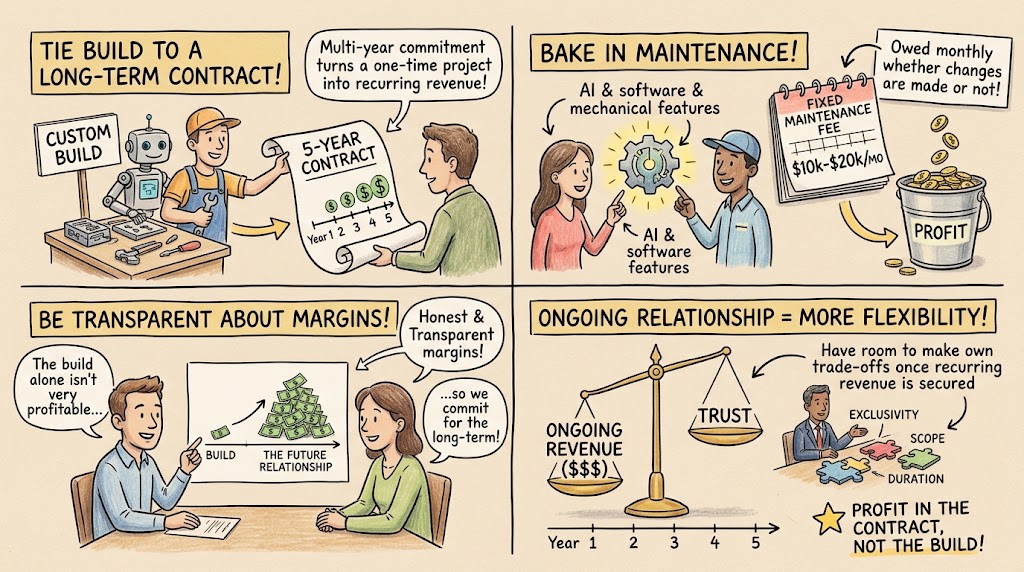
The most useful advice in the room was to stop treating the build as the main event. One CEO suggested tying the custom work to a long-term commitment, something like a five-year contract. You can tell the customer openly that you aren't making much on the integration itself, and that you're willing to do it if they commit to a multi-year contract that's profitable over its life.
Another member added a sharper version. A five-year contract may be a hard ask, but a baked-in maintenance contract is much easier to justify. Instead of a vague long-term deal, you specify a fixed maintenance fee, say $10,000 or $20,000 a month as an illustration, owed whether or not they use you for changes. In his view, that's where you're going to make your profit.
- Tie the build to a term. A multi-year commitment turns a one-time project into recurring revenue that justifies the effort.
- Bake in maintenance. A fixed monthly maintenance fee covers the ongoing cost of keeping AI-built features working and becomes the profit center.
- Be transparent about margins. Telling a customer the build alone isn't very profitable is a reasonable way to justify asking for a longer commitment.
Framed this way, exclusivity becomes one term among several. Once the money is coming from the ongoing relationship, you have more room to trade on exclusivity, scope, and duration.
Shrink exclusivity by scope, territory, and time
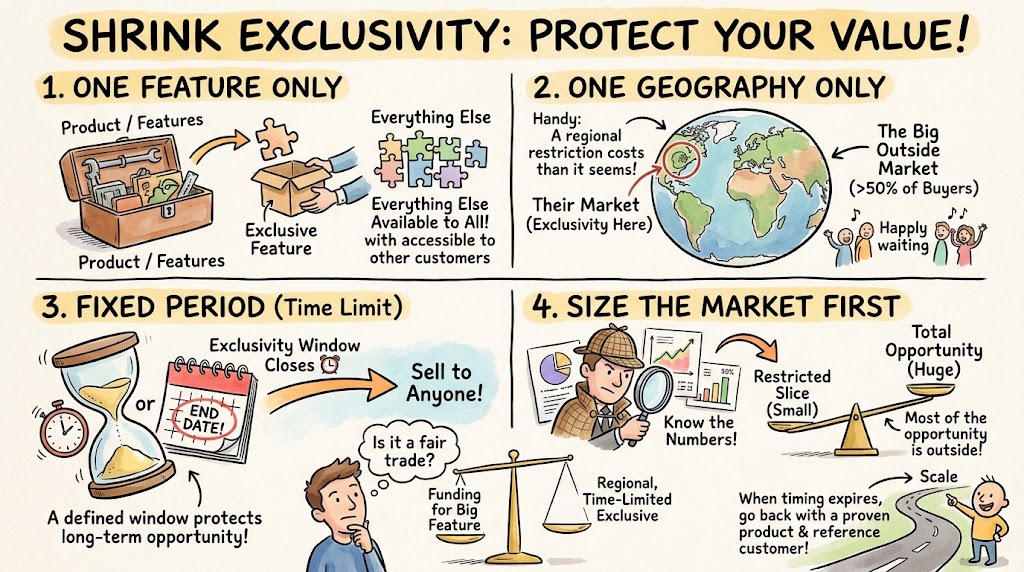
The founder wanted to know which arguments to use and what defines when exclusivity is worth it. The group came back to three levers: narrow it to a single feature, limit it to a specific market, and put an end date on it. The customer had already said they didn't need it forever, which is an opening worth using.
Then I asked a simple question: of all the companies worldwide that could buy this feature, how many sit outside the customer's home market? The answer was more than half. That changes the picture. Even with exclusivity in one market, once you have a product that only a small set of companies can use, you can go after every single one of them outside that market. A member who works across international markets added that companies outside that region often move faster anyway.
- Exclusivity on one feature only. Keep everything else in the build available to all of your customers.
- Exclusivity in one geography only. If most potential buyers sit elsewhere, a regional restriction costs you far less than it seems.
- Exclusivity for a fixed period. A defined window, after which you can sell into that market, protects your long-term opportunity.
- Size the market before you agree. One member asked whether the outside market had actually been sized. Know the numbers before you trade them away.
Once you see that most of the opportunity is outside the restricted territory, giving a regional, time-limited exclusive can feel like a fair trade for a customer funding your next big feature. The founder put it well after hearing this: the group was doing a great job of selling the deal for them.
It also helps to be clear with yourself about what you're actually trading. Exclusivity is worth granting when the customer is funding something you couldn't otherwise afford to build, when the restricted market is a small slice of your total opportunity, and when the window is short enough that the feature will still be valuable when it opens back up. It's a bad trade when the restricted market is where your best reach is, or when the term is open-ended. In this case, the founder's own strongest relationships happened to be in that same market, which made the territory feel costly. That's exactly why the time limit matters so much. A regional exclusive that expires lets you come back to that market later with a proven product and a reference customer.
Look for ways to turn the client into a partner
There's one more option worth considering. If you trust the customer and the relationship is strong, one member suggested you could join forces in their home market and run your own business everywhere else. That turns a defensive negotiation into a partnership where both sides benefit from the feature existing.
- Co-sell in the restricted market. If they have reach where they want exclusivity, partnering may earn you more there than going alone.
- Sell it as an add-on everywhere else. The founder estimated they could charge other customers a meaningful monthly add-on for the feature, a strong revenue expansion play.
- Bring it to more than one room. Hard deal questions like this benefit from a second set of experienced eyes before you sign.
The bigger lesson is that a customer funding a custom feature is offering you something valuable: a paid R&D roadmap for something no one else has. Price it on value, earn your profit through the ongoing contract, and keep exclusivity narrow in scope, place, and time. Do that well and one custom deal becomes the start of a new product line instead of a ceiling on your growth.