Should I Show My Emotions & Stress to My Team
Founders in our mastermind on how much stress to let a team see during hard stretches, why explaining the why beats projecting fake calm, and why you still need one person you can be completely honest with.

One of our members brought a question to the group that most founders sit with privately for years before ever saying out loud. His company had been through a hard stretch, more than a decade of what he called a yo-yo cycle tied to forces mostly outside his control, algorithm changes and shifting consumer sentiment on the distribution channels his business depends on. He'd just gotten some gentle feedback from his team that he'd been showing his stress a little too openly, and he wanted to know how the rest of the room handled it. Do you let your team see you struggle, or do you keep the composed face on no matter what's happening underneath?
The answers that came back weren't identical, and that's the useful part. A few different, workable philosophies emerged, and the differences between them tell you more than any single piece of advice would.
Transparency about the market, not about individuals
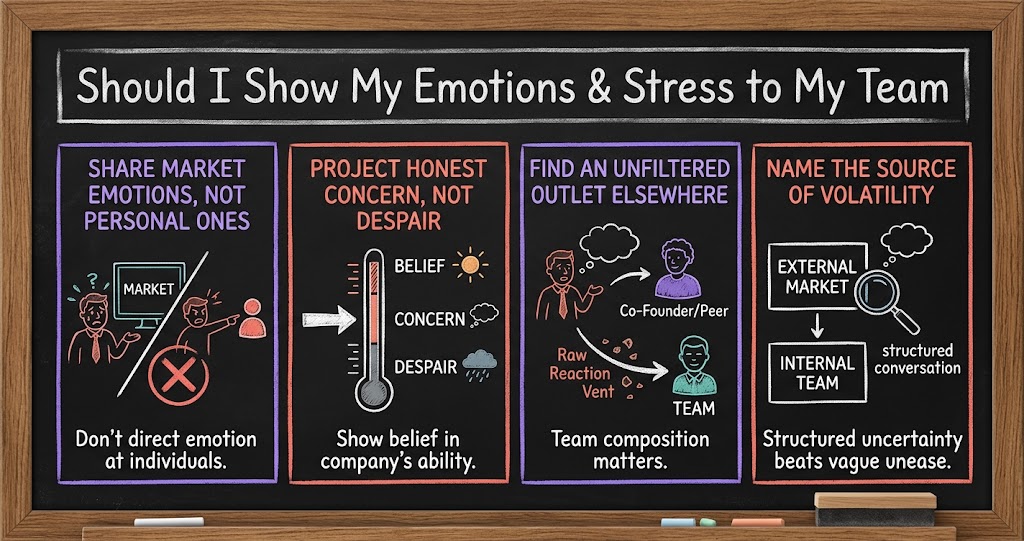
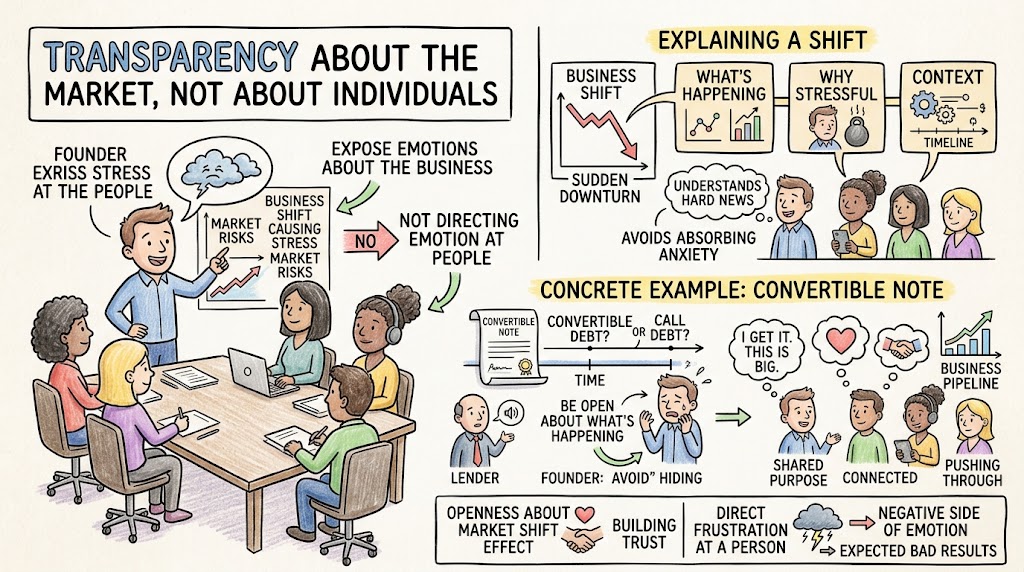
One founder described running a genuinely open leadership team, where the operating principle is that you expose your emotions about what's happening in the market and the business, but you don't direct that emotion at individual people. When a shift in the business is causing real stress, the move isn't to hide it. It's to explain it: here's what's happening, here's why it's landing on me this way, here's the context behind it. That explanation is what lets a team actually process hard news instead of just absorbing the anxiety without understanding it.
He gave a concrete example. His company had a convertible note that became a serious source of stress for a stretch, a lender who went quiet and wouldn't share information about whether they'd convert a meaningful chunk of debt or call it. That kind of uncertainty is exactly the sort of thing that's tempting to hide from a team, since there's no resolution to offer yet. Instead, he was open about what was happening and why it was hitting the company hard.
- The team didn't panic. They understood. Because people had already seen the business go through ups and downs with real transparency, they had context for why this particular thing mattered, rather than reacting to it cold.
- Explanation turned stress into shared purpose. People responded with something closer to 'I get it, this is big' than fear, and felt more connected to pushing through it rather than less.
- The distinction that matters is target, not intensity. Being open about how a market shift affects you is different from directing frustration at a specific person. One builds trust. The other, in his words, is the negative side of emotion, and it tends to produce exactly the results you'd expect.
Projecting steady optimism on purpose
A different founder in the group takes closer to the opposite approach, and it's worth taking seriously rather than treating it as the wrong answer just because it's different. In all-hands meetings and manager meetings, he consistently brings an upbeat, positive tone, even when it isn't the easiest thing to do that day. He's naturally optimistic by disposition, so a lot of this isn't performance so much as leading with the version of himself he trusts most in front of the team. But he was candid that it isn't automatic either. He described being called out once, gently, after a meeting where he'd let a grimmer picture show through more than usual, and said that feedback stuck with him for a year and a half as he worked through what the right balance actually looks like.
That's a useful data point on its own. Even a founder whose default style leans toward steady optimism has hit moments where too much candor about how bad things looked created a ripple effect he didn't expect, and had to recalibrate. There isn't a setting you get right once and leave alone.
Honesty, consistency, and belief, not the absence of concern
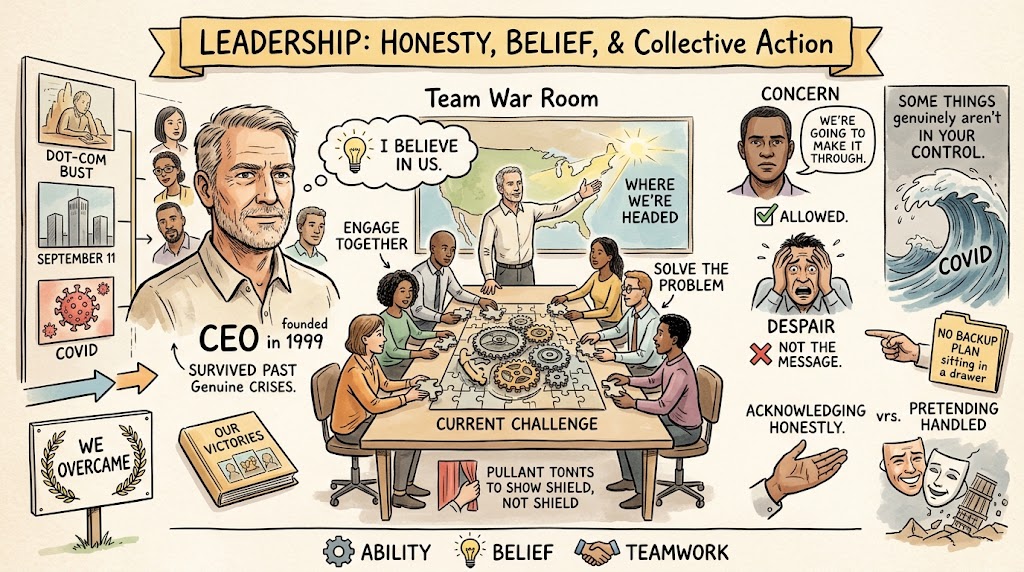
A founder who's been running his company since 1999, through the dot-com bust, September 11th, and COVID, offered a framing that threads the needle between the two approaches above. His view is that you do need to be honest with your employees. But he separates honesty from the specific role a CEO plays, which is different from any other person's role on the team.
- People need to see that you believe in the company. Not that nothing is wrong, but that you believe in where it's headed and in the team's ability to get there.
- Engage the challenge together rather than hiding it. With the right people, that means bringing them into solving the problem, not shielding them from the fact that there is one.
- Some things genuinely aren't in your control. When COVID hit, there was no alternative plan sitting in a drawer. Acknowledging that honestly is different from pretending you have it handled.
- Concern is allowed. Despair isn't the message. The honest version of concern he tries to model is something closer to 'we're going to make it through this,' not a denial that things are hard.
Having survived multiple genuine crises gives this founder a useful trick, too: reminding a team periodically of the hurdles the company already overcame. It's not spin. It's real evidence that hard stretches have ended before, and that alone does a lot to steady a room without requiring anyone to pretend the current situation is easy.
Why this question is harder in some businesses than others
It's worth naming why this particular founder's question felt so pointed. His business sits in a consumer-facing category where success depends heavily on algorithms and distribution channels he doesn't control, so a good quarter can be followed by a rough one for reasons that have nothing to do with how well the team executed. Other founders in the room described a version of the same anxiety from a different angle, worrying about long-term relevancy as bigger platforms move into adjacent categories and start pulling customers away. That kind of structural uncertainty is a different animal from a normal execution problem, because there's no clear internal fix to point to, which makes it harder to project confidence without it feeling hollow.
- Name the source of the uncertainty explicitly. A team can handle 'the algorithm changed and here's how it's affecting us' far better than vague unease with no explanation attached.
- Separate what you control from what you don't. Founders who deal well with this kind of external volatility tend to be clear with themselves and their teams about which parts of the problem are theirs to fix and which parts simply have to be absorbed and adapted to.
- Build a regular touchpoint for surfacing concerns before they compound. One founder gets his top managers together once a quarter specifically to ask what the team should be working on and how the company should adapt, which turns anxiety about relevance into a structured conversation instead of a private worry.
That quarterly habit is worth calling out on its own. It doesn't eliminate the uncertainty, nothing does when the pressure is coming from outside the business, but it gives a team a regular, expected outlet for raising concerns candidly, which takes some of the weight off any single all-hands meeting needing to carry all of the honesty at once.
You still need somewhere to put the rest of it
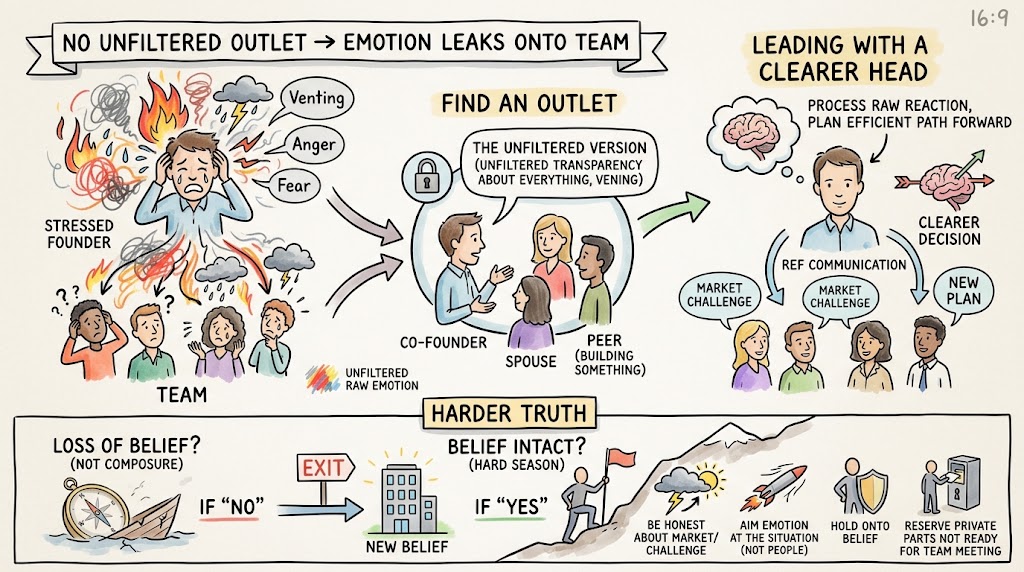
The most direct piece of advice offered to the founder who asked the original question was about what happens before you ever get in front of your team. His point was that context matters enormously, since the right amount of visible emotion depends heavily on what the emotion is actually about, but underneath that, there's a more universal need. You need at least one person you can be completely, unfiltered transparent with about everything, including the parts of running a company you'd never say out loud to your team, the moments you'd like to vent about a specific person or decision.
- That person is your outlet, not your team. A co-founder, a spouse, a peer who's also building something, someone who's genuinely in it with you and can hear the unfiltered version.
- Without that outlet, the unfiltered version leaks out somewhere else. Usually onto the team, in moments you didn't plan and can't fully control.
- With it, you get to lead with a clearer head. Getting the raw reaction out first makes room to think about what the situation actually calls for, and what the most efficient path forward looks like, before you say anything to the wider team.
There's a harder truth buried in this conversation too. The founder who originally asked the question eventually admitted that his real issue wasn't how much emotion to show, it was that he'd stopped believing in the company itself, at least for the moment. That's a much bigger question than composure, and it's worth being honest with yourself about which one you're actually dealing with. If you don't believe in what you're building anymore, no amount of careful emotional management is going to fix that, and it might be a signal that it's time to think about selling and moving on to something you do believe in. But if the belief is intact and it's just a hard season, the pattern that emerges from all of this is fairly consistent: be honest about the market and the challenge, keep the emotion aimed at the situation and not at people, hold onto your own belief in the company even when it's being tested, and make sure you have somewhere private to put the parts that aren't ready for a team meeting.