
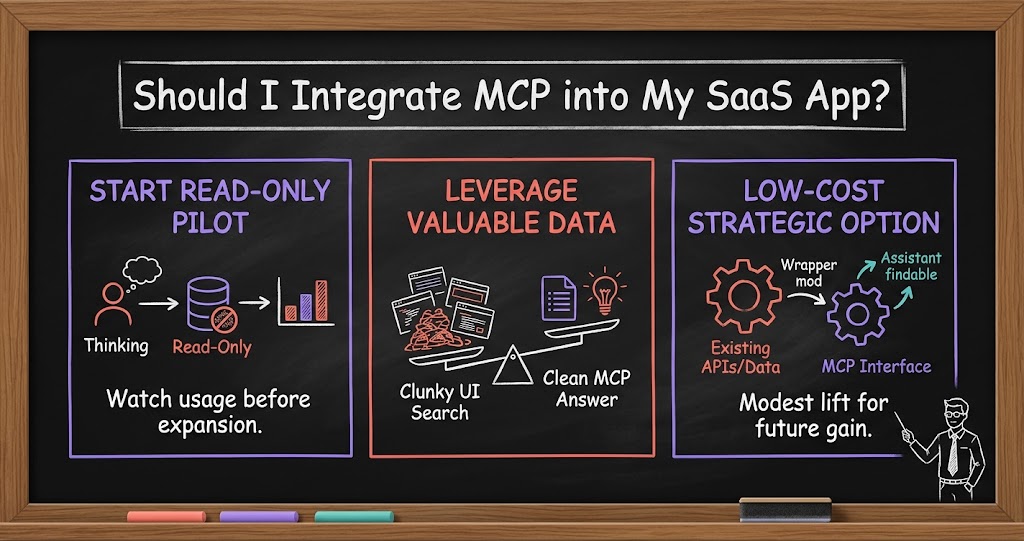
Should I Integrate MCP into My SaaS App?
MCP adoption inside B2B SaaS is all over the map right now, some founders see it driving real usage, others see almost none. Here's what a room full of SaaS founders actually reported, and how to think about whether to build for it.

I brought this question to our Enterprise Mastermind a few weeks ago because one of our members had a specific use case in mind: instead of logging into a tool's UI, he wanted to hand it context through an AI assistant and let the assistant do the work. His example was using Grok to generate a game soundtrack through Suno rather than opening Suno directly and clicking around. The question he asked the group was simple. Is this the interface of the future, something a huge share of software users will be doing in a couple of years, or is it a niche behavior that mostly technical founders are playing with right now?
What came back from the group was one of the more useful data points I've heard on this topic, because it wasn't theory. It was real usage numbers from real SaaS products, and the range was enormous.
The traffic numbers tell two different stories
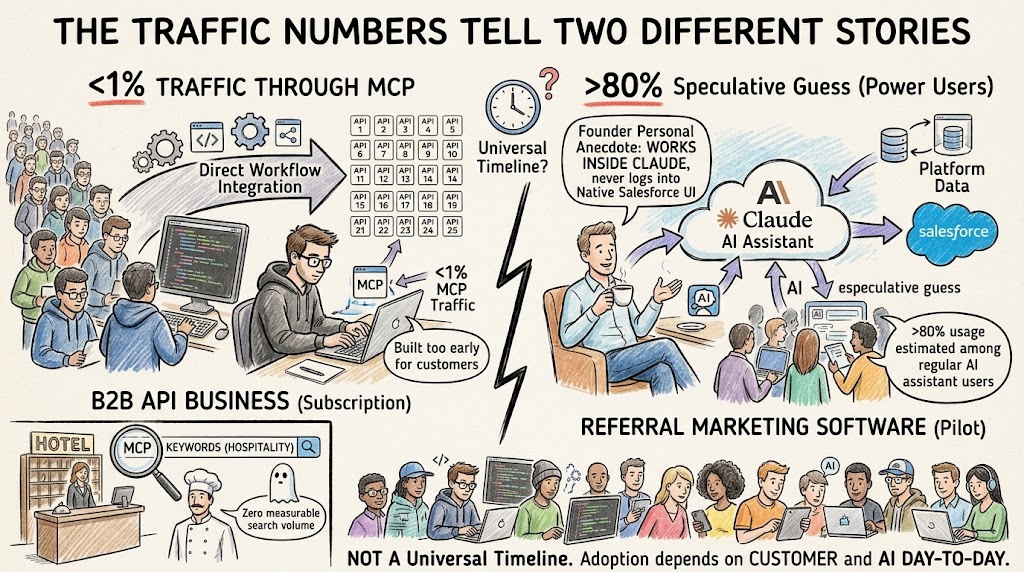
One founder in the group runs a set of B2B APIs, twenty five of them, sold on subscription to a developer customer base that's used to integrating directly into their own workflows. He built MCP interfaces for those APIs expecting a new kind of user to show up. Less than one percent of his traffic today comes through an MCP interface. He was candid that his team may have built it too early for where his customers actually are.
Contrast that with a founder running referral marketing software who connected MCP directly to his platform's data and started piloting it with a small group of customers to learn what kinds of questions they'd ask. He also made a comment that stuck with me: he personally never logs into Salesforce anymore. He works inside Claude, connected to Salesforce, and lets the assistant retrieve what he needs. When someone floated a guess that MCP-style usage of a tool like Salesforce might already be above eighty percent among people who use AI assistants regularly, nobody in the room pushed back hard on that number.
- Under 1% of traffic for a developer-facing API business with an existing MCP interface live today.
- Possibly 80%+ for how often power users of a tool like Salesforce are estimated to already be interacting with it through an AI assistant rather than the native UI.
- Zero measurable search volume for MCP-related keywords in at least one vertical (hospitality), even though the founder is convinced the shift is coming.
That spread isn't a contradiction. It's a signal that MCP adoption depends heavily on who your customer is and what they're already doing with AI assistants day to day, not on some universal timeline the whole SaaS industry is moving through at the same pace.
Who's actually using it right now
The pattern that emerged from the group was pretty consistent once you look past the raw numbers. The tools seeing real MCP usage tend to be ones where the underlying data is genuinely useful to pull into a conversation and act on, and where the user is already comfortable working inside an AI assistant for other parts of their job. A CRM is a great example. So is a large analytics data set where the value is being able to ask a question in plain language and get an answer, rather than clicking through a dashboard.
One founder running ERP software for a regulated industry described his current use case in a way I think generalizes well: right now, most of what people want out of an MCP connection isn't complex multi-step agentic behavior. It's a smarter way to ask questions of a large data set and get something like a chart or a number back, without the friction of building a custom dashboard for every question someone might have.
- Large, valuable data sets win first. If your product sits on top of data your customer wants answers from, MCP gives them a faster path to those answers than clicking through reports.
- Read-only is a sane starting point. One founder building an MCP layer for his marketing platform deliberately started read-only, letting users ask about campaign performance before opening up any ability to take action.
- Regulated or high-trust categories move slower. A founder selling into hospitality operators who aren't especially tech forward, and who often use tools like Microsoft Copilot because that's simply what their IT department allows, pointed out that his customers aren't even searching for MCP yet, let alone asking for it.
There was also a sharp point raised about who controls the roadmap. If your customer's daily tools are chosen by a larger vendor, Microsoft shops standardized on Copilot were the example that came up, your customer may simply be waiting on that vendor to decide when and how MCP shows up in their world. That's worth knowing before you assume your own customers are free agents on this.
The strategic question underneath the technical one
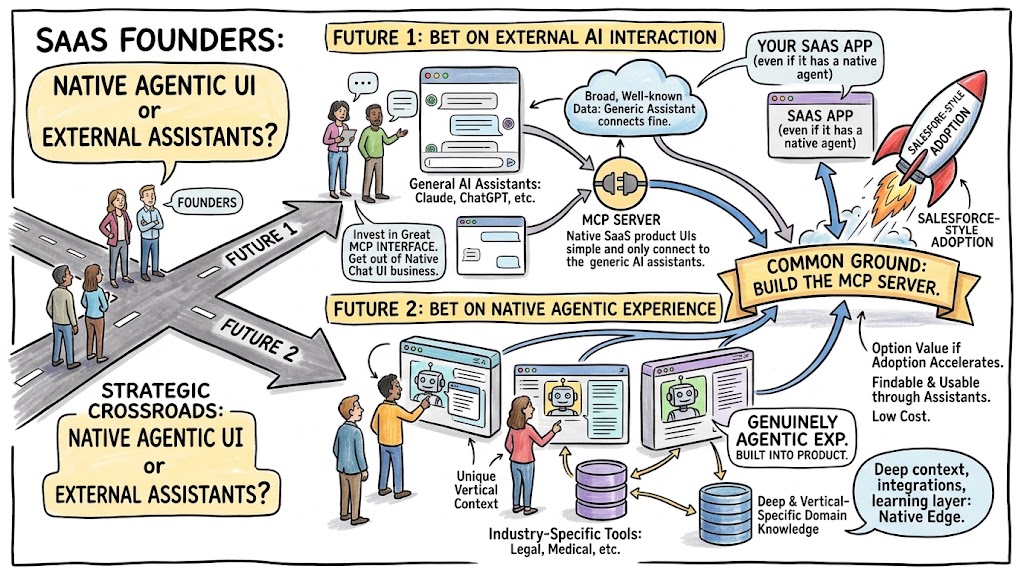
The more interesting debate in the room wasn't whether to build an MCP server. Most of the founders who'd already shipped one agreed that's a relatively low lift and worth doing defensively if nothing else. The harder question was whether to also build agentic interfaces directly into your product's UI, versus betting that your users are increasingly going to interact with your tool through whatever general-purpose AI assistant they already use as their daily driver, Claude, ChatGPT, or whatever comes next.
One founder framed it as a bet between two futures. In one, overall AI usage keeps climbing and people mostly interact with their software through a general frontier model, which argues for investing in a great MCP interface and getting out of the business of building your own chat UI. In the other, industry-specific tools win because they can feed an assistant far more relevant context than a generic assistant would ever have on its own, plus better integrations and a learning layer tuned to that vertical. That argues for a genuinely agentic experience built into your own product.
- If your data is broad and well-known a generic assistant connected via MCP can probably serve your users fine without you building much on top of it.
- If your data is deep and vertical-specific you likely have an edge building your own agentic layer, because you can feed it context and domain knowledge a general assistant simply doesn't have.
- Either way, build the MCP server the cost of being findable and usable through an assistant is low relative to the option value if adoption accelerates the way Salesforce-style usage suggests it might.
What building an MCP server actually costs you
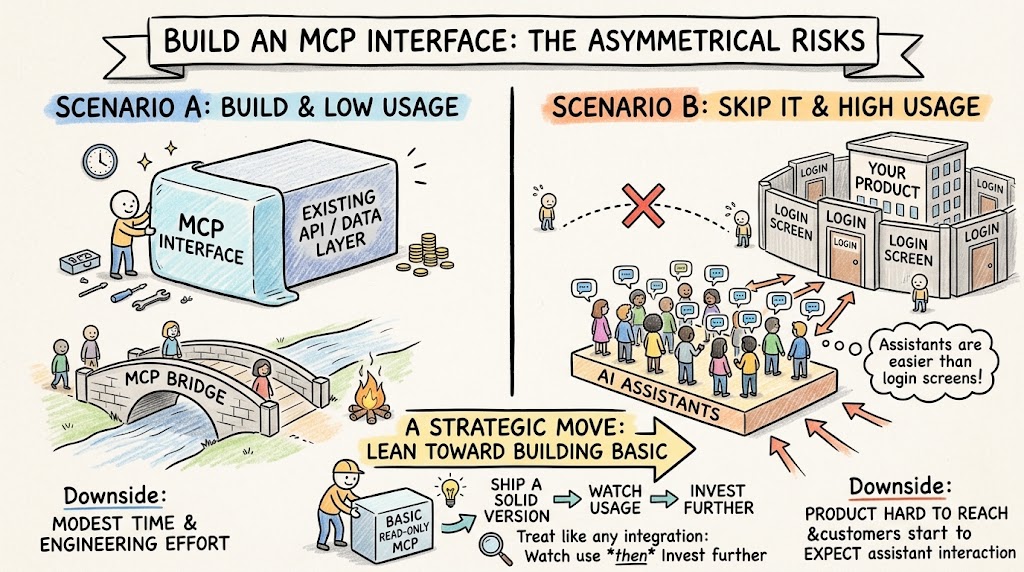
It's worth being honest about the actual investment here, because the founders in the room who'd already shipped one weren't describing a massive engineering project. Most of them had wrapped an MCP interface around an API or a data layer they already had, which is a very different lift than building a new product from scratch. That's part of why the calculus tilts toward building it even when adoption is uncertain. The downside if usage stays low, as it has for the API business seeing under one percent of traffic through MCP, is a modest amount of engineering time. The downside if you skip it entirely and adoption accelerates the way the Salesforce example suggests it might is that your product becomes harder to reach at exactly the moment your customers start expecting to work through an assistant instead of a login screen.
That asymmetry is why I'd lean toward building a basic MCP interface even for a founder who's skeptical about near-term usage. Start read-only, the way the marketing platform founder in the group did, and treat it the same way you'd treat any other integration or API surface: ship a solid version, then watch what people actually try to do with it before investing further.
My take
Given the traffic numbers we saw, from under one percent to reportedly north of eighty percent depending on the product, I don't think there's a single right answer to whether you should integrate MCP today. What I do think is true is that the businesses seeing real usage all share one thing: their data is genuinely useful to pull into a conversation, and their customers already trust AI assistants enough to work inside them for other parts of their job. If that describes your customer base, get an MCP interface live, even a read-only one, and watch what people actually ask it. That usage data will tell you far more about where to invest next than any prediction about industry-wide adoption timing ever could.
If your customer base looks more like the hospitality example, where the tech is understood in theory but nobody's searching for it yet, there's no harm in building the plumbing now so you're ready. Just don't expect it to move the needle on usage or revenue this year. Get the foundation in place, keep shipping the product improvements your customers are actually asking for, and let the adoption curve tell you when to lean in harder.