Should I Amortize or Expense my R&D Costs?
A recent US tax law change lets SaaS companies expense R&D immediately instead of capitalizing it, but GAAP still requires amortization. Here's how founders in our enterprise mastermind are thinking about which path to take, especially heading into a sale.

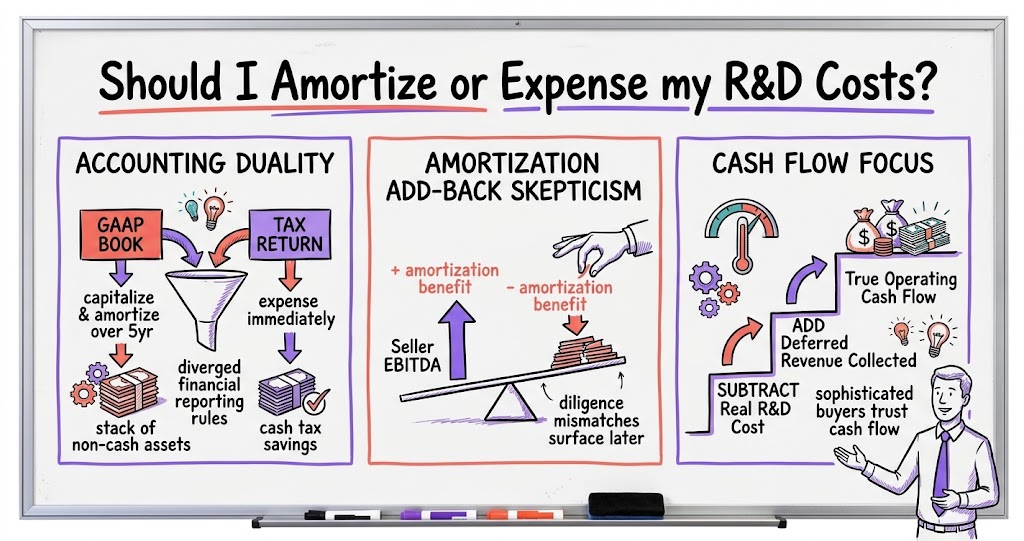
This question came up as a quick side note in a conversation about EBITDA multiples, and it turned into one of the more detailed accounting debates we've had in this group. The question was simple: when you're calculating EBITDA, or presenting it to a buyer or investor, do you capitalize your software development costs and amortize them over time, or do you expense them as you incur them? The honest answer is that it depends on which set of books you're showing someone, and that's exactly the kind of thing that can quietly move your valuation by a lot more than founders expect.
What GAAP requires versus what the tax code now allows
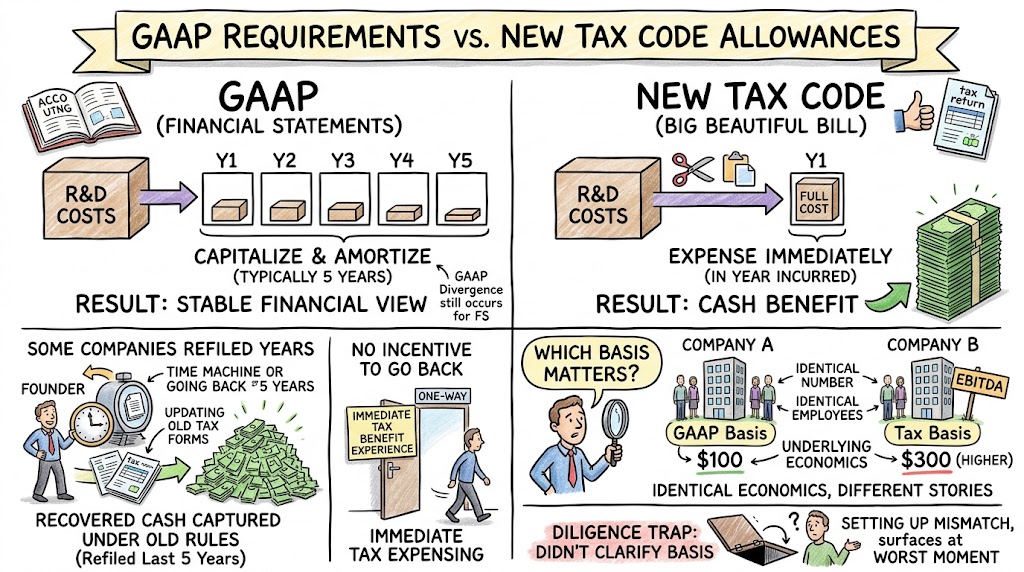
Under US GAAP, development costs are generally required to be capitalized and then amortized over time, typically five years. That's been the standard accounting treatment for a long time, and if you're a company that follows GAAP for your financial statements, you've likely been doing this whether or not it felt like the right economic picture of the business. A recent piece of federal tax legislation, the one people in the group have been calling the big beautiful bill, changed the picture on the tax side. It now allows companies to expense R&D costs immediately in the year they're incurred, rather than capitalizing and amortizing them, for tax purposes.
- GAAP accounting and tax accounting can now diverge. GAAP still generally requires capitalization for your financial statements, while your tax return can expense the same costs immediately.
- Some companies refiled years of tax returns. One founder in the group described refiling the last five years of R&D expenses to recover cash that had been sitting capitalized on the tax side under the old rules.
- That founder doesn't expect to go back. Once you've experienced the cash benefit of immediate expensing on your tax return, there's little incentive to voluntarily capitalize again for tax purposes.
- Which basis you're showing someone matters. A buyer or investor asking about your EBITDA needs to know whether they're looking at your tax basis or your GAAP basis, because the two can tell noticeably different stories.
That last point is the one that trips people up. Two companies with identical underlying economics can show very different EBITDA numbers depending on which basis they're presenting and how consistently they apply it. If you don't clarify which one you're using in a conversation with a buyer, you're setting up a mismatch that surfaces later in diligence, usually at the worst possible moment.
What happens when a buyer strips the amortization add-back
Here's where this stops being a theoretical accounting question and starts affecting real valuations. Imagine a company that capitalizes its development costs and amortizes them, and reports EBITDA that includes adding that amortization back, a fairly standard practice since amortization is a non-cash expense. A prospective buyer can choose not to accept that add-back. If they instead treat the underlying development spend as a real, ongoing cost of running the business and pull the amortization benefit back out of EBITDA, the resulting number can be dramatically smaller. A company reporting something like $750,000 in EBITDA under the standard add-back treatment could see that cut to $350,000 or less once a skeptical buyer normalizes it their way, and since EBITDA multiples compound off that base number, the swing in valuation can be enormous, in some cases cutting it roughly in half.
This isn't a hypothetical buyers dream up to lowball you either. It reflects a real school of thought among sophisticated acquirers and investors, some of whom described the capitalize-and-add-back approach as something they'd simply reverse out mentally whenever they're valuing a business, regardless of what the seller's financial statements show. If your investors already think this way, you can be fairly confident a future acquirer will too.
Why buyers increasingly look past EBITDA to cash flow
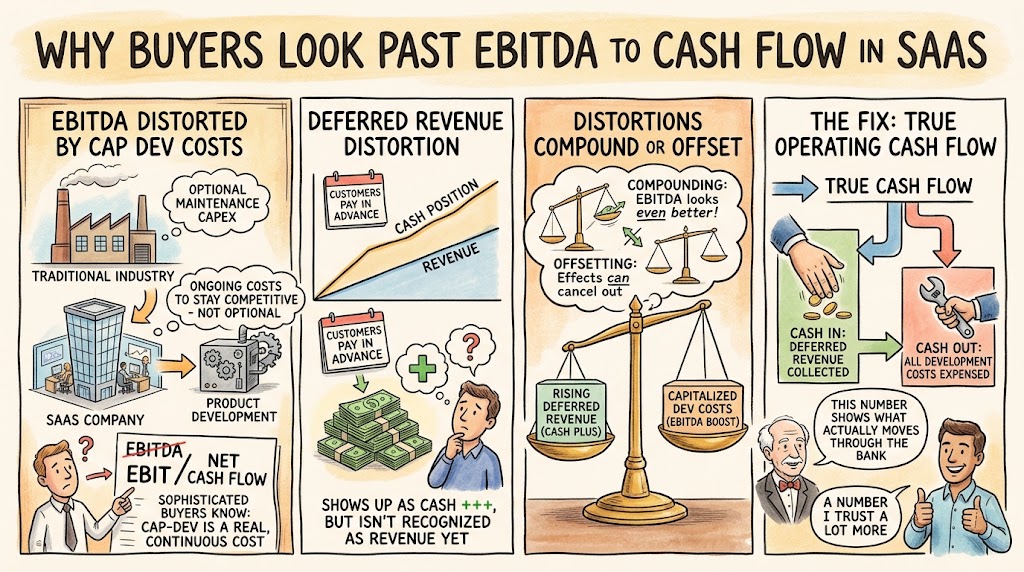
The deeper reason this debate exists is that EBITDA, as a metric, was never designed to capture software development economics cleanly. For a SaaS company, ongoing product development isn't optional maintenance capex the way a factory upgrade might be. It's closer to a continuous cost of staying competitive. Sophisticated buyers know this, which is why many of them look past EBITDA entirely and focus on EBIT, or better yet, actual net cash flow: how much cash genuinely lands in the bank account each year after every real cost is accounted for.
- Deferred revenue can distort the picture too, in the other direction. If you've had strong growth in deferred revenue, meaning customers paying you in advance, that shows up as a real plus in your cash position, even though it isn't recognized as revenue yet.
- The two distortions can offset or compound. A company with rising deferred revenue and capitalized development costs might look healthier or unhealthier on cash flow than its EBITDA suggests, depending on which direction each effect is pulling.
- The fix is presenting true operating cash flow directly. Rather than relying on EBITDA and its add-backs to tell the story, walk a buyer through the actual cash coming in from deferred revenue and the actual cash going out for development, so there's no ambiguity about what's real.
One CPA in the group put it plainly: if you're capitalizing development costs and you want to show someone true cash flow from operations, you need to add back the deferred revenue collected and expense the development costs you'd otherwise be capitalizing, so the number reflects what actually moved through the bank account. That's more work than pointing to a single EBITDA line, but it's a number a sophisticated buyer will trust a lot more.
How this plays out differently depending on your ownership structure
The right answer also shifts depending on who you're accountable to day to day. A few founders in the group who run companies with more conservative, value-oriented investors said their backers essentially treat the whole capitalize-versus-expense debate as noise. Their investors described themselves as thinking like old-school value investors, the kind who care about what a business actually generates in cash over time, not how a particular accounting election makes a single year's EBITDA look. To them, capitalizing development costs to inflate a near-term EBITDA number reads as close to gaming the metric, and they'd mentally reverse it out of any valuation conversation whether or not the company presented it that way.
- If your investors already think this way, match their lens. Presenting a capitalized, add-back-heavy EBITDA to a board or investor group that already discounts it mentally just costs you credibility for no benefit.
- If your board pushed you toward capitalizing to raise reported EBITDA, revisit that decision now that a buyer conversation is closer. What looked advantageous internally can become a liability once an outside party is scrutinizing the number.
- Restating history is expensive and slow. Reversing a capitalization policy typically means restating five years of financials, since that's the standard amortization window, so this isn't a decision to make lightly or change back and forth on.
One founder in the group had been capitalizing engineering costs to boost EBITDA on the assumption that a higher reported number would be more attractive to future acquirers. After hearing how other members' buyers had treated the same practice, that founder was reconsidering the assumption entirely. It's a good example of how a policy that seems purely mechanical can actually be a strategic choice about who you're trying to look credible to, and it's worth revisiting periodically rather than treating it as a decision you made once and never touch again.
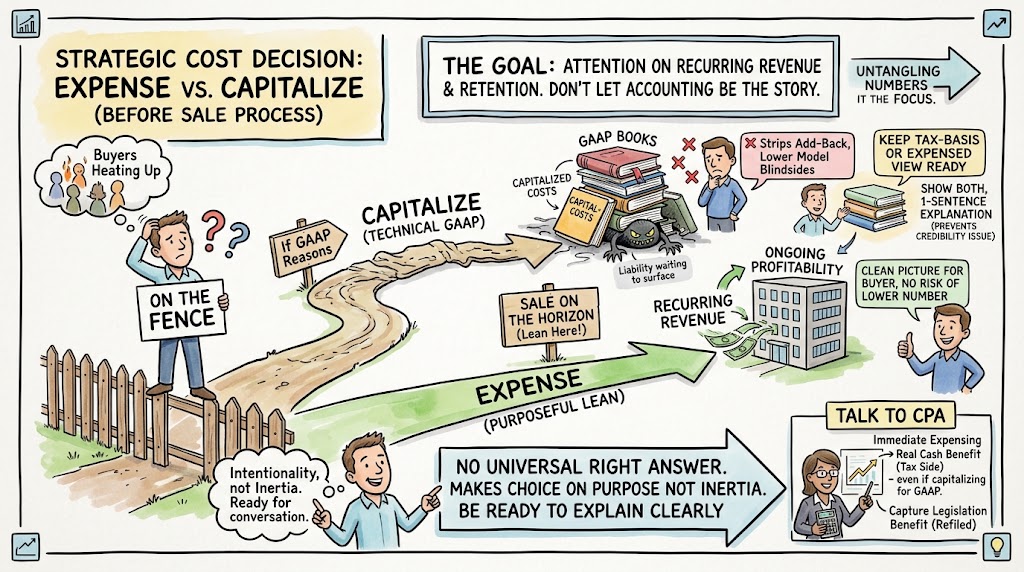
Deciding which way to go before you're in a process
One founder in the group described being on the fence about capitalizing development costs for the first time this year, right as conversations with potential buyers were starting to heat up. His read, and it's a reasonable one, was that if he were on the buy side, he'd want everything expensed, because a capitalized cost sitting on the books looks like a liability waiting to surface later, not a clean picture of ongoing profitability. That's a useful frame for making this decision: think about how the number will look to the specific audience you're about to show it to, rather than defaulting to whichever treatment is technically permissible.
- If a sale process is on the horizon, lean toward expensing. It removes the risk that a buyer strips your add-back and blindsides you with a lower number than you'd modeled.
- If you do capitalize for GAAP reasons, keep a clean tax-basis or expensed view ready. Being able to show both cleanly, and to explain the difference in one sentence, prevents the conversation from becoming a credibility issue.
- Don't let the accounting policy become the story. The goal is for a buyer's attention to land on the strength of your recurring revenue and retention, not on untangling which of your two sets of numbers to believe.
- Talk to your CPA about the tax law change specifically. Immediate expensing under the recent legislation is a real cash benefit on the tax side even if you keep capitalizing for GAAP, and several founders in the group had already refiled to capture it.
There's no universally right answer here, because the right treatment depends on where you are in your company's life and what conversation you're about to walk into. What matters is making the choice on purpose instead of by accounting inertia, and being ready to explain it clearly the moment someone on the other side of the table asks.