
Setting Next Year's Marketing Budget When Your Buyers Won't Take Cold Calls
How one founder is sorting trade shows by payback speed, trimming sponsorships, and funding a new market segment, plus a simple framework for building your own marketing budget.

Budget season is the part of the year when a founder finds out what the company really believes. Every line item has to justify itself against the others, and the question at the bottom of the spreadsheet is a blunt one: will there be any money left at the end of all this? One founder in our mastermind is working through that right now. His target is to lock the budget by the end of next week, and most of his effort is going into marketing, where he is deciding what to cut, what to trim, and where to put the savings.
His situation is unusual in an interesting way. He sells to government and law enforcement buyers, a market where you can't cold call into the accounts. That constraint shapes everything, and it makes his approach a good case study for any founder whose buyers are hard to reach directly.
Start With the Channels You Can't Skip
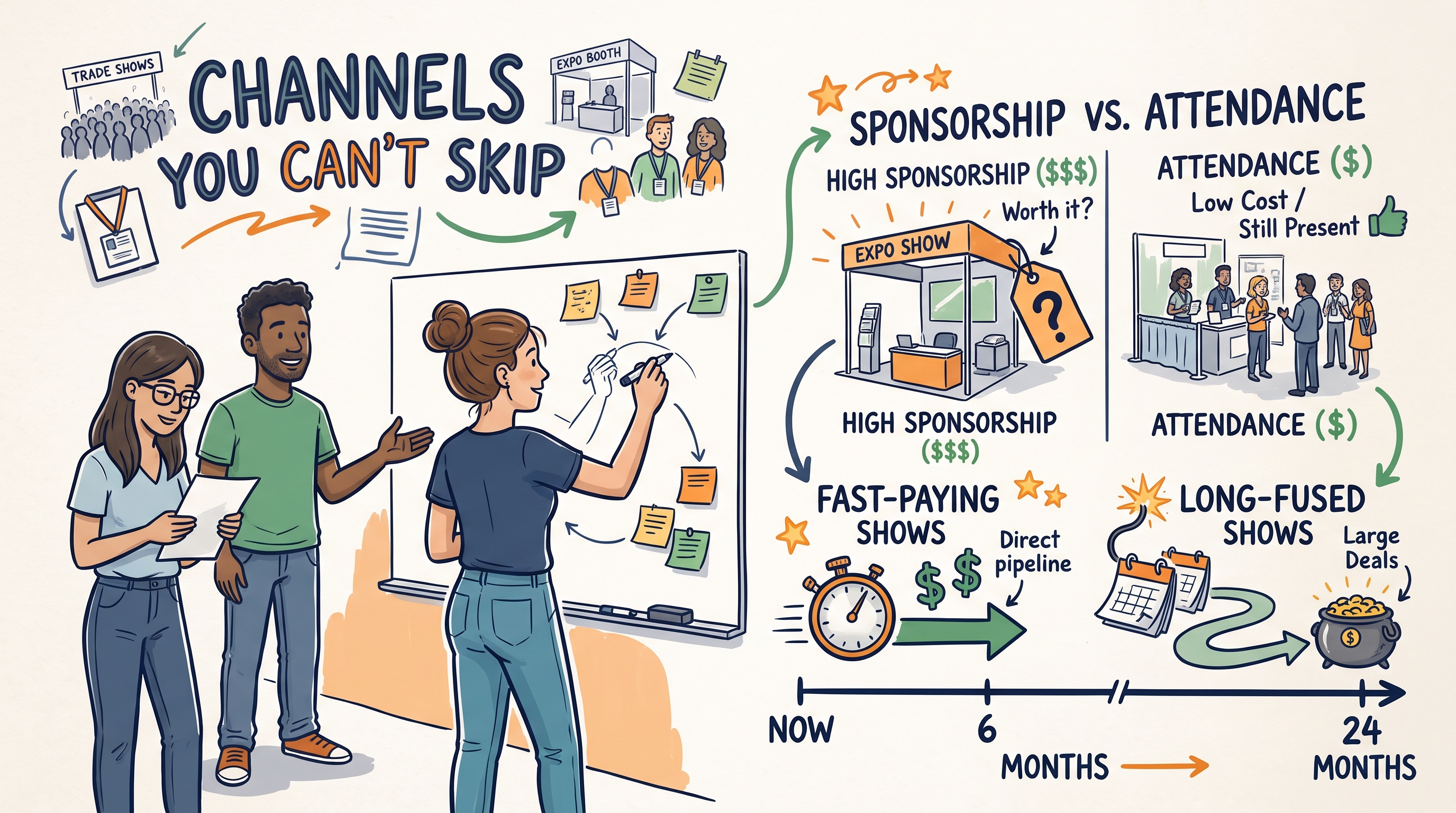
For his core market, most leads come from trade shows. Since he can't cold call into these organizations, being physically present at the events where buyers gather is the best available way to start a conversation. Over the past few months he ran an extensive study of every show he attends, and his team reviewed the results channel by channel in a marketing meeting. What came out of it is a clear sorting of events into those that perform well and those that are long-fused, with some deals taking as long as 24 months to produce anything from a lead.
- Fast-paying shows. Events where leads turn into pipeline within a normal sales cycle.
- Long-fused shows. Events that feed large deals but may take up to 24 months to show results.
- Sponsorship level. Some shows have been supported at a high sponsorship tier, and that level may no longer be justified.
- Attendance vs. sponsorship. You can often keep a presence at a show while spending much less than a headline sponsor.
The key insight is that a single ROI number for trade shows hides the timing. A show that pays back in six months and one that pays back in 24 should not be compared on the same calendar, and the budget should reflect when each one is expected to produce revenue.
Trim Where the Return Is Weakest
Having sorted the events, he's taking a practical next step: reducing the sponsorship level at some of the shows where the company had been a major sponsor. The money doesn't disappear. It gets reallocated to sectors where the company hasn't been spending enough. That's the right way to think about trimming, because a cut with no destination is just a smaller budget, while a reallocation is a decision about where growth will come from.
When I asked him what channel is working best for customer acquisition this year, the answer was trade shows, and it has been historically, since the vast majority of his revenue comes through government and law enforcement. That tells me he's not abandoning what works. He is moving the marginal dollar, not the whole budget.
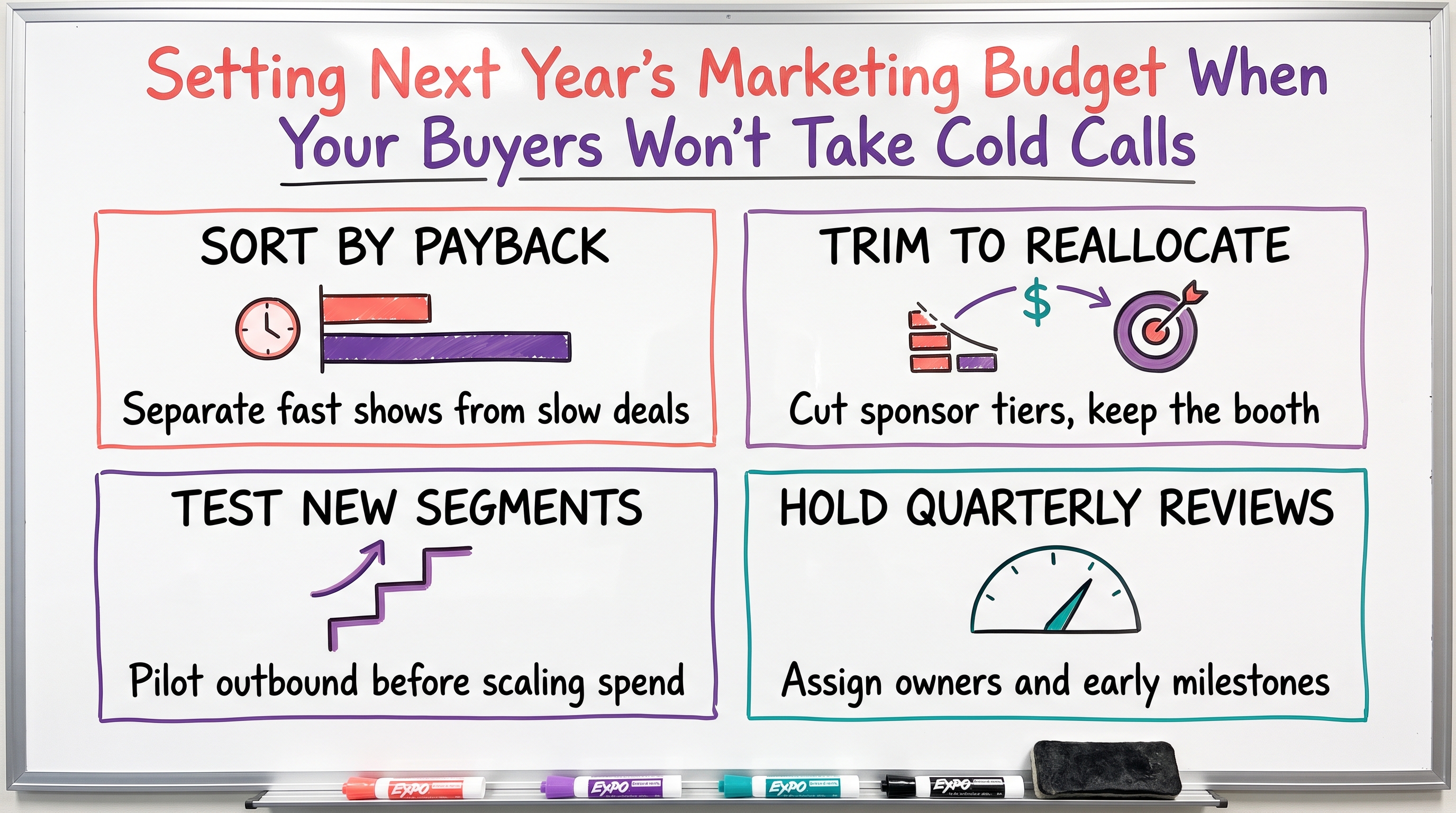
- Rank every program by payback time. Put fast and slow programs in separate columns.
- Cut sponsorship before attendance. The booth and the meetings often matter more than the logo placement.
- Name the destination for every dollar saved. Decide where freed money goes before you cut.
- Protect what's working. Leave your best channel alone unless the data says it has peaked.
Here's some illustrative math, not real data. Suppose a show costs $60,000 as a major sponsor and $25,000 as a standard exhibitor, and the leads you get are about the same either way. Moving down a tier saves $35,000, which could fund a full test of a new channel. Whether the leads really are the same is something you can only know by checking past results, which is why the study matters.
Funding a New Segment
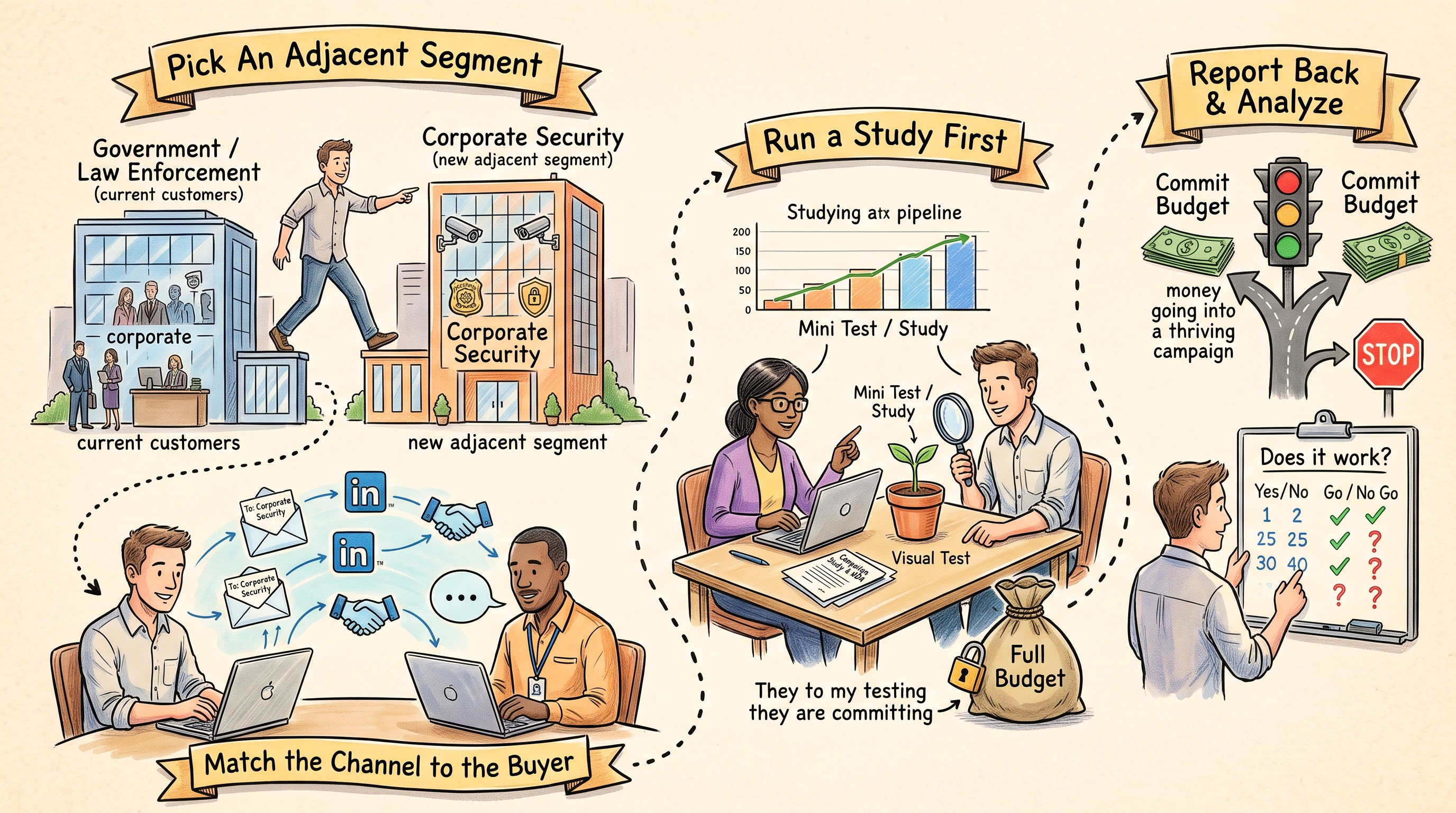
The new destination for his reallocated dollars is a different market: corporate security. It's a natural neighbor to his current customers, and the buyers there are reachable in ways that government buyers are not. Unlike law enforcement, corporate security teams can be approached with outbound email and LinkedIn campaigns. So he is considering shifting money into the kinds of marketing that work in that sector, which he can't use in his core market.
He has already started the process. The week before our conversation, his team held a webinar, then met with a go-to-market specialist who builds AI-driven outbound campaigns. They signed an NDA, and the specialist is now doing a study. The founder is in the initial stages, and he said he'd update the group as it goes. I'm interested in how it turns out, because it's a good example of testing a channel before committing the full budget to it.
- Pick an adjacent segment. Buyers who look like your current customers are easier to understand and sell to.
- Match the channel to the buyer. Outbound works where cold outreach is accepted, and trade shows work where it isn't.
- Run a study first. A short engagement to design and test a campaign costs far less than a full-year commitment.
- Report back to yourself. Define in advance what results will justify more spending.
I like this approach because it answers the main risk of reallocation, which is putting real money behind a hunch. A study with an outside specialist turns a hunch into a plan, and gives you a way to say no if the numbers don't show up.
The Operational Side of Budgeting
There's also a finance question underneath all of this. The point of the exercise, he explained, is to project revenue and expenses accurately, so the team can see how much room is left at the end. Marketing is only one input. Hiring, software, and other costs all compete for the same dollars. One category that has grown quickly across our group is AI tools, which range from a few hundred dollars a month to several thousand depending on the team, and they belong in the same spreadsheet as everything else.
- Project revenue conservatively. Use the numbers you'd be comfortable explaining to your board.
- Treat AI spend as a real line item. Review it monthly, since usage can change quickly.
- Keep a contingency. Hold back a percentage for opportunities and surprises.
- Review quarterly. A budget set once a year is stale by spring.
Questions to Ask Before You Commit Dollars
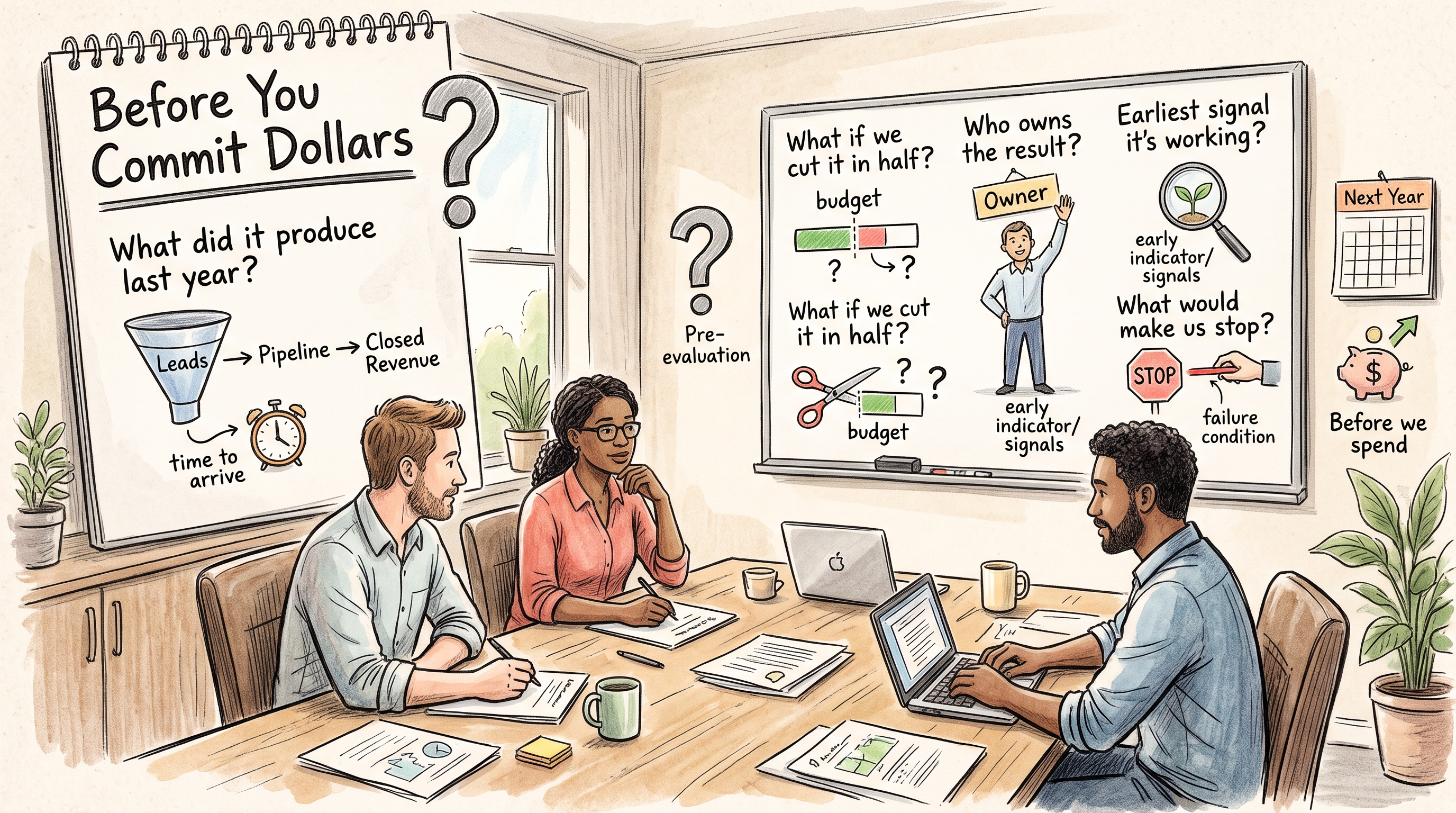
A budget meeting goes better when everyone brings the same questions. Before any program gets funded for next year, I'd ask the team to answer a short list in writing, because writing forces clear thinking and exposes the programs that survive only on habit. This matters most for the long-fused channels, where the results arrive so late that it's easy to keep funding something for years without anyone checking whether it's still working.
- What did this program produce last year? Count leads, pipeline, and closed revenue, and note how long each took to arrive.
- What would we lose if we cut it in half? If the honest answer is very little, you've found savings.
- Who owns the result? Every line item needs one person accountable for what it returns.
- What is the earliest signal that it's working? For slow programs, pick an early indicator, such as qualified meetings, so you aren't waiting two years to find out.
- What would make us stop? Define the failure condition before you start spending.
These questions are simple, but they change the conversation from defending last year's plan to deciding what the company should believe next year. They also make it much easier to explain your choices to a board, an investor, or a partner who asks why a familiar program was cut.
A Simple Framework for Your Own Budget
If you're about to set your own marketing budget, I'd use what this founder did as a template. It doesn't take a large team, and the steps can be done in a week. The study itself, channel by channel with outcomes tracked, is what lets him make confident cuts.
- Step 1: Audit every channel. List cost, leads, pipeline, and revenue for the last 12 months.
- Step 2: Sort by payback time. Separate quick returns from long-fused programs.
- Step 3: Trim the weakest tier. Reduce spend where results don't justify the level.
- Step 4: Reallocate on purpose. Pick a segment or channel for the savings.
- Step 5: Test before scaling. Run a small, measured pilot and set success criteria in advance.
Budgets are a statement about priorities. The founders who get the most from them are the ones who check last year's results honestly, move money from weaker bets to stronger ones, and test new ideas in small steps before scaling. Do that work this week, and you'll walk into next year knowing what each dollar is supposed to do.