
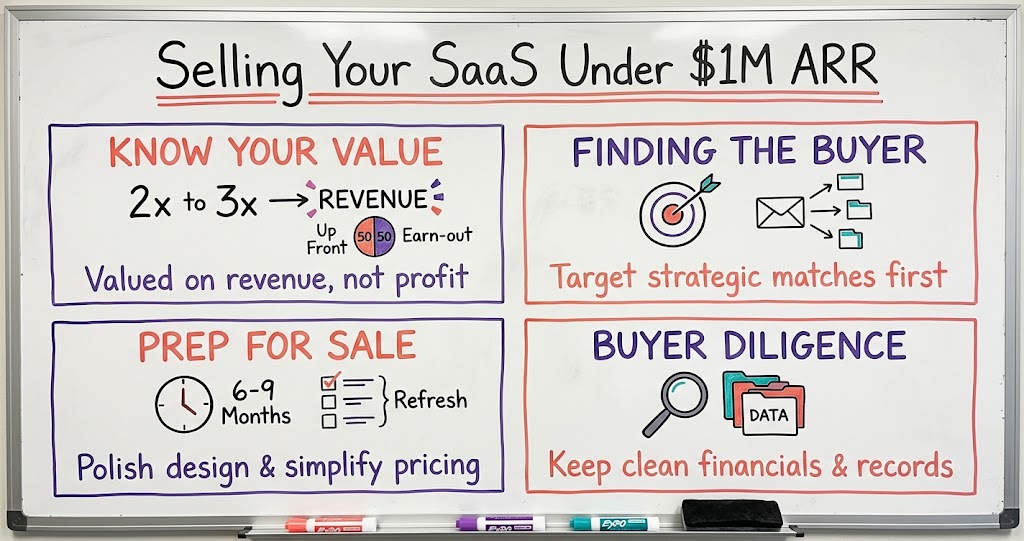
Selling Your SaaS Under $1M ARR
Buyers keep telling small SaaS founders to call back at $1M ARR, but a sale below that line is realistic. Here is what a smaller company can fetch, where to find buyers, and how to get diligence-ready first.

I had a one-on-one call this week with a founder who has been building his company for well over a decade. He is tired, he has a product he is proud of, and he wants out. Over the last couple of years, he has received a couple dozen inbound inquiries from people interested in buying him, and every one of them ended the same way: call me when you are at a million dollars in ARR. He has taken that to mean that nobody will touch a company his size, and he asked me whether he was dreaming to think a sale was possible.
I told him that I think it is a false assumption that you can't sell. The buyers who filter on a million in ARR are usually financial buyers with a fixed screen, and they are only one part of the market. A company under that line has several realistic routes to an exit, and this post covers what they look like, how to find the right buyer, and what to fix before you start.
What a company this size is actually worth
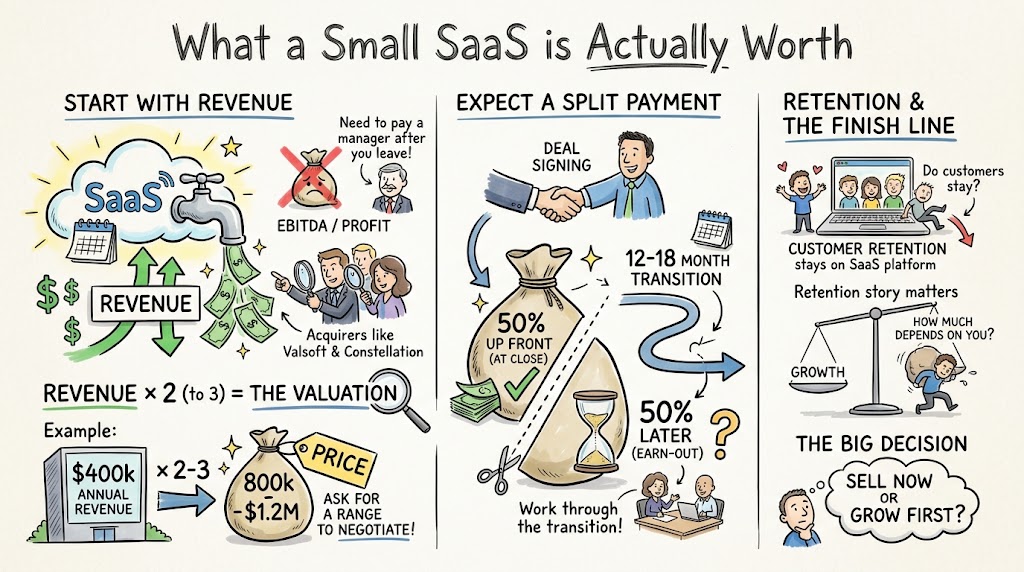
For a small SaaS business, the number to start with is revenue, not EBITDA. Most of the profit in a company this size goes to the founder, and a buyer will need to pay a manager to run it after you leave, so profit-based valuations tend to be small and not very meaningful. The acquirers that specialize in buying small software companies, such as Valsoft and Constellation Software, are known for paying around two times revenue.
As an illustration, a company with $400,000 in annual revenue would be looking at something in the neighborhood of $800,000 at two times revenue, and you might ask for two to three times to leave room to negotiate. The payment terms matter as much as the headline number. A common structure is half up front and half 12 to 18 months later, so part of the price is an earn-out that depends on the business holding together after the sale.
- Start with revenue multiples. Around two times revenue is a sensible planning number for a small, steady SaaS company.
- Ask for a range. Quote two to three times so there is room to land at two.
- Expect a split payment. Half at close and half a year or so later is common, which means you will likely work with the buyer through the transition.
- Plan for an earn-out. Part of what you get paid depends on customers staying, so your retention story matters.
These numbers aren't a promise, and your own result will depend on your growth, your customer base and how much of the business depends on you. Even so, knowing the likely range helps you decide whether a sale now is acceptable or whether you want to work on the business first.
Two ways to find a buyer
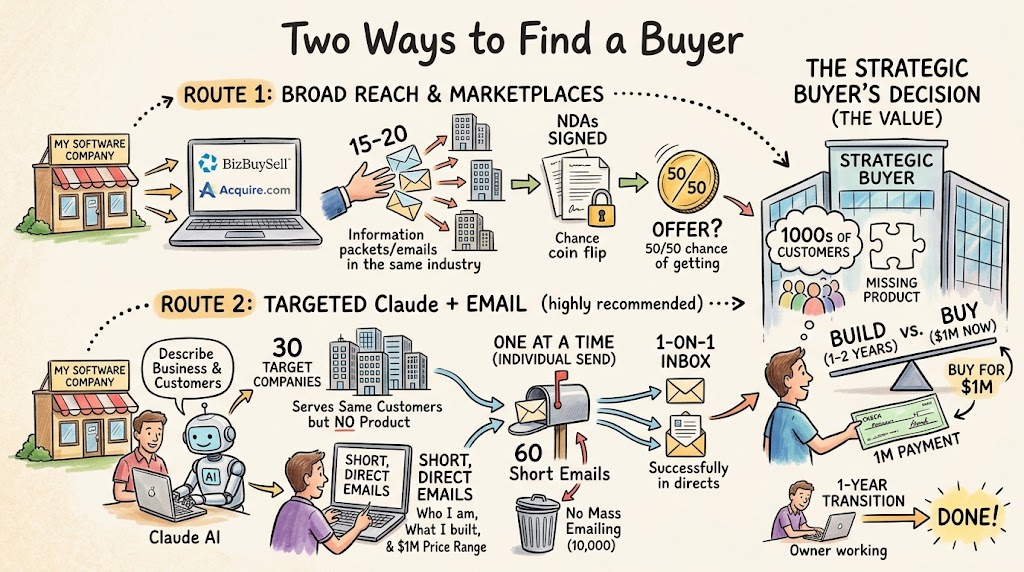
The first route is to list the company on a marketplace such as BizBuySell or Acquire.com, and to reach out directly to companies in your industry. You send information to 15 or 20 of them, get NDAs signed, and see who responds. I would put your chance of getting an offer from that process at about 50/50, which is good enough to be worth a try. You can also go straight to the acquirers who buy small software companies and tell them what you have and what you would sell it for.
The second route is more targeted, and it tends to produce better offers. You use Claude to build a list of about 30 companies that already serve the same customers you do but don't offer what you sell. You then write to a few people at each one individually, which comes to roughly 60 short emails sent one at a time. This is not the place to send 10,000 messages through a mass-mailing tool.
- Describe your business to Claude. Give it your profile, your customer base and the kind of strategic buyer you are looking for.
- Ask for 30 target companies. These should be firms with an existing customer base that would benefit from your product but don't have it yet.
- Write short, direct emails. Say who you are, what you built, what you are doing with it and the price range you have in mind.
- Send them one at a time. Connect Claude to your email so each note goes out individually and lands in the inbox.
The case you are making to a strategic buyer is simple. They already have thousands of customers, they don't have your product, and building it themselves would take a year or two. If paying around a million dollars gets them there faster, that is an easy decision, because even a modest cross-sell to their existing customers can be worth far more than the price. You work for them for a year, collect the second half of the payment, and you are done.
If you have six to nine months, here is how I would use them
The founder I spoke with said he still has a year of energy left, and I told him that changes the answer. If you are not ready to leave today, you can spend the next six months improving the things a buyer will pay for. Two things stood out to me when I looked at his situation.
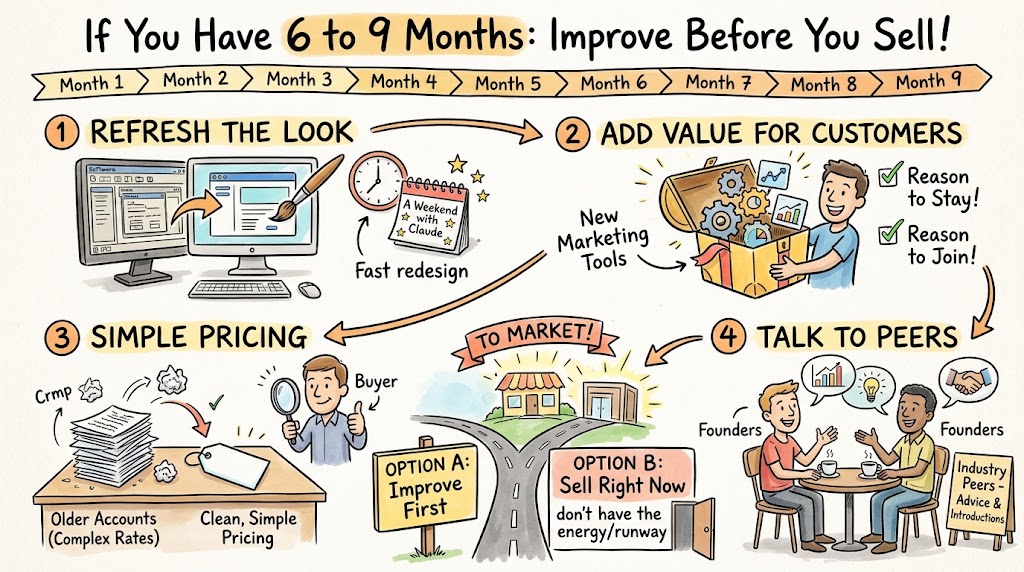
The first is the interface. If you haven't refreshed the design of your product in two years, an AI design tool can redo it quickly. I would plan for about an hour for the initial build and six to eight hours of quality checking across the site, which adds up to a weekend of work at most. He told me that customers already say his product is the most intuitive one they have used, so this may matter less for him, but a more polished product never hurts in a sale.
- Refresh the look of the product. A weekend with Claude can modernize the interface across the whole app.
- Add value for customers. He is considering built-in marketing tools that use the customer data he already holds, which would give existing customers a reason to stay and new ones a reason to join.
- Make pricing simple. Older accounts that pay far more than current rates make it hard to publish clean pricing, and a buyer will notice that.
- Talk to peers in your industry. Founders who sell into the same customers can give you advice about the market and sometimes introductions.
None of this is required, and some of it may not move the number. The point is that if you have the energy and the runway, you can improve the business before going to market, and if you don't, the sale route we discussed above is available right now.
What buyers look at once they take you seriously
Our mastermind calls this week covered the next stage of this process. Several founders are thinking about a sale or a capital raise next year, and the conversation turned to what buyers pay attention to. One founder who has been talking to private equity firms said they all put a high value on EBITDA. He had invested heavily in AI development and customer support, found his EBITDA was thin as a result, and began a restructuring to bring operating costs down before going to market.
Revenue mix matters too. One member who splits first-year revenue about evenly between subscription and implementation work was told that implementation revenue is valued differently, and that he might be doing himself a disservice by not shifting more of the dollars into recurring revenue. The same advice covered expansion, since for enterprise customers, the strongest net revenue retention is often in the range of 120% to 130%, and it is usually easier to get an extra dollar from an existing customer than from a new one.
- Maximize EBITDA in the last couple of years. Show the buyer which expenses disappear after the sale, such as arrangements that exist only because you own the company.
- Value recurring revenue. Move work from one-time services into subscription revenue where you can.
- Prove expansion. A buyer wants to see customers paying more over time, ideally with net retention above 100%.
- Get diligence-ready early. That means clean financials, so one founder is hiring an experienced controller whose first job is to get the company ready.
Diligence readiness also means being organized in a way that is boring and useful. One member keeps a strict file structure for vendor files, payments, employee agreements and customer agreements, and he insists that every special quote written for a customer goes into the system, even if the customer never accepts it. On the technical side, he archives his code and documents every third-party vendor and what each one does. His document storage is locked down so nothing can be moved or deleted by accident. A buyer who sees that will trust the numbers a great deal more.
Decide if you are done
When the founder asked me whether he was dreaming, I told him it was time for a conversation with his soul. As I put it to him, you just have to decide if you're done or not. If you are done, you can sell now at about two times revenue, take half up front, and be finished within a year or so. If you have more energy, you can spend six to nine months building the business and then sell for more.
It is worth keeping the broader picture in mind too. In our community we have seen about 18 exits over the last three years, and only two of them crossed nine figures. The realistic outcomes in this range look like the ones in this post, which are solid sales of businesses that someone else can grow. If that sounds like a good result for you, it may be closer than you think.