
SaasRise Mastermind Recap - September 2, 2026
The SaasRise Mastermind meetings on September 2, 2026 featured discussions among SaaS CEOs and founders on these topics.

⚙️ Company Overview & Capabilities
Challenges: Communicating highly ambitious claims (e.g., completing 1–2 years of development work in 1–2 weeks) without triggering skepticism.
Advice: Maintain outcome-focused messaging but add a high-level explanation of how the process works — not deep technical detail, but enough to reduce doubt.
🔗 Channel Enablement
Challenges: The model sounds similar to a simple affiliate program, which may undersell its true depth (e.g., white-label options, tiered discounts).
Advice: Clarify the distinction from affiliate models while keeping the explanation accessible at a high level.
💰 Usage-Based Billing
Challenges: Customers may not immediately understand the value of metering or how it protects them from cost overruns.
Advice: Use concrete examples (e.g., "2 cents per minute") to make the concept tangible.
🧱 Millionaire vs. Billionaire SaaS Thinking
Challenges: A founder in the "millionaire thinking" model (rich feature sets, responsive to loyal customers) wants to shift to "billionaire thinking" (minimal self-service, value pricing at scale) to compete with lower-priced competitors ("ankle biters") in the review management/listings space.
Advice:
- This shift implies a significant architectural change — different team skills, metrics, and culture.
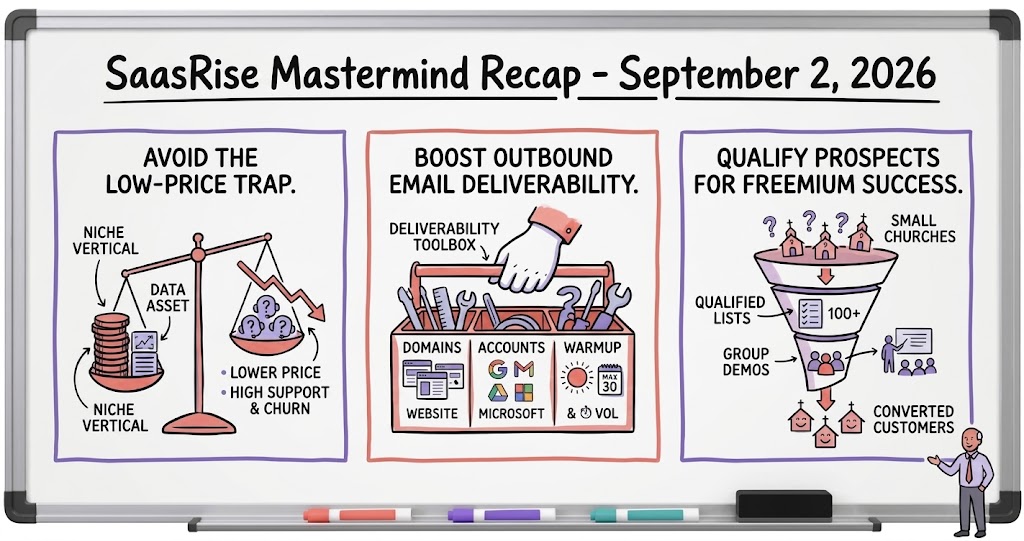
- Risk of a "race to the bottom" on pricing; lowest-paying customers often demand the most support and churn fastest.
- Consider monetizing existing data assets (e.g., selling aggregated review data to private equity or growth-focused businesses) as an alternative.
- Distribution and brand are increasingly valuable as software commoditizes; a lower-priced tier could expand distribution.
- Sub-branding a cheaper plan (rather than a new brand) could avoid white-label conflicts.
- Niching by industry vertical and charging more may outperform a race-to-the-bottom strategy.
🎯 Freemium Model for a Church Community SaaS (SocialGlow)
Challenges: Small churches dominate the funnel but lack the member density, tech adoption, and budget to convert; demo no-shows are high; founder is splitting attention between two businesses.
Advice:
- Freemium works best in very large markets; conversion and churn can be problematic.
- Use group demos (capped at 5) to reduce no-show impact.
- Explore sponsorship/tithing models where larger members fund smaller ones.
- Target qualified prospects via better ad segmentation and separate conversion events for qualified vs. unqualified leads.
- Build a targeted list filtering for churches with 100+ members.
- Avoid feature-chasing; focus on the core problem being solved.
📬 Outbound Email Deliverability (Instantly)
Challenges: Campaigns get blocked quickly due to high bounce rates; email infrastructure built on hosting-provider accounts.
Advice:
- Use Google or Microsoft email accounts — hosting-provider emails severely hurt deliverability.
- Use separate domains from the main business domain to protect brand reputation.
- Verify email lists with a dedicated tool (e.g., Rion) before importing to Instantly.
- Warm up inboxes for 30 days before sending; keep volume at max 30 emails/day per inbox.
- Consider alternatives like Smartlead, Lemlist, Apollo, or Reply.io if issues persist.
🛠️ UI/UX Testing Tools
Challenges: Users sometimes make decisions based on visual appeal rather than data quality.
Advice:
- Use Chrome DevTools (Lighthouse) to assess speed and rendering performance.
- Use AI (e.g., Claude) to analyze your website and competitor sites for UX feedback.
- Run informal focus groups with people outside your target audience to observe navigation behavior.
Tools Recommended
AI & Automation
- Claude
Outbound & Lead Generation
- Instantly
- Rion
- Smartlead
- Lemlist
- Apollo
- Reply.io
Analytics & Dashboards
- Chrome DevTools (Lighthouse)
Best Advice
Founders wrestling with pricing and business-model shifts should be wary of racing to the bottom — value pricing at scale requires different team skills, metrics, and culture, and low-paying customers often churn fastest while demanding the most support. Niching by vertical, monetizing existing data assets, and leaning on distribution and brand can outperform a pure price war. For outbound, deliverability comes down to fundamentals: Google or Microsoft inboxes on separate domains, verified lists, a 30-day warmup, and capped daily volume. And when evaluating product decisions, pair data (Lighthouse performance scores, AI-assisted UX analysis) with real user observation rather than relying on visual appeal alone.