
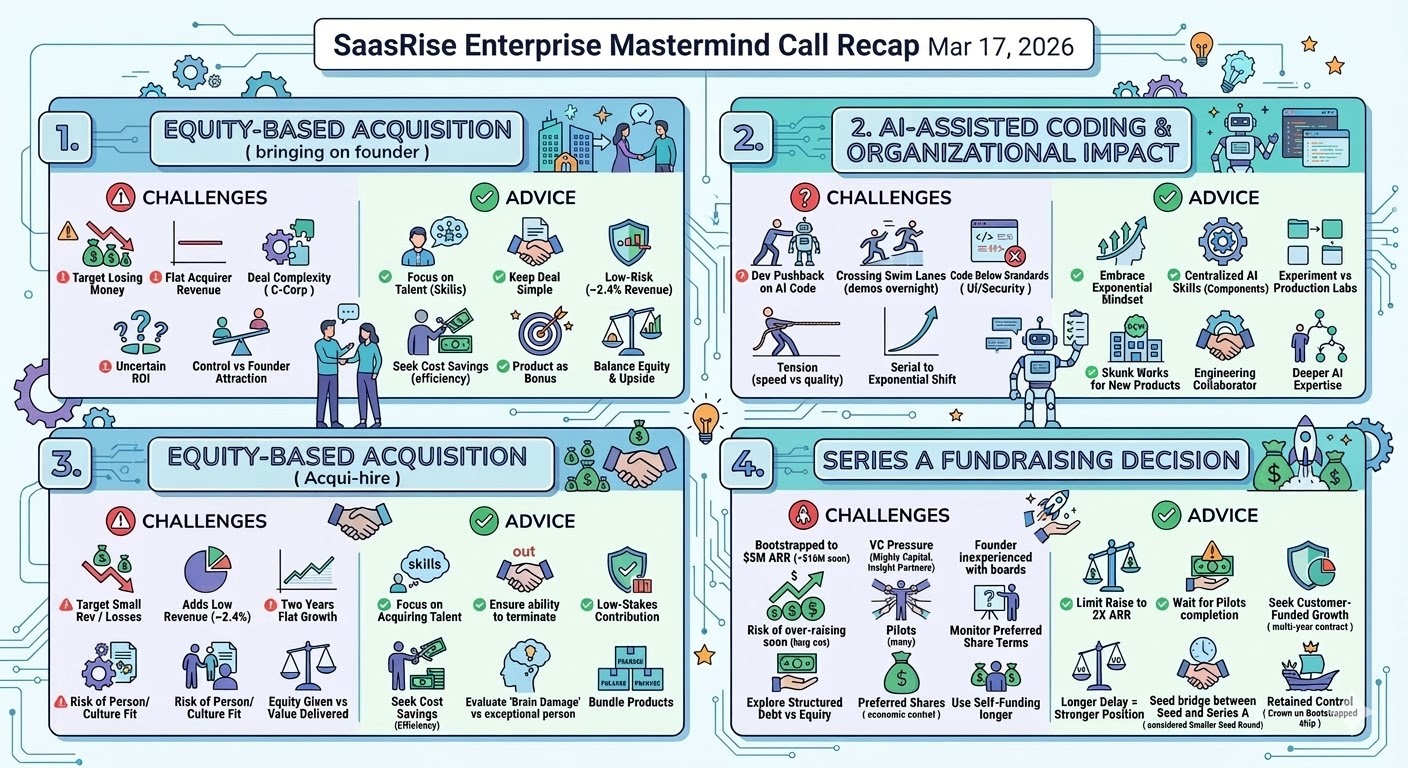
SaasRise Enterprise Mastermind Call Recap Mar 17, 2026
This is what we discussed today in the Enterprise SaaS CEO and Founder Mastermind

Topic 1: Evaluating an equity-based acquisition of a small SaaS company and bringing on its founder
Challenges:
- Target company is losing $5-6K monthly (double its $5-7K revenue) with churn issues
- Acquirer's revenue has been flat at $2.5M for two years
- Deal structure requires converting to C-Corp with formal shares
- Uncertainty about whether the acquisition will deliver expected value
- Need to balance control with attracting the founder
- Risk of adding complexity without clear ROI
Advice:
- Focus on the talent acquisition rather than the product—the founder's skills in product development and cost optimization are the real value
- Keep the deal simple with clear performance expectations and termination ability
- View it as low-risk given the small revenue contribution (~2.4% of current business)
- Leverage the founder's expertise to trim costs and potentially consolidate developers
- Consider the complementary product as a bonus rather than the primary driver
- Ensure the equity structure maintains control while providing meaningful upside for the founder
- Set clear milestones for integration and cost savings within the first 6-12 months
Topic 2: AI-Assisted Coding and Organizational Impact
Challenges:
- Developers pushing back on AI-generated code and prototypes built by non-technical staff
- Crossing traditional swim lanes as sales/product people can now build working demos overnight
- AI-built code not meeting production standards (UI consistency, security, SOC 2 compliance, scalability)
- Tension between speed of prototyping and engineering team's need for supportable, enterprise-grade code
- Managing the shift from serial development (spec → engineering → testing → shipping) to exponential capabilities
Advice:
- Embrace the exponential mindset rather than linear thinking
- Build centralized "skills" (reusable components) for UI, security, and backend standards that everyone uses
- Separate experimental environments from production systems for innovation without risk
- Require engineering review to rebuild prototypes for production while maintaining the speed advantage
- Consider skunk works approach—separate production environments for new products
- Find at least one engineering collaborator who can bridge the gap between prototypes and production
- Focus on making each discipline deeper in their expertise with AI rather than everyone going wide
- Recognize this is a fundamental mindset shift across the entire organization
Topic 3: Equity-Based Acquisition (Acqui-hire)
Challenges:
- Target company generating only $60-84K annually with $5-6K monthly losses
- Would add just 2.4% to current $2.5M revenue
- Flat revenue for past two years raises questions about growth strategy
- Requires converting to C-Corp with formal share structure
- Risk of person/culture fit and potential need to terminate
- Balancing equity given vs. actual value delivered
Advice:
- Focus on acquiring the talent (product expertise) rather than the revenue
- Ensure ability to terminate while maintaining control
- Consider it low-stakes given modest revenue contribution
- Look for cost savings through developer consolidation and operational efficiency
- May not be worth the "brain damage" of legal paperwork for <5% revenue unless the person is truly exceptional
- Bundle products together for better sales positioning
- Keep equity percentage reasonable (mentioned around revenue-based calculation)
Topic 4: Series A Fundraising Decision
Challenges:
- Bootstrapped to $5M ARR with 25 customers, approaching $10M in 6 months
- Pressure from top-tier VCs (Insight Partners, Mighty Capital) to skip seed round and go straight to Series A
- Never raised external capital before; founder inexperienced with boards
- One large enterprise customer (3-year contract) but others still in 6-month pilot phase
- Risk of raising too much too soon and destroying profitable unit economics
- Preferred shares could collapse ownership if valuation decreases
- VC pressure vs. maintaining control and bootstrapped flexibility
- Founder has $7M from previous exit available for self-funding
Advice:
- Don't raise more than 2X ARR to avoid losing control
- Be cautious of raising $10M at current stage—consider waiting for more enterprise customers to complete pilots
- Watch for preferred share structures and dividend/coupon terms that increase VC economic control
- Consider customer-funded growth: negotiate prepayment terms, milestone-based payments, and multi-year commitments
- Explore structured debt against receivables instead of equity
- Use self-funding from previous exit to maintain control longer
- Remember VCs gain leverage when deploying more capital—they're playing portfolio game
- Longer you delay while remaining viable, stronger your negotiating position
- If things go wrong, preferred shares mean VCs could own 70-80% economically despite 20-30% nominal stake
- Consider smaller seed round (10% equity) to bridge 16 months rather than larger Series A now
- Every day bootstrapped is a day of retained control and alignment with customers over investors
Several AI and software development tools were mentioned during the call:
AI Coding & Development:
- Claude/Cloud Code - Used for AI-assisted coding and building prototypes rapidly
- Cursor - Referenced as an AI coding tool
- Gemini whiteboards - Used for visualizing concepts and planning
- ChatGPT - Mentioned for building dashboards and KPIs
Infrastructure & Deployment:
- Cloudflare - Used for sandbox environments
- Supabase - Database solution for prototyping
- GitHub repositories - For open source components and code management
Design & Product:
- Figma - Traditional design tool that teams are moving away from in favor of building UI skills directly in Claude
Development Approach:
The discussion emphasized building "skills" (reusable components) in Claude for various functions like UI standards, security checks, and backend middleware, rather than relying on traditional development workflows. Organizations are creating centralized skill repositories that different teams can use to maintain consistency while enabling faster AI-assisted development.
The overarching theme was the shift from traditional development tools and processes to AI-native workflows, with Claude emerging as the central platform for building, prototyping, and standardizing development work across multiple disciplines.