
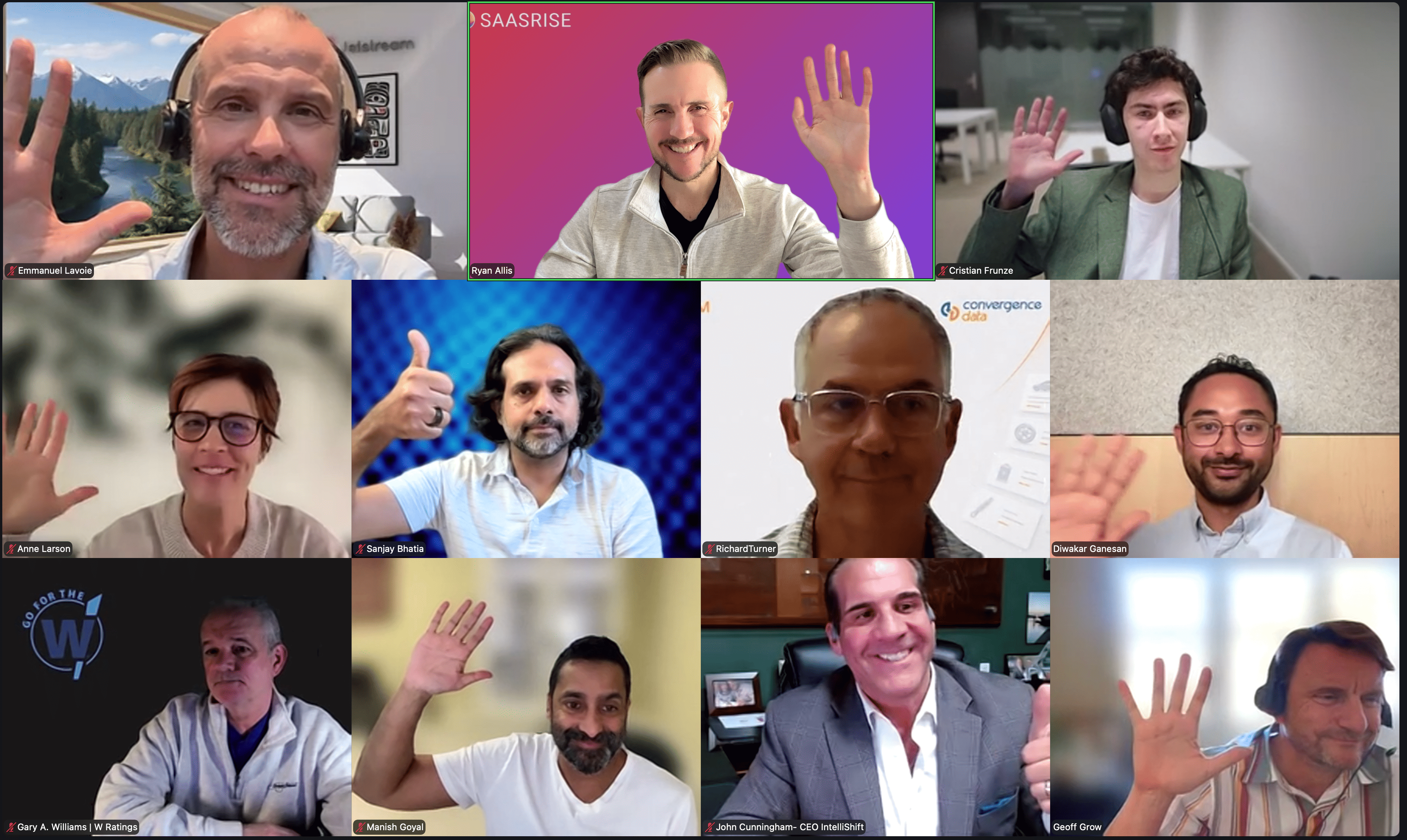
SaasRise CEO Mastermind Recaps for the Week of September 29 - October 1, 2026
This week's SaasRise discussions covered how SaaS leaders are rethinking pricing, using AI across analytics and go-to-market work, and fixing the funnels behind their growth. The conversations focused on contract structure, website recovery, paid acquisition, onboarding, and positioning for an agent-driven future.

💰 Pricing, Contract Length & Entry-Tier Offers
Challenges: Founders are weighing a lower-priced entry solution ($60K vs. $100K) and whether 3-year contracts lengthen the sales cycle. They also worry a discounted tier attracts the wrong clients and that upselling from a low anchor is unrealistic.
Advice: Keep the 3-year term but add a conditional opt-out clause, with setup cost recovery and a 50–75% termination fee if a client exits early. Lower tiers can open the funnel but rarely convert to higher pricing once anchored, so separate self-serve from full-service tiers clearly and protect upper-market pricing with guardrails.
🤖 AI-Powered Data Analysis (Win Share)
Challenges: Disparate data sources made real-time business analysis difficult, and a dedicated data scientist failed to deliver. Leaders need accessible, affordable ways to analyze data without waiting on specialists.
Advice: Connect Claude to data lakes via Power BI MCP for powerful, accessible data science. Complement it with cost-efficient tools like JEV + DuckDB for large dataset analysis, such as 100K rows, at a fraction of the cost (~444× cheaper than alternatives).
💵 Budget Cuts & Preparing for a Business Sale
Challenges: One leader is cutting R&D and marketing spend, including trade shows and headcount, ahead of a potential exit. The goal is to protect team morale and avoid cultural damage along the way.
Advice: Involve the leadership team in the rationale and make cuts that can be rationally explained to staff. Focus messaging on ROI and smart spending rather than hinting at a sale. Actual cuts, not just add-backs, yield better valuation multiples.
🔗 AI Adoption in GTM Teams & Choosing the CRM Stack
Challenges: GTM teams copy-paste into ChatGPT while engineering builds sophisticated AI workflows, and ROI is hard to demo quickly. Meanwhile, members are mid-transition from GoHighLevel or weighing HubSpot, where complex setups get expensive and hard to manage.
Advice: Lead by example with tangible wins such as AI-generated one-pagers and client prototypes, and let champions emerge organically. Consider AI-native CRMs like Lightfield or Monaco, or layer AI onto HubSpot via MCP. Budget for implementation, specialist support, and maintenance, and map existing workflows before migrating.
🔍 Website Rebrand & Traffic Recovery
Challenges: A rebrand launched ~2 months ago cut impressions ~66% and clicks ~48%, with near-zero conversions. Causes include missing 301 redirects, a broken main menu, six solution pages pointing to a Webflow staging URL, only 10 pages in the sitemap, and a Cloudflare/Meta in-app browser conflict affecting ~39% of users.
Advice: Redirect the old blog subdomain to the homepage as a patch, then fix 301 redirects, repair menu links, and update the sitemap. Consider replacing the agency with a dedicated Webflow expert. Be transparent with investors and plan for 6+ months of steady growth post-fix before pursuing a Series A.
📣 Meta Ads, Funnels & Creative Testing
Challenges: Members running Meta, Reddit, X, and OpenAI ads (budgets around $100–$200 per week) can't tell where conversions come from, mobile users drop off, and payment events are too few for Meta to optimize. Actor-led videos still beat AI-generated ones but cost far more time and money.
Advice: Optimize Meta around micro-conversions such as registrations or WhatsApp connections, then shift to paid conversions. Build your own attribution and feed it to the agency. Test one channel and one market at a time with small budgets, design for the mobile journey, and use AI for creative volume while actors handle trust-heavy creatives.
🎯 ABM, LinkedIn Thought Leader Ads & Founder-Led Content
Challenges: LinkedIn advertising has been expensive with low ROI, the ad manager ran boosted posts instead of thought leader ads, and prior-quarter outbound sequences were poorly executed. There is also concern that European accents hurt US outbound effectiveness.
Advice: Switch to thought leader ads (~$50/day for an 800-person list) and promote founder content that already performs organically, with links in the first comment. SaasRise has seen CPMs around $18 versus $200+ for conversion ads. Expand to ~5,000 contacts on Meta (40–50% match rates), keep retargeting running even at $10/day, and test demographics for accent concerns.
📈 Customer Onboarding & Activation (SocialGlow)
Challenges: Acquiring church customers is easy, but ~90%+ of sign-ups never activate. They download the app and stop, without inviting members or creating content.
Advice: Study what successful users did and recreate that experience for new users, and try gamification such as progress bars and achievement rewards. Hire a UX researcher via Upwork or boot camp programs, and sign up for a competitor's free trial to observe its onboarding. Use AI agents with tracking data to simulate customer behavior and run A/B tests, and consider calling prospects directly.
🤝 Building an Implementation Partner Program (Rigger / Oil & Gas)
Challenges: Expanding globally into Europe and the Middle East requires local partners, but no formal partner program exists yet. Local presence also matters, since some organizations strongly prefer buying from local companies.
Advice: Formalize a partner program with clear criteria (market size, sales team, customer base) to be taken seriously, and run pilot projects before committing to full partnerships. Focus on UK/Norway offshore oil and gas, which links globally to Africa and the Middle East, and attend industry conferences such as Aberdeen to meet serious vendor partners.
⚙️ Frontier AI, MCPs & Voice Interfaces
Challenges: Large AI companies keep releasing features that overlap with startup offerings, threatening differentiation. As AI trains users to interact by voice, founders also wonder how to adapt their products.
Advice: Build strong MCPs and APIs now, since agents will be the majority SaaS users within a few years, and expect pricing to shift toward usage/outcome-based models. Avoid being a pure AI wrapper, combine technology with human service, and invest in analytics and observability. For voice, watch for data leakage across users, set token limits, and account for slang and accents.
Tools Recommended
AI & Automation
- Claude
- Claude Code
- Codex
- ChatGPT
- GrokBot
- Victor
- Lovable
- MCPs (Model Context Protocols)
- AI-generated video
Outbound & Lead Generation
- Lightfield
- Monaco
- GoHighLevel
- HubSpot
- Attio
- LinkedIn Sales Navigator
- Instantly
- Kakia
Analytics & Dashboards
- Power BI MCP
- JEV + DuckDB
- Meta Pixel
Marketing & Ads
- Meta Ads
- Google Ads
- Reddit Ads
- X Ads
- OpenAI Ads
- ExtraHuman (ExtraMan)
Other
- Obsidian
- Cloudflare-hosted KME K3 instance
- Clearstream
- Upwork
- Product Led Growth resources
- Ghostwriter
Best Advice
Test before you scale, and solve the funnel before blaming the channel. Whether it is Meta, Reddit, X, OpenAI Ads, or a new market, keep initial spend controlled, feed platforms micro-conversion data, and build your own attribution so agencies optimize against your real numbers. On pricing, protect revenue with a conditional opt-out inside a 3-year term and guard upper-market pricing, since low anchors rarely convert upward. Use AI to increase output rather than replace everything: put Claude on your data through Power BI MCP, let GTM champions show tangible wins, and use AI for creative volume while actors and founder stories carry trust. Fix the basics first, whether that is 301 redirects after a rebrand or the onboarding steps where 90% of sign-ups stall, and build MCPs and APIs now for an agent-driven future.