
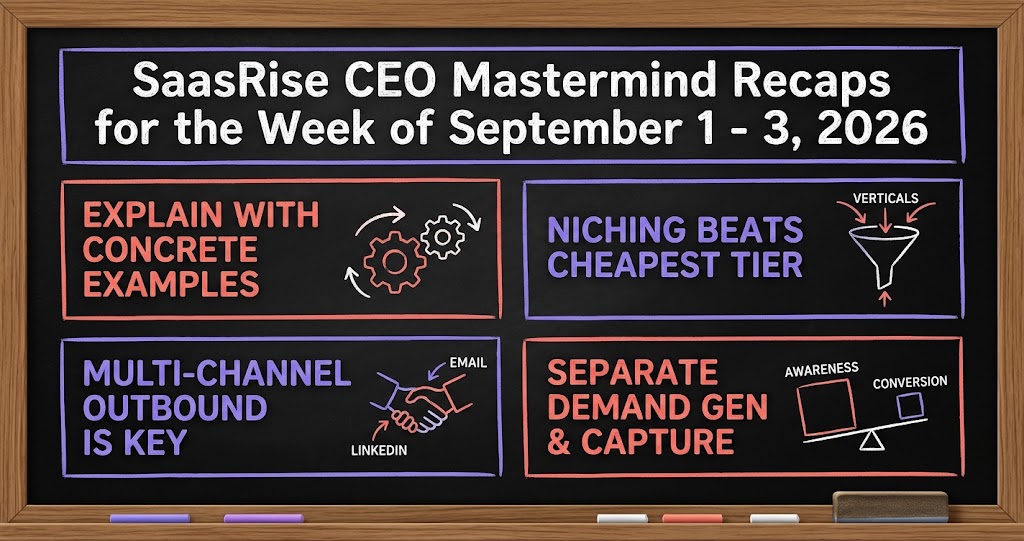
SaasRise CEO Mastermind Recaps for the Week of September 1 - 3, 2026
This week's SaasRise discussions covered how SaaS leaders are communicating ambitious AI-driven claims, rethinking pricing and channel strategy, and fixing outbound systems that have stopped converting. The conversations focused on making complex value propositions tangible, building institutional knowledge instead of relying on individual employees, and looking past headline numbers in both marketing funnels and equity deals.

⚙️ Communicating Ambitious AI/SaaS Product Claims
Challenges: Companies using patented technology to compress 1–2 years of development into 1–2 weeks struggle to communicate outcome-focused claims without triggering buyer skepticism.
Advice: Keep messaging outcome-focused rather than burying it in technical detail. Add a brief, high-level explanation of how the process actually works — just enough to reduce doubt without overwhelming the prospect. The goal is credibility, not a full technical breakdown, so keep the explanation accessible to a non-technical buyer.
💰 Usage-Based & Metered Billing
Challenges: Customers often don't immediately grasp the value of metered billing layered on top of a standard subscription, or how it protects them from unexpected cost overruns.
Advice: Use concrete, tangible examples (e.g., "2 cents per minute") rather than abstract descriptions of the metering model. Pair metered billing with automated invoicing and usage alerts so customers can see the value in real time. Tangibility, not technical accuracy, is what makes the pricing model land.
🔗 Channel Partnerships & International Expansion
Challenges: Enabling resellers and channel partners can sound like a simple affiliate program and undersell its real depth, while expanding into markets like Germany, France, and Spain is slowed by language barriers, complex B2B sales cycles, and a lack of local relationships.
Advice: Clarify how partner programs differ from affiliate models — white-label options and tiered discounts add real depth. For international growth, use local channel and sales partners, hire multilingual channel managers, and use AI to accelerate localization followed by human review for accuracy and cultural context.
🧱 Millionaire vs. Billionaire SaaS Pricing Strategy
Challenges: A founder built around rich features and high-touch service ("millionaire thinking") wants to shift toward minimal self-service, value pricing at scale ("billionaire thinking") to compete with lower-priced "ankle biter" competitors.
Advice: This shift requires different team skills, metrics, and culture, and risks a race-to-the-bottom where the lowest-paying customers demand the most support and churn fastest. Consider monetizing existing data assets instead, niching by industry vertical to charge more, and sub-branding a cheaper tier rather than launching a new brand.
🎯 Freemium Funnel Challenges for Niche SaaS
Challenges: A church-community SaaS finds that small churches dominate its funnel but lack the member density, tech adoption, and budget to convert, with high demo no-show rates compounding the problem.
Advice: Freemium works best in very large markets, so target qualified prospects with better ad segmentation and separate conversion events for qualified vs. unqualified leads. Use capped group demos to reduce no-show impact, build a list filtered to churches with 100+ members, and avoid feature-chasing in favor of the core problem.
📬 Outbound Email Deliverability & Multi-Channel Outreach
Challenges: Outbound campaigns get blocked quickly due to high bounce rates and infrastructure built on hosting-provider email accounts, and direct brand outreach was generating response rates below 0.5%.
Advice: Use Google or Microsoft inboxes on separate domains, verify lists with a tool like Rion, and warm up inboxes for 30 days at a max of 30 emails/day before scaling. Don't rely on cold email alone — combine it with LinkedIn outreach, and test niche influencer product reviews ($300–$400 spend generated 14–15 sign-ups) as an added channel.
🛠️ UI/UX Testing & Website Optimization Tools
Challenges: Users sometimes make product and design decisions based on visual appeal rather than actual data quality or performance.
Advice: Use Chrome DevTools (Lighthouse) to assess site speed and rendering performance objectively. Use AI tools like Claude to analyze your site and competitor sites for UX feedback, and run informal focus groups with people outside your target audience to observe real navigation behavior rather than relying on internal opinions.
🤖 AI-Powered Knowledge Management & Onboarding
Challenges: New hires and internal teams often depend on experienced employees or consultants for answers, creating a knowledge gap whenever someone leaves and slowing onboarding.
Advice: Build a "bot-first" culture where employees query an AI assistant before going to colleagues, using tools like Chatbase to turn documents, transcripts, and Q&As into an accessible knowledge base. Capture meeting recaps and Q&As continuously, and use shared channels between consultants and internal teams so knowledge is captured before consultants move on.
💵 Equity Transactions & PE Deal Structures
Challenges: Founders can struggle to understand the true value of minority, majority, and full acquisition offers, since deal structures are often far more complicated than the headline valuation or ownership percentage suggests.
Advice: Don't focus only on the valuation multiple — carefully review preferred shares, liquidation preferences, and drag-along rights, which can materially change the founder's real payout. Shop the deal around, since terms vary significantly between PE firms, and structure the first transaction so you're financially comfortable even if a "second bite at the apple" never materializes.
📣 Digital Marketing: Demand Generation vs. Demand Capture
Challenges: Generating qualified pipeline through digital channels is difficult, particularly for businesses that lean too heavily on outbound email or a single acquisition channel.
Advice: Separate demand generation from demand capture — use Facebook and Instagram to build awareness, and LinkedIn and Bing to capture and convert existing demand. Retarget visitors who don't convert immediately, build the flywheel consistently since results compound, and create niche-specific content and case studies focused on a clearly defined ICP rather than generic volume.
Tools Recommended
AI & Automation
- Chatbase
- Hermes
- Obsidian
- GetVictor
- Claude
- ChatGPT
Outbound & Lead Generation
- Instantly
- Rion
- Smartlead
- Lemlist
- Apollo
- Reply.io
Marketing & Ads
- YouTube
- Bing
Other
- Chrome DevTools (Lighthouse)
- Fellow
- Slack
Best Advice
The clearest thread this week was that credibility comes from clarity, not complexity — whether explaining a patented technology, a metered billing model, or a channel-partner program, founders get further with concrete examples and a brief "how it works" than with either jargon or vague claims. On pricing and growth strategy, the advice consistently favored niching and value pricing over racing to the bottom on price, since the cheapest customers tend to churn fastest and demand the most support. Outbound systems need real infrastructure — warmed inboxes, verified lists, and multiple channels — rather than a single high-volume email push, and marketing performs best when demand generation (awareness) and demand capture (conversion) are treated as separate motions. Finally, both knowledge management and deal-making came down to the same principle: don't let value live in one place you don't control, whether that's an individual employee's head or a headline valuation multiple that hides the real deal terms underneath.