
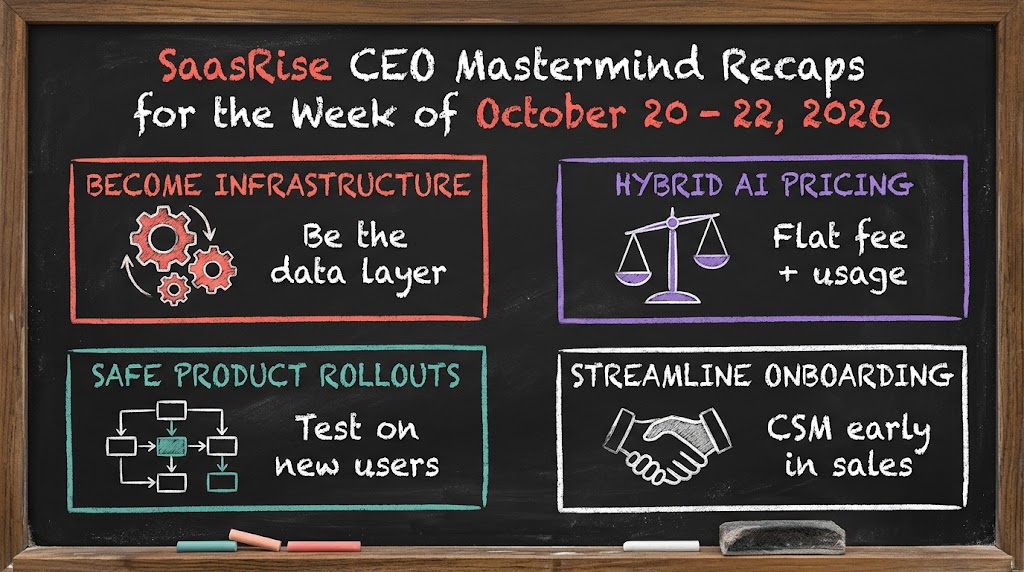
SaasRise CEO Mastermind Recaps for the Week of October 20 - 22, 2026
This week's SaasRise discussions covered how SaaS leaders are responding to AI-driven disruption, rethinking pricing, and navigating team and product transitions. The conversations focused on defending against customers who build their own tools, hybrid seat-and-usage pricing, onboarding efficiency, outbound and conversion, and exit structures.

🤖 AI Disruption & Customers Building Their Own Tools
Challenges: AI is cutting the time and cost of building software, with MVPs now possible in days, while middleware like N8N declines. Mid-market customers with in-house automation staff are vibe-coding their own tools, believing they can self-build a simplified alternative for roughly half the cost.
Advice: Adapt rather than assume the model is doomed: list what a competitor could rebuild in a weekend versus what took years (integrations, compliance, data, customer trust) and invest in the second list. Become the data and connectivity layer customers build on, with strong APIs, an MCP connector and clear documentation. Offer an open-source, freemium or lower-cost "down offer," then upsell managed connectivity, reliability and compliance. Talk to top customers about their AI use and ship small AI features quickly.
💰 Pricing Models for the AI Era
Challenges: A G2 report found only 9% of buyers consider per-seat pricing fair and 74% will shop for alternatives at renewal, as AI automates work and seat counts stop reflecting value. For AI-heavy products, high token consumption makes flat subscriptions difficult, credits add variable costs, and API key adoption may be low.
Advice: Use a hybrid model: a meaningful flat monthly fee (~$200+) with included credits, plus overage billed per usage, with higher tiers offering more credits at a lower per-token rate. Avoid relying on users bringing their own API keys. Pick the usage metric that tracks value, test on new customers before migrating existing ones, and proactively reprice accounts approaching renewal. Consider outcome-based packaging in compliance, legal and tax.
⚙️ Product Upgrade Rollout Gone Wrong
Challenges: Existing customers were migrated overnight to an entirely new product with no option to revert, breaking Zapier integrations and automations and sparking public customer backlash. A planned price increase worth ~$200K–$250K/month in additional revenue had to be delayed to Q1/Q2 next year.
Advice: Beta test with new trial users only, not existing customers, to isolate bugs before a full rollout. Communicate openly, own mistakes without defensiveness, and be highly available, which builds trust and even superfans. Use new features, such as ChatGPT/Claude plugins, as incentives to migrate legacy customers to new plans voluntarily.
👥 R&D Team Overhaul
Challenges: The internal engineering team was underperforming relative to R&D investment benchmarks, and the engineering manager is also being let go, leaving a non-technical founder without strong internal technical oversight.
Advice: Offer retention or appreciation bonuses to key transitional staff, and address "survivor syndrome," which can cause ~7% additional attrition. Designate an operations/people-culture point person so employees don't escalate directly to the CEO. Enable GitHub notifications to watch for unauthorized access or exports and run AI security audits on the codebase. Non-technical founders should build side projects to hold engineering accountable.
📣 Marketing New AI Products & Marketplace Connectors
Challenges: No community benchmarks exist yet for acquisition via AI marketplaces, and the approval process is rigorous: 6–8 weeks, security certifications and specific server changes. Separately, a newly launching product struggles to articulate its value proposition clearly for marketing.
Advice: Treat the marketplace listing as a funnel similar to HubSpot/Salesforce app stores, but expect lower initial conversion rates. Being an approved connector could lead to AI assistants proactively recommending the product, a significant acquisition opportunity. For positioning, learn to explain the value proposition verbally, not just through demos.
🌐 Lounge.ai Community & Mastermind Quality
Challenges: Large, mixed WhatsApp groups and short mastermind calls can become noisy and less relevant to founders at different business stages, with different challenges and levels of technical expertise.
Advice: Segment communities by founder stage and the relevance of their challenges. Use the What → So What → Now What framework: what was done, why it matters and what others can apply, with a brief tech stack mention. Keep calls focused on high-level use cases and take implementation deep-dives offline. Value the peer group as a place to speak candidly, which matters more than ever during disruption.
🛠️ CRM Consolidation & Data Management
Challenges: Managing data across multiple CRMs is cumbersome for non-technical users, and consolidating means competing with tools like Clay and benchmarking pricing against close competitors such as Lightfield.
Advice: Build toward an all-in-one CRM that handles both outbound (cold email, segmented domain) and standard workflows in one platform. Keep two-way sync with HubSpot and Salesforce for customers who stay on them. Use Lightfield as a pricing benchmark, and treat Clay as a potential replacement target.
🤝 White Glove Onboarding Efficiency
Challenges: Onboarding takes 3–4 months, the team resists handling more than one client at a time, and clients can only go live on the first of a month, limiting opportunities to ~10 per year.
Advice: Introduce the onboarding team member at the tail end of the sales cycle and have the customer success manager participate throughout onboarding, the #1 factor in post-close success. Document what your company is responsible for versus third parties and get client sign-off. Consider self-serve onboarding tools in the product, and use AI such as ElevenLabs to call new free-trial leads and offer onboarding help.
🎯 Outbound Agencies & Conversion Optimization
Challenges: Finding an agency that executes targeted outreach effectively at a reasonable ACV is difficult, and most prior agency experiences underdelivered. In self-serve/PLG, users drop off at the credit card screen; removing the requirement reduces friction but increases abuse.
Advice: Seek agencies that charge per accepted sales-qualified lead, align on ICP definition collaboratively and provide transparent visibility into outreach activity. Redefine conversion metrics around qualified pipeline opportunities rather than raw signups. Send transactional email sequences with coupon incentives to users who stall at activation, and accept that signup-to-conversion becomes less meaningful without a credit card gate.
💵 Selling / Exiting a SaaS Company
Challenges: Earn-out structures tied to EBITDA targets can be difficult when the seller loses control of the financials after the acquisition.
Advice: Favor earn-out structures based on customer retention rather than EBITDA, and engage multiple acquirers to compare multiples and deal terms.
Tools Recommended
AI & Automation
- Claude
- ChatGPT
- Grok
- Cursor
- Victor
- ElevenLabs
- Make.com
- N8N
- MCP (Model Context Protocol)
- Claude Marketplace
Outbound & Lead Generation
- Revenue Flow
- CIENCE
- MoltSets
- Apollo.io
- Clay
Payments & Integrations
- Stripe
- Churnkey
Other
- HubSpot
- Salesforce
- Pipedrive
- Lightfield
- HighLevel
- Intercom
- Rocketlane
- Trello
- Figma
- GitHub
- Vercel
- Supabase
- G2's 2026 AI Agents report
- Software as a Science / STEM Artel
Best Advice
Don't compete with customers who want to build; become the infrastructure they build on by providing the connectivity, monitoring, account management and compliance that make their solutions reliable, and keep self-builders in your ecosystem with an open-source or freemium entry point. Reconsider per-seat pricing as AI changes how software is used: a hybrid of a meaningful flat fee with included credits plus usage-based overage protects margins while staying accessible, and outcome-based packaging works well in compliance, legal and tax. Roll out big product changes to new trial users first, and communicate openly and own mistakes when things go wrong. Bring onboarding owners into the sales cycle early, favor retention-based earn-outs when selling, and keep mastermind advice practical with the What → So What → Now What framework.