
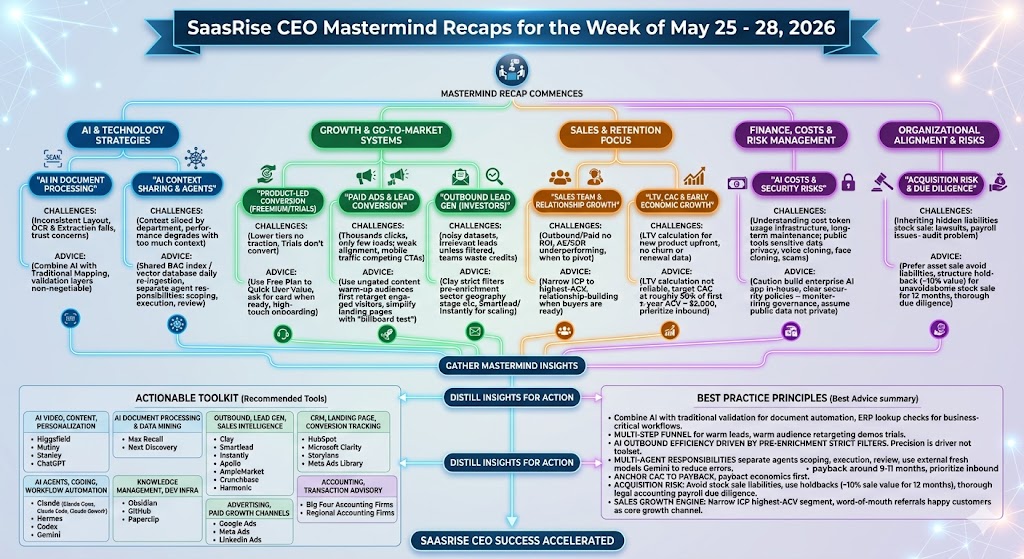
SaasRise CEO Mastermind Recaps for the Week of May 25 - 28, 2026
This week’s SaasRise masterminds covered AI document processing, AI security, B2B content strategy, freemium conversion, paid ads, outbound systems, multi-agent workflows, LTV/CAC planning, sales performance, and acquisition due diligence.

🤖 AI in Document Processing and Business-Critical Validation
Challenges: Members discussed the difficulty of using AI for document processing, OCR, and data extraction when document quality is inconsistent, layouts vary, watermarks interfere with extraction, and ERP integrations fail. A major concern was that AI alone is not reliable enough for workflows where one wrong extraction can break trust.
Advice: Combine AI-based data capture with traditional mapping, validation, and ERP lookup checks. Use AI to extract and interpret the document, but validate the output against structured systems before allowing it into business-critical processes. For document automation, validation layers are non-negotiable.
💸 AI Costs, Adoption Risks, and Data Security
Challenges: Companies are increasingly going “all in” on AI without understanding the real cost of token usage, infrastructure, or long-term maintenance. Members also raised concerns about sensitive corporate data being uploaded into public AI tools, plus emerging risks around voice cloning, face cloning, ransomware, and social engineering scams.
Advice: Be cautious about building enterprise AI apps in-house without understanding cost behavior. For sensitive data, use air-gapped or on-prem models where appropriate, and assume anything uploaded into public AI tools may not remain private. AI adoption should be paired with clear security policies, cost monitoring, and governance.
📣 B2B Marketing, Thought Leadership, and Content Strategy
Challenges: Members discussed how difficult it is to stand out in a market flooded with AI-generated content. Companies are struggling to build trust, establish credibility, and avoid producing generic “AI slop” that does not differentiate them.
Advice: Focus on becoming a category thought leader by providing genuine value. Make an individual the face of the company, publish consistently, and prioritize useful, credible content over gimmicks. In B2B, consistency and trust matter more than high-volume generic posting.
🚀 Freemium, Free Trials, and Product-Led Conversion
Challenges: Lower-tier plans were not gaining traction, and trial sign-ups were not converting well. Members discussed the challenge of getting users to experience value before asking them to commit financially.
Advice: Use a free plan to get users into the product quickly, prove value first, and then ask for a credit card when they are ready to upgrade to premium. High-touch onboarding can dramatically improve conversion because users are more likely to pay once they understand the product’s value.
🎯 Paid Ads, Landing Pages, and Lead Conversion
Challenges: One member shared that thousands of ad clicks generated only a few leads, with most traffic coming from mobile. The landing page had competing CTAs, long forms, weak ad-to-page alignment, and no unique tracking URL for ad traffic.
Advice: Use ungated top-of-funnel content to warm up cold audiences before pushing demos or trials. Simplify landing pages using the “billboard test,” choose one CTA per page, use pop-up forms or multi-step forms, create unique URLs for ad traffic, and A/B test the page. Make sure the ad message and landing page message are tightly aligned.
📬 Outbound, Investor Research, and Lead Generation Systems
Challenges: Members discussed the difficulty of building high-quality outbound systems when working with large, noisy datasets. For investor research, most leads are irrelevant unless filters are tightly defined before enrichment begins. Without strong qualification, teams waste credits, time, and money.
Advice: Use Clay to source and enrich pre-seed and early-stage investors from sources like LinkedIn, Google Search, Crunchbase, and Harmonic, but only after defining strict filters around stage, check size, sector, geography, and recent activity. Enrich only after initial qualification signals are present. Set up outbound infrastructure with Smartlead or Instantly before scaling campaigns.
🧠 AI Context Sharing and Multi-Agent Workflows
Challenges: AI context often stays siloed by department, which prevents company-wide learning. Members also discussed how large AI workflows degrade when too much context is pushed into one agent, especially across complex team setups.
Advice: Build a shared RAG index or vector database that re-ingests data from team repositories daily. For agent workflows, separate responsibilities across agents: one for scoping, one for execution, and one for review. Use Gemini as a lightweight review layer, Claude for contained solo execution tasks, and Hermes for team-based Slack workflows. Clear agent roles improve reliability and output quality.
💰 LTV, CAC, and Early Growth Economics
Challenges: One member was trying to calculate LTV for a new product sold at $4,000 per year upfront, but had no churn or renewal data yet. Without historical retention data, it was unclear how much should be invested in marketing.
Advice: Without churn data, LTV cannot be reliably calculated yet. Use first-year ACV as the anchor and target CAC at roughly 50% of first-year ACV, or around $2,000 in this case. Since cohort data showed average sales and marketing payback around 9–11 months, the advice was to prioritize inbound channels like SEO, word of mouth, affiliates, and trade shows before investing heavily in paid acquisition.
🤝 Sales Team Performance, ICP Focus, and Relationship-Led Growth
Challenges: Members discussed outbound and paid ad efforts producing zero ROI, underperforming AE/SDR activity, and uncertainty around when to pivot growth strategy. There was also concern about how to identify the best-fit customer segment.
Advice: Segment the customer base to identify the highest-ACV cohort and focus the ICP there. Shift from high-frequency outbound to relationship-building and being present when ideal buyers are ready. Channel partnerships can work, but they require a dedicated person and long-term investment. A strong tactic was to “implement before you sell” by using live or customized prospect data in demos to build trust faster.
🏢 Acquisition Risk, Due Diligence, and Hidden Liabilities
Challenges: One member was evaluating a potential acquisition of a ~$3M ARR company and was concerned about inheriting hidden liabilities, including lawsuits, payroll issues, or audit problems, especially in a stock sale.
Advice: Prefer an asset sale over a stock sale when possible to avoid inheriting liabilities. If a stock sale is unavoidable, structure a holdback of around 10% of sale value for 12 months and invest $20K–$50K in thorough legal, accounting, and payroll due diligence. A regional accounting firm with transaction advisory experience may be more cost-effective than a Big Four firm.
Tools Recommended
AI Video, Content, and Personalization
- Higgsfield
- Mutiny
- Stanley
- ChatGPT
AI Document Processing and Data Mining
- Max Recall
- Next Discovery
Outbound, Lead Generation, and Sales Intelligence
- Clay
- Smartlead
- Instantly
- Apollo
- AmpleMarket
- Crunchbase
- Harmonic
CRM, Landing Page, and Conversion Tracking
- HubSpot
- Microsoft Clarity
- Storylane
- Meta Ads Library
AI Agents, Coding, and Workflow Automation
- Claude
- Claude Opus
- Claude Code
- Claude Cowork
- Hermes
- Codex
- Gemini
Knowledge Management and Development Infrastructure
- Obsidian
- GitHub
- Paperclip
Advertising and Paid Growth Channels
- Google Ads
- Meta Ads
- LinkedIn Ads
Accounting and Transaction Advisory
- Big Four Accounting Firms
- Regional Accounting Firms
Best Advice
Combining AI with structured validation is essential for business-critical document processing. AI alone is not reliable enough when one mistake can destroy trust, so ERP lookups, cross-reference checks, and validation layers should be built into the workflow from the beginning.
Use a multi-step funnel instead of sending cold traffic directly to a conversion page. Start with ungated, valuable top-of-funnel content, warm up the audience, and then retarget engaged visitors with a demo, trial, or offer once they have shown interest.
AI-driven outbound systems only become efficient when strict filtering happens before enrichment. The real performance driver is not the toolset itself, but the precision of the filters used to decide which investors, prospects, or accounts are worth processing.
Multi-agent workflows perform better when responsibilities are clearly separated. Assign different agents to scoping, execution, and review, then use external validation layers such as Gemini or a fresh model pass to reduce errors and improve reliability.
Without churn data, LTV should not be treated as a reliable metric. For a new product, anchor CAC decisions around first-year ACV, payback period, and lower-cost inbound channels before scaling paid acquisition.
For acquisition risk, avoid inheriting liabilities whenever possible by preferring an asset sale. If a stock sale is unavoidable, use a holdback and invest in proper legal, accounting, and payroll due diligence before closing.
In sales, the best growth engine may come from narrowing the ICP, focusing on the highest-ACV customer segment, and building relationships instead of relying only on high-frequency outbound or paid ads. Word-of-mouth and referrals from happy customers should be treated as a core growth channel.